

- Joined
- Sep 22, 2020
- Messages
- 4,691
- Reaction score
- 1,500
FYI: the rise of publishing by the eighteenth century led to the use of newspapers and cheap editions of popular books for cleansing. Lord Chesterfield, in a letter to his son in 1747, told of a man who purchased a common edition of Horace, of which he tore off gradually a couple of pages, carried them with him to that necessary place, read them first, and then sent them down as a sacrifice to Cloacina. (Quoted in Maxted, Ian. "Sic transit gloria cloacarum".)
Joseph Gayetty is widely credited with being the inventor of modern commercially available toilet paper in the United States. Gayetty's paper, first introduced in 1857, was available as late as the 1920s. Gayetty's Medicated Paper was sold in packages of flat sheets, watermarked with the inventor's name. Original advertisements for the product used the tagline "The greatest necessity of the age! Gayetty's medicated paper for the water-closet."

Seth Wheeler of Albany, New York, obtained the earliest United States patents for toilet paper and dispensers, the types of which eventually were in common use in that country, in 1883. Modern commercial toilet paper originated in the 19th century, with a patent for roll-based dispensers being made in 1883.

The other pictures of the hull in the process of being built are engraving type images. Those can not really be relied upon. We also have some other photographs of the SS Great Eastern construction, but those photos raise questions, instead of answering them.
The mere existence of this ship in 1858 makes no sense. I will do my best to explain why. I also think she gave her "creator" Isambard Kingdom Brunel so much "headache", he suffered a fatal stroke. Possible restoring something years ahead of your time had to be a daunting task. Brunel died in 1959.
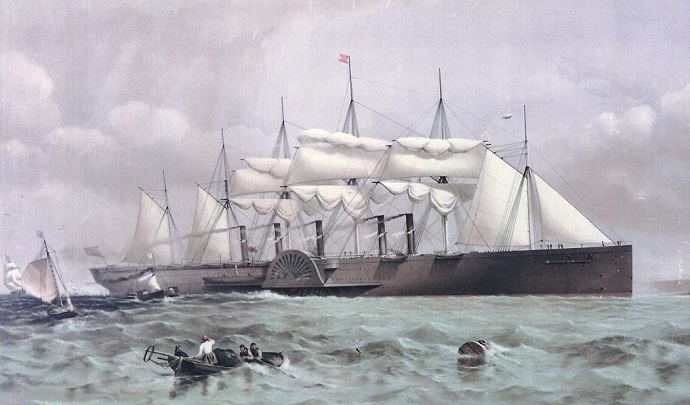
SS Great Eastern was an iron sailing steamship. Though christened Leviathan during an initial launching attempt in early November 1857, she was thereafter always known as Great Eastern. Nearly three month's costly struggle to get her afloat, and more problems while she was completing, left her original company bankrupt. New owners decided to employ her on the route between Britain and North America. However, insufficient capitalization restricted outfitting to luxury accommodations, thus ignoring the decidedly non-luxurious, but very profitable immigrant trade. The ship financial difficulties continued, compounded by a series of accidents.
I will not go into detailed description of this ship and her story. There are plenty of articles, covering the SS Great Eastern:
A typical railcar used in the 1940’s and 1950’s had a gross capacity of 180,000 lbs. or the ability to carry 74 tons when the weight of the car is taken into consideration. I'm pretty sure that in 1850's it was much less but that's what I was able to find. Factoring in the weight of the car, it would take over 150 railcars to transport all the iron plates.
There are two types of propellers:


Technological difference between the two is enormous, and easy to see. Remaining behind the scenes is the mechanism rotating the blades. And we are talking about 1854-1859. I have hard time believing here. Things do not come from nowhere.
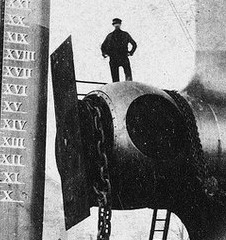
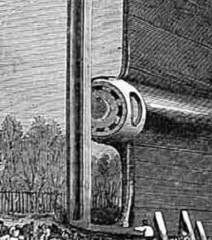
You decide what type of propeller was on the SS Great Eastern (below.) It sure looks like the VPP one to me.


2. The hull construction is not supported by the history of welding.
The official version is that approximately 30.000 iron plates were connected by the means of 3.000.000 rivets. Here is what ship rivet looks like.
A small 40 second video of what riveting looked like in 1906 - approximately 50 years later after the SS Great Eastern was built. I was unable to find what it looked like in 1856.
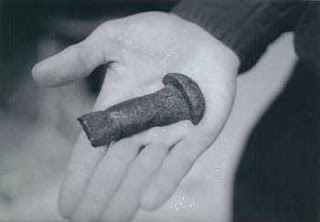
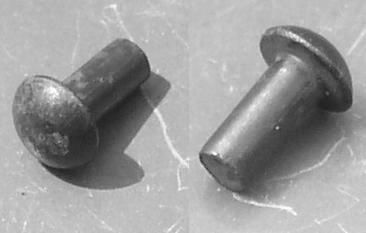
Here is what a rivet connected ship looks like. Note that rivets are easily visible and discernible.


In the example below you can see the bow of the USS Basilone constructed in 1949. The hull has two distinctive construction indicators: welding seams and some riveting. The second picture is the Titanic, by the way.


Now when it is clear what a riveted ship hull should look like, let us take a look at a couple close up photos of the SS Great Eastern hull.



I do not see any rivets. What I do see is some sort of weird lighter shaped lines connecting 9.84 ft x 2.75 ft. There are only only two problems. Welding was not available until 1880s, which would be some 20 plus years later. And the second issue I have is the quality of the welding when compared to the 1949 USS Basilone above. Obviously 1949 welders need to learn from the SS Great Eastern Welders.
The other possibility it is neither welding, nor riveting. Than what is it?
On top of it, the cellular method was used in the building of her double hull. For double hull picture refer to the propeller engine photos below.
3. Sharp contrast between propeller and paddles engines
We have two engines powering the ship. Both are claimed to be steam engines. One engine is for the paddle wheel and the other one for the propeller shaft. Traditional marine steam engines can be seen in two images below (1849 and 1855 engines).


Let us see the engines installed on the SS Great Eastern. My understanding is that the actual engines did not make it for us to take a look. Available are reproductions and graphical representations of those.


And while I'm ok with this engine being technologically achievable in 1850s, it's the second, so-called propeller engine (below) that baffles me.


The year is 1857 (initial launching attempt. Toilet paper is being developed.) I can’t even begin to imagine what this is. What kind of engine is this? It is supposed to be a steam engine rotating an approximately 150 foot long propeller shaft. It looks way too advanced for 1857 in my opinion. Could it be that the "creators" were never able to start this engine? No proper fuel?
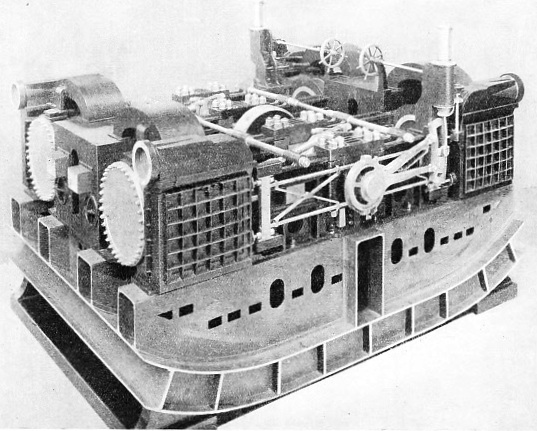
The direct-acting screw engines of the Great Eastern weighed 500 tons. This photograph of a working model in the Science Museum, South Kensington, also shows the cellular method used in the building of her double hull. The screw engines, which the Great Eastern carried in addition to paddle engines indicated 4,886 horse-power. The four cylinders were arranged in pairs and had a diameter of 7 feet and a stroke of 4 feet. The engines were built by James Watt & Co. at Birmingham, and drove a 24-feet diameter 36-ton cast iron propeller via a shaft 150 feet (46 m) long and weighing 60 tons.
Below is the location of these two engines as situated inside the SS Great Eastern.


4. No sufficient technology to give her enough power
It is hard to confirm the exact power SS Great Eastern's engines were able to produce. We have this quote from one of the articles:


Very confusing, but apparently somewhere between 3,000 and 8,000 horse power. The infamous Titanic was capable of producing 46,000 horse power. The SS Great Eastern weighed 20,000 tons. The weight of the Titanic was 52,310 tons. The ratio is incomparable.
The paddle engines indicated 3,411 horse-power and drove the Great Eastern at 7¼ knots on trial. I did not find any other recorded speed. There is a 14 knot speed mentioned in the Wikipedia article. But these 14 knots was a projection.
Clearly there was not enough power to get this ship moving at an acceptable speed. And what works better then the time tested sail system?
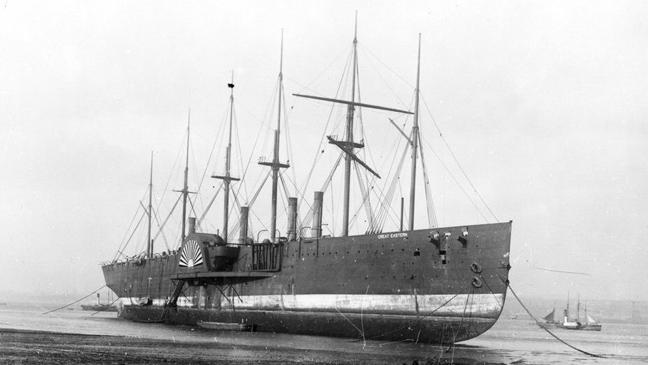
The ship probably looked cool under sail, but it only shows how desperate the "creators" were for every single push forward. There simply was no technology to make this ship propel itself fast enough. I bet she did look marvelous with 6,500 square yards or 58,500 square feet of sail above her. If only it was a beauty pageant....
5. No dry dock for building and launching. Launch planning raises questions.
I am not sure if planning was available in the 1850s. One would assume it was. Why there is no trace of planning observed as related to the SS Great Eastern remains a mystery. The only explanation I have is that they had no choice. They simply used an almost intact ship which was sitting there waiting to get restored.
Back on track. Below is a couple of dry dock pictures from the same era.


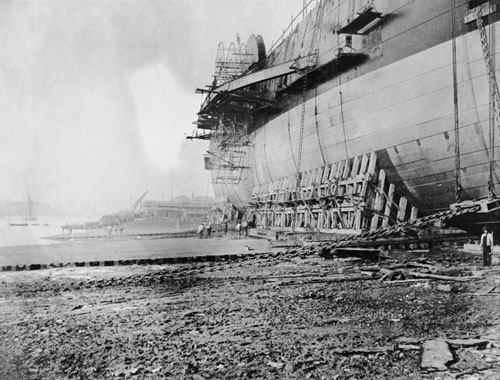
The SS Great Eastern dry docks were non-existent. Therefore the construction site looked like this. The official explanation was that building dry docks for construction was too expensive. and there was no site for building it. The cost of the project was £258,000. Dry dock for building SS Great Eastern would cost approximately £8–10,000. So judge yourselves whether it was too expansive. My math says its ~ 3.8% more.


What did they use to bring 22,000,000 pounds of iron and 3,000,000 of those rivets, and all the other things they would need? Where are the hoists? Where is some sort of rail based delivery system?
The construction site adds a few questions to the table. What is this anchor chain drum which looks like it's been sitting there for 10 years? The drum is clearly embedded into the dirt. Do you see the size of that thing?
There is something positive we can see in the below two photos. We see the technology. The picture on the left has a rope hanging on the metal arm of the drum. The picture on the right shows a stick tied off to the metal arm. And I can only guess that they are trying to release the chain. Bizarre. This drum does not look like it belongs to the SS Great Eastern. Otherwise it would not be this weathered and embedded. But look at the size of that thing. It is at least 12 feet in diameter as compared to people in the photos. A drum like that had to belong to a ship of a comparable size. Another mystery.


How were they planning to launch this ship? It was built 184 feet (56m) from the water. What was the general idea of getting it afloat?
6. "Creators" could not get her afloat for 3 months
It took three months and three different attempts to get her in the water. Historic UK gives the following explanation:
The ship was finally launched sideways at 1:42pm on 31 January 1858, aided by an unusually high tide and strong winds and using more powerful hydraulic rams. It took an act of God to get the SS Great Eastern afloat.
7. Constant problems due to to lack of understanding of their own "creation" and short life span
The year 1874 was the last in the SS Great Eastern's seafaring career. It spent a year moored at Liverpool as a floating amusement park. On 20th October 1887 in Liverpool, the ship was sold at auction to Mr Craik for £26,000. In 1888, she was taken to Henry Bath & Sons near Birkenhead for breaking up.
8. Technological ineptness to take her to pieces (for two years) after decommission
The 'Great Eastern' was broken up on the River Mersey between 1888 and 1889. Brunel's mighty vessel was built so strongly that it took 200 men two years to take her to pieces, consuming a total of 3.5 million man-hours.
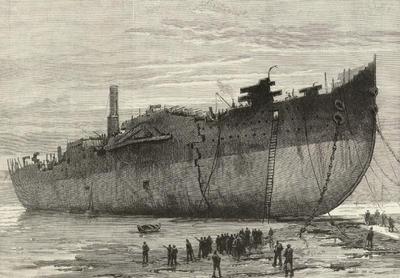
Another sign that the technology was not fully there to even break her apart. If sheet iron cutting technique was available to build it, than where was it to take her to pieces?
My Summary and Understanding: too much too weird. I think this boat washed ashore with a high tide. Mr. Brunel was hired to get it going again, hence the building location and all the weirdness and inconsistencies accompanying just about everything related to the SS Great Eastern. Where it came from is another question. I think this ship was built the same civilization that built the below.


And I am not talking about Italians or Russians. They probably did not build those either. The civilization I'm talking about was very similar to ours in their technological advancement. This civilization I'm talking about seized to exist some time in the 17-18th century. Dark ages followed. Just an opinion.
This is a separate topic I will tackle at some point.
Joseph Gayetty is widely credited with being the inventor of modern commercially available toilet paper in the United States. Gayetty's paper, first introduced in 1857, was available as late as the 1920s. Gayetty's Medicated Paper was sold in packages of flat sheets, watermarked with the inventor's name. Original advertisements for the product used the tagline "The greatest necessity of the age! Gayetty's medicated paper for the water-closet."

Seth Wheeler of Albany, New York, obtained the earliest United States patents for toilet paper and dispensers, the types of which eventually were in common use in that country, in 1883. Modern commercial toilet paper originated in the 19th century, with a patent for roll-based dispensers being made in 1883.
To the boats, shall we?...
This is one of those cases where on one hand, we do have photo proof of the object being in the construction stage. On the other hand, this one photo is not enough to answer all the questions this ship brings to the table. Here is the photo of an unfinished SS Great Eastern's hull. It shows one portion of the hull with some of the starboard (right side when looking at the bow) iron plates missing.It was not until more than fifty years after the keel of the “Great Eastern” was laid down that vessels of larger dimensions were put into commission. She was a unique ship, provided with sails and paddles as well as with a screw propeller

The mere existence of this ship in 1858 makes no sense. I will do my best to explain why. I also think she gave her "creator" Isambard Kingdom Brunel so much "headache", he suffered a fatal stroke. Possible restoring something years ahead of your time had to be a daunting task. Brunel died in 1959.
SS Great Eastern was an iron sailing steamship. Though christened Leviathan during an initial launching attempt in early November 1857, she was thereafter always known as Great Eastern. Nearly three month's costly struggle to get her afloat, and more problems while she was completing, left her original company bankrupt. New owners decided to employ her on the route between Britain and North America. However, insufficient capitalization restricted outfitting to luxury accommodations, thus ignoring the decidedly non-luxurious, but very profitable immigrant trade. The ship financial difficulties continued, compounded by a series of accidents.
I will not go into detailed description of this ship and her story. There are plenty of articles, covering the SS Great Eastern:
- SS Great Eastern - Wikipedia
- SS Great Eastern
- History of the Atlantic Cable & Undersea Communications
- The Great Eastern
- Isambard Kingdom Brunel
- The Famous “Great Eastern”
Several quick facts:
- Length: 693 feet (211m) - approximately two football fields
- Beam: 120 feet (36.5 m)
- Design: Iron hull powered by sails, steam paddles and steam propeller
- Construction dates: 1854 - 1859
- Function: Passenger ship later converted to laying submerged telegraph cable
- Occupant Capacity: Designed for 4,000 passengers and 400 crew
- Sails size: 6,500 square yards
- Paddle Wheels: 58 feet (17.7 m)
- Propeller: 24 feet (7.3 m)
- Dead weight: 12,000 tons
- Displacement: of 22,500 tons
Little Big Details
The ship’s 30,000 iron plates were standardized to 9.84 feet (3m) by 2.75 feet (.84m) each. Plates on the bottom were 1 inch (25mm) thick, on the sides 3/4 inches (19mm), and on the deck and bulkheads 1/2inches (13mm). This is approximately 10,000 tons or 22,000,000 pounds. Each plate was fixed in place with 100 rivets, .86 inches (22mm) in diameter. That totals out to 3,000,000 rivets. The two watertight iron skins of her 58 foot (17.7m) deep hull had a gap of 2.82 feet (860mm) between them. Brunel intended her to be unsinkable, extending the double plating 4.9 feet (1.5m) above the ship’s deepest load line and dividing the hull into 10 compartments.A typical railcar used in the 1940’s and 1950’s had a gross capacity of 180,000 lbs. or the ability to carry 74 tons when the weight of the car is taken into consideration. I'm pretty sure that in 1850's it was much less but that's what I was able to find. Factoring in the weight of the car, it would take over 150 railcars to transport all the iron plates.
SS Great Eastern And Jules Verne:
Giant ship interested famous French writer Jules Verne, who made a special trip to England to take on the “Great Eastern” crossing the Atlantic. This journey Jules Verne ever wrote a small novel called “floating city.” With delight Jules Verne wrote about his first impressions: After graduating from the inspection of the ship, Jules Verne came to the conclusion that “… it is not a ship, but a floating city of the county, separated from British soil, so we had sailed across the ocean, hit the American continent.“Here is what I find questionable in her creation in 1850s.
- Variable pitch-like like marine propeller hub
- The hull construction is not supported by the history of welding (official version of rivets being used is not supported by the photo evidence)
- Sharp contrast between propeller and paddles engines
- No sufficient technology to give her enough power
- No dry dock for building and launching. Launch planning raises questions.
- "Creators" could not get her afloat for 3 months
- Constant problems due to to lack of understanding of their own "creation" and short life span
- Technological ineptness to take her to pieces (for two years) after decommission
There are two types of propellers:
- Veriable Pitch Propeller (VPP, aka Controllable Pitch Propeller, or CPP). We will use VPP.


- Fixed Pitch Propeller (FPP)


Technological difference between the two is enormous, and easy to see. Remaining behind the scenes is the mechanism rotating the blades. And we are talking about 1854-1859. I have hard time believing here. Things do not come from nowhere.
You decide what type of propeller was on the SS Great Eastern (below.) It sure looks like the VPP one to me.


2. The hull construction is not supported by the history of welding.
The official version is that approximately 30.000 iron plates were connected by the means of 3.000.000 rivets. Here is what ship rivet looks like.
A small 40 second video of what riveting looked like in 1906 - approximately 50 years later after the SS Great Eastern was built. I was unable to find what it looked like in 1856.
Here is what a rivet connected ship looks like. Note that rivets are easily visible and discernible.


In the example below you can see the bow of the USS Basilone constructed in 1949. The hull has two distinctive construction indicators: welding seams and some riveting. The second picture is the Titanic, by the way.


Now when it is clear what a riveted ship hull should look like, let us take a look at a couple close up photos of the SS Great Eastern hull.


The other possibility it is neither welding, nor riveting. Than what is it?
On top of it, the cellular method was used in the building of her double hull. For double hull picture refer to the propeller engine photos below.
3. Sharp contrast between propeller and paddles engines
We have two engines powering the ship. Both are claimed to be steam engines. One engine is for the paddle wheel and the other one for the propeller shaft. Traditional marine steam engines can be seen in two images below (1849 and 1855 engines).


Let us see the engines installed on the SS Great Eastern. My understanding is that the actual engines did not make it for us to take a look. Available are reproductions and graphical representations of those.
- Engine #1 - the paddle wheel engine.


- Engine #2 - the propeller engine.


The direct-acting screw engines of the Great Eastern weighed 500 tons. This photograph of a working model in the Science Museum, South Kensington, also shows the cellular method used in the building of her double hull. The screw engines, which the Great Eastern carried in addition to paddle engines indicated 4,886 horse-power. The four cylinders were arranged in pairs and had a diameter of 7 feet and a stroke of 4 feet. The engines were built by James Watt & Co. at Birmingham, and drove a 24-feet diameter 36-ton cast iron propeller via a shaft 150 feet (46 m) long and weighing 60 tons.
Below is the location of these two engines as situated inside the SS Great Eastern.


It is hard to confirm the exact power SS Great Eastern's engines were able to produce. We have this quote from one of the articles:
Various sources revolve around 8,000 horse power. Four steam engines for the paddles and an additional engine for the propeller. Total power was estimated at 6 MW (million Watts) (8,000 hp.) This is what we see published today. But... what looks like a contemporary page states otherwise:Brunel showed his idea to John Scott Russell, a great experienced ship builder and naval architect of the time and whom he had first met at the Great Exhibition in 1851. Scott Russell examined Brunel’s plan and made his own calculations as to the ship’s feasibility. He calculated that it would have a displacement of 20,000 tons and would require 8,500 horsepower (6,300 kW) to achieve 14 knots (26 km/h), but believed it was possible.

Very confusing, but apparently somewhere between 3,000 and 8,000 horse power. The infamous Titanic was capable of producing 46,000 horse power. The SS Great Eastern weighed 20,000 tons. The weight of the Titanic was 52,310 tons. The ratio is incomparable.
The paddle engines indicated 3,411 horse-power and drove the Great Eastern at 7¼ knots on trial. I did not find any other recorded speed. There is a 14 knot speed mentioned in the Wikipedia article. But these 14 knots was a projection.
Clearly there was not enough power to get this ship moving at an acceptable speed. And what works better then the time tested sail system?
The ship probably looked cool under sail, but it only shows how desperate the "creators" were for every single push forward. There simply was no technology to make this ship propel itself fast enough. I bet she did look marvelous with 6,500 square yards or 58,500 square feet of sail above her. If only it was a beauty pageant....
5. No dry dock for building and launching. Launch planning raises questions.
I am not sure if planning was available in the 1850s. One would assume it was. Why there is no trace of planning observed as related to the SS Great Eastern remains a mystery. The only explanation I have is that they had no choice. They simply used an almost intact ship which was sitting there waiting to get restored.
Back on track. Below is a couple of dry dock pictures from the same era.


What did they use to bring 22,000,000 pounds of iron and 3,000,000 of those rivets, and all the other things they would need? Where are the hoists? Where is some sort of rail based delivery system?
The construction site adds a few questions to the table. What is this anchor chain drum which looks like it's been sitting there for 10 years? The drum is clearly embedded into the dirt. Do you see the size of that thing?
There is something positive we can see in the below two photos. We see the technology. The picture on the left has a rope hanging on the metal arm of the drum. The picture on the right shows a stick tied off to the metal arm. And I can only guess that they are trying to release the chain. Bizarre. This drum does not look like it belongs to the SS Great Eastern. Otherwise it would not be this weathered and embedded. But look at the size of that thing. It is at least 12 feet in diameter as compared to people in the photos. A drum like that had to belong to a ship of a comparable size. Another mystery.


How were they planning to launch this ship? It was built 184 feet (56m) from the water. What was the general idea of getting it afloat?
It took three months and three different attempts to get her in the water. Historic UK gives the following explanation:
Another article describes the launch like this:So why, with such a precision engineer as Brunel behind the helm, did it take three attempts to finally get the Great Eastern into the water?In short, it is believed that the foundations for the slipway were far too slim to support the 12,000 tonne [KorbenDallas: I thought it was supposed to be 20,000 ton] ship against the subsidence of the river bed. For the launch to work, both slipways had to be exactly the same height so that the ship was level. Unfortunately, the concrete foundations which supported the timbers and iron rails just weren’t thick enough, and in the end the slipway at the bow end became steeper than the slipway at the stern end.
Under threat of another bankruptcy should there be further delays, there was an attempt to launch the hull on 3 November 1857 using untried and inadequate equipment. Brunel had originally planned to use hydraulic launching gear specially built for the project but because of the financial difficulties this was judged by the company to be too expensive and he had to use steam winches and capstans worked by teams of men. To further complicate an already risky procedure, the company, seeking to make money, had sold tickets to the public to attend the launch event and the yard was overrun with onlookers, getting in the way of Brunel’s system of signals. The launch was a disaster and the attempt abandoned.
What did they expect with the ship sitting 184 feet away from the water? Brunel built the boat but was unable to figure out that the timbers used for the ramp were not strong enough? Really?Brunel tried again on the 19th and 28th, but to little effect. The failure of the winch system led Brunel to turn to the use of hydraulic jacks to push the ship down the slope. These were not up to a job of this magnitude and after ten weeks of the ship inching painfully forward, Brunel stopped the work in mid-December until better equipment could be obtained. This was built by the Tangye brothers, based in Birmingham, who would later boast ‘we launched the Great Eastern and she launched us’.
The ship was finally launched sideways at 1:42pm on 31 January 1858, aided by an unusually high tide and strong winds and using more powerful hydraulic rams. It took an act of God to get the SS Great Eastern afloat.
7. Constant problems due to to lack of understanding of their own "creation" and short life span
Launched 1859 - Decommissioned 1874
The unquantifiable number of problems arisen during the exploitation of the SS Great Eastern indicate that there was a sufficient lack of understanding of the ship by its users. To avoid copying and pasting tons of text, please use the links above for detailed accounts of all the issues.The year 1874 was the last in the SS Great Eastern's seafaring career. It spent a year moored at Liverpool as a floating amusement park. On 20th October 1887 in Liverpool, the ship was sold at auction to Mr Craik for £26,000. In 1888, she was taken to Henry Bath & Sons near Birkenhead for breaking up.
8. Technological ineptness to take her to pieces (for two years) after decommission
The 'Great Eastern' was broken up on the River Mersey between 1888 and 1889. Brunel's mighty vessel was built so strongly that it took 200 men two years to take her to pieces, consuming a total of 3.5 million man-hours.
My Summary and Understanding: too much too weird. I think this boat washed ashore with a high tide. Mr. Brunel was hired to get it going again, hence the building location and all the weirdness and inconsistencies accompanying just about everything related to the SS Great Eastern. Where it came from is another question. I think this ship was built the same civilization that built the below.


This is a separate topic I will tackle at some point.
Note: This OP was recovered from the Wayback Archive.
Note: Archived SH.org replies to this OP: 1854-59 ship: SS Great Eastern a.k.a. Leviathan
Last edited by a moderator:


