

- Joined
- Aug 31, 2020
- Messages
- 1,141
- Reaction score
- 2,177
I just read this article:
Bison in Canada Discover Ancient Petroglyphs, Fulfilling an Indigenous Prophecy
It has the following pictures in it. The claims are:
a/ that these are engravings, ancient carvings/artwork crafted on the stone.
b/ are 1000 years old (perhaps as old as 1800 years, or as young as 300).
But all I see are some scratches!
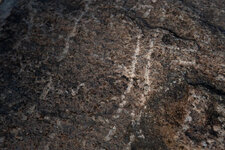
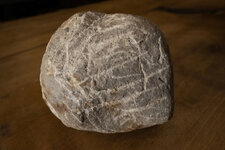
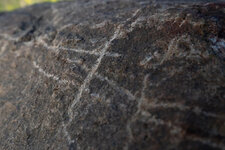
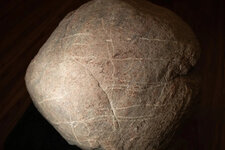
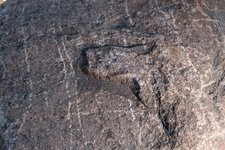
Apparently they were created with this tool - 'a stone knife':
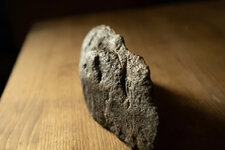
Am I wrong - are there 'metaphorical ribs' denoting a bison there, or is it scratches?
If I'm honest, I suspect this as another example of real-time history creation. Mainstream historians are very busy, these are exciting times - as a phd has previously told us. They have a lot of work on!
SH Archive - Ask Pro | - Questions for History Professionals
"subaltern voices". Is this history or zestory??!
Bison in Canada Discover Ancient Petroglyphs, Fulfilling an Indigenous Prophecy
"They’re a glimpse into somebody’s hopes and dreams." Hmm..Just months after they arrived, after almost 40 years of human-led archaeological excavations, the bison unearthed the park’s first petroglyphs. “We’d found the detritus of everyday living: broken stone tools and debris from the manufacture of stone tools, bones, charcoal, potsherds, seeds and things like that,” Walker says. “But [we] didn't find ideas. [We] didn’t find emotions. The petroglyphs brought that. They’re that other dimension. … They’re a glimpse into somebody’s hopes and dreams.”
"In the case of the ribstone, Walker explains, “The ribs are metaphorical. Those ribs represent a bison.”"Instead of picking, abrading or engraving a whole bison onto a rock—a process that would be difficult and time consuming—practitioners of the hoofprint tradition simply engraved a recognizable feature of a chosen animal, such as hooves. In the case of the ribstone, Walker explains, “The ribs are metaphorical. Those ribs represent a bison.”
Do the petroglyphs show 'a good life'? Can the children now know that?“You know, we don’t really know our history. We have oral history,” he says, “... but all the books were written after contact. [The petroglyphs] show us more. We had a good life. Our children need to know that so they can go forward.”
It has the following pictures in it. The claims are:
a/ that these are engravings, ancient carvings/artwork crafted on the stone.
b/ are 1000 years old (perhaps as old as 1800 years, or as young as 300).
But all I see are some scratches!
Apparently they were created with this tool - 'a stone knife':
Am I wrong - are there 'metaphorical ribs' denoting a bison there, or is it scratches?
If I'm honest, I suspect this as another example of real-time history creation. Mainstream historians are very busy, these are exciting times - as a phd has previously told us. They have a lot of work on!
SH Archive - Ask Pro | - Questions for History Professionals
"2. There are certainly historians who are set in their ways, but I don’t think that as a discipline history is stagnant. Actually, it is a really exciting moment to be a historian right now. The amount of new work that is being done to recover what are called ‘subaltern voices’, the histories of people who have been traditionally excluded from historical narratives like women, LGBT+ people, people of colour, people in poverty, etc., means that the discipline is changing very rapidly and new vistas of opening up all the time. The reason I love being a historian is that every day I work with documents and objects that give me insights into the lives of people who have been systematically ignored, and whose stories I have the chance to bring to light."
"subaltern voices". Is this history or zestory??!
Last edited:
 I'm really surprised some university professor hasn't popped up out of the woodwork to translate the scratches from ancient Hebrew into the ten commandments. Did they give the Bison a PhD?
 off and leave us alone!"


