Chocolate Hills in Bohol Philippines

reverendALC

Core Member
Active Member
Joined
Dec 24, 2022
Messages
276
Reaction score
521
I recently stumbled upon this fantastical landscape in the philippines. I can’t seem to find anything about it, but it seems implausible that it’s naturally occurring.

1738460539719.jpeg


From Wikipedia:

The Chocolate Hills (Cebuano: Mga Bungtod sa Tsokolate, Filipino: Mga Tsokolateng Burol or Mga Burol na Tsokolate) are a geological formation in the Boholprovince of the Philippines.[1] There are at least 1,260 hills, but there may be as many as 1,776 hills spread over an area of more than 50 square kilometers (20 sq mi).[2] They are covered in green grass that turns into a chocolate-like brown during the dry season, hence the name.
 
I recently stumbled upon this fantastical landscape in the philippines. I can’t seem to find anything about it, but it seems implausible that it’s naturally occurring.

View attachment 33054

From Wikipedia:

The Chocolate Hills (Cebuano: Mga Bungtod sa Tsokolate, Filipino: Mga Tsokolateng Burol or Mga Burol na Tsokolate) are a geological formation in the Boholprovince of the Philippines.[1] There are at least 1,260 hills, but there may be as many as 1,776 hills spread over an area of more than 50 square kilometers (20 sq mi).[2] They are covered in green grass that turns into a chocolate-like brown during the dry season, hence the name.
thank you for this! I thot only china had weird landscapes. this is very similar to Yangshuo's hills/mountains. Yangshuo and The Moon Hill, China » Geology Science I tried and failed to create a link.
Using some really elementary geology, the Chocolate Hills would be older than the one aforementioned, they're smoother and look like bonbons. The ones in Yangshuo look more like Hershey's Kisses. A new discipline, candy geology.
If I were to guess I'd say the Chocolate Hills are giant burial mounds.
If you find anything else let us know!
 
I found this:
https://www.esquiremag.ph/long-read...39-20240318-lfrm?s=tef5iqvnoj25nla8glfm31attv

Which offers this blurry ass explanation:
1738472256811.jpeg


And further on, it’s exquisitely explained by:
“The limestone was later raised by geological processes”

I did learn that the formations are called “mogotes” or “karsts” and the process by which they’re formed “karstification” and that they frequently have caves at the bottom because of water runoff. There are quite a few pics of you search “Mogote cave” on Google.

These chocolate hills don’t look like any mogotes or karsts I see online though.
 
Last edited:
I found this:
https://www.esquiremag.ph/long-read...39-20240318-lfrm?s=tef5iqvnoj25nla8glfm31attv

Which offers this blurry ass explanation:
View attachment 33055

And further on, it’s exquisitely explained by:
“The limestone was later raised by geological processes”

I did learn that the formations are called “mogotes” or “karsts” and the process by which they’re formed “karstification” and that they frequently have caves at the bottom because of water runoff. There are quite a few pics of you search “Mogote cave” on Google.

These chocolate hills don’t look like any mogotes or karsts I see online though.
I read your link to Esquire. Those cutaways you displayed gave me horrible flashbacks to my geology classes in school.
Just a thought, you saw that they were going to build a resort on the Chocolate hills?
What if my guess that they're giant burial mounds was correct? Building a resort on the graves of dead giants, nothing can go wrong.
 
I recently stumbled upon this fantastical landscape in the philippines. I can’t seem to find anything about it, but it seems implausible that it’s naturally occurring.

View attachment 33054

From Wikipedia:

The Chocolate Hills (Cebuano: Mga Bungtod sa Tsokolate, Filipino: Mga Tsokolateng Burol or Mga Burol na Tsokolate) are a geological formation in the Boholprovince of the Philippines.[1] There are at least 1,260 hills, but there may be as many as 1,776 hills spread over an area of more than 50 square kilometers (20 sq mi).[2] They are covered in green grass that turns into a chocolate-like brown during the dry season, hence the name.
I think this was a great find, and maybe they were "burial mounds" like the ones in the Americas, or they were actually places where people lived and these little hills are remnants of earlier buildings after a great cataclysm turned these "homes" into piles of dirt. I am not surprised to hear that you could not find anything about this place.

Cambodia is another place I would like to spend some time on google earth looking at because that is where some shit went down in the Vietnam War, and I believe the war was an excuse to go into these places and bomb the shit out of important history that lies deep within the jungle.
 
Reminds me somewhat of the Palouse in eastern WA, USA.

Palouse - Wikipedia

1738598769261.png


Not quite as "chocolate kiss" shaped like the ones in the Philippines but reminiscent nonetheless.

The Palouse is attributed to loess deposits which would make the geology different from Karst formations. There are theories that these massive loess deposits can be attributed to a cataclysmic flooding.

The wiki page for Chocolate Hills seems to be running some sort of damage control for a particular narrative:

Self-published, popular web pages present a variety of fanciful and less credible explanations about how these hills formed. They include sub-oceanic volcanism; limestone covered blocks created by the destruction of an active volcano in a cataclysmic eruption;[16] and tidal movements.[17] The lack of any exposed or associated volcanic rocks in the Chocolate Hills refutes the popular theories involving volcanic eruptions. The theories involving either a sudden, massive geologic shift, coral reefs being erupted from the sea, or tidal movements lack any corroborating evidence and support among geologists.

Similar to the loess deposits of the Palouse in Washington it seems that the mainstream will go out of their way to attempt to disprove the idea of a sudden, cataclysmic event creating these chocolate hills. In my mind the result of a massive volcanic event creating these hills seems more likely than the bizarre gradualism explanation that has been found and provided in this thread.

All of that to say that it is still possible these are not manmade structures, but the true origin could possibly be connected to a previous global cataclysm in some way.

____________________

Thinking about this site also reminded me of a different site local to me here in Arkansas. The site is called Potato hill.

1738599452985.png
1738599583916.png


It is difficult to get good images of it since it is located on military property. It is a common target of artillery fire used in training. If you look this up on google earth you will find pockmarks of decades of shelling.

Similar to chocolate hills, Potato hill also has a common geological explanation. In this particular case however, this is the only formation of its kind in the area which is surrounded by pretty standard ozark hills and plateaus. However it is very difficult to get solid information on the site since it has been under military control for the better part of a century.

I will say having seen it in the distance when traveling it is unlike any formation I've seen in the area - it certainly does look like it has defined sides and corners. Unfortunately I doubt much will be uncovered about the site - though it is refreshing to hear that many locals do not believe it is a natural formation and think it might in fact be some type of pyramid structure.
 
Last edited:
All of that to say that it is still possible these are not manmade structures, but the true origin could possibly be connected to a previous global cataclysm in some way.
Yes agreed. Another thing I discovered is that the mogotes (or weird geological formations categorized thusly) are discovered around the equator of the earth. Even if there’s some natural geological process creating them (say the earth is a spinning ball and these larger chunks of material are centrifugally forced outward) I dont think we’ve correctly identified it.

I’ve seen the foothills of Palouse (native Washingtonian here) and several other similar topographies, but the chocolate hills are pretty unique. The density and relative uniformity (shape and size) is pretty neat.
1738615550129.jpeg


Another thing I found interesting was this:

Karst landscapes have extensive underground cave systems

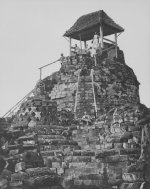
Which sort of dovetails into my original (and fanciful) question: were these once manmade structures? Perhaps they’re rubble piles earthed over by centuries or millennia of abandon. It’s hard to find a picture of a real melted building, but here’s a suitable picture of a collapsed one:
1738616573322.jpeg
 
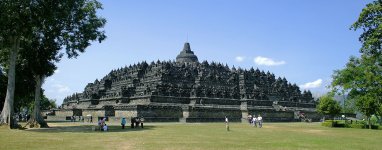
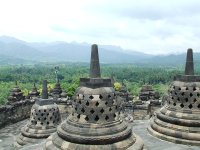
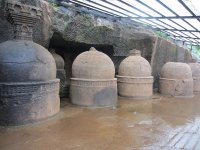
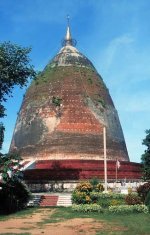
Could they be something like these stupas, decayed and buried under meters of hardened silt or mud? Nobody will ever convince me that they are natural. Geologists use erosion and geological forces the way cosmologists use gravity or biologists use evolution--to explain whatever they need it to do.
 

Attachments

  • Borobudur-Nothwest-view.jpg
    Borobudur-Nothwest-view.jpg
    800.7 KB · Views: 140
  • Borobudur stupas.JPG
    Borobudur stupas.JPG
    342.1 KB · Views: 144
  • Triple antenae stupas.png
    Triple antenae stupas.png
    528.1 KB · Views: 146
  • Bhaje Caves stupas.jpeg
    Bhaje Caves stupas.jpeg
    111 KB · Views: 150
  • bell shaped stupa.jpg
    bell shaped stupa.jpg
    44.3 KB · Views: 141
  • Borobudur Temple, Indonesia brick stupas.jpg
    Borobudur Temple, Indonesia brick stupas.jpg
    81.8 KB · Views: 130
Yes agreed. Another thing I discovered is that the mogotes (or weird geological formations categorized thusly) are discovered around the equator of the earth. Even if there’s some natural geological process creating them (say the earth is a spinning ball and these larger chunks of material are centrifugally forced outward) I dont think we’ve correctly identified it.

I’ve seen the foothills of Palouse (native Washingtonian here) and several other similar topographies, but the chocolate hills are pretty unique. The density and relative uniformity (shape and size) is pretty neat.
View attachment 33062

Another thing I found interesting was this:

Karst landscapes have extensive underground cave systems

Which sort of dovetails into my original (and fanciful) question: were these once manmade structures? Perhaps they’re rubble piles earthed over by centuries or millennia of abandon. It’s hard to find a picture of a real melted building, but here’s a suitable picture of a collapsed one:
View attachment 33063
Cool thread rev....I was a seattlite for 17 years, did six months right near palouse in Moscow ....it's really pretty, but it didn't strike me as odd the way your discovery does...chocolate hills reminds me of seeing a bunch of anthills spring up in a grass yard or something
 
Last edited:
In my opinion, all landscape is architecture that has been transformed into stone. Mountains and hills? Buildings. Canyons & valleys? Former streets or canals between buildings. Streams, rivers, waterfalls, lakes, underground aquifers? All parts of massive water transport and plumbing systems, still running but no longer connected to the power grid. Caves are just rooms and hallways, deformed beyond recognition. Nothing was carved, there are no megaliths, it was all made of bricks, mortar, concrete, maybe even geopolymer stone that, in some cases, melted and fused into blocky shapes, and in others, simply collapsed into shapeless blobs of rock that we now call hills, mountains, and cliffs. That's what I think the Chocolate Hills are: a melted city. I bet there are caves all throughout them.
 
Caves are just rooms and hallways, deformed beyond recognition.
I've always wondered about the caves & tunnels in the Afghanistan mountains which have been described as a "virtual ant farm of thousands of caves, countless miles of tunnels, deeply dug-in bases and heavily fortified bunkers". The pictures say it all...

1758964584462.png
1758964472664.png

1758964687188.png
1758964993285.png

1758965222786.png
1758965293040.png

1758964770818.png
Former site of the Buddha statues in Bamiyan valley (Afghanistan)​
 
Last edited:
I've always wondered about the caves & tunnels in the Afghanistan mountains which have been described as a "virtual ant farm of thousands of caves, countless miles of tunnels, deeply dug-in bases and heavily fortified bunkers".

For those who find @Broken Agate 's claim to be far fetched, watch Torus Mundi's video on Meltology which provides what may be a very straightforward explanation for the "underground cities". I'd been exposed to the concept of meltology before, but this REALLY clarified things for me. Their assessment is that we're looking at melted structures rather than rock carvings. I highly recommend checking out the other videos on their channel as well. Definitely looking forward to more of their videos.


View: https://www.youtube.com/watch?v=iBeEATVECtg
 
Last edited:
melted structures rather than rock carvings

I think there’s a whole lot of stuff out there that’s dangerously congruent with melted structures. The meltology/meltrix school of thought definitely has some support with me, but some of those examples are (to me) unmistakably carved out.

On the other hand, the chocolate hills really give me deluge vibes 🤷🏻‍♂️
 
Tips
Tips
Please respect our Posting Rules.
Back
Top