Defective Children 1900's

SH.org OP Username
Timeshifter
SH.org OP Date
2020-01-13 09:53:35
SH.org Reaction Score
5
SH.org Reply Count
11

Timeshifter

Core Member
Patron
Active Member
Joined
Aug 26, 2020
Messages
893
Reaction score
1,052
Location
United Kingdom
I was not sure where to place this @KorbenDallas so please move if needs be.

I came across this on Twitter yesterday, on one of the Liverpool pages I follow. @YOliverpool

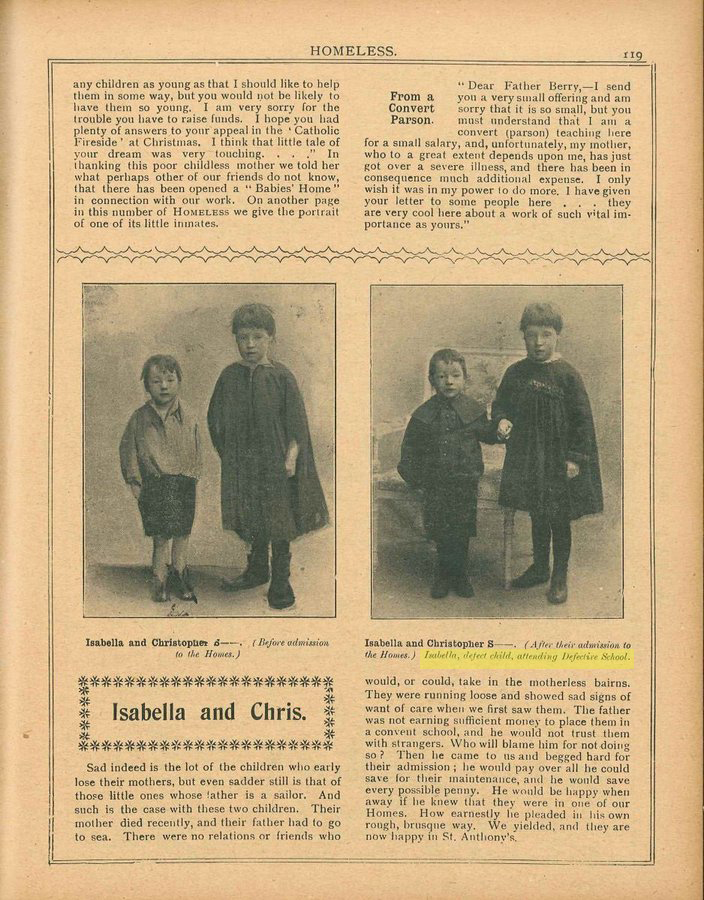
Not sure of the year, early 1900's? These kids had been orphaned after their mother died and their father could not look after them.... Saved by the Catholic Church... saved perhaps not the right word.

What struck me, is the description of the girl in this picture as ‘defect’ attending a defective school.
isobella and chris.jpg

WOW I thought, what a strange way to describe a human, someone who we may say these days had special educational needs. I have heard lots of derogatory terms to describe disabled people before, but never this.

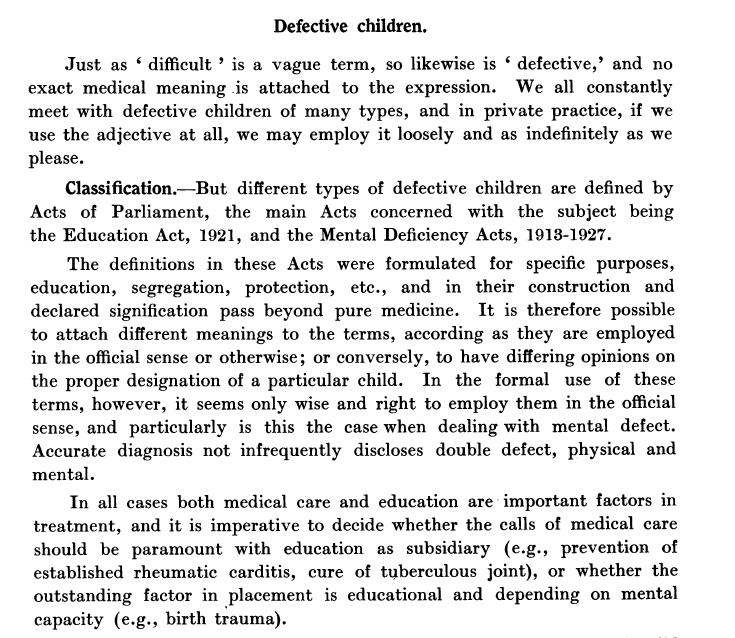
A quick bit of research revealed this: PDF by. A. Dingwall Fordyce, m.d., f.r.c.p.,. Physician, royal Liverpool children's hospital (Strange coincidence?) This passage in particular refers to Defective Children.
1578908205279.png
So, it would seem that in the early 1930's at least, it was normal to describe someone (a child?) who was mentally or physically ill as ‘defective’ or 'a defect' but, where did this way of describing a ‘faulty’ human come from?

Defective Meaning: adjective
  1. 1. imperfect or faulty.
    "complaints over defective goods"
I am not suggesting this girl is a bio robot, clone or whatever (But she may be) more I am wondering how we ended up using this term to describe her?
:unsure:
Note: This OP was recovered from the Sh.org archive.
Note: Archived Sh.org replies to this OP are included in this thread.
 
Note: This post was recovered from the Sh.org archive.
Username: KorbenDallas
Date: 2020-01-13 10:30:02
Reaction Score: 5
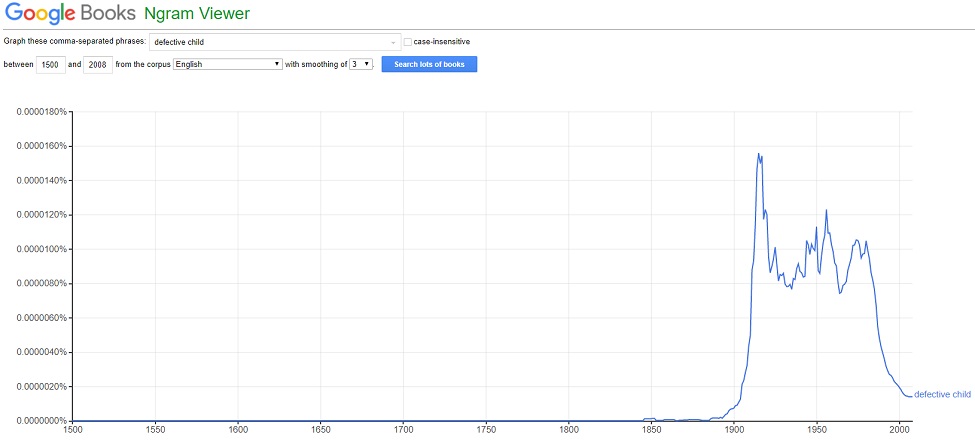
Really like your thought process. Google Ngram has quite a few examples of this "defect child" combination. I find it interesting when the term kicks in.

defect-child.jpg
I also checked for a "defective child".

defective-child.jpg
Time frames for both are rather interesting. Was there no children with disabilities prior, or a different term was used?

And I agree. In our today's life anything "defective" normally associates with goods. Healthwise... may be @whitewave could indulge us.
 
Note: This post was recovered from the Sh.org archive.
Username: jd755
Date: 2020-01-13 11:39:45
Reaction Score: 1
The 1921 Education Act full text

PART V.
BLIND, DEAF, DEFECTIVE, AND EPILEPTIC CHILDREN.

Education of Blind and Deaf Children.
51. Duty of parent as to blind and deaf children.
52. Duty of local education authority with respect to blind and deaf children.

[page iv]

Section.

Education of Defective and Epileptic Children.
53. Obligation of parent as to defective and epileptic children.
54. Enforcement of duties of parents of defective and epileptic children.
55. Duty of local education authority to determine what children are defective or epileptic.
56. Duty of local education authority to provide for education of defective and epileptic children.
57. Discontinuance of certified school.
58. Consultation of parents and co-operation with other authorities and persons.
59. Limitation on liability of local education authority.
60. Determination of residence.

General Provisions as to Education of Blind, Deaf, Defective, and Epileptic Children.
61. Period of education for blind, deaf, defective, and epileptic children.
62. Powers for providing special schools.
63. Conditions and effect of grant of certificate to school for blind, deaf, defective, or epileptic children.
64. Provisions as to religious instruction.
65. Liability of parent for expenses of blind, deaf, defective, or epileptic child.
66. Saving for rights of parents.
67. Grants from public money towards education of blind, deaf, defective, and epileptic children.
68. Particulars to be included in report to Parliament.
69. Interpretation of terms in Part V.

From here Special services in education - The National Archives

Elementary Education (Defective and Epileptic Children) Act 1899 – local authorities enabled to provide for the training of physically and mentally disabled and epileptic children
Children Act 1989
It's a legal term. Dehumanising, that is the purpose of legality.
 
Note: This post was recovered from the Sh.org archive.
Username: whitewave
Date: 2020-01-13 16:46:44
Reaction Score: 3
"Defective" is almost an obsolete term in referencing human limitations and abilities (adult or child). It's used more now to designate specific parts such as a "septal defect". The politically correct term now is disabled or handicapped. Or, more specifically, whatever's wrong with them such as epileptic, etc. When I first started my nursing career, the word wasn't used as an insult but as a descriptive. Kind of like the word "retarded". It was a medical term. It was also not uncommon to hear of "defective" children kept at home hidden from the world. From my observations such precautions were taken, not so much out of shame but, as a mercy to the child to prevent any teasing or embarrassment. Some were treated worse than animals, though, and horribly abused. That goes on today even with perfectly formed children. Have to agree with the PC change as the word "defective" is a bit insensitive and dehumanizing. Don't guess I've ever really thought about how the word came to be associated with human beings but I'd caution against applying modern thought process and values to our ancestors. There was a time when epileptics were considered "touched by the gods" and not necessarily a bad thing.
 
Note: This post was recovered from the Sh.org archive.
Username: Beedubya
Date: 2020-02-16 15:51:33
Reaction Score: 1
We did use a lot of words that would now be considered harsh or even rude.
 
Note: This post was recovered from the Sh.org archive.
Username: OpenMind
Date: 2020-02-16 21:27:46
Reaction Score: 1
We had shops selling second hand goods called 'the Spastics Society' to raise money for them. Not a nice term now, I think the meaning and way we use words changes from generation to generation.
 
Tips
Tips
Please respect our Posting Rules.
Back
Top