'Impossible' Bangladesh bridge?

SH.org OP Username
Mifletz
SH.org OP Date
2020-05-30 20:38:36
SH.org Reaction Score
8
SH.org Reply Count
17

mifletzet

Core Member
Active Member
Joined
Sep 16, 2020
Messages
243
Reaction score
217
What is the opinion of this Russian fellow's claims that the 1 mile long Hardinge Bridge in Bangladesh is constructed of too-fine quality corrosion-resistant steel, is too perfectly riveted, could not have been built in 2 years, is older than the claimed 108 years, and is too long and sophisticated to have been built by the British with local coolie help?

Are there genuine anomalies here?


Hardinge Bridge, Pabna [Complete Tour Guide] | Pabna, Bridge ...
Note: This OP was recovered from the Sh.org archive.
Note: Archived Sh.org replies to this OP are included in this thread.
 
Note: This post was recovered from the Sh.org archive.
Username: Willmatron
Date: 2020-05-31 05:17:35
Reaction Score: 0
Metal isn't going to rust if it's kept painted. I believe it can be over a hundred years old.
 
Note: This post was recovered from the Sh.org archive.
Username: Klenas
Date: 2020-05-31 12:11:03
Reaction Score: 0
Do we really not have an understanding of the 20th century riveting technology? 1912 (apparently) seems way to recent for any mass production technology to be lost?
Is welding really the superior tech?
Those are not rhetorical questions, I really am not aware if we could place rivets the same way nowadays if we wanted to.
 
Note: This post was recovered from the Sh.org archive.
Username: Mifletz
Date: 2020-05-31 12:59:15
Reaction Score: 1
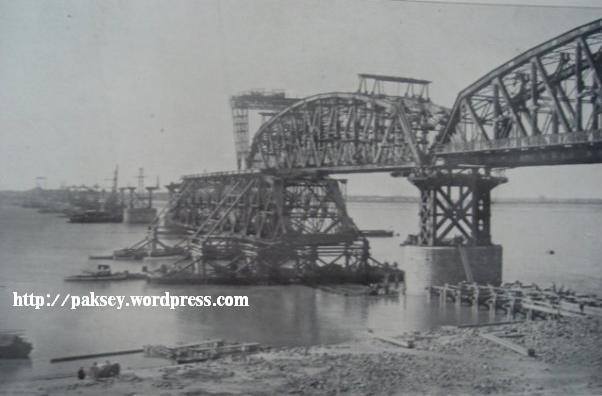
The Russian fellow "Global Vision" narrates that 'the locals don't know who built the bridge', that 'it is much older that 100 years', 'that it could not have been built in 2 years', 'that it was beyond the technology of 1912', 'that there are no photos of its construction', 'that the British could not have shipped all that steel from Britain', when in fact there were factories in India mass producing steel already in 1874 etc.

But judging from these 204 photos of its construction, is there really anything anomalous?

If there is nothing, then he is obligated to amend or delete his video.

Hardinge Bridge Construction, India

And there doesn't seem to be a Britishman in sight!
 
Note: This post was recovered from the Sh.org archive.
Username: jd755
Date: 2020-05-31 16:52:47
Reaction Score: 1
The Russian fellow is talking out of his backside. https://www.rendel-ltd.com/pdfs/Bangladesh-100-year.pdf

The 359 feet through trusses of the river spans are simple girders of the modified Petit type, having a maximum depth at the centre of 52 feet, a width centre to centre of the trusses of 32 feet and weighing 1,250 per span. Construction of the spans was by way of 72 feet high girder erecting travellers moving from each end of the bridge and straddling the girders erected. They spanned 41 feet across the width of the spans (32 feet c/c), and ran along steel runways. For construction over chars or shallow water, the spans were erected on timber staging supported on piles. For the erection of the main channel spans, a service truss-span (Fig. 3) was floated in on pontoons and placed on the top of the masonry piers, moving from span to span as construction proceeded. The assembly of all the components of the spans required meticulous planning and supervision to ensure the final dead load camber was as specified. Cylindrical drifts with tapered ends together with service bolts were initially installed, to be replaced after the complete span had been erected by the 60,000 rivets required in each of the spans.

The steelwork for the superstructure was supplied from England and “shipped with the greatest regularity by fast liners”. “In the 1914-1915 season ...... the last three spans were shipped from Liverpool in preference to East Coast ports, and successfully ran the gauntlet of the enemy cruiser “Emden” in the Indian Seas.”
Two of the land spans had been captured in Luxemburg and one interned at Port Said and had to be replaced.

The bridge was opened for goods-traffic on one track on the 1st January 1915, 3 years 5 months from the commencement of the erection of the first well curb. The Hardinge Bridge was formally opened for double line working of all classes of rail traffic on 4th March 1915.


Fascinating albums of how the bridge was built, thank you.

http://www.iabse-bd.org/session/1.pdf
Completion of this giant bridge in the short period during the early Twentieth century, and part of it during the First World War, that affected trade and commerce world wide, is sort of a miracle that was possible only with the meticulous planning and deployment of engineering skill of the highest order as would be difficult to replicate even today with great strides in technological development. Some of the aspects that helped this achievement under the dedicated leadership of Sir Robert Gale were:
i.Prior planning of the source of construction materials that were not available in the delta region. Quarries were identified and reserved in advance for construction grade sand and stone and arrangement made for their transportation to site by rail/ road/ waterway, which had to be created anew for many stretches.
ii.Arrangement of extensive infrastructure for the working force like well planned living quarters, hospital, water supply and treatment, sanitation, workshop, power house and other services on both banks of the river in advance. This paid rich dividend in retaining the workforce at site and getting their dedicated service and also avoided onset of epidemics that were very common in those times.
iii.Advance decision for using concrete in the foundations and piers, in place of brick that needed coal fired kilns, by using small sized stones that were available when sourcing boulders for the protection work.Employment of electric power throughout the construction of the bridge for major functions like well sinking, concreting, operation of plants and equipments, girder erection and the like, even though use of electrical plants were not tried earlier. For this purpose giant power houses were commissioned on both banks and work could proceed simultaneously from both sides.
iv.Use of precasting technic for making concrete blocks that were extensively used for construction of well and piers--again use of a technology hardly known in those days.
v.Use of adequate number of plants and machinery to ensure rapid progress and provision of back up spares to avoid stoppages during breakdown. Complete control were placed on sinking of wells which, due to the uncertainties offered by under bed obstructions, delay work. Special protection was provided, around wells during sinking, from scour, by pitching stones around. Pumping or “Running” was resorted whenever sinking got slowed down.
vi.The girders for the bridge were fabricated at Liverpool with the steel produced in plants in England and transported by ship. For close coordination of the entire manufacturing process and despatch, senior staff was posted there and close contact maintained with site organisation and their progress. Ship movement was affected due to war and particularly due to swift attacks by the dreaded German cruiser Emden. Three land spans were captured and one of them had to be replaced on emergency basis.
vii.For fast assembly of the girders and accurate camber achievement drifts were extensively used. Hydraulic Riveting was used wherever possible for improved assembly.

All the above attributes helped in speeding up the project that needed 27,500 tons of steel and 1,700,000 field rivets for the structure. The total cost of the spans was £1,393,000 and cost of river Training works £705,650.
 
Note: This post was recovered from the Sh.org archive.
Username: Mifletz
Date: 2020-05-31 17:19:01
Reaction Score: 1

In the UK, there is no greater indictment than some one "talking out of his back side"!

Whilst prolific video makers like Global Vision, Jon Levi, UAP, Liedtke, Auto-Didact, Albers, Druzhinin, Iwanova, Fomenko, Spacebusters, Lady Mud, Tartarian Zephyr etc etc promote thought-provoking ideas, could it be that literally up to 50% of what they expound is readily demonstrable pure glib flatulence?

It needs a sober analysis of their claims to filter out the valuable less readily demonstrable pouffes.
 
Note: This post was recovered from the Sh.org archive.
Username: Banta
Date: 2020-05-31 18:59:08
Reaction Score: 1
It's super easy to get sucked into your own narrative. We should all be very skeptical of wide-reaching claims that act as a sort of "master key" to analysis. The alternative history community is full of this. It's understandable on one hand, but also really disappointing because most of these commentators only got to where they are by questioning everything that the mainstream presents. At some point, there is an apparent tendency to lose that skepticism, especially when one needs to turn the skepticism inward. I suspect the mainstream only became the mainstream because of similar folly. It becomes an odd sort of confidence that attracts people who only wish to follow, which then reinforces the supposed veracity of your beliefs.

Carlos Castaneda's The Teachings of Don Juan: A Yaqui Way of Knowledge
 
Note: This post was recovered from the Sh.org archive.
Username: dreamtime
Date: 2020-05-31 19:16:08
Reaction Score: 3
What primarily matters is the intent, not the implementation. Intent is the key to unlocking hidden aspects of our reality.

Other than that, it's always a group effort and a differentiated analysis of a given topic is always helpful. At least if the intent is a honest one.
 
Tips
Tips
Please respect our Posting Rules.
Back
Top