Alternative Means of Data Storage That Have Been Lost/Hidden

Library Genesis

Emoto's books are on libgen. He discovered water crystals became more beautiful shapes when words like love and good were taped to the container of water.

The contrary also being the case. Negative words like war and hate caused the crystals in the water to deform and look muddy.

The makers of Monster energy drink probably know this...
 
Indeed. I saw a Cymatics experiment on water (and another on sand) in the same vein. Certain resonances created beautiful, intricate, repeatable patterns… while others created messes or even displaced the medium entirely.
 
If - per other threads - we have only a partial understanding of magnetism/aether/electricity, then you might expect data storage to use properties that we don't pay much attention to. So certain iron items might hold magnetic field structures that we are unaware of (and don't routinely look for). Certain items might hold paramagnetic patterns that we are unaware of (and don't routinely look for). Perhaps also diamagnetic structures too.

And that's just speculating about magnetism and its variants. There may be fields we've not noticed and structures that can record their past structure that we think are just chemicals. Or viruses. Or...

I have spent the last time reading some e-books linked in an article about the Hieronymus Machine ...
what I've read so far is really really mind-blowing, so to say, heavy stuff, sometimes disgusting, but if what's written is true ... 😲 ???

According to the author, with the help of such "psionic devices" everyone should be able to "remote view" whatever event or whatever period in time one wants ! Or people. If true, forget about privacy ! One would even be able contact dead people, unless "they were dead for too long and had reincarnated." :unsure:

So, is this nothing but a game, a "playzone" for souls ? With just few having the knowledge (and thus power and control) how this physical realm really functions ?

The author mentions in one of the books, that this "psionic work" is also called paganism. 💡 :LOL: I now came to "energy patterns" that can be "transmitted", which in fact are their gods or the planets. Some of the lesser keys of Solomon are depicted in one of the books, also called "spirits", some with healing properties or for improving knowledge, others with destructive properties. They are energy forms, thoughtforms, egregores, energy loaded symbols, that can be transmitted into the subconscious of people. That energy can be programmed. I used to call it THEY psychological warfare and subliminal programmation.
 
This may sound weird, but I also believe there is stored information in the relationships that we acquire throughout our life times and then in our reincarnations. This information is so strong that it breaks through the barriers of "time" and dimensions.

Embryonic fluid must also be a way of transferred and stored information, along the same lines as water.

Our senses, I believe, are another form of information transferred and stored, but I guess that falls under the brain, like I had mentioned before, sorry about the redundance.

I would also like to mention special spots on the Earth that I believe have ways to store and transfer info, almost like memory spots. I guess they would be portals or places where dimensions are able to be accessed, like they say they have in Iceland.
 
As I was perusing several different threads on this website deep into the late hours last night, I had an errant thought that I wanted to sleep on before trying to formulate something cogent, and its not something I've seen mentioned. What if there are means of data storage that are unknown to the modern masses that were intentionally cycled out, forgotten because we do not know their function, or that we lost the means of accessing?
Speaking philosophically about 'what if?'... The obvious answer is: could we play back and see the recorded data? Could we learn from being able to play back the data that was stored with it? Could we reinstate the technique and use it for new recordings?

And then moving out from there: could we ponder the technology, science and clues to its creator-culture (that is: could we examine the meta-data of the technology?) and determine other paths (and unrecognised clues) to follow up on?

And could we use this to start rolling forward? To instate a general progression?

...art porn culture tends to influence the popular data storage devices of the time, at least for popular visual media. Heck, when was the last time any of you saw a computer with a built-in disc drive? How often have our connecting cables for just cellphones since they were popularized? As was popular video trend a few years ago, we know how young people react to older technology and are often confounded by it. We also know that the way technology actually works is often intentionally misrepresented/hidden and can often be the source of "inexplicable" deleterious effects on human health. Not to mention, the increased used of technology serves as a function of cybernetics (systems of control).
Speaking of porn culture and built-in drives, bio-companion technology can misrepresent and have 'inexplicable' deleterious effects on human health, particularly on the hormone-flooded young:

bride-and-groom-silhouette-wedding-clipart-11-1290800177.png
A bait and switch cybernetic system. Source

Maybe 'bait and switch' is too strong. Perhaps they exchanged in public at market price but misunderstood the value of each other's currencies:

74494-sterling-pound-symbol.pnginverted_japanese-yen-currency-symbol-black-260nw-1379328770-1991828944.jpeg

Technology now appears to be encroaching on this space too:

WeChat-Image_20200330215035.jpg
AI (presumably) companion. Source: AINIDoll

Or maybe it always did. Funnily enough, while originally looking for a more robotic/AI-like doll image than the one above, AINIDoll's website text released a memory from my own data storage banks.

From AINI Artificially Intelligent Sex Doll Features - AINIDOLL - Online Shop for Next-Generation AI Sex Dolls and More!
  • Cloud based artificial intelligence: She holds non-sexual and sexual conversations interactively. With proper training, she’s able to recognize your voice and respond the way you want. Learn More

That prompted my internal data catalogue to retrieve and play back a memory of George Bernard Shaw's 1913 play Pygmalion. In which Eliza Doolttle is taught to speak:

Download Video

AI in action. Source: Sexdollgenie

Not all of those connections were the ones I was originally intended to show. But then, the unexpected is a key feature of bait and switch :)
But not to get to far into to the weeds, let's return back to to my main point - what data storage methods have we lost access to, be it intentional or otherwise? ... how would someone even know that such a thing contained data if they did not have the means to access it with a proper reading device? It would just look like a weird knickknack without knowing about such technologies.
Things we classify as decorative or ritual?
So what have we lost access to that is staring us right in the face?
Correctly functioning silver/mercury-backed mirrors?

I'd add in a clip from Fringe but it would take time to retrieve the original from storage.
Could glass have been one such means that we're finally coming back around to? Could it have been trees? Any and all speculation is welcome, even if it is sourced from fiction (as this often is used as a means of revealing information on its own), as I know there have to be methods that we have lost or had hidden from us.
Tree of Life mythology sounds like a dendritic version of DNA. I'd dig out a clip from American Gods but time is passing.
Perhaps this is too obvious, or perhaps you are looking for material sources to stand the test of time, but how about stories and songs? These, we are told, were ways to pass down information in the past. But our stories and songs nowadays, are not our own, not specific to our location or background.
The more I play with that idea, the more probable it seems. Mobile, self-maintaining, devices for recording data, storage, and playback. It would explain many aspects of classical culture - from story-tellying (?) to poetry to acting to dancing. It might help us understand the (possible) references to mystery/miracle plays in church doom paintings and the Royston/Burgstein bottle caves.

It would explain why kids demand experiences and talk so much. They are just programmed to practice for their adult role as event storage devices.

Perhaps even the crudeness and sensory overload of opera was originally a means of raising the signal-to-noise ratio of playback in distracting environments.
I would add water to this list. Water has been shown to remember all kinds of things (Emoto's memory of water comes to mind), and there are plenty of theories that consciousness is cellular and driven by water. That aussie guy who was using memory of water to convert to oil and other substances was mentioning something about that, though I lack the tools to test that theory myself, so it's just conjecture.
We're stuffed with water, DNA and a colourful ferro-liquid that hardens on contact with air. Could scabs be the new vinyl? Or the old vinyl?

Might explain John Byng's obsession with retrieving old red and blue stained-glass from 18th church ruins.
The author mentions in one of the books, that this "psionic work" is also called paganism. 💡 :LOL:
If you 'do the Russian thing' with 'paganism', you get Roganism. As in the alternative ideas-believing entity that is broadcast as 'Joe Rogan'.
sorry about the redundance.
Redundancy isn't a bad thing in a data storage device.

The very clever multi-entendres in this thread are great. You folks are genii.
 
Last edited:
I just remembered something about data transfering in the bible. I'm not a Christian, but I have to tip my hat to the genius invention of parables. These are pithy stories that transcend time, culture and language - which is a pretty amazing accomplishment.

If someone wanted to convey information in a way that it can become enlivened in someone, in a different time and culture, parables fit the bill. They are a sort of a riddle.

When it comes to distorting the information they contain, I don't think it's possible to bend or distort the parable into meaning something else, or to reframe the context and have the parable still make sense. You can try to provide an alternative interpretation of the meaning in the parable, but the parable's answers remain available to anyone reading them. The only thing you can do is turn them into nonsense or something obscure that no one can understand.

Anyway, I see parables as an amazing way of transferring information over the years, etc, in a way that is pretty tamper proof, a sort of reverse encryption where you are trying to spread truth and don't mind who reads the message but do want it to have longevity. It's an awesome talent to be able to write these I think.
 
Speaking philosophically about 'what if?'... The obvious answer is: could we play back and see the recorded data? Could we learn from being able to play back the data that was stored with it? Could we reinstate the technique and use it for new recordings?

And then moving out from there: could we ponder the technology, science and clues to its creator-culture (that is: could we examine the meta-data of the technology?) and determine other paths (and unrecognised clues) to follow up on?

And could we use this to start rolling forward? To instate a general progression?

I believe if we could recognize stored data as such, we could attempt to develop the means to read it, and then conceivably see metadata and all of the other content you listed (if there is any). There undoubtedly small groups out there who employ such data storage currently (signs/symbols/otherwise), but I could see there being a hard version of storage that the rest of us wouldn't know how to use.

Things we classify as decorative or ritual?

I am open to both options, as well as any others.

We're stuffed with water, DNA and a colourful ferro-liquid that hardens on contact with air. Could scabs be the new vinyl? Or the old vinyl?

That's certainly an interesting thought. We know hair, bones, and DNA can store a lot of information about life events. The average person just has no way of "reading" them.

Might explain John Byng's obsession with retrieving old red and blue stained-glass from 18th church ruins.

I too have wondered about architecture and old glass, especially since we know that the origins of most of them are not what we have been told.

I just remembered something about data transfering in the bible. I'm not a Christian, but I have to tip my hat to the genius invention of parables. These are pithy stories that transcend time, culture and language - which is a pretty amazing accomplishment.

If someone wanted to convey information in a way that it can become enlivened in someone, in a different time and culture, parables fit the bill. They are a sort of a riddle.

When it comes to distorting the information they contain, I don't think it's possible to bend or distort the parable into meaning something else, or to reframe the context and have the parable still make sense. You can try to provide an alternative interpretation of the meaning in the parable, but the parable's answers remain available to anyone reading them. The only thing you can do is turn them into nonsense or something obscure that no one can understand.

Anyway, I see parables as an amazing way of transferring information over the years, etc, in a way that is pretty tamper proof, a sort of reverse encryption where you are trying to spread truth and don't mind who reads the message but do want it to have longevity. It's an awesome talent to be able to write these I think.

Parables would certainly qualify - which makes me wonder which ones might have been tampered with (even of the non-religious sort) and just sound garbled and confusing to us now, which we might falsely attribute to cultural differences or social mores changing.
 
Parables would certainly qualify - which makes me wonder which ones might have been tampered with (even of the non-religious sort) and just sound garbled and confusing to us now, which we might falsely attribute to cultural differences or social mores changing.
Candidates for examination would be those parables which are openly acknowledged as parables:
Modern media often has parables built into it. To such an extent that much modern media seems to be a continuation of the mystery, miracle and morality plays. Because the contents of first two have been largely suppressed (or shifted into some other unidentified form), their contents are not publicly known. So it is not easy to investigate and evidence this idea. Morality tales in modern media are much easier to identify. Or so it seems to me.
 
Last edited:
Candidates for examination would be those parables which are openly acknowledged as parables:
Modern media often has parables built into it. To such an extent that much modern media is a continuation of the mystery, miracle and morality plays. Because the contents of first two have been largely suppressed (or shifted into some other unidentified form), their contents are not publicly known. So it is not easy to investigate and evidence this idea. Morality tales in modern media are much easier to identify.

I think the modern "morality tales" (more like lack of morality if you ask me) will be indecipherable in short order, given that most of them are just spouting progressive political views, which change as quick as the weather.

As far as encoding data in a visible but easily overlooked way goes, are we aware of their being other systems akin to Braille, sign languages, or knot systems (like Quipu) that have faded from public view?
 
I think the modern "morality tales" (more like lack of morality if you ask me) will be indecipherable in short order, given that most of them are just spouting progressive political views, which change as quick as the weather.

As far as encoding data in a visible but easily overlooked way goes, are we aware of their being other systems akin to Braille, sign languages, or knot systems (like Quipu) that have faded from public view?

I'm not sure I'm always meeting your 'faded from public view' requirement with these. So:

Rug designs, 'traditional' wallpaper designs, fisherman's sweater designs, Jacquard patterns, Lynne Kelly's memory boards (though I understand these were individualised prompters rather than public-usable keys to encrypted data).

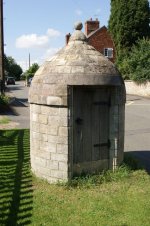
Aurally, there may be something in punning. Eg, Manly P Hall and my semi-private experiment that "Manly P Hall spends a penny" (at the village lock-up/dovecot/wellhead):

digby-lock-up.jpg
It was whatever the authorities tell you it was. Source

And sorcerers, who may have played around with special bowls called, perhaps, mazers.

And bells and carillons.
 
Last edited:
I'm not sure I'm always meeting your 'faded from public view' requirement with these. So:

Rug designs, 'traditional' wallpaper designs, fisherman's sweater designs, Jacquard patterns, Lynne Kelly's memory boards (though I understand these were individualised prompters rather than public-usable keys to encrypted data).

Aurally, there may be something in punning. Eg, Manly P Hall and my semi-private experiment that "Manly P Hall spends a penny" (at the village lock-up/dovecot/wellhead):

View attachment 26938
It was whatever the authorities tell you it was. Source

And sorcerers, who may have played around with special bowls called, perhaps, mazers.

And bells and carillons.
Nice list. When I say 'faded from public view' I mean things that are not well known outside of historical or regional circles, or were once widely represented in the public (media, academia, folklore, etc.) and then have lost this visibility for whatever reason.

I too am quite fond of wordplay, and that has certainly been used to encode and transmit data in a way that only the initiated will get.
 
I wholeheartedly concur that folklore is the layman’s way to pass down information, particularly amongst the illiterate. But these informations are subject to a generational game of telephone, allowing each carrier of the torch to omit, transpose, transform, or otherwise alter the information at will or by accident. Generational memory seems vulnerable to this similarly.

there must be/have been a more static means of preserving the fact that generally speaking, water is two hydrogen and one oxygen. Carving that data into stone would read the same 100 or 1000 years later, but trusting people to accurately relay that through the generations, I would imagine the story would change some over 1000 years.
 
Perhaps you were referring to the name itself, which sounds like 'manly pee hole'?
Yes, that's what I meant. I think of the pun as 'manly pee hall' and, when speculating about the technology and/or technological process that might be hidden in the pun, then the halls that come to mind are like Digby village lock-up pictured above.

But 'manly pee hole' works too. From Wikipeedia: Village Lock-up:
a hole into which drunken and bleeding men were thrust and allowed to remain until the following day

The authorities seem to have been keen to collect the output of their pissed and ferro-fluid oozing prisoners:
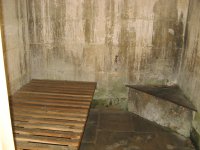
Lacock_lock-up,_interior.jpg
Bed and urinal in Lacock village lock-up. Source

I read - possibly somewhere in Roy's Village Lock-ups blog pages - that wives of locked-up prisoners would bring a jug of beer and a clay pipe through which to deliver more beer through the bars to the prisoner. I've also seen an account of relatives bringing beer to prisoners in Lincoln's former Stonebow prison - although it didn't look like a typical village lock-up so far as I know.

Regardless, this suggests to me that prisoner oozings were valued and perhaps even linked to their release. The over-the-top roofs of these structures and the fact that very similar-looking structures also get labelled as well-heads and dovecots makes me wonder if we've been misled about their true purpose.

That doesn't answer the engineering questions. What processing would be involved? What transformations would make piss and blood valuable enough that delivery and collection infrastructure was built all over the country.

Perhaps a clue to that lies in Manly P Hall's writings. I'll look at more physical evidence before I turn to writings for explanations though. Physical evidence trumps written evidence because it costs slightly more effort to create and maintain.
 
Last edited:
I agree that Architecture is a place of stored information, for instance the pyramids, and other ancient structures around the planet.
One place that comes to mind is the Rosslyn Chapel. In this chapel there is plenty of information stored in the design and within this chapel. Music is used, mathematics, symbols, and the that the design of the building itself, is supposed to represent Solomon's temple is just an example of this ancient stored information. I would also like to point out the two pillars inside as well. I suggest a look see if you have never looked before. This information that is stored in this temple is remarkable and is still not fully understood to this day.
 
If you’ve not seen it, the Netflix show Travelers is a fun sci-fi trip.

It’s got sort of a 12 Monkeys vibe involving people from a dystopian future sending travelers back in time to repair/resolve issues which led to their predicament. The method they used to transmit messages into the future was human blood/dna.
 
I agree that Architecture is a place of stored information, for instance the pyramids, and other ancient structures around the planet.
One place that comes to mind is the Rosslyn Chapel. In this chapel there is plenty of information stored in the design and within this chapel. Music is used, mathematics, symbols, and the that the design of the building itself, is supposed to represent Solomon's temple is just an example of this ancient stored information. I would also like to point out the two pillars inside as well. I suggest a look see if you have never looked before. This information that is stored in this temple is remarkable and is still not fully understood to this day.
Are you recommending a physical visit or a visit of the various written analyses of Rosslyn? I ask because the material I have read suggests the form of the analysis is more important than the forms the writers are analysing. To use a metaphor: the writings are like large ornate gilt frames around a small, dark, oil-painting. The frame overwhelms the art.
If you’ve not seen it, the Netflix show Travelers is a fun sci-fi trip.

It’s got sort of a 12 Monkeys vibe involving people from a dystopian future sending travelers back in time to repair/resolve issues which led to their predicament. The method they used to transmit messages into the future was human blood/dna.
Thanks for the heads-up. The lock-ups/dovecots/well-heads share some physical features with Dr Who's Tardis that suggest they were travel-related. They are lone, single-roomed structures usually sited by the side of the road. Sometimes as part of wall.

As with the IHASFEMR thread, when speculating about what they were used for, I've applied Maslow's Razor:
Entities invest in the necessities of life before they invest in sophistication for its own sake.

So, for a working theory, I've assumed these structures were related to substance collection and processing. And that their output was either fuel, float-gas or both.

Of course, I may have missed the bus.
 
Last edited:
Are you recommending a physical visit or a visit of the various written analyses of Rosslyn? I ask because the material I have read suggests the form of the analysis is more important than the forms the writers are analysing. To use a metaphor: the writings are like large ornate gilt frames around a small, dark, oil-painting. The frame overwhelms the art.

Thanks for the heads-up. The lock-ups/dovecots/well-heads share some physical features with Dr Who's Tardis that suggest they were travel-related. They are lone, single-roomed structures usually sited by the side of the road. Sometimes as part of wall.

As with the IHASFEMR thread, when speculating about what they were used for, I've applied Maslow's Razor:


So, for a working theory, I've assumed these structures were related to substance collection and processing. And that their output was either fuel, float-gas or both.

Of course, I may have missed the bus.
I wish I could just hop on over to the UK and visit, but what I am referring to is the whole of the structure and whatever may be beneath it. I think that there are plenty of pictures that will illustrate what I am talking about. Many have tried to decipher the musical notes that are represented within the many sculptures inside, carvings that represent foods and other things that were not even known to these peoples at the time like corn.
 
I just thought of another good example of hidden information - the law.

When we speak English (or any other language) I think it is considered that we are speaking 'Vulgar Latin'. Whereas the law itself, uses proper Latin. You need to use a legal dictionary to decode the legal terms - eg birth translates to berth (of a ship), person is a company, nice means stupid. The point is that although 2 people might think that they are having a conversation in English, only one is actually speaking English whereas the other is talking in 'legalese'.
 
I just thought of another good example of hidden information - the law.

When we speak English (or any other language) I think it is considered that we are speaking 'Vulgar Latin'. Whereas the law itself, uses proper Latin. You need to use a legal dictionary to decode the legal terms - eg birth translates to berth (of a ship), person is a company, nice means stupid. The point is that although 2 people might think that they are having a conversation in English, only one is actually speaking English whereas the other is talking in 'legalese'.
Use of jargon is certainly a fantastic way to hide information using common terms. Nice catch!
 
Tips
Tips
Please respect our Posting Rules.
Back
Top