Castration, Circumcision, and Transgenderism from Antiquity to Today

@SonofaBor , what you describe here is provocative -- a subtle symbolic order ruled by natural energies, frequencies, and processes to which so-called "primitive" people would be attuned.

All I can say here is that as a literate Westerner, this "natural mind", if it exists, is foreclosed to me. I can speculate on it, and I can read about it, but I cannot feel it.

Here is the thing. I am a paranoid and cynical man. What I have learned as a psychoanalyst is that people lie. They lie to others and they lie to themselves. They lie to preserve a positive vision of themselves and the societies to which they belong, all of which are based on a certain degree of hypocrisy and repression.

I didn't intend to elicit a confession, especially one that-- while not a lie-- is a bit diminutive; for I recall a reference by you to the, if not the spirits, then the natural structure outside our bubble with some wonder.

Everybody wonders. We wonder here about history. The clues are standing all around us; and, if we are willing and able to look deeper, we see patterns of fabrication-- of lies-- everywhere. I appreciate greatly your desire and capacity to think through these patterns. Stolen History reminds and provokes me to wonder about who we are; it also strangely comfort me-- insofar as I can recognize a world greater in many ways than our own and (this may seem counter-intuitive to my apparent magical naturalism) that humans can re-code this joint. Certainly Fomenko proves this, no matter what one makes of his historical reconstructions.

Because the coding has been bad, the investigation itself seems very worthy of energy/desire. Bad? I make this moral judgment because the coding has promulgated a world that negatively feeds on itself and one which refuses a reckoning that only truth can bring. That is my adult judgment. From where does that arise? Not from a vacuous moral imperative or-- despite what some of my friends might say-- from my astrologically formatted being. Rather, the buildings and the stories, including the lies so confusing, remind me of what I take to be most valuable and what I've always known to be most valuable. What are they? 1. The city-centers, in my youth and to today, excite me. I could and can feel the energy, the animating magic, of community life; 2. I feel depth, ontological depth, in the stone; 3. I also get a sense of moral proportion-- the Old World says depth and strength are possible in a vital world; while our word often says depth should be sacrificed for collective and individual purpose. Defacing and eliminating this energy and replacing it with the brutal but thin modern world may be an unintended consequence of post-apocalypse reprogramming or it could be a flat-out crime. It is probably both. As @ViniB notes above, there is a "dark side." As a child I also had lingering sense that I had been here before. Is this a basis for judgment or simply an impression? Perhaps both-- and I'll turn to that question in the next paragraph. As an adult, I've also witnessed moments of reckoning, of healing. In 1994 I was in Shandong, China-- the traditional heartland of what we call today China. The romantic but terribly destructive cultural liberation movements (roughly, 1937-1979) were over. The Soviet Union had just fallen. The Tienanmen counter attack against the people was well known in China. For various personal reasons, I was there. The deepest impression I got was that people just sitting and wondering: What just happened? What the heck do we do now? A moment of truth. Of course, The New World Order had an answer. But to achieve that they had to beat down, once again, the desire (or, better, yearning) of people to be together and cultivate themselves and their worlds. I wish we could see such a moment, without the intrusion of the super-colonial answer, in the United States. I'd like to see the consumerist paradigm fall and for people to open their doors, literally and figuratively, and engage each other deeply, to find wonder and joy in that, and leave behind the mono-culture world. I participate here because I believe that Stolen History is vital to any such reckoning.

While I was thinking about your rejoinder to my post above, I remembered something from our well-documented cultural history-- namely, the simultaneous appearance of psychoanalysis and impressionism around 1900. Structuralists should recognize this immediately. One without the other seems incomplete. The intense drive to puncture the lies, to untangle the knots, seems meaningless if there is not something more real and true than the web. And yet, impressionism without serious thought is without anchor. Despite his brilliant structural/scientific intentions and accomplishments, Levi Strauss knew this, too. I recall a chapter heading, "A Little Glass of Rum," his photos of natives at play, and his book-concluding connection to the consciousness of a cat. When I search for quotes online, I find this one right away:

The work of the painter, the poet or the musician, like the myths and symbols of the savage, ought to be seen by us, if not as a superior form of knowledge, at least as the most fundamental and the only one really common to us all; scientific thought is merely the sharp point — more penetrating because it has been whetted on the stone of fact, but at the cost of some loss of substance — and its effectiveness is to be explained by its power to pierce sufficiently deeply for the main body of the tool to follow the head.

I'm glad you reminded me of this book. It broaches very elegantly, what was known in the early 19th century, as the Classical/Romantic split. He was saddened by the destruction. And yet he was part of it. The irony was well understood by him; and irony-- as a literary device-- was one of his non-scientific tools.

And here I want to turn to a perhaps more ticklish thought.

The Gospel of John begins:

1 In the beginning was the Word, and the Word was with God, and the Word was God.
2 The same was in the beginning with God.
3 All things were made by him; and without him was not any thing made that was made.
4 In him was life; and the life was the light of men.
5 And the light shineth in darkness; and the darkness comprehended it not.

Now, if I can make a great cultural leap, the Dao De Jing begins:

道可道,非常道
名[可名,非常名
無名天地之始
有名萬物之母
故常無欲,以觀其妙
常有欲,以觀其徼
此兩者,同出而異名
同謂之玄
玄之又玄,衆妙之門

The following translation seems reasonable to me:

The Tao that can be spoken is not the eternal Tao
The name that can be named is not the eternal name
The nameless is the origin of Heaven and Earth
The named is the mother of myriad things
Thus, constantly without desire, one observes its essence
Constantly with desire, one observes its manifestations
These two emerge together but differ in name
The unity is said to be the mystery
Mystery of mysteries, the door to all wonders

- Translated by Derek Linn, 2006, Chapter

These two passages are civilizationally fundamental and generally misunderstood. They both seem to say that the coding of this manifest reality goes all the way down and people are both executors and witnesses of this coding. There is a certain difference in emphasis that a structuralist would perceive immediately, too. The Christian vision seems to privilege the active, executive mode; while the Dao De Jing seems to emphasize caution and witness. Caution corrects the zealot, at least in principle. I don’t ascribe to such a reading because both texts say there is something-- God, the Dao, or a source-- beyond the manifestations and that people are both coders and witnesses. In the Christian text the life manifests as the light of people; but there is darkness that doesn't comprehend the light. The Gospels show repeatedly that the light doesn't shine in everyone-- that is, not everyone is receptive to it. The Dao De Jing repeatedly points to administrators who fail to understand the Dao and over-manage, as it were, the manifest world. In both traditions, to act against-- for lack of a better word-- source is to invite destruction.

It seems to me that if executor consciousness prevails, then things go badly. But we cannot become mere witnesses either. (And we really can't-- even music is coded). That means we have a difficult path-- we both code and evaluate, and we must do so honestly. To use the language of Russell Jay Gould, we must "stop and correct." But correct to what signal? I think this should be obvious (see my three points above), but it isn't because discourse distorts; laws and regulations have unintended and intended consequences; history-- such as circumcision-- repeats; some people don't care and others mistake their beliefs for reality, etc.

A collective moment of "What the heck happened?" would be good for us. We might be able to examine the coded deliriums that have shaped our lives. We can sit with each other, smell each other, and wonder together.

(Please note, I was writing as @Frostychud previous post appeared. Please consider this response a footnote....)
 
Last edited:
I brought up David Ayalon's "Eunuchs, Caliphs, and Sultans" in my last post. Ayalon is an Israeli historian, so calibrate accordingly. It's a fascinating read. I'm only about sixty pages in and I have already found enough material to fill another post. Ayalon's thesis appears to be that the Mamluk phenomenon and the eunuch phenomenon were two sides of the same coin. While he does not go as far as to say that eunuchs were the power behind the throne, that is the thesis that emerges from between the lines. Judge for yourself.

Mamluk or mamaluk (/ˈmæmluːk/; Arabic: مملوك, romanized: mamlūk (singular), مماليك, mamālīk (plural);[2] translated as "one who is owned",[5] meaning "slave")[7] were non-Arab, ethnically diverse (mostly Turkic, Caucasian, Mongol, Eastern and Southeastern European)[8] enslaved mercenaries, slave-soldiers, and freed slaves who were assigned high-ranking military and administrative duties in the Muslim world.[11] They were purchased as military slaves, converted to Islam, and trained in martial and courtly skills. Upon completion of their training they were freed, but remained part of the ruling military caste, forming elite regiments and, in some periods and regions, rising to sovereign power.

Screenshot 2026-06-26 9.52.36 PM.png
Screenshot 2026-06-26 11.09.28 PM.png


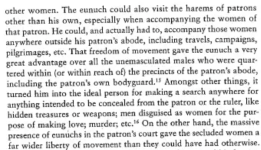
So eunuchs were freer to move around than their patrons, were in charge of money and property, and ran the prisons.

Screenshot 2026-06-26 11.38.38 PM.png


"The impact of the eunuch on him was overwhelming. Neither did that impact cease after his graduation." We see here that the eunuchs essentially created and trained the Mamluks.

Screenshot 2026-06-27 1.16.06 PM.png


Ayalon insists on the importance of the eunuch class in shaping the sexuality of the young Mamluks.

Screenshot 2026-06-27 2.01.54 PM.png


"A constant and dominant element"

Screenshot 2026-06-27 2.03.08 PM.png


Of course this begs the question: were the eunuchs pulling the strings even after the rulers became adults?

Screenshot 2026-06-27 2.09.36 PM.png


Eunuch supervisors.

Screenshot 2026-06-27 2.16.54 PM.png


This is of particular interest. What this suggests to me is that the Mamluk (and therefore the eunuch) phenomenon was real, and the rest of Islamic military history was forged during the great falsification enterprise.


Screenshot 2026-06-27 2.23.51 PM.png

Screenshot 2026-06-27 2.23.02 PM.png


"So many first ranking military commanders". This confirms one of my intuitions, namely that the Muslim Warrior phenomenon has to be articulated with the eunuch commander phenomenon. Eunuchs were the brains whereas Mamluks were the muscle. If I may paraphrase Ayalon in more straightforward language, he shows that the Mamluk armies, which were the backbone of Muslim military power, were slave-soldiers kidnapped as children and subjected to trauma-based mind-control by eunuchs throughout their initiation and training. Could we really expect such people to attain psychic sovereignty upon reaching adulthood, or would they essentially all function as brainwashed "Manchurian Candidates" puppeteered by the discreet eunuch brotherhood?

If that sounds extreme, read the book yourself, I am not exaggerating Ayalon's thesis, just formulating it a bit more sensationalistically than he does. Looking forward to reading further and sharing here.
 

Attachments

  • Screenshot 2026-06-26 9.53.20 PM.png
    Screenshot 2026-06-26 9.53.20 PM.png
    406.7 KB · Views: 8
Last edited:
I know that I am spamming this thread with different themes in rapid succession, but I have time to research at the moment and the ideas keep coming.

I think I have a good one today.

The cult of Mithras remains a mystery. We have no surviving written documents describing the Mithraic religion. What we do have is a lot of frescoes depicing the tauroctony, the central symbol of Mithraism. Here is a description:

The Tauroctony

Mithraism - Wikipedia

Mithraism was based in Rome.

Screenshot 2026-06-29 11.19.06 AM.png


The oldest known representative of the tauroctony scene is CIMRM 593 from Rome, 2 a dedication of a certain Alcimus, slave steward/bailiff (servus vilicus) of T. Claudius Livianus, who is identified with T. Iulius Aquilinus Castricius Saturninus Claudius Livianus, the praetorian prefect under Trajan.

Check out the bolded name of that prefect - CASTRicius. I think you can probably guess where I am going with this.

Look at the image. Look where the bull is sitting in relation to Mithras. His head is at crotch level.

1. Andrey Pustogarov argues pretty persuasively that bull worship was the religion of the original world empire which radiated outwards from Spain in the 16th century (in particular to Asia Minor), and that the tradition of bullfighting that still exists in Spain is a direct relic of this religion. Moses was originally depicted with horns to identify him with the bull. The circular and semi-circular theaters that we find around the rim of the Mediterranean were not built to perform plays by Aristophanes. They were built for bullfights. According to this theory, the word "church" comes from the original circle of the arena.​
2. Grishin and Melamed argue that the original merchant empire was run by eunuchs, as I have mentioned several times already in this thread.​
3. Flavio Barbiero argues that the Mithraic cult was the esoteric version of Christianity reserved for high-level initiates, and later became Freemasonry.​
4. Mr. E argues that the biggest secret of Freemasonry and other such secret societies is elite gender inversion.​
So here's my idea. It's very simple. The bull has always been a symbol of uncontrolled virility. This requires no complex explanation.

Was the Mithraic rite simply...castration?

Carl Jung, Rudolf Steiner, and others have suggested that the Mithraic rite enacted the symbolic murder of the "lower self" governed by instincts, represented by the bull, and the emergence of a "higher self" governed by reason, represented by Mithras.

Note in the depictions of the tauroctony that the scorpion attacks the genitals of the bull.

There is another striking detail here, namely the two torch-bearers, Cautes and Cautopates. One holds his torch up, and the other holds his torch down. Supposedly they represent the sunrise and the sunset, or the spring and fall equinoxes.

I think they also represent the phallus in its erect and flaccid states.

Supposedly the word "cauterize", which means to seal an amputation wound with a hot iron, comes from the Greek word "to burn", kaiein. That looks like a stretch to me. Where do the U and the T come from? Do the names "Cautes" and "Cautopates" represent the initiate before and after castration and cauterization? Note as well the resemblance of those two words. Is the torch they hold the instrument with which the wound was cauterized?

There were supposedly seven degrees of Mithraic initiation. The degrees of initiation were patterned on the seven celestial spheres. Saturn was the seventh of these spheres. One of his symbols is the sickle, because he used it to castrate his tyrannical father (the bull?). Was Saturn therefore an avatar of Mithras? Was the seventh degree full physical self-castration? Is this the real reason the occultists worship Saturn?

Saturn_with_head_protected_by_winter_cloak,_holding_a_scythe_in_his_right_hand,_fresco_from_th...jpg


The initiation ritual of Skull & Bones involves the initiate being forced to lie in a coffin and masturbate as he recounts all of his sexual misdeeds to his future brothers. Isn't this a first "castration", in which sexuality is explicitly associated with death?

Mithraism as an institution was intimately associated with the Roman officer corps, which immediately connects us to the information I presented in my previous post about the role of eunuchs in the training and commanding of the Mamluk armies.

(By the way, Roman forts and military camps were called "castra" (!). Just a coincidence, nothing to see here, these were never pagan-gelding centers, move along!)

Was the bullfight the means by which the eunuch rulers illustrated their religion and ideology to the uncastrated masses? Look at a bullfight today. The bullfighter's strength comes from his discipline, his courage, and his ability to out-think the bull. He is smaller and weaker than his adversary, but in the end the bull's physical strength is no match for the torero's science and self-mastery.

Were the original bullfighters eunuchs? Was this how the lesson of the necessity of instinctual sublimation was driven home to the people the eunuchs were attempting to "civilize" (transform into docile workers)?

I may be stretching here, but isn't the impossible love between a woman and a torero also a recurring motif in Spanish lore?

From the website linked to above:

The literary and epigraphic sources for the taurobolium have been collected by Duthoy.6 None of them make any reference to Mithras. The ritual is associated with the cult of the Great Mother, the Magna Mater, Cybele. (...) Franz Cumont...suggested that the cults of Cybele and Mithras were associated.

This is getting even more interesting.

Cybele - Wikipedia

Uniquely in Greek religion, she had a eunuch mendicant priesthood, the Galli.[3] Many of her Greek cults included rites to a divine Phrygian castrate shepherd-consort Attis, who was probably a Greek invention.
The festival date coincided, more or less, with events of the Roman agricultural calendar (around April 12) when farmers were advised to dig their vineyards, break up the soil, sow millet, "and – curiously apposite, given the nature of the Mother's priests – castrate cattle and other animals."
Rome's strictures against castration and citizen participation in Magna Mater's cult limited both the number and kind of her initiates. From the 160s AD, citizens who sought initiation to her mysteries could offer either of two forms of bloody animal sacrifice – and sometimes both – as lawful substitutes for self-castration. The Taurobolium sacrificed a bull, the most potent and costly victim in Roman religion; the Criobolium used a lesser victim, usually a ram.

It is no exaggeration to say that the cult of Cybele centered on castration. Here we rejoin the more psychoanalytic themes discussed above of the Great Mother archetype (I am currently reading Neumann's excellent "The Great Mother" and hope to discuss it here).

Lastly, I think there may be a connection between these "Galli" and all the (mostly coastal) -gal places we find around the world (Galicia, Wales, Portugal, Galway, etc.). Joshua had his soldiers circumcised at "Galgal". The exoteric Mithras stand-in Jesus Christ was from Galilee. The Galata neighborhood of Istanbul was founded by Genoese merchants and historically associated with Jews and foreigners. If someone else wants to pursue this angle, I would be very grateful.

I think I'm really hovering over the target here if I may say so myself.
 
Last edited:
This post is a footnote to my previous post, so read it first.

I mentioned the work of Flavio Barbiero, which I go into in greater detail elsewhere (check my post history).

I read the book, but I will delegate the work of summarizing it to AI:

Screenshot 2026-06-29 1.35.22 PM.png

Screenshot 2026-06-29 1.36.06 PM.png

Screenshot 2026-06-29 1.36.55 PM.png

Screenshot 2026-06-29 1.37.21 PM.png


Barbiero is not a chronological revisionist. His thesis actually becomes much stronger when we compress the timeline.

One of the big debates in the field of chronological revisionism is the real location of the Temple of Solomon. I've written a lot about it. Barbiero's theory is weakened by the fact that he believes the Temple was located in today's Jerusalem.

• Alexander Tamansky, whose work I also discuss at length elsewhere, shows (convincingly) that the Temple was not in today's Jerusalem, and argues (not so convincingly) that its real location was somewhere in Anatolia. He also shows (again, convincingly) that the relics supposedly looted from the Temple of Solomon ended up in Rome, where they remain today.

• Fomenko thinks Constantinople was Jerusalem.

• Andrey Pustogarov thinks it was Marseille.


Didier Lacapelle's argument is to my mind the simplest and most convincing. If there was a Jerusalem Temple, it was in today's Rome, which is why the relics ended up there. The name "Rome" just meant "Europe" at the time, which is why the Romanorum Imperator was based in Vienna, not Rome. That's why the relics "ended up" there. They never left. Considering that there are 13 "ancient Egyptian" obelisks in Rome and only 8 in Egypt, it stands to reason that the pre-1530 Temple ran Egypt as well.

(Remember, this is the second temple we're talking about. The question of the first temple remains open. Was it nothing but a phantom double of the real second temple? Was it located in Spain? Avignon? Constantinople? Was it nothing but a metaphor for the heavens, or for the rhizomatic Temple System as such? Please see this post as well for a further exploration of these themes: Was the temple of King Salomo in Spain, Part 03 )

Chronology 5 by Fomenko : precious data but issues

Chronology 5 by Fomenko (2) : Egypt

Chronology 5 by Fomenko (3) : Revelations and Scandinavian geographical tractates

Screenshot_20260628-225613_Chrome.jpg

Screenshot_20260628_230227.jpg

Screenshot_20260629_104704.jpg


I find Lacapelle's idea that Yohanan Ben Zakai was sent from Rome to the current Jerusalem to start a new religion there to be extremely insightful. Here is what I wrote about Zakai earlier: The Beheading of St. John the Baptist

Suddenly this all makes more sense. The same silly kidnapping story is recycled for Flavius Josephus and Yohanan ben Zakai (John the Baptist), because they are both undercover agents with the same job: create a new mind-control religion from scratch, one in Rome, one in the Levant, each presumably adapted to the locals, and both originally run by the Flavians (Ben Zakai's religion, which became Rabbinic Judaism, must nonetheless have been closer to the original, and at least somewhat independent of Rome). This may be why the Mandaeans, who still worship John the Baptist, are located in the Middle East. As @Jef Demolder points out, the Templar deity "Baphomet" is nothing but a portmanteau word composed of "Baptist" and "Mahomet", presumably two of the fake prophets the Templars promoted as mind-control operations to dominate politically. Baphomet's bisexuality would therefore be a metaphor for the basic mechanism of the Templar exploitation system, which involved creating two rival egregores, pitting them against each other, and controlling them both from the middle (it still works today, see "democracy"). However, I think it is possible that Baphomet's androgynity might also have a more concrete and literal referent, namely the actual Templar practice of initiatic castration and transsexualism. I think "Templar" is probably the best name for the "old religion", whatever it was, because it preserves the reference to the Temple and is not weighed down with contemporary associations.*

The more I read about eunuchs and castration, the clearer it becomes that the practice was regarded with extreme abhorrence by both the later Roman and Ottoman Empires, even as the institution persisted underground. My suspicion is that the sack of Rome/destruction of the Temple in 1526 (or whatever year this actually occurred) was the moment when castration was officially abolished and Mithraism went literally underground. Saint Paul's "war on circumcision" was actually a war on castration (Paul himself may have been a eunuch). This is the moment at which the "old religion", which we can only reconstruct, and which must have been some combination of Templarism, Judaism, saint worship, bull sacrifice, "eunuchism", etc. was replaced with the modernized offshoot religions we know today (Catholicism, Protestantism, Islam, Judaism), all of which were based on a shared official refusal of the central rite of the original religion.

Was this the moment when Saturn, the Mithras stand-in who castrated his father, was "demoted" and the Sabbath moved to Sunday?

More generally, I am imagining a dialectic of Mithraism and Christianity, which could also be formulated as a dialectic of castration and circumcision. On the one hand, Christianity can be seen as nothing but the exoteric and therefore "less true" version of the esoteric religion of illumination through castration. On the other hand, in proper Hegelian fashion, it can also be seen as a cancellation or a transcendence of the original religion, which for obvious reasons functions as an invitation to perversion rather than a negation of it. The German word "Aufhebung" which is so central to Hegel's system combines all of these meanings. There must have come a moment when Mithraism and Christianity came into open conflict with each other after originally developing together.

* I have to add one more bit of speculation here. If we accept that (1) the old religion was based on castration and (2) the Flavians abolished it in favor of Judaism and Catholicism, both of which they invented via their agents Josephus and Yohanan ben Zakai (was Mohammed another Flavian agent?), we are faced with the following contradiction: why banish castration only to maintain it underground? Barbiero makes it very clear that Flavius Josephus actively preserved the original religion of the Temple in the form of Mithraism, and this cannot have escaped the notice of Vespasian (= Tamansky identifies him with Pope Innocent, I believe). Mr. E shows us that something similar happened in the Rabbinical Judaism of Zakai, which also preserved certain esoteric traditions around transgenderism (which is why so many of these Illuminati Trannies are Jewish or married to Jews). But why? Well, I think the figure of Donald Trump offers us a clue. Trump is supposedly some kind of "family values conservative", yet his own family and administration are absolutely chockablock with trannies. For years he has run the tranny-training program that is the Miss Universe pageant. All his wives have been trannies. His "daughter" is a tranny. His son Don Jr. just married a tranny. This appears to make no sense at all. Mr. E has a great video in which he shows that Trump always uses the same sneaky formula when the issue of transgenderism comes up. Check out the headline of this White House press release:

President Trump Ended Democrats’ “Transgender for Everybody” Insanity

President Trump Ended Democrats’ “Transgender for Everybody” Insanity​


The Templar magus Trump is not against transgenderism. He is against spreading the cult to the masses. The political movement he represents wants people to remain trapped in cartoonishly oversimplified ego identifications and the cheap narcissistic satisfactions associated with them, because they are more easily enslaved that way. I would describe the MAGA identity and lifestyle that is currently being promoted as "kitsch heterosexuality" and a perverse mockery of what is good and healthy about "conservative family values". Let me be very clear, I also think that the version of "illuminism for all" pushed by the tranny "left" (Obama, etc.) is an abomination. The fact is that both sides appear to be run by Galli, and for that reason, they BOTH have absolutely no idea what real freedom, beauty, and truth are, which is why I reject them both. That's all I will say about "politics" here. I bring it up only because I think the Trump phenomenon possibly sheds light on the Flavian phenomenon. Was their goal, like Trump's, simply to limit the spread of the old religion's secrets in order to keep for themselves the (financial) benefits of this system?
 
Last edited:
Thank you for your wonderful and clear analyses, Frostychud.
If I may be so bold as to add the following, although your writing might already be enough,

A fascinating insight provided by this doctor. Thanks to the information on this site, it all makes perfect sense to me now—and seems entirely plausible! It’s incredible—could those humanists from the 13th, 14th, and 15th centuries have simply made it all up? The details about the sexual struggles, in particular, really got me thinking. But anyway, take a look for yourself:
View: https://www.youtube.com/watch?v=GpJMivKkXsg&t=548s


(What I personally also enjoy when reading old books (or copies of them) with a critical eye is paying attention to the pots and pans, the pens and paper—what people ate, what their houses and roofs were like. It might all seem trivial, but it actually reveals a great deal. For instance: what did Jesus actually eat? Or why does Paul at one point say, "I am not lying now"(if I am correct)? Things like that. You can build up a picture of the time and place from the surrounding details. Paintings, too, reveal a lot to an observant eye—every single detail, no matter how small. Even a slip of the tongue in an "old" book that gives something away.)

But the writers themselves also sometimes reveal themselves through details, such as sexual preference, how often someone is mentioned, and so on.
 
Last edited:
Thank you for your wonderful and clear analyses, Frostychud.
If I may be so bold as to add the following, although your writing might already be enough,

A fascinating insight provided by this doctor. Thanks to the information on this site, it all makes perfect sense to me now—and seems entirely plausible! It’s incredible—could those humanists from the 13th, 14th, and 15th centuries have simply made it all up? The details about the sexual struggles, in particular, really got me thinking. But anyway, take a look for yourself:
View: https://www.youtube.com/watch?v=GpJMivKkXsg&t=548s


(What I personally also enjoy when reading old books (or copies of them) with a critical eye is paying attention to the pots and pans, the pens and paper—what people ate, what their houses and roofs were like. It might all seem trivial, but it actually reveals a great deal. For instance: what did Jesus actually eat? Or why does Paul at one point say, "I am not lying now"(if I am correct)? Things like that. You can build up a picture of the time and place from the surrounding details. Paintings, too, reveal a lot to an observant eye—every single detail, no matter how small. Even a slip of the tongue in an "old" book that gives something away.)

But the writers themselves also sometimes reveal themselves through details, such as sexual preference, how often someone is mentioned, and so on.

When they equated that the only lens we had to interpret the coronavirus is the Black Plague and the Spanish Flu, yet both events are probably falsified, something clicked for me. Is the version of history given to us simply falsified history? Or is it carefully prepared predictive programming to guide how people will react to future events The Powers That Be know will occur or plan to manufacture.
 
When they equated that the only lens we had to interpret the coronavirus is the Black Plague and the Spanish Flu, yet both events are probably falsified, something clicked for me. Is the version of history given to us simply falsified history? Or is it carefully prepared predictive programming to guide how people will react to future events The Powers That Be know will occur or plan to manufacture.
"Or is it carefully prepared predictive programming to guide how people will react to future events The Powers That Be know will occur or plan to manufacture.".

Looking at it that way, it amounts to predictive programming. (Incidentally, Miles Mattis has a good perspective on this too—though I should add that "controlled opposition" is also part of their tactics, so there are few people you can actually trust.)
To me, it seems that everything is largely fabricated or manipulated in such a way that people are effectively brainwashed by it.

It is indeed true that the world we live in is run by people who are deeply disturbed—mentally and physically—yet also very clever and sometimes highly intelligent. That last part is particularly troubling, because they are clever enough to make 99% of people think whatever they want them to, especially given the technological tools at their disposal.

The major problem for us is that most people simply cannot grasp how the world operates within that cult. That is our weakness: stupidity, a lack of faith in our fellow human beings, and—above all—greed make people dependent on the greatest villains on earth. I can also imagine them putting toxins in our food and water to dull our minds; at the very least, I observe a great deal of apathy when it comes to these kinds of issues.
 
I've mentioned a few times the possible connection between all the GAL places around the world and the practice of castration.

All I have to offer today is cherry-picked circumstantial evidence, but I think there may be some substance to it.

1. The eunuch priests of antiquity we're discussing were known as "Galloi" in Greek and "Galli" in Latin. We find references to them by name in Catullus, in Martial, in Ovid, in Lucretius, in Juvenal...they were of great interest to the classical authors.

2. The Sumerian priests of Inanna were known as "Gala". We know from Heinsohn that "there were no Sumerians" in the sense of a 5,000 year-old ur-civilization. Were the Gala therefore invented from whole cloth (...by real 19th-century German Galli?) and projected into an invented ultra-antiquity, or are the cuneiform texts referring to the Gala real and simply contemporary with the other cults of "antiquity" (= 16th/17th centuries?) we are discussing?

Screenshot 2026-07-02 8.59.22 AM.png


3. Mainstream history says that they were called "Galli" because of the Gallus River which flows through Phrygia, their cult center. Mainstream history also records a curious coincidence: the same area was settled by "Celtic tribes" known as "Galatians".

Screenshot 2026-07-01 10.34.23 AM.png


This "coincidence" has not gone unnoticed by scholars:

Screenshot 2026-07-02 9.05.27 AM.png


Cybele, Attis, and related cults : essays in memory of M.J. Vermaseren : Free Download, Borrow, and Streaming : Internet Archive

4. The Galli are associated with the famous Phrygian cap. Attis, the mythological consort of Cybele whose self-castration was rendered in verse by Catullus, is usually presented with a Phrygian cap. The Phrygian cap would later go on to be a symbol of illuminism. See for example the iconic depiction of Marianne, the goddess of France, rallying revolutionaries at the barricades (the French Revolution was scripted by Freemasons). I believe that one breast is exposed and one is partially covered because this Marianne is a hermaphrodite.
Screenshot 2026-07-02 10.38.38 AM.png


Here is Attis:

Screenshot 2026-07-02 10.40.25 AM.png


And here is another statue of Attis, showing that not only is he Marianne, he is also the (equally hermaphroditic) Statue of Liberty:

Screenshot 2026-07-02 10.42.06 AM.png


5. There are GAL places scattered around the world, particularly in coastal areas: Galicia, Galway, Wales, Gallia, Portugal, Wallonia, Galata (Istanbul), Cornwall, etc. Supposedly they all have different etymologies connected with local words inevitably meaning "great".

6. One of the names for mercenary soldiers in Islam, some of whom were eunuchs, was "Ghilman", "Golman", "Goulam" as we saw in an earlier post (the pretty, beardless soldiers next to the caliph). The word supposedly comes from the Arabic word meaning "boy".

Here I would like to introduce a new angle.

The word GALIL in Hebrew apparently means region, district, area.

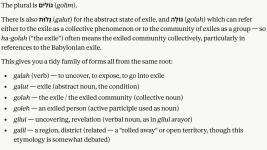
The Hebrew root GLH refers to the concept of "uncovering" (in the sense of exposing the genitals) as well as the concept of "exile" (galut), supposedly because exile is a form of exposure.

Screenshot 2026-07-01 10.50.54 AM.png


Book of Joshua:

Screenshot 2026-07-02 9.29.06 AM.png


After forty years of wandering, the Israelites finally enter the Promised Land. The first thing their leader Joshua does is circumcise them. ("Gibeath Haaraloth" just means "Hill of Foreskins".) To commemorate the event, the site is named "Gilgal" because God has "rolled away" the reproach of Egypt (i.e. their uncircumcised state). The Hebrew root GLL means "to roll away".

So although the official etymology doesn't line up, we have an incredible triple coincidence: God commemorates an act of genital mutilation by naming a place "Gilgal", whereas history associates the cult of castration with a place named Gallus and a people named Galli, a place which was also colonized by unrelated exiles named "Galatians".

I am not convinced by the "roll away" pun. It feels forced to me. What is clear, however, is that the toponym GILGAL is some sort of wordplay.

My idea is simple. It goes as follows:

- The original meaning of the phoneme GAL is "exile" and it comes from Hebrew
- The original "Jews" practiced circumcision AND castration as different initiatic degrees
- They called themselves exiles, which in Hebrew is "goleh" and in Jewish Aramaic is "galeh" (!)
- I'm not sure if they were real exiles in the sense that they had been kicked out of Jerusalem (Rome) after the fall of the Temple, or if "exile" meant something more like "colonizer" to them
- The "Galateans" were therefore not "Celtic tribes", but Jewish "exiles"
- They named the places they settled after the Biblical Gilgal, since this toponym commemorates the end of exile
- This gives us the meaning of "region"
- They set up their Temple system wherever they went, part of which included castrating and circumcising local "recruits", a practice which would eventually ramify to the Mamluk phenomenon discussed above
- The famous "Phrygian cap" is nothing but an early version of the Jewish head covering
- If I may say so, the Phrygian cap looks like...a foreskin

There is another substrate as well to the Exodus story. The wandering of the Israelites is a metaphor for the process of esoteric initiation. The "entry into the promised land" after "forty years of wandering" must have originated as some kind of initiatic narrative that was only later literalized (isn't forty the age at which rabbis are eligible to be initiated into Kabbala?). Was the Joshua story read at whatever degree of initiation corresponded to the rite of circumcision? In "Argonauts of the Desert", Philippe Wajdenbaum shows beyond a shadow of a doubt that the Jason story and the Exodus story were constructed using the same Neoplatonic source material.

The "Promised Land" is not Israel, or France, or South Africa, or the Americas. The Promised Land is...the whole world. It is wherever a Jew sets up a temple.

In the same vein, the Gallus River, which supposedly gave the Galli their name, has a heavenly counterpart in the Neoplatonic tradition and is referred to by the Emperor Julian and Sallustius. This "heavenly river" is associated with the "changeable body"...hmmm.

From the Lane book:
Screenshot 2026-07-02 11.33.04 AM.png


The following passage lines up beautifully with Joshua:

Screenshot 2026-07-02 11.33.51 AM.png


So in the Neoplatonic tradition the Gallus River is the place where Attis castrated himself, and in the crypto-Neoplatonic Old Testament Gilgal is the place where Joshua circumcised his men.

A.T. Fear's text in the Lane book, Cybele and Christ, shows the extent to which Christ/Mary are a watered-down version of Attis/Cybele, which supports Flavio Barbiero's thesis (= the Flavian Emperors promulgated a PG-rated version of their Temple religion for the helots and kept doing the juicy stuff in private).

- Is there a connection here with the famous Golem of Jewish lore, which I interpret as a mythical stand-in for a castrated and mind-controlled Goulam soldier? (Goulam is the singular of Ghilman.)

BONUS: We find a similar theme in the myth of Pygmalion and GALatea.

Screenshot 2026-07-02 10.05.52 AM.png


I believe that this is an encrypted reference to the Templar practice of creating "artificial women" through castration. I mentioned the Miss Universe pageant before. As Mr. E shows, these pageants exist to train Galli how to become indistinguishable from women (check out his Erika Kirk videos). Presumably some of the contestants are real women included to test the Galli. The moment the Gallus is crowned Miss Whatever must be an important initiatic milestone. Imagine the emotion. There you are, on stage, in a bikini or a revealing gown, probably scared to death that someone will stand up and shout, "She's a he!" The judges know you're a man, of course. But no one else does, including many of the contestants even. At the moment you are crowned, you realize: the hypnosis is really functioning. The men in the audience want to go to bed with me. The women in the audience want to be me. Millions are watching, but none see. I am a GODDESS! Imagine the narcissistic rush. What better training for duping and mocking the masses? Perhaps the aristocratic ritual of the cotillion is another version of this practice. This would make Trump a Pygmalion figure (he was a king, after all).

BONUS TWO: I once attended a naturalization ceremony in France. There was a bizarre moment when a bust of Marianne was unveiled on stage and the prefect in charge of the ceremony explained that she was the symbol of France. All of the newly-minted French citizens were then invited to come on stage one by one and have their photos taken next to the statue (!). This now strikes me as a purely masonic ritual, whether or not any of the people participating in it realized it.
 

Attachments

  • Screenshot 2026-07-01 11.01.13 AM.png
    Screenshot 2026-07-01 11.01.13 AM.png
    149.3 KB · Views: 4
Last edited:
Tips
Tips
Please respect our Posting Rules.
Back
Top