SH Archive (D)Turkey: 13th Century Chapel, Mud Flood and Renamed Cities

SH.org OP Username
KorbenDallas
SH.org OP Date
2019-10-22 06:52:31
SH.org Reaction Score
2
SH.org Reply Count
5

KD Archive

Not actually KorbenDallas
Active Member
Joined
Sep 22, 2020
Messages
4,691
Reaction score
1,500
If these musical chairs with various city names in Turkey are of any indication, we will never be able figure out what was where, and when. At first, I came across a 13th century buried chapel, which was recently excavated in Turkey. While trying to establish what older city its location could be attributed to, it became obvious, that TPTB had their way with city/town names. Same names jump all over the place. Eventually, we ended up with what we have today, but what we have does not necessarily match with what we used to have.
  • City/Town Name was moved to a different location
  • City/Town was renamed
  • City/Town was renamed and moved to a different location
But first things first... In 2009 archaeologists used a ground-penetrating radar to detect some underground anomalies. The shape and size of those anomalies suggested that those were walls and buildings.

Buried Chapel
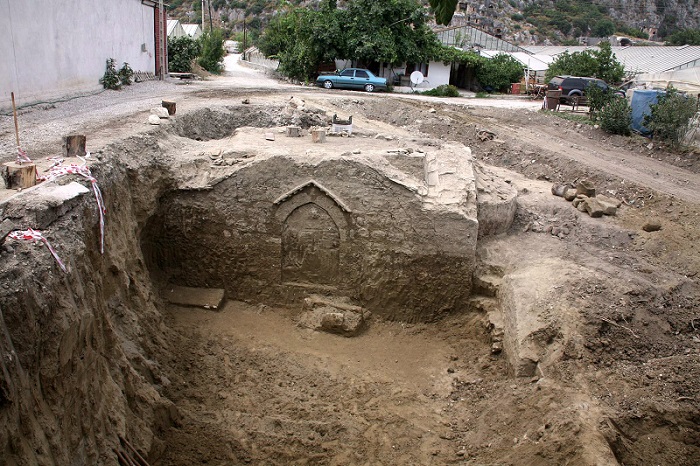
Archaeologists first detected the ancient city in 2009 using ground-penetrating radar that revealed anomalies whose shape and size suggested walls and buildings. Over the next two years they excavated a small, stunning 13th-century chapel sealed in an uncanny state of preservation. Carved out of one wall is a cross that, when sunlit, beams its shape onto the altar. Inside is a vibrant fresco that is highly unusual for Turkey.

myra_chapel_primary-1.jpeg
The chapel’s structural integrity suggests that Myra may be largely intact underground. “This means we can find the original city, like Pompeii,” said Nevzat Cevik, an archaeologist at Akdeniz University who is director of the excavations at Myra, beneath the modern town of Demre.
myra_chapel_primary-3.jpg

But Myra attracted invaders, too. Arabs attacked in the 7th and 9th centuries. In the 11th, Seljuk Turks seized the city, and the bones thought to be those of Nicholas were stolen away to Bari, in southern Italy, by merchants who claimed to have been sent by the pope.
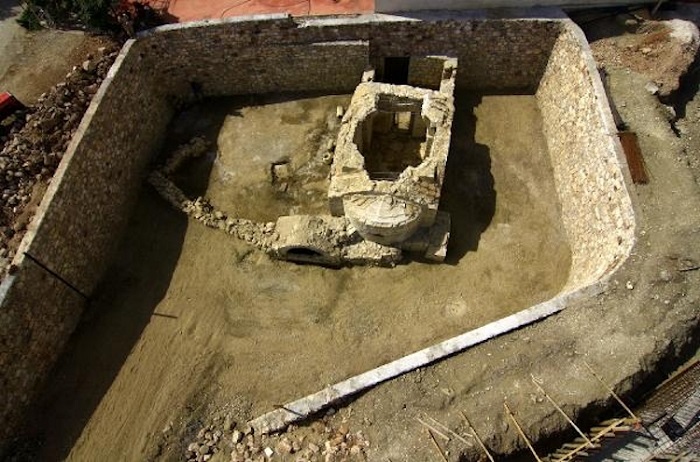
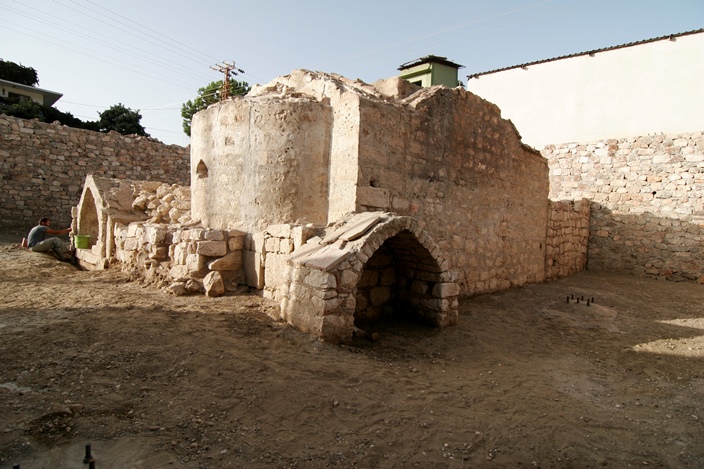
  • By the 13th century, Myra was largely abandoned. Yet someone built the small chapel using stones recycled from buildings and tombs.
  • Decades later, several seasons of heavy rain appear to have sealed Myra's fate. The chapel provides evidence of Myra's swift entombment. If the sediment had built up gradually, the upper portions should show more damage; instead, except for the roof's dome, at the surface, its preservation is consistent from bottom to top.
myra-chapel-3.jpg

Sources:
kd_separator.jpg
KD: This thread was sitting in this semi-started condition for about a week already. I guess I'm just lazy to do all the map related stuff. Here is in a nutshell on this city of Myra:
  • Myra was an ancient Greek, then Roman Greek, then Byzantine Greek, then Ottoman Greek town in Lycia, which became the small Turkish town of Kale, renamed Demre in 2005, in the present-day Antalya Province of Turkey.
    • The ancient Greek citizens worshipped Artemis Eleutheria, who was the protective goddess of the town.
    • In 1923 its Greek inhabitants had been required to leave by the Population exchange between Greece and Turkey, at which time its church (KD: institution?) was finally abandoned.
    • It was founded on the river Myros in the fertile alluvial plain between Alaca Dağ, the Massikytos range and the Aegean Sea.
  • Demre is a town and its surrounding district in the Antalya Province on the Mediterranean coast of Turkey, named after the river Demre.
    • Demre is the Lycian town of Myra, the home of Saint Nicholas of Myra, the historical man later developed into the figure of Santa Claus.
    • The district was known as Kale until it was renamed in 2005.
    • A substantial Christian community of Greeks lived in Demre (Myra) until the 1920s when they migrated to Greece as part of the 1923 population exchange between Greece and Turkey agreement.
    • The abandoned Greek villages in the region are a striking reminder of this exodus.
    • Abandoned Greek houses can still be seen at Demre and the regions of Kalkan, Kaş and Kaya which is a Greek ghost town.
    • A small population of Turkish farmers moved into the region when the Greeks migrated to Greece.
As you can see, its pretty confusing, but luckily we have some KISS info:
  • By the 13th century, Myra was largely abandoned. Yet someone built the small chapel using stones recycled from buildings and tombs.
  • Decades later, several seasons of heavy rain appear to have sealed Myra's fate. The chapel provides evidence of Myra's swift entombment. If the sediment had built up gradually, the upper portions should show more damage; instead, except for the roof's dome, at the surface, its preservation is consistent from bottom to top.
Maps
1665

1665_Myra.jpg
Source

1686
1686_Myra.jpg
Source

1822
1822_Myra.jpg
Source

1707 Ruins
1707_Myra.jpg
Source
kd_separator.jpg
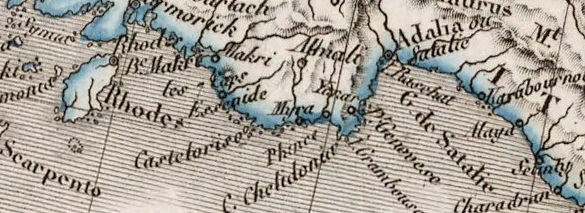
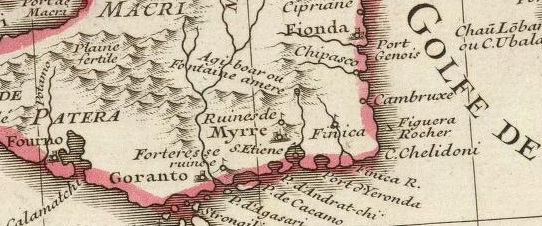
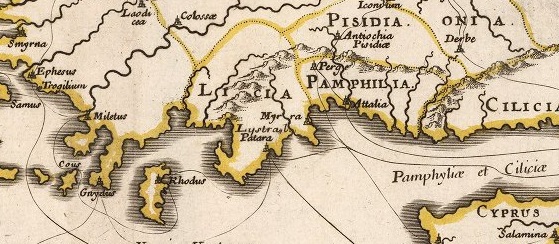
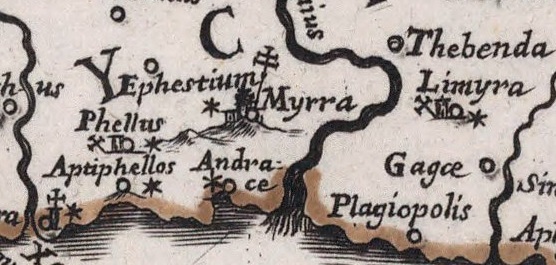
Here are most of the maps of Turkey. It appears that we have a contradiction between texts and maps. I do not see this Myra mentioned on any maps prior to about 1650s. I also see that Myra/Myrra jumps from place to place,and somehow in 1707 ends up in Ruins. These dates are still a far cry from the 12th century when it was supposed to get buried by all the official mud.

At the same time our Myra appears to be present in the Bible:
  • Myra, a city of the ancient country of Lycia about 2 1/2 miles from the coast. Here, according to Acts 27:6, Paul found a grain ship from Alexandria. The city stood upon a hill formed by the openings of two valleys.
  • At an early period Myra was of less importance than was the neighboring city Patara, yet later it became a prominent port for ships from Egypt and Cyprus, and Theodosius II made it the capital of the province.
  • It was also famed as the seat of worship of an Asiatic deity whose name is no longer known.
  • Nicholas, a bishop and the patron saint of sailors, is said to have been buried in a church on the road between Myra and Andraki, the port.
  • Here an Arab fleet was destroyed in 807.
  • In 808 Haroun al-Rashid, the renowned kalif of Bagdad, took the city, and here Saewulf landed on his return from Jerusalem.
  • Dembre is the modern name of the ruins of Myra, which are among the most imposing in that part of Asia Minor.
  • The elaborate details of the decoration of theater are unusually well preserved, and the rock-hewn tombs about the city bear many bas-reliefs and inscriptions of interest.
  • On the road to Andraki the monastery of Nicholas may still be seen.
Funny, that the city of Patara is present on the maps prior to 1650s, and then Myra pops up. Kind of like the Bible says, but much much later.

1750 - BBL
old_myra.jpg
Source
Eventually everything comes down to some real probability of the Church of Myra actually being the same old factory of Artemis.
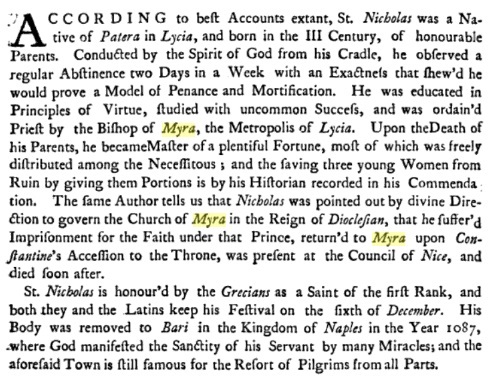
  • The town (Myra) had a market place, temples, a town hall, a gymnasium, and a bathhouse that was built by the Romans in the third century CE. The temple of Artemis Eleuthera was called the most splendid building of Lycia. And of course, it had a well-known harbor.
  • Myra was destroyed in 141 CE, but rebuilt by a rich man named Opramoas of Rhodiapolis, who is known to have paid for the restoration of the gymnasium and the shrine of Artemis.
  • In Antiquity, however, the town was especially famous for its temple of Artemis, which was shown on the urban coins.
  • According to a medieval legend, bishop Nicholas of Myra destroyed the temple of Artemis in Ephesus; the truth may be that he managed to get the temple of the goddess in his own town closed.
  • KD: In my opinion all these events took place much later. Meaning around 1650s +/-.
1702
old_Myra-3.jpg
Source
And for those interested in the musical chair cities, you might want to investigate how far TPTB moved Didyma. Every honest historian should be ashamed with the Didyma thing alone.
Note: This OP was recovered from the Sh.org archive.
Note: Archived Sh.org replies to this OP are included in this thread.
 
Note: This post was recovered from the Sh.org archive.
Username: Huaqero
Date: 2019-10-22 17:07:47
Reaction Score: 5
These 'musical chairs' of names seem more and more to be a valid case.
(I even expressed that in an exaggerated way somewhere here asking "How do we even know that Rome is 'Rome'?")

Acc. to wiki on the Aegean Sea,
"The current coastline dates back to about 4000 BC. Before that time, at the peak of the last ice age (about 18,000 years ago) sea levels everywhere were 130 meters lower, and there were large well-watered coastal plains instead of much of the northern Aegean..."

If we accept that, 4000BC is pretty recent for such a drastic change in the topography and a sea level variation of 130 meters can cover a huge number of formerly habitable places. People could actually walk from 'island' to 'island', since they were connected, until the sea level rise transformed some tops into islands. No need for risky seafaring, too. Take into consideration the timeline and dating discrepancies and one could validly imagine mythical cities existing under the waters of the Aegean. And explain statues of ... lions in Macedonia.

I will divert a bit from Myra, but not from the subject. While taking a google map/streetview look at an ancient site in central Greece, of which I had not heard before, ancient 'Plevrona', I thought, how on earth did they know that THIS was 'Plevrona' and not the ruins some kilometers to the east. Locals only knew it with the name 'Gyftokastro / Gypsy Castle', which shows how detached they were from its origins.

Well, maybe, naming and renaming places was what all those cartographers and travellers of the early 19th c. were doing in the Balkans and Anatolia, on a mission from secret societies of the north.
They would arrive into a post-cataclysmic scene (not necessarily a recent one) and ask the help of the locals to locate ruins.
Then, Iliad on one hand, empty map on the other and they named, renamed and registered the ruins with their new names.

So, 'Gyftocastro' becomes 'Plevrona' because the Iliad mentions 5 cities in the area and our traveller picks this one name for it.
In the case of Myra, they make a little mess, lol.

The reason for doing this? Continuity of the historical narrative.
Since ALL mentioned cities in the Iliad can be 'found' above water and on maps,
you can now forget the flood and the sunken cities...!


Back to Myra, my maternal ancestors were Greek Anatolians from those places in the south, who came came to Greece in 1923 after the population exchange agreement. Grandmother from Seleucia (Silifke) and grandfather from a town called 'Mara'. I still cannot identify 'Mara'. I guess it is either Myra or Kahraman Maras/ Kahramanmaras. A turkish friend suggested that it was a place now called Sultanbeyli but my research on sources of greek places there could not verify that. Grandad lived too young there to remember, just heard the grown ups calling it 'Mara'...
 
Note: This post was recovered from the Sh.org archive.
Username: EinarK
Date: 2019-10-25 06:35:50
Reaction Score: 1
The Magdalena Flood
The Magdalene Floods of 1342-43 and the Black Death
“In this Summer, there was a great inundation of the waters throughout our zone, this was not caused by rainfall but it seemed that the waters gushed out from everywhere, even out of the peaks of mountains (…) and over the walls of the city of Cologne they traversed with boats. (…) the rivers Danube, Rheine, and Main carried away towers, very strong city walls, bridges, houses and the fortification walls of the city. And the portals of heavens were opened, and rain fell onto Earth like in the 600th year of Noah (…) it happened in Wurzburg, that the river Main crushed the bridge with its might and forced many to leave their homes”. (Curt Weikinn)
The destruction of this bridge is also confirmed in the “Chronicles of the city of Wurzburg”. In some cities, water levels were up to 10 meters above normal. Churches were inundated up to the roof.
[…] alongside all great rivers of Europe and the small tributaries, the Inundation destroyed towns, people, trees, fields and meadows completely, and carried all to the lower parts of the stream.” (Johannes von Viktring).
Traversing over the city walls of Cologne in a boat? That used to appear to the historians of the last centuries as a gross exaggeration, to say the least. But the archeological and geological data suggests that this could have been indeed possible.
To make matters worse, land mismanagement had contributed to the extreme devastation of soil erosion, forests had previously been cut down for agricultural land clearing and wood use. This had gone along with the enormous population growth in the Medieval Climate optimum. At the height of this warm period, forests were reduced to about 10 to 15 % of the total land surface of Germany, today forests again cover over 30 % of the land. This weakened soil was carried away more easily, but this was only a secondary factor, considering the never again reached catastrophe.
The water damage to the soil was almost incomprehensible, vast amounts of agricultural soil was washed away, an estimated 13 billion tons of soil were lost in a few days. More than is usually eroded away in one millennium. Bork: “One third of the entire soil erosion of the last 1500 years took place in this weak. Many villages lost more than half of their agricultural land.”
As survivors took refuge in elevated areas, in many cases farmers did not return, farmland was abandoned permanently and reclaimed by forests until today.

Black death 1348
Black Death and Abrupt Earth Changes in the 14th century

The most consistent metaphor for plague was the arrow.
It was not by accident that Italian notary Gabriele de’ Mussis described plague as “sharp arrows of sudden death”: or that Flemish Abbot Gilles li Muisis celebrated the heaven-sent arrows that decimated the Mongol Tartars before striking Europe. Some Muslin poets also pictured plague as jinn-fired arrows.

The Umbrian physician Gentile da Foligna (c. 1275-1348) suggested a celestial connection to the plague and claimed that among sin and retribution, ‘poisonous darts of God’ (as first described by Homer) lay behind the plague.
Already seven centuries earlier, in the Justinian plague in 590 CE, Honorius of Autun described the Justinian Plague as “arrows falling from heaven.”
If you have seen a large shooting star or small fireball streaking across the night sky, you might get the idea that someone who doesn’t know what it is, may call it an arrow from heaven or a dragon even.
Fig. 2 Black Death illustrated as an calamity involving arrows being fired by mystical beings (angels) from the sky (lightning?) and liquids being poured down by (God?) Image: The Black Death ppt video online download

Fig. 3 ”The notion of arrows representing a plague can be seen in a curious wall painting dating from 1355, in Lavaudieu, Haute Loire, in the Auvergne region of France. Image from: Mormando, F. 2007: Piety and Plague: From Byzantium to the Baroque. Thomas Truman State Univ. Press.
 
Tips
Tips
Please respect our Posting Rules.
Back
Top