

- Joined
- Mar 19, 2021
- Messages
- 131
- Reaction score
- 309
Beyond the Virgin Birth: Cesarean Section as a Key to Understanding Nativity and other Parallel Accounts
Abstract : This analysis examines illustrations and narratives surrounding birth of Jesus, Muhammad, Ghazan, Augustus, and Rustam through the lens of the theory that Jesus' birth involved a Cesarean Section (C/S). By integrating conventional historical and religious viewpoints with alternative theories like Fomenko's New Chronology, the study aims to uncover anomalies, connections, and recurring motifs that challenge traditional interpretations. Key findings include the influence of Royal Christianity on other narratives and the recurring theme of C/S birth reflected in historical illustrations and texts. Symbols such as fire, the shepherds and the Magi as well as special drinks offered to mothers are identified and interpreted. In addition, potential surgical interpretations of birth events are discussed. The research also questions the origins and authenticity of the manuscripts, highlighting uncertainties about their provenance and journey to Western collectors.
Keywords : Jesus, Cesarean Section, New Chronology , Ilkhanids
Introduction
This analysis explores illustrations and narratives surrounding births of various figures like Jesus, Muhammad, Ghazan, Augustus, and Rustam. Several shared symbolic elements appear, particularly when viewed through the lens of Fomenko's New Chronology and the theory of Jesus's Cesarean Section birth.
Though their artistic representations are within the Ilkhanid dynasty of Persia, the figures themselves belong to distinct religious and historical contexts. This complexity may initially challenge the readers, as they might encounter seemingly unrelated narratives and images. However, with careful examination, the connections are expected to become clearer over time.
Historical Background
In this section I will cover the official views on some related topics. Four illustrations belong to Ilkhanid era, thus necessitating a discussion of the political and artistic context of the Ilkhanid dynasty.
Ilkhanid Dynasty: Political and Religious aspects
The Ilkhanid dynasty, established by Genghis Khan's grandson Hulegu Khan, ruled Iran from 1256 to 1335. During the reign of Mahmud Ghazan (1295-1304), the dynasty lost contact with the remaining Mongol chieftains in China and embraced Sunni Islam. Ghazan's reign marked a period of Iranian cultural renaissance, with scholars like Rashid al-Din flourishing under his patronage. Rashid al-Din, a Persian statesman and historian, authored the universal history known as Jamiʿ al-Tawarikh (“Collector of Chronicles”). He was born into a Jewish family but later converted to Islam.
Ghazan's brother, Öljeitü, converted to Shia Islam, causing unrest. However, his successor, Abu Said, reconverted to Sunni Islam. Without an heir, Abu Said's death led to the dynasty's fragmentation as various princes ruled parts of its territory until 1353. link
Ilkhanid Iran: Art
The Ilkhanid period is known for its artistic achievements, particularly in manuscript illumination. In fact ,the art of Persian manuscript illustration experienced its first flowering in the Ilkhanid capital, Tabriz, during the early fourteenth century. link. The Jamiʿ al-Tawarikh (Compendium of Chronicles) and other texts produced during this time featured elaborate illustrations that reflected the political narratives and cultural exchanges of the era.
The Ilkhanid initially practiced religious tolerance, which affected their patronage of the arts and architecture. However, this changed after Ghazan's conversion to Islam in 1295, leading to curtailment of other religions. Despite this shift, Ilkhanid art still reflected diverse sectarian trends active in the early fourteenth century.
- Christianity in Ilkhanid Art: Various forms of Christianity, including Jacobite, Nestorian, and Armenian Christianity, were present in Ilkhanid Iran. Armenian artists who trained at monasteries incorporated typical Ilkhanid techniques and styles into their book painting.
- Islam in Ilkhanid Art: With Ghazan's conversion to Islam, the patronage of religious art became focused on spreading Islam. Depictions of Muhammad became popular, despite conservative Muslims rejecting such representations today.
- Judaism in Ilkhanid Iran: Jewish communities were significant in Ilkhanid Iran. The vizier Rashid al-Din, a Jewish convert to Islam, had an interest in Judaism, and his Compendium of Chronicles contains a history of the Jews.
- Ilkhanate painting combined artistic elements from Chinese, Iranian, Byzantine, and Arabic civilizations.
Illustrated books were used as a means of legitimizing the Ilkhanid domination over Iran. The Shahnameh (Book of Kings) and Jamiʿ al-Tawarikh (Compendium of Chronicles) were prominent examples of manuscripts employed for this purpose. The royal lineage was a central theme, with Mongol court scenes reinforcing Ghazan's Mongol descent and presenting him as a sovereign with royal glory link
Illustrations
Initially, the manuscript is examined. Following this, I will present each painting along with the available historical and academic perspectives
- Birth of the Prophet Muhammad in Jami' al-Tawarikh (Compendium of Chronicles)
- The birth scene of Ghazan Khan in Diez Album.
- Cesarean delivery of Caesar in the Chronology of Ancient Nations.
- Rustam birth via C/S in Shahname.
- Nativity of Jesus.
Jamiʿ al-Tawarikh (Compendium of Chronicles): Birth of the Prophet Muhammad
The Compendium of Chronicles, written by Rashid al-Din Hamadani in 1314-1315 A.D. is considered the first comprehensive world history. Commissioned by Ilkhan Ghazan to record Mongol history, it expanded under Öljeitü to cover a wide range of cultures and events. Rashid al-Din established a production center in Tabriz to create annual copies in Persian and Arabic for distribution. The work's significance lies in its global perspective, cultural legacy, and artistic value, featuring diverse historiographies and lavish illustrations. The surviving manuscripts are fragmented and divided into several collections. The oldest known copy is an Arabic version split between the Edinburgh University Library and the Khalili Collection of Islamic Art. The manuscripts' journey involved movements through Heart, Mughal India, and eventual acquisition by British entities like the East India Company.
The Edinburgh Folios was in the Indian prince Farzada Kuli's library until acquired by Colonel John Baillie of Leys of the East India Company. Finally , it was bequeathed to Major General Thomas Gordon in 1841, loaned to the British Museum and Library, and acquired by the Khalili Collection. link
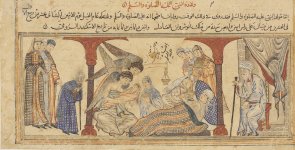
The depiction of Muhammad's birth appears in the Jami' al-Tawarikh (Figure 1). Here is an academic viewpoint. link- It adapts the standard Byzantine composition for the Nativity of Jesus.
- The painting is divided by columns into three panels.
- In the middle panel, there is Amina's picture, according to her quote, "the heavenly women helped her during childbirth and gave her a drink." Amina is covered with a checkered cloth.
- An angel facing Amina is holding the baby in her arms and another angel, holding a censer, looks at the newborn.
- Abd al-Muttalib, the grandfather of the Prophet is sitting and he has a simple cane in his hand. In the left part, an old woman with three women have come to congratulate.
- "The blessed birth of the king of the universe, peace be upon him" is the Persian phrase in the middle panel.
- "Finding no previous painting of the Prophet’s birth, It is believed that this painting is influenced by Nativity scene paintings ( notably from a Syriac manuscript from the Vatican Library ) that were provided as models for painters working at Tabriz’s workshops. Joseph is replaced by the Prophet’s grandfather, ʿAbd al-Muttalib, who sits on the right. On the other side, three standing women are painted instead of the Magi.
- There are five ladies in the middle panel—midwives and maids—one of them, the first one from the right, holds a basin.
Figure 1 : Birth of the Prophet Muhammad. It has three panel similar to a triptych. It depicts Amina lying down , covered by a cloth. She is offered a drink. There are angels and visitors.
Diez Album: Birth Scene of Ghazan Khan
"Art historians attribute these artworks to the Rabʿ-i Rashidi workshops around 1320, based on stylistic features. Identifying the subject of each image and reconstructing the mutilated manuscript is difficult because the images were cut from their original setting and pasted into an album folio according to their size and color palette.
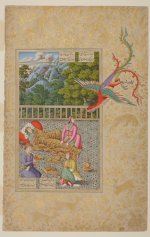
Key elements of this painting, allegedly from Tarikh-i Mubarak-i Ghazani (Tabriz, circa 1320) (Figure 2). It depicts : link
- The scene features a leaning woman, assumed to be Ghazan’s mother, resting on a golden pillow next to an infant wrapped in red cloth.
- Three noble women, distinguished by their headdresses, red robes and golden earrings, are seated in the middle.
- Three maids are present too, one standing behind the mother with a feathered hat, another seated on the floor, and the third holding a thurible (censer).
- On the right, there are three astrologers with astrolabes indicating the child's fate.
- The Ghazan birth scene shares similarities with Nativity scenes. In Gazan’s birth scene, there are also three men, the astronomers. While there is no other man, this unusual presence could be related to the Magi in the number and their functions in both narratives that link them to the predictions of the infant’s future."
- Specifically, a Syriac manuscript from the Vatican Library (Figure 6 ), contains scenes of the Magi visiting Mary and the newborn Christ that resemble elements in Ghazan’s birth scene.
- This scene underscores Ghazan’s royal lineage and divine endorsement, drawing prophet-like parallels.
- Experts have also compared this birth scene with that of the Cesarean delivery of Julius Caesar in the historical text "the Chronology of Ancient Nations "by Biruni.
Figure 2 : Birth scene of Ghazan. The mother is covered by a cloth. There are three astrologers with astrolabes
The Chronology of Ancient Nations : Cesarean Delivery of Caesar
- Edinburgh copy, an Ilkhanid codex allegedly by Ibn al-Kutbi from AH 707 (AD 1307–1308). This manuscript was likely produced in northwestern Iran or northern Iraq.
- The Paris manuscript is an undated, anonymous Ottoman copy of the Edinburgh version.
The next painting is from this book (Figure 3) . It depicts :
- The birth of Augustus, the first Roman Emperor, via a primitive form of Caesarean Section.
- According to Biruni, he was delivered by this method after his mother died during labor.
- It shows how a doctor removes the infant head-first from an incision in Atia Balba's abdomen
- Three other figures look on from the side. link
- The painting shows the mother lying nude and lifeless while male surgeons draw out her baby.
- The clinical quality of the Biruni image suggests that its prototype was taken from a scientific text or medical handbook, a context in which the representation of nudity was considered acceptable.
- The surgeon and the attendants have halos around their heads.
Figure 3 : Atia is naked and dead.
Shahnameh: Illustrated Versions : Birth of Rustam
This scene has been popular with artists and copyists. Here are a few examples. Since I couldn't find sources describing the images, I will provide some details myself.
The first one ( Figure 4 A) is from Diez Album. Illustration from a Shahname (Diez Album). Probably from Isfahan, Ilkhanid period, around 1335. link
- Here is the Simorgh, resembling a rooster, along with a brazier, three maids, and a worried lady on the right.
Figure 4 A : Rustam's birth. Look at the brazier
- You can see Rudabeh, three individuals , and the Simorgh.
- There is a brazier and a basin on the ground.
- In this scene, Rudabeh appears nude and lifeless, reflecting her state under anesthesia according to the Shahnameh.
- One surgeon and four ladies are present, with one of the ladies assisting the surgeon.
- There is a brazier and a basin on the ground.
Figure 4 C : Rudabeh is naked but alive and unconscious
The Syriac lectionary Vatican Syr. 559 : Nativity Scene
The Syriac lectionary Vatican Syr. 559 was created for the altar at the Monastery of Mar Mattai near Mosul. The manuscript is one of the most richly and lavishly decorated Syriac manuscripts. There is some dispute about the reading of the date, some scholars arguing for 1220, while others argue for 1260. The style of the manuscript's miniatures is closely related to contemporary illustrated Islamic manuscripts.The Vatican Library, where it is currently held, was formally established in 1475, though its origins are much older. It holds 75,000 codices and 1.6 million printed books and is considered one of the oldest and most significant collections of historical texts. link , link , link , link
The Nativity scene ( Figure 5) includes:
- Several scenes related to the infant Christ were painted in a single frame.
- In the upper part, the Magi visit the mother , half-risen Mary , and the child.
- Mary gazes at the three men standing on the left.
- The newborn lies beside Mary on a golden bed .
- There are several angels
- In this scene, we see two babies: one on the bed and the other being washed in a basin. Scholars believe that this dual representation—Jesus being bathed by midwives and another image of Jesus lying next to Mary—incorporates more details from the Nativity narratives.
- There are other visitors whose details have been erased, and they might be shepherds. The figures have halos around their heads.
Figure 5 : There are two newborns. Aren't they twin brothers?
Birth Narratives
The details and signs surrounding the Birth of Prophet Muhammad
- Amina, Muhammad’s mother, saw the wing of a white bird drawn over her heart, which dispelled her fear and anxiety.
- She was given a white drink and enveloped in light.
- Tall women spoke to Amina, but their speech was unlike that of humans and men stood in the sky holding cups of water.
- A white silk cloth covered the sky, and a voice instructed to take Muhammad from the most honorable people, indicating his noble lineage and divine selection.
- Muhammad was born while raising his fingers to the sky. A white cloud descended from the sky and enveloped him
- Three keys made of new pearls were with him, and Hatif said the keys of help, mercy, and prophethood are always with him.
- Three people whose faces shone like the sun appeared; one had a silver cup with musk, another had a four-cornered emerald bowl with a white pearl in each corner, and the third had a white silk cloth.
- The angel Ridwan, the guardian of Paradise, washed the water from the same cup seven times and sealed Muhammad's shoulder with it, and put his saliva in the blessed mouth of the child and made him speak.
- A light shone from Muhammad’s head to the sky, and Amina saw the palaces of Syria and beautiful birds, symbolizing the illumination of the world through his birth. Muhammad's face shone like the full moon.
- Aminah, the Prophet's mother, experienced supernatural events during her pregnancy . She reported seeing a light emanating from her house, illuminating everything and seeing stars drawing near her. Aminah dreamed of a light coming forth from her. Her pregnancy was described as easier than any other, and supernatural details were attributed to her. The birth was remarkably easy, with the infant born clean, with a cut umbilical cord, and circumcised.
According to Ibn Hesham:
The Messenger of Allah related this story about himself after his Prophetic mission: "When my mother became pregnant of me, she saw as if light came out of her and made her see the palaces of Sham.
While I was with my foster-brother grazing some animals belonging to us behind our dwelling places, two men dressed in white and carrying a dish of gold filled with ice, came to me. They laid me down, split open my belly, extracted my heart which they split open too, and took out a black blood clot and threw it. Then, they washed my heart and abdomen with that ice until they cleaned them. One of them said to the other: “Weigh him by ten of his ummah.” He weighed me by them, and I indeed outweighed them." link
Ghazan's khan Birth according to Tarikh e Mubarak e Ghazani
"Tarikh e Mubarak e Ghazani", which translates to "The Blessed History of Ghazan", refers to a historical chronicle that primarily details the life and reign of Mongol ruler Ghazan Khan. It was written by Rashid al-Din as part of his larger work, the Compendium of Chronicles.
"Ghazan Khan's birth on Friday, the 29th of Rabi‘ I 670 [November 4, 1271] in Abuskun in Mazandaran was highly anticipated. All the expert astrologers who were in attendance took celestial readings and cast horoscopes with all care. Finding his natal extremely auspicious, they all said of one accord, I have looked into your ascendant and have seen that your estates will be a hundred thousand souls.’ ” All agreed that he would be an extremely magnificent and awe-inspiring ruler, and unanimously they cried, “ ‘Lofty are his ascendant and his luck ;his throne will be raised to the shining sun. After Ghazan Khan's birth, he was given to a wet nurse of good character. link
I found no other sources describing Ghazan's birth.
Augustus Birth
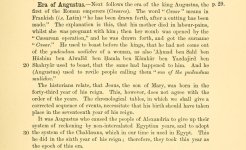
According to Biruni :"Era of Augustus. — Next follows the era of King Augustus, the first of the Roman emperors (Caesares). The word "Caesar" means in Frankish (i.e., Latin) "he has been drawn forth after a cutting has been made." The explanation is this: His mother died in labor pains while she was pregnant with him; then her womb was opened by the "Caesarean operation," and he was drawn forth, receiving the surname "Caesar." He used to boast before the kings that he had not come out of the pudendum muliebre ( external genitalia) of a woman, just as Ahmad ben Sahl …. used to boast that the same had happened to him. And he (Augustus) used to revile people, calling them "sons of the pudendum muliebre." link
However, other sources believe that there is no historical evidence suggesting Augustus was born via a Caesarean Section. The myth surrounding the origin of the term "Caesarean" is often mistakenly linked to Julius Caesar, but this too is not supported by historical evidence. Augustus was born on September 23, 63 BC, in Rome, and there is no mention of a Caesarean Section in any of the historical accounts of his birth, such as those by Suetonius or other Roman historians. link
Rudabeh's Labor in Giving Birth to Rustam
This is a famous story in Firdausi's Shahnameh. It describes the C/S in full detail. Probably this is the most vivid parallel of C/S birth of Jesus found by Dr. Fomenko. link
- Rudabeh's pregnancy was extremely difficult, with her describing the sensation of carrying "a mass of iron". She endures this until she can no longer rest or sleep and eventually faints.
- Concerned for Rudabeh's life, Zal remembers the Simorgh's feather and burns it in a brazier to summon the mythical bird. The Simorgh appears and explains that Rudabeh will give birth to a son destined for fame.
- The Simorgh provides specific instructions for the delivery. A skilled priest is called to assist, and he makes Rudabeh drunk with wine.
- Rudabeh under the influence of the wine falls into a death like sleep. Then the priest cuts open her side and turns the baby's head toward the opening. The baby is brought forth without causing Rudabeh pain, which is described as a wonder.
- After the delivery, Rudabeh sleeps for a day and night. Her wound is sewn up, and the scar is massaged with a special mixture described by the Simorgh. After a day and night she wakes up from sleep.
Birth of Jesus based on Christian Tradition
The canonical Gospels of Matthew and Luke provide the basic framework for the Nativity story, while apocryphal texts expand upon these narratives with details, legends, and theological interpretations. Here is a summary: link
- Both Matthew and Luke state that Jesus was born in Bethlehem. Luke adds the infant was laid in a manger. The Protevangelion of James, an apocryphal text, describes the birth in a cave.
- The birth of Jesus is associated with a bright light that fills the cave.
- Apocryphal texts assert Jesus's birth was painless, with no bloodshed, emphasizing Mary’s virginity remained intact after the birth. These accounts underline Mary’s unique experience compared to other women.
- Visitors present in the Nativity scene include midwives, shepherds, the Magi, and angels as well as some animals. These figures will be discussed in more detail.
Nativity Scene : General Aspects and Evolution
The Nativity scene has evolved significantly in its artistic depictions over time. These depictions are primarily based on the narratives from the Gospels of Matthew and Luke, which have been further elaborated through written, oral, and artistic traditions.
Early depictions were simple, often showing the infant Jesus in a trough or basket, with an ox and an ass present. Over time, Nativity scenes began to integrate other elements such as the Adoration of the Magi and the shepherds. This integration enriched the narrative and added more characters to the scene. Other elements include midwives, the washing of the newborn Jesus.
Nativity Scene : Midwives
Midwives in Nativity scenes, originate from apocryphal sources. Two midwives are depicted assisting with the birth, often shown washing the newborn Jesus. One of the midwives is traditionally named Salome. Her story begins with refusal to accept the possibility of a virgin birth. She hears of Mary's miraculous delivery, but declares that she will not believe it "unless I thrust in my finger, and search the parts of Mary's body". Salome attempts to conduct a physical examination of Mary . However, her actions are met with divine intervention and immediate consequences. In one account, as she reaches out to touch Mary, fire emanates from Mary's womb, burning Salome's hand. Another version states that Salome's hand dries up or withers upon attempting the examination.
In Western depictions midwives gradually declined in prominence due to theological disapproval of the legends. link link
Nativity Scene : Shepherds
The adoration of the shepherds is a common episode in the story of the Nativity of Jesus. A group of shepherds arrives to witness the newborn Christ Child., affirming that they had seen angels singing a hymn at midnight and glorifying and praising God.
"And some shepherds, whose names were Misael, Acheel, Cyriacus, and Stephanus, wondered at the star which had appeared, and affirmed that they had seen angels singing a hymn at midnight, praising and blessing the God of heaven. And when they had lighted a fire, they rejoiced greatly; and there appeared to them the hosts of heaven. Based on other sources one angel of God appears to the shepherds and tells them that a Savior has been born in the city of David, who is Christ link
In art, the adoration of the shepherds is sometimes combined with the adoration of the Magi.
Nativity Scene : Magi
The adoration of the Magi is an important episode in the Nativity of Jesus, where wise men from the East come to Jerusalem because they have seen his star and then travel to Bethlehem to worship the child and give him gifts. Tradition often holds that there were three Magi and that their names were Melchior, Caspar, and Balthasar.
Nativity Scene : Angels
The presence of angels during Jesus's birth highlights the Nativity's divine significance. Key scenes feature an angel or a host announcing His birth to the shepherds, Though less frequent, angels also appear in the Adoration of the Magi, sometimes directing them to Jesus. Many Nativity depictions show angels hovering over the manger.
St. Birgitta of Sweden's Influential Vision of the Nativity
It is said the Nativity scene has evolved significantly in its artistic depictions over time. Studying the details is interesting but beyond the scope of this writing. However, one relevant topic is the vision of Saint Bridget of Sweden (1303–1373) which significantly influenced later images. link The standard image of the Nativity in Western Europe until the 14th century showed the Virgin Mary reclining in bed. Jesus was usually lying in the manger, being adored by the visitors. In the 14th century, however, a new type of Nativity scene began to appear, due in a large part to Birgitta’s vision. The kneeling Virgin and the shining Infant on the ground became part of the visual tradition of the Nativity, persisting in many Nativity scenes to the present day. link
"And when her Son was born, He emerged with a radiant brightness. The Virgin knelt in prayer and adored Him, saying: ‘Welcome, my God, my Lord, and my Son!'" The infant lay on the ground, glowing. The earth seemed to shine as the ox and the ass bowed their heads in reverence." link
In short, a conscious, kneeling Mary appeared in the 14th century instead of a typical reclining Mother.
Birth of Jesus Based on Quran and Islam
The birth of Jesus is described in Surah Maryam (19:22-28). These differ from Christian tradition.
- Mary gives birth in a remote place. In this account, Mary is alone during childbirth, with no mention of Joseph or any visitors (the Magi, shepherds, angels)
- Based on the Quran, Maryam's labor is in the wilderness under a palm tree, where a stream appears .
Discussion
Illustrations
- In general, the birth scenes of Muhammad ( Figure 1) and Ghazan ( Figure 2) are influenced by the Nativity, especially the Syriac Nativity scene (Figure 5). While no direct comparison has been drawn between the Shahnameh illustrations ( Figures 4 )and these images, the birth scene of Rustam from the Diez Album ( Figure 4 A) resembles Ghazan's birth.
- Augustus's birth ( Figure 3) is often viewed differently because his mother is depicted as lifeless and naked. However, in the Turkish translation, Rudabeh ( Figure 4 C) is portrayed as naked and unconscious, resembling Augustus's birth scene. Thus, Atia Balba may not be dead but rather unconscious due to anesthesia.
- In the Prophet's birth scene ( Figure 1), two angels support the mother and the newborn, similar to the Simorgh in Shahnameh. Nativity scenes typically include angels, but they are absent in the birth images of Ghazan and Augustus.
- Most interestingly, the presence of visitors stands out. Three women in the left panel of Muhammad's birth ( Figure 1) have been compared to the Magi. Additionally, five more ladies in the middle panel are most likely midwives. Scholars have noted a similar pattern in Ghazan's scene ( Figure 2). We see three individuals and one surgeon in Augustus's scene ( Figure 3), and three or four individuals surrounding Rudabeh ( Figures 4)
- All depictions of Rustam’s birth( Figures 4) include a brazier. Interestingly, fire is present in Muhammad's and Ghazan's scenes ( Figures 1 and 2) too, in the form of a censor ( thurible ) .While these two illustrations have been compared to Nativity we know that there is no brazier in Nativity scenes.
- While it is reported in the Shahnameh that wine was given to Rudabeh, this detail is not depicted in illustrations. Offering a drink to Amina ( Figures 1) is unique, and does not appear in Nativity scenes.
- I mentioned that four individuals in Augustus's birth scene ( Figures 3)have halos around their heads. similar to the haloed figures in Nativity scenes (Figure 5), reflecting Christian traditions.
- The depiction of Muhammad's birth ( Figures 1)includes a phrase that titles him as "Padishah," meaning king. This contrasts with Islamic traditions, as Muhammad, the founder of Islam, is not titled a king. In Islamic tradition, he is revered as a prophet and messenger of God, rather than a monarch. Regarding other characters, sources suggest that Rashid al-Din attempted to present Ghazan Khan as "Padishah al-Islam," or king of Islam. Augustus is considered the first Caesar, according to Biruni. In Christian tradition, Jesus is referred to as a king.
Manuscripts
This subject requires in-depth discussions but I will keep it brief. It is worth noting how the images and texts made their way into European collections and museums and became recognized in the academic community.
- The Compendium of Chronicles was written in Iran during the early 14th century. Then it was moved to India, where it ended up being acquired by two East India Company agents. Similarly ,the Edinburgh copy of The Chronology of Ancient Nations was composed in Iran in the early 14th century, 300 years after the original work. It then moved to India, and after 450 years, it was acquired through donations from East India Company officials.
- The Shahnameh was completed in 1010 AD . The earliest known illustrated manuscripts date back to around 1300, during the Ilkhanid period. Similarly, Biruni finished The Chronology of Ancient Nations in 1000 AD and it was illustrated in 1307–1308 AD . The Great Mongol Shahnameh has no reliable Information on it.
- What about the Diez Album? Over two centuries ago, a German orientalist took a chaotic collection of illustrations and mutilated manuscripts from Constantinople to Europe. Several scholars successfully identified the subjects of each drawing by comparing them to another books, determining the place and date of production.
- The Syriac Lectionary Vatican Syr. 559 was transferred to Vatican library , with no data provided on how and by whom it was done.
Birth Narratives
Let's first examine the birth narratives of Prophet Muhammad, which share similarities with Christian narratives about Jesus' birth.It's crucial to highlight that the Quran offers a distinctly different account of Jesus's birth.
- Star of Bethlehem: Different descriptions of illumination and light.
- Angel: a white bird drawn on Amina's heart.
- Visitors: tall women; men holding cups and bringing good news.
- The Magi : three shining men with gifts to offer.
- The newborn was washed.
- Amina was offered a white drink
- Indirect references to Prophet's shoulder sealing and abdomen splitting.
Interestingly, Western sources do not acknowledge Augustus's Cesarean Section birth, and Biruni erroneously confuses him with Julius Caesar. Oddly, scholars reject the old reports of the Cesarean Section birth of Julius Caesar, stating, "The story that he was delivered by Cesarean Section is a myth." The best argument against Caesar being born by Cesarean Section is that his mother, Aurelia, lived for almost fifty years after his birth. link
While Biruni reports that Augustus's mother died just before the Cesarean Section, Atia, similar to Aurelia, lived for a long time after Augustus's birth. Therefore, there are confusing and contradictory narratives regarding the Cesarean Section birth of Caesar.
I won't repeat Shahnameh's account of Rustam's birth, but two key elements are similar to the Muhammad's birth story: Simorgh, which offers Rudabeh assistance and instructions on how to perform a Cesarean Section, and the white bird, that calms Amina. Another noteworthy parallel is the consumption of a special drink just before delivery.
We have discovered several issues and anomalies with illustrations, manuscripts, and birth narratives. Further research is necessary to uncover plausible reasons for these discrepancies. I have already covered official narratives, so I will not repeat them. Let's examine the issues through the lens of alternative historical perspectives.
Fomenko's New Chronology
Caesarian Birth of Jesus
Caesarian Birth of Jesus
The miraculous birth of Jesus Christ is a central principle of Christianity, though some propose alternative interpretations, such as birth by Caesarean Section. Dr. Fomenko suggests that Jesus's birth via Caesarean section was a significant and widely discussed event, reflected in various religious and historical contexts. At that time, it was a difficult and dangerous operation, and a successful Caesarean Section was perceived as a miracle. This perception may have influenced the concept of the Immaculate Conception and Mary's perpetual virginity, leaving a lasting impact on medieval sources and "ancient" art..
New Chronology also suggests that the Caesarean Section narrative has been subject to varied interpretations and distortions over time. Generally, documents and chronicles describing the events were subjected to editing and distortion, particularly in the 16th-18th centuries. These edits sometimes involved "cleaning up" or obscuring details, or shifting dates to create chronological discrepancies. link
Based on New Chronology, the following historical and religious figures are believed to have been born via Caesarean section:
- Jesus Christ : Certain interpretations of canonical church services allude to Christ's birth "in flesh from virgin's side" . This phrasing could be interpreted as a reference to a surgical procedure rather than a natural birth .Texts like the 'Infancy Gospel of Thomas' and the 'Gospel of Pseudo-Matthew' emphasize that a virgin gave birth and remained a virgin, implying a birth without the usual complications or "sickness". This insistence on Mary's virginity is seen by some as consistent with a caesarean birth.
- Julius Caesar : The origin of the term "caesarean section" itself may be linked to Julius Caesar's birth, delivered via incision. there is a link between his story and the narratives of Jesus Christ. link
- The Prophet Muhammad : Fomenko believes that the biography of Mohammed includes a noticeable layer from the life of Jesus and that is why accounts of Prophet Muhammad's birth include a vivid description of a surgical procedure. As I have mentioned previously ,according to a famous story, two men opened Muhammad's chest, removed a black clot from his heart, and washed it with ice. Muslim authors have confused the child ( Jesus- Muhammad) with his mother ( Mary- Amina). link
- Rustam : The birth of Rustam includes a detailed account of a Cesarean Section. According to Fomenko, the story of Rustam's birth is linked to the birth of Jesus. link
- Other figures : Buddha , Athena, Zeus, etc .
Two Branches of Christianity and Religious Schism
Following the crucifixion of Jesus, two branches of Christianity emerged: Royal (or Ancestral) Christianity and the Apostolic Church
- Royal Christianity : The religion of the ruling class and relatives of Christ.
- The Apostolic Church: This movement, led by Christ's disciples, was known as the movement "of the people." After the adoption of Apostles' Christianity in the 14th century, Royal Christianity was declared paganism. Terminology and rituals were changed, and its beliefs and symbols were denounced. Specifically, the story of Jesus's birth was altered to suggest that he was born naturally, and Mary remained a virgin after his birth. The Apostolic Church cut off the blood relationship between Christ and Joseph, thereby removing the basis for the deification of kings.
- Nude figures are linked to royal Christianity in several ways, particularly through art, symbolism, and the cultural practices associated with it. link
Chronological Shifts
At the heart of Fomenko's theory is the identification of three primary chronological shifts. These shifts, discovered through mathematical and statistical analysis of historical texts, suggest that many events attributed to ancient civilizations actually occurred much later in history.
These shifts are:
- 333 years : It elongated the histories of Rome and Byzantium, pushing them into the past.
- 1053 years : It artificially inflated the age of the Roman Empire.
- 1800 years: It pushed the histories of Greece and the Bible further into the past.
"Mongol Empire"
The "Mongol Empire" was the same as Russia-Horde, a vast empire that included territories in Eurasia, Africa, and America. The great conquest by the "Mongols" was a Slavic expansion that began in the late 13th to early 14th centuries . This conquest was initiated by Russian czars-khans, who considered themselves heirs to the Romaic Empire and sought to reclaim their "ancient legacy" through world domination. link
Closing Evaluation
Here, a hypothesis emerges that could potentially explain illustrations and their accompanying discussions. The central idea is that all these illustrations and narratives depict the C/S birth of Jesus.
The birth scenes of Augustus and Rustam actually depict a nude Mary, reflecting the influences of royal Christianity, a period when nudity in images was permitted. The prototype of Biruni's book is not from a medical text, as scholars say, but rather from a very early type of Nativity scene in Christianity. Over the years, due to a shift in ideology within Christianity, the Nativity scene has changed. Images showing a nude and unconscious Mary were systematically removed from Christian traditions; In artistic representations, the reclining Mary was covered with a blanket. This evolving attitude became so profound that even the portrayal of a reclining Mary was replaced by a kneeling figure, influenced by a particular "vision."
Muhammad's birth scene shows the use of a drink preceding the C/S delivery. During childbirth, Amina was assisted by heavenly women who gave her a drink. This drink induced a dreamlike state, often described by historians as reports of "supernatural events." Many analgesic and anesthetic medications are associated with hallucinations, which might explain the vivid experiences Amina described. She observed phenomena such as fire and light, saw surgeons surrounding her speaking in an incomprehensible language, noticed individuals with bizarre appearances, and heard voices amidst clouds and other extraordinary sights. Despite these hallucinatory experiences, she was able to understand that she was undergoing some form of operation. Similarly, Rudabeh was given wine to induce anesthesia before surgery.
The birth scene of Augustus does not depict a lifeless mother, as some scholars suggest. Instead, it shows an unconscious mother undergoing surgery. This theory also explains the presence of halos surrounding the "pagan" surgeon and visitors depicted in Biruni's book. The figures in Syrian Nativity scenes have similar halos.
Additionally, the theory clarifies why historians have sometimes confused Caesar with Augustus and why Muhammad is referred to as a king. Ultimately, these narratives and images all converge on the central figure of Christ the King. Indeed, Caesar's mother, Mary the Virgin, did not die during the Caesarean section.
The theory can help us understand who the visitors at Jesus' birth truly are. But first, let's address this question: Why are braziers or censers (thuribles) always present in illustrations? What role does fire play? In the Shahnameh, Simurgh (the angel) assists Rudabeh. Zal burns Simurgh's feather in a brazier to summon the mythical bird. Simurgh then provides specific instructions for Caesarian Section. This likely depicts the use of fire to sterilize surgical instruments, such as knives. The fire can be linked to illuminations described in texts about Jesus' and Muhammad's births. link
Who are the shepherds? According to apocryphal texts, they lit a fire before Jesus' birth, reminiscent of Zal’s actions. Therefore, the shepherds could actually be the surgeons. As we have already discussed, fire was used to sterilize surgical instruments. Jesus was a king, and his birth was unrelated to visiting shepherds. The apocrypha mentions that there were three or five shepherds. Interestingly, almost every illustration depicts a similar number of surgeons or midwives.
Additionally, it's important to note that in some narratives and illustrations, surgeons have been replaced by midwives. The Nativity story includes a skeptical midwife, Salome, who thrusts her finger to examine Mary's body. This is similar to the C/S scenes of Rustam and Augustus' birth. In reality, Salome delivers the infant from the womb with her hand while also attempting to remove the placenta.
Surgeons/midwives also played a role in providing some form of post-operative care for both the baby and mother. This included washing and weighing the baby. However, the description of the mother’s post-operative care has altered. Back to the story of Salome, the doubting midwife was punished for her disbelief: “Fire came out of Mary’s belly and burned Salome’s hand and made it wither.” In Salome’s narrative, her punishment for disbelief—fire burning her hand—likely symbolizes cauterization, a medical technique to mitigate bleeding and prevent infection by burning a part of body. The sensitive act of cauterization has been transformed into a type of punishment for the midwife's hand. In contrast, we find that Rudabeh, received a gentler form of post-surgery care. "Her wound is sewn up, and the scar is massaged with a special mixture." Due to the use of cauterization, delivery was with no bloodshed as some sources have described.
In accounts of Muhammad’s birth, an angel named Ridwan, seals the wound, but the author confuses the baby with the mother and the abdomen with the shoulder. Another account describes two men who opened Muhammad's chest and removed a black clot from his heart. These are two midwives - actually surgeons - according to Islamic traditions.
By altering the narrative, Biruni has excluded post-operative care. Augustus' mother dies before the operation.
This theory can also shed light on the identity of the Magi. Dr. Fomenko believes that the Magi of the Bible are actually high officials from Russia. I do not disagree, but examining the images and narratives that I have presented, we can conclude that the Magi are astrologers. In fact, the birth of Jesus—the first Caesar—marks the time when the calendar was created, and astronomy/astrology emerged. According to Morozov (Christ vol. 1), there is an astronomical interpretation of the Nativity. While I won't delve into the specifics, the presence of the ox and donkey can be explained. In what are referred to as Ilkhanid illustrations, these symbols are replaced by astrologers holding astrolabes.
What about the angels ? Nativity scenes also always include angels. On the other hand, It is evident that Simorgh and angels share a connection. In Islamic traditions, a white bird soothes Amina, just before the birth, much like Simorgh aiding Rudabeh during her difficult delivery. So, what does this angel-bird symbolize? From a non-religious and non-mythological perspective, the angel-bird can symbolize medical science—the science that aids a dying mother and fetus. It facilitates a painless delivery, as mentioned in the birth narratives of Jesus, Rustam, and Muhammad. Moreover, it embodies the knowledge that offers post-operative care, helping the mother recover from anesthesia without complications.
Official narratives indicate that copyists and artists waited over three centuries to produce illustrated copies of the Shahnameh and the Chronology of Ancient Nations. Fomenko's theory explains this by proposing a 333-year chronological shift in the historical timeline. Consequently, the writing and illustrating of these books occurred at the same time.
The concept of chronological shifts provides further insights. Dr. Fomenko suggests that Mahmoud Ghaznavi (998-1030) might be a phantom reflection of the Prophet Muhammad from a later epoch. He proposes a 333-year chronological shift backward, placing the phantom Mahmoud, or Muhammad, Ghaznavid into the period of 665-697, which coincides with the Scaligerian epoch of "Muhammad the Prophet" (as discussed in History; Fiction or Science Vol. 2). While Dr. Fomenko does not elaborate on Ghazan's era, we observe that after about three centuries, Mahmud Ghazan reappears in history. His name is strikingly similar to Mahmoud Ghaznavi, and his birth narrative resembles that of the Prophet. Comparing these three individuals requires a separate, detailed discussion.
Scholars often argue that the Ilkhanid court was influenced by various religions and diverse artistic styles, ranging from Armenia to China. However, this seems improbable. It appears more likely that these artistic products were created more recently, during a time when communication between different nations and countries was more feasible. Even within the accepted chronology, this would be after the 16th century, known as the Age of Sail or the Age of Discovery. We know that many manuscripts were taken to Europe by the East India Company. link
The uncertainty surrounding the dates of manuscripts, books, and albums indeed raises questions. It's possible that some of these documents are 17th and 18th-century forgeries created for high-value sales. Despite this, the New Chronology theory suggests that these works still contain elements of true historical events. In this context, even if the manuscripts are later forgeries, they might retain valuable insights into the historical narratives they depict, such as the C/S birth of Jesus. These documents could provide a lens through which we can examine how historical events were perceived and recorded over time, despite the challenges in verifying the origins of their precise sources.
Conclusion
In conclusion, illustrations and narratives surrounding the births of Jesus, Muhammad, Ghazan, Augustus, and Rustam reveal significant anomalies and resemblances, challenging traditional interpretations. Echoing Fomenko's New Chronology, a central theme emerges, suggesting the birth of Jesus Christ via Cesarean Section. Recurring symbolic elements such as fire, drinks offered to the mother, and midwife-like figures or astrologers suggest shared practices or interpretations.
In addition, interpretations of symbols, such as the white bird or Simorgh representing medical science and shepherds as surgeons, propose new understandings. These perspectives suggest that many narratives may be related to the C/S birth of Jesus, with potential reinterpretations influenced by evolving Christianity and subsequent ideological shifts.
Attachments
Last edited:


