Dating and Chronology

Status
Not open for further replies.
I looked at this Astronomical methods as applied to chronology. Ptolemy's Almagest. Tycho Brahe. Copernicus. The Egyptian zodiacs. History: fiction or science? Volume 3. and it is almost entirely about the dating of the Almagest. Have the authors considered other documentary evidence that might conflict with their hypothesis?
Did you read 800 pages in one night? Have you considered answering my question about the non-existing scientific method used for ancient chronologies as well as that of Scaliger? If you can prove they in fact used the scientific method then I'm all ears.

By the way, @Grosseteste, you talked about your interest in a different point of view on history. Can you open a thread about your field of expertise, so that we can all enjoy a little bit of your research?
 
Last edited by a moderator:
Now, I am going to prove to you that the works attributed to Dionysius Exiguus must have been created at least after 1,400 AD.

Dionysius Exiguus, On Easter (translation from Latin to English)

Dionysius Exiguus, On Easter, or, the Paschal Cycle (2003)

Exiguus assigns the date of March 24, year 563 AD, for the Passover.

Perpetual Easter Calculator: Julian/Gregorian Easter Sunday and Jewish Passover

However, in the year 563 AD, the Passover fell on March 25.


Dr. G.V. Nosovsky:

Ecclesiastical tradition, in accordance with the New Testament, tells that Christ was resurrected on March 25 on Sunday, on the next day after Passover, which, therefore, fell in that time on March 24 (Saturday). These are exactly the conditions used by Dionisius in his calculation of the date of the First Easter.
Dionysius supposedly conducted all these arguments and calculations working with the Easter Book. Having discovered that in the contemporary year 563 (the year 279 of the Diocletian era) the First Easter conditions held, he made a 532-year shift back (the duration of the great indiction, the shift after which the Easter Book entirely recurs) and got the date for the First Easter. But he did not know that Passover (the 14th moon) could not be shifted by 532 years (because of the inaccuracy of the Metonian cycle) and made a mistake: "Dionysius failed, though he did not know that. Indeed, if he really supposed that the First Easter fell on March 25, 31 A.D., then he made a rough mistake as he extrapolated the inaccurate Metonian cycle to 28 previous cycles (that is, for 532 years: 28 x 19 = 532). In fact, Nisan 15, the Passover festival, in the year 31 fell not on Saturday, March 24, but on Tuesday, March 27!". [335, pg. 243: I.A. Klimishin, Calendar and Chronology, in Russian, Nauka, Moscow, 1985]
That is a modern reconstruction of what Dionysius the Little did in the 6th century. It would be all right, but it presupposes that near Dionysius' date of 563 A.D. the 14th moon (Passover) really fell on March 24. It could be that Dionysius was not aware of the inaccuracy of the Metonian cycle and made the mistake shifting Passover from 563 to the same day of March in 31 A.D.

But he could not have been unaware of the date of Passover in the the almost contemporary year 563! To that end it was sufficient to apply the Metonian cycle to the coming 30-40 years; the inaccuracy of the Metonian cycle does not show up for such intervals.
But in 563 Passover (the 14th moon) fell not on March 24, but on Sunday, March 25, that is, it coincided with Easter as determined by the Easter Book.


As he specially worked with the calendar situation of almost contemporary year 563 and as he based his calculation of the era "since the birth of Christ" on this situation, Dionysius could not help seeing that, first, the calendar situation in the year 563 did not conform to the Gospels' description and, second, that the coincidence of Easter with Passover in 563 contradicts the essence of the determination of Easter the Easter Book is based on.
Therefore, it appears absolutely incredible that the calculations of the First Easter and of the Birth of Christ had been carried out in the 6th century on the basis of the calendar situation of the year 563. It was shown in Sec. 1 that the Easter Book, used by Dionysius, had not been compiled before the 8th century and had been canonized only at the end of the 9th century. Therefore, the calculations carried out by (or ascribed to) Dionysius the Little had not been carried out before the lOth century.

www.chronologia.org/en/es_analysis2/index.html (pages 390 - 401 and 401 - 405)


Exiguus, the central pillar of the official historical chronology, could not have made such a colossal mistake UNLESS his works/biography were forged/falsified at least five centuries later in time.

In the official chronology, Bede, Syncellus, Scaliger, Blastares, and Petavius base their calculations on Exiguus' methods and data.

Dr. G.V. Nosovsky verified the interval of 100 BC - 1700 AD, using the exact conditions stipulated by Exiguus, and found that ONLY the date of 1095 AD corresponds exactly.

The Metonic cycle is valid for a period of 300 years.

The malfunctions in the cycle shall begin after 300 years, which is to say that if we cover 300 years in 19-year cycles, the full moon shall gradually begin to migrate to its neighbouring location in the calendar. The same applies to new moons and all the other phases of the moon.

1095 + 300 = 1395

It is only after 1,400 AD that the works attributed to Dionysius Exiguus were created.
 
By the way, @Grosseteste, you talked about your interest in a different point of view on history. Can you open a thread about your field of expertise, so that we can all enjoy a little bit of your research?

Of course, perhaps later. I think I already pointed you to my book (with Prof Jack Zupko, Jack Zupko, BA, MA, PhD - Directory@UAlberta) on an early work of Scotus Duns Scotus on Time and Existence: The Questions on Aristotle's "on Interpretation": The Questions on Aristotle’s “On Interpretation”: Amazon.co.uk: John Duns Scotus, Edward Buckner, Jack Zupko: Books
This will settle any and all questions:

Study Version of Edwin Johnson's "The Pauline Epistles - Re-studied and Explained"

This 100-page book from 1894 shows that:
  • · The Paul figure was a literary invention from the 1500's
  • · The purportedly early Church Father writings were literary inventions of the 1500's
  • · Eusebius' Church History was written in the 1500's.
  • · The Gospels were written in the 1500's.

Re "The Gospels were written in the 1500's". Let’s take an example, and stress that there are hundreds, possibly thousands more. Duns Scotus, Ordinatio Book I, Prologue Part 5 article 1: ““Quia in Ioan. 20: Haec scripta sunt ut credatis”- Agrees with John 20 HOLY BIBLE: John 20, Greek ταῦτα δὲ γέγραπται ἵνα πιστεύσητε, English “these things are written [in order] that you might believe.

The Ordinatio has been reliably dated to 1300 or shortly thereafter (more on that later, if you wish).It follows from what we agreed above that either the dating of the Ordinatio is wrong (and again, more later) or Johnson is wrong.


A Vatican Library manuscript is available online here DigiVatLib and a screenshot of the quotation from John is below.
 

Attachments

  • vat lat 883 12r Haec scripta sunt ut credatis.jpg
    vat lat 883 12r Haec scripta sunt ut credatis.jpg
    38.3 KB · Views: 140
Last edited:
You must have missed my previous message: the works attributed to Dionysius Exiguus were written at least after 1,400 AD.

You have must have missed my previous proof where the Council of Nicaea could not have taken place before the year 876-877 AD:

New radical chronology of history

These figures are based on Gauss' Easter formula the most accurate astronomical dating tool available.
 
You must have missed my previous message: the works attributed to Dionysius Exiguus were written at least after 1,400 AD.

You have must have missed my previous proof where the Council of Nicaea could not have taken place before the year 876-877 AD:

New radical chronology of history

These figures are based on Gauss' Easter formula the most accurate astronomical dating tool available.

One thing at a time please. I am focusing entirely on Johnson's claim, cited by you, that the Gospels were written in the 1500s. The problem is clear: if the Gospels were written no earlier than the 1500s, no one can have quoted them before the 1500s. Makes sense?
 
Exactly, one thing at a time. You brought up a reference, whose dating is annihilated by my references (dating of the works attributed to Dionysius Exiguus, and the dating of the Council of Nicaea).
The Ordinatio has been reliably dated to 1300
Not anymore.
 
@Grosseteste, just an explanation for you about this forum (this is my personal observations, so I am not talking for other people who might have a different point of view).

There are mainly two currents when talking about chronology and I am not saying that they are well defined and everyone here consciously pushes for one or the other. One "current" thinks that historical events are mostly true but misinterpreted or even faked due to the chronological error (this is generally my point of view), while the other "current" thinks that many ancient and even modern events simply never happened because they were invented (and I don't want to say more because ' don't want to misinterpret their thoughts). If there is a third one, I have not noticed...
 
Personally I think the subject of dating and chronology is a minefield, one that I prefer to avoid. However, I am quite sad to see the aggression and arrogance on display in this thread. Someone said earlier that the OP was about Venice and yet it continues to venture further and further from that theme.

I also don't think it helps the non-mainstream argument to go quoting Wikipedia in its support.

Perhaps we could all calm down a bit and treat each other's points of view with respect on a friendly basis. The stolen history community really shouldn't become entrenched in its own dogma and then defend it at all costs, otherwise how is it any different to what we already have?
 
Exactly, one thing at a time. You brought up a reference, whose dating is annihilated by my references (dating of the works attributed to Dionysius Exiguus, and the dating of the Council of Nicaea).

Not anymore.

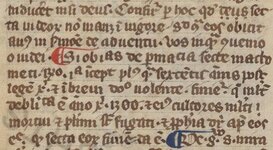
OK let’s look at the dating of the Ordinatio. Scotus writes (Prologue Part 2)

Confirmatur, quia secta iudaeorum non manet in vigore, sicut contra eos obicit Augustinus in illo sermone (dominica quarta de Adventu) ((Vos, inquam, convenio, o iudaei!)). Si obiciatur de permanentia sectae Mahometi, respondeo: illa incepit plusquam sexcentis annis post legem Christi, et in brevi, Domino volente, finietur, quia multum debilitata est anno Christi millesimo trecentesimo, et eius cultores multi mortui, et plurimi sunt fugati; et prophetia dicitur apud eos esse quod secta eorum est finienda.

That is:

There is confirmation in that the sect of the Jews does not remain in vigor, as Augustine objects against them in the sermon [Ps.-Augustine, Sermon against Jews, Pagans, and Arians ch.11]: “Against you, I say, O Jews, I bring my charge!” If an objection be made about the permanence of the sect of Mohammed, I reply: that sect began more than six hundred years after the law of Christ, and in a short time, if the Lord will, it shall end, because it was much weakened in the 1300th year of Christ, and many of its worshippers are dead and very many put to flight; and a prophecy is said to exist among them that their sect must end.

Manuscript is below. This is not the only evidence for the dating. I worked on the dating (and authenticity) of Scotus’s earlier logical works at around 1295. We have separate evidence of the circumstances and date of his death (1308). We have the fact that Scotus is quoted verbatim by William of Ockham, whose birth and death date we can establish approximately (though not accurately, to be sure). Then there is Walter Burley who I quoted above, who tells us he was writing in 1337 at the age of 62.

@Grosseteste, just an explanation for you about this forum (this is my personal observations, so I am not talking for other people who might have a different point of view).

There are mainly two currents when talking about chronology and I am not saying that they are well defined and everyone here consciously pushes for one or the other. One "current" thinks that historical events are mostly true but misinterpreted or even faked due to the chronological error (this is generally my point of view), while the other "current" thinks that many ancient and even modern events simply never happened because they were invented (and I don't want to say more because ' don't want to misinterpret their thoughts). If there is a third one, I have not noticed...

There are not ‘two currents’ in my field (medieval logic and theology). I cannot name a single person who would give the revisionist view any credence whatever. The hypothesis conflicts with pretty much everything we know about the subject.

For those who subscribe to the non-mainstream revisionist view, the onus is to resolve the apparent contradictions between the conventional dating - which includes everything we know about the works of scholastics like Grosseteste, Aquinas, Scotus, Ockham and hundreds of others.
 

Attachments

  • vat lat 876 confirmatur, quia secta iudaeorum.jpg
    vat lat 876 confirmatur, quia secta iudaeorum.jpg
    157.5 KB · Views: 137
There are not ‘two currents’ in my field (medieval logic and theology). I cannot name a single person who would give the revisionist view any credence whatever. The hypothesis conflicts with pretty much everything we know about the subject.

For those who subscribe to the non-mainstream revisionist view, the onus is to resolve the apparent contradictions between the conventional dating - which includes everything we know about the works of scholastics like Grosseteste, Aquinas, Scotus, Ockham and hundreds of others.
The particular chronological order between A, B and C doen't mean that A happened in 600 BC, B in 330 AD and C in 1200 AD. I can agree about the order of A-B-C, not the time in which they happened.

It's really not important what medievalists think about chronology, since they are not chronologists themeselves and they work with the chronology they were provided with. If chronology changes, medievalists will find new ways to explain what happened.
 
Personally I think the subject of dating and chronology is a minefield
That is why you need to fly over this field using astronomy.

I worked on the dating (and authenticity) of Scotus’s earlier logical works at around 1295. We have separate evidence of the circumstances and date of his death (1308).
I have a much more famous historical figure from the same period: Matthew Vlastar (Matthew Blastares) surely contradicting your premises.

Let us turn to the canonical mediaeval ecclesial tractate - Matthew Vlastar’s Collection of Rules Devised by Holy Fathers, or The Alphabet Syntagma. This rather voluminous book represents the rendition of the rules formulated by the Ecclesial and local Councils of the Orthodox Church.

Matthew Vlastar is considered to have been a Holy Hierarch from Thessalonica, and written his tractate in the XIV century.
EXPLICIT DATING GIVEN BY MATTHEW VLASTAR

It is indeed amazing that Matthew Vlastar’s Collection of Rules Devised by Holy Fathers – the book that every Paschalia researcher refers to – contains an explicit dating of the time the Easter Book was compiled. It is even more amazing that none of the numerous researchers of Vlastar’s text appeared to have noticed it (?!), despite the fact that the date is given directly after the oft-quoted place of Vlastar’s book, about the rules of calculating the Easter date. Moreover, all quoting stops abruptly immediately before the point where Vlastar gives this explicit date.
“There are four rules concerning the Easter. The first two are the apostolic rules, and the other two are known from tradition. The first rule is that the Easter should be celebrated after the spring equinox. The second is that is should not be celebrated together with the Judeans. The third: not just after the equinox, but also after the first full moon following the equinox. And the fourth: not just after the full moon, but the first Sunday following the full moon… The current Paschalia was compiled and given to the church by our fathers in full faith that it does not contradict any of the quoted postulates. (This is the place the quoting usually stops, as we have already mentioned – Auth.). They created it the following way: 19 consecutive years were taken starting with the year 6233 since Genesis (= 725 AD – Auth.) and up until the year 6251 (= 743 AD – Auth.), and the date of the first full moon after the spring equinox was looked up for each one of them. The Paschalia makes it obvious that when the Elders were doing it; the equinox fell on the 21st of March” ([518]).
Thus, the Circle for Moon – the foundation of the Paschalia – was devised according to the observations from the years 725-743 AD; hence, the Paschalia couldn’t possibly have been compiled, let alone canonized, before that.


The spring equinox could not, and did not, fall on March 21, in the year 325 AD, CONTRARY to the figures implied by manistream chronology.


Gauss' Easter formula proves that the Council of Nicaea could not have taken place before the year 876-877 AD, and that the vernal equinox fell on March 21, in the year 743 AD (and not in the year 325 AD).
Thesaurus Temporum, published by Joseph Scaliger, was based almost entirely on the calculations of Dionysius Exiguus and Matthew Blastares.


You see, astronomical dating is foremost: it has precedence over any other considerations (documents, books).
 
That is:


Manuscript is below. This is not the only evidence for the dating. I worked on the dating (and authenticity) of Scotus’s earlier logical works at around 1295. We have separate evidence of the circumstances and date of his death (1308). We have the fact that Scotus is quoted verbatim by William of Ockham, whose birth and death date we can establish approximately (though not accurately, to be sure). Then there is Walter Burley who I quoted above, who tells us he was writing in 1337 at the age of 62.
Sorry, but this explanation is entirely based on St. Augustine manuscript the earliest copy of which is certainly not from the epoch in which he supposedly lived (unless you can prove otherwise). St. Augustine doesn't provide an explanation for his datings and the chronology he refers to is totally un-scientific and based entirely on tradition, unless you can prove otherwise. On the other hand Nosovsky has given a peculiar explantion you should at least read before going on... A.FOMENKO. Empirico-Statistical Analysis of Narrative Material and its Applications to Historical Dating
 
Sorry, but this explanation is entirely based on St. Augustine manuscript the earliest copy of which is certainly not from the epoch in which he supposedly lived (unless you can prove otherwise). St. Augustine doesn't provide an explanation for his datings and the chronology he refers to is totally un-scientific and based entirely on tradition, unless you can prove otherwise. On the other hand Nosovsky has given a peculiar explantion you should at least read before going on... A.FOMENKO. Empirico-Statistical Analysis of Narrative Material and its Applications to Historical Dating

The key part of that document is where it says '1300'. Scotus says he is writing in the year 1300. I will look at the Fomenko argument later (I have to do something else now).

[Sandokhan] You see, astronomical dating is foremost: it has precedence over any other considerations (documents, books).
On the contrary, we medievalists say that documentary evidence has precedence over all else. How will we resolve that one?
 
The key part of that document is where it says '1300'. Scotus says he is writing in the year 1300. I will look at the Fomenko argument later (I have to do something else now).


On the contrary, we medievalists say that documentary evidence has precedence over all else. How will we resolve that one?
Sorry, I meant Scotus, not Augustine.
On the contrary, we medievalists say that documentary evidence has precedence over all else. How will we resolve that one?
Chronology has obviously precedence. If Plato comes after Cartesius, I think you should re-write the entire philosophical corpus, I think! (and I am not saying that Plato comes after Cartesius. It was just to make a clear point).
But there is obviously an inner chronology inside historical manuscripts which can tell the order of events (A-B-C) and that should be reliable. The datings given are un-scientific though, unless you or someone else can prove the opposite (with real proofs, I mean documents and manuscripts which show the scientific method applied for determining the correct chronology. This should be easy for those who study ancient books and know many languages!!!)
 
Last edited by a moderator:
I have started a project to investigate the conflict between astro dating methods, and conventional methods. This may take some time, as it requires accessing papal records.

Meanwhile, here is an interesting article by my colleague Henrik Lagerlund.

There was no such thing as ‘Renaissance philosophy’ – Henrik Lagerlund | Aeon Essays

The basic elements of study for the historian are singular events of linguistic utterances. These come to the historian usually through manuscripts or books, which contain the expressions of ideas or thoughts of the individual philosophers. For the historian of philosophy, humans or places are referred to only in so far as they are connected to utterances. They can hence figure in explanations of these utterances.
 
and conventional methods
What are these methods? Were they used by whom? There is no need to start projects to answer these questions, I think. IF there was a method, this should be known to scholars.

So the question remains. What kind of scientific method did Scaliger and his successors use in their work?
 
What are these methods? Were they used by whom? There is no need to start projects to answer these questions, I think. IF there was a method, this should be known to scholars.

So the question remains. What kind of scientific method did Scaliger and his successors use in their work?

Conventional method = method used by historians such as myself. Principally (1) establish relative dates between texts by establishing which was written first. And (2) use the dates (cautiously) given on the manuscripts themselves.

On the project: I am accepting the hypothesis that the Gospels were written after 1500, as some revisionists suggest. Then I want to understand which documents are incorrectly dated as a result.

For example, Scotus explicitly says he is writing in the year 1300. But he quotes the gospels in a number of places in the same document. It immediately follows that the date he gives is incorrect.

I want to see how many of the 100,000 odd manuscripts in the Vatican library have been incorrectly dated - by accident or design - on the assumption that the revisionist dating is correct.

Does that make more sense?
 
Conventional method = method used by historians such as myself. Principally (1) establish relative dates between texts by establishing which was written first. And (2) use the dates (cautiously) given on the manuscripts themselves.
It is implied that the method should give absolute dates, not the relative order of events, about which I am confidnt enough to say that you are pretty much capable of doing it, since it is your area of expertise. So yes, they are both methods, but to obtain different things: absolute dates in the first case, the relative order of events in the second.
On the project: I am accepting the hypothesis that the Gospels were written after 1500, as some revisionists suggest. Then I want to understand which documents are incorrectly dated as a result.

For example, Scotus explicitly says he is writing in the year 1300. But he quotes the gospels in a number of places in the same document. It immediately follows that the date he gives is incorrect.

I want to see how many of the 100,000 odd manuscripts in the Vatican library have been incorrectly dated - by accident or design - on the assumption that the revisionist dating is correct.

Does that make more sense?
It did make sense from the start to me. As I said, there are two currents here, which you are now grouping into one, as if the other doesn't exist. I would not be confident to say that the Gospels were written after 1500 and I'm sure you will find plenty of documents proving the opposite.

Just to be clear, the problem with chronology, at least for me, is mostly with ancient history, while I think the medieval one should be more precise. But the problem is that if ancient history was misdated, then those events happened in a more recent timeframe and this would necessarily modify our point of view on the entire historical corpus
 
It is implied that the method should give absolute dates, not the relative order of events, about which I am confidnt enough to say that you are pretty much capable of doing it, since it is your area of expertise. So yes, they are both methods, but to obtain different things: absolute dates in the first case, the relative order of events in the second.

It did make sense from the start to me. As I said, there are two currents here, which you are now grouping into one, as if the other doesn't exist. I would not be confident to say that the Gospels were written after 1500 and I'm sure you will find plenty of documents proving the opposite.

Just to be clear, the problem with chronology, at least for me, is mostly with ancient history, while I think the medieval one should be more precise. But the problem is that if ancient history was misdated, then those events happened in a more recent timeframe and this would necessarily modify our point of view on the entire historical corpus

Right, but I was rising to Sandokhan's challenge that he has proved the gospels written after 1500. Fomenko makes similar (though not identical) claims.

I agree there is a real problem with ancient history. There is an academic consensus that the chronology given in the Hebrew Bible does not reflect the likely reality. But medieval historians look at, er, the medieval period.

On relative vs absolute, the only absolute method is the astronomical method, which medievalists don't rely on. But we can pick a date as an anchor then work back via the relative method. Also, as I said above, we have documents which give dates.
 
I agree there is a real problem with ancient history. There is an academic consensus that the chronology given in the Hebrew Bible does not reflect the likely reality. But medieval historians look at, er, the medieval period.

On relative vs absolute, the only absolute method is the astronomical method, which medievalists don't rely on. But we can pick a date as an anchor then work back via the relative method. Also, as I said above, we have documents which give dates.
To be more precise, I don't think that ancient and early medieval dates can be really proven even with the "working back" method. Fomenko has provided many clues about the possibility that ancient and "Hebrew" history happened during the middle-ages but was backdated to a distant past for various reasons.

By the way, I appreciate Fomenko's reasearch but I have many doubts about his overall reconstruction, which I find a little bit too biased concerning the opposition between the West and East. The same bias that I see in conventional chronology, which spawned from the ecclesiastic world with a complete monopoly n the subject. In particular, starting from Scaliger's epoch, a series of "new historians" began their work to create a mythology out of what in the middle-ages was believed as historical truth. All of this in a context of book burnings, witch huntings and wars of religion.
 
Status
Not open for further replies.
Back
Top