Dating and Chronology

Status
Not open for further replies.
Right, but I was rising to Sandokhan's challenge that he has proved the gospels written after 1500.
That's the new chronology of history.

I embrace the new radical chronology of history: the bible was written in the period 1780-1800 AD.

Christoph Pfister has investigated each and every castle, cathedral in Switzerland. His conclusion: before 1700 AD there was no human presence on the present day territory of Switzerland, the printing press was invented after 1730 AD, all castles and cathedrals were built after 1750 AD.

New radical chronology of history (Christoph Pfister's work)

Here is a most extraordinary fact.

EK6TGPAT3_w7IpcOTuEUGfuMfruvjVFRDpJdwipLln0d7=s800.jpg


Jerusalem quae in Bosphorus est possidebit civitates Austri.

http://www.johncunyus.com/files/The_Book_of_Obadiah.pdf

Obadiah 1:20 "et transmigratio exercitus huius filiorum Israhel omnia Chananeorum usque ad Saraptham et transmigratio Hierusalem quae in Bosforo est possidebit civitates austri"

Jerome, author of translation of the Bible into Latin (the Vulgate) used the word Bosphorus in Obadiah 1:20.

Et transmigratio exercitus hujus Filiorum Izraelu omnia loca Chananæorum usque ad Sareptam: et transmigratio Jerozolima, quæ in Bosphoro est, possidebit civitates Austri.

The same word appears in one English translation as well ( Douay–Rheims), from 1610.

And the captivity of this host of the children of Israel, all the places of the Chanaanites even to Sarepta: and the captivity of Jerusalem that is in Bosphorus, shall possess the cities of the south.

Douay-Rheims Bible, Abdias (Obadiah) Chapter 1

In most later translations, the word ‘Bosphorus’ was replaced with ‘Sepharade’. It is supposedly a place of ‘uncertain location’.
 
Not uncertain location. Sepharade jews have migrated to Bosphorus (Istanbul) after immigrated from Spain. As I mentioned earlier in another article, a crypto Jewish community in Beykoz uses the secret Kabbala teachings. That group could be this group. If this determination is true so Sepharade may be Beykoz.

I have raised this issue before and told you that Jesus was crucified in Beykoz (a district in Istanbul), but I think you did not take this into account enough.
 
That's the new chronology of history.

I embrace the new radical chronology of history: the bible was written in the period 1780-1800 AD.

So every single document I have studied in my specialist area is either mistakenly dated, or is a forgery?

The same word appears in one English translation as well ( Douay–Rheims), from 1610.

How so, if the Bible was written later than 1610?

Jerusalem quae in Bosphorus est possidebit civitates Austri.
You have quoted out of context. “quae” does not refer back to ‘Jerusalem’ but to ‘transmigratio’. The whole passage is “transmigratio Jerusalem, quæ in Bosphoro est, possidebit civitates austri.”

Jerome was translating the Septuagint, which has Εφραθα for the Hebrew bis-p̄ā-raḏ. I am not expert in Hebrew at all, but the concordance says it probably means ‘place of exile’. Thus “the diaspora from Jerusalem who are in Exile will possess the towns of the Negev”.

[EDIT] Indeed the document you linked to has the correct translation: "Jerusalem’s captivity, which is in the Bosphorus, will possess the south’s cities." I.e. it's the captivity or diaspora or migration which is in the bis-p̄ā-raḏ, not Jerusalem. Obviously.
 
Last edited:
Can you imagine the outrage and the uproar which would have followed had the book of Obadiah featured that quote for some 1,200 years? It says clearly: Jerusalem which is in the Bosphorus.

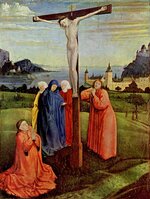
Does this look like Jerusalem to you, or more like Constantinople?

Konrad_Witz_005.jpg

De_Calvarieberg_Rijksmuseum_SK-A-4921.jpeg


Constantinople and the crucifixion:

https://upload.wikimedia.org/wikipe...830_-_Bavarian_State_Painting_Collections.jpg

https://i2.wp.com/upload.wikimedia....-Frosch_Totentafel_Leidensweg_Christi_VLM.jpg

005.jpg

Dr. Anatoly Fomenko:

Incidentally it is interesting to look carefully at the representation of the crucifixion. It appears that in many paintings, icons and frescoes Christ’s crucifixion is shown with a background of either a big sea strait or a wide river. Besides the artists were painting in particular either a strait or a river, but by no means a sea, fig.5. So, by depicting water, the opposite shore was always shown [5v1], ch.14. As we understand it now, it could not have been otherwise, as the Beykoz mountain is situated right on the shore of the wide Bosphorus. From there can be seen very clearly the European shore of the strait, where the centre of Constantinople is situated.

Any artist, had a more or less accurate recollection of the original story, would have depicted the Bosphorus strait as a significant part of the landscape, which served as a backdrop to the site of Christ’s crucifixion.

Christ entering Constantinople:

ch1_zps41988551.jpg

Pilate wearing a turban:

ch2_zps19cee9be.jpg

Original quote from the epistle to the Galatians:

ch3_zps5dbcd85c.jpg
ch4_zpse3592f27.jpg
ch5_zpseaf756c0.jpg
Jerusalem = Constantinople/Hagia Sophia = Temple of Solomon

ch6_zps5cf3db61.jpg

Wayback Machine (pages 349 - 351, also includes a preface written by Garry Kasparov)
 
Wasn't this thread about chronology? How can someone answer when submerged with data that have nothing to do with the subject at hand?
 
We are trying to get to the bottom of this question: when was the Bible actually written?

You are right, I won't interfere anymore.

A note to the readers: read the links in the Christoph Pfister archive, you will find it very interesting.
 
Can you imagine the outrage and the uproar which would have followed had the book of Obadiah featured that quote for some 1,200 years? It says clearly: Jerusalem which is in the Bosphorus.

No it doesn't. It says "transmigratio Jerusalem, quæ in Bosphoro est”. And in any case that is Latin translated from the Septuagint Greek, not the Hebrew. Got it?

Then you link to bunch of paintings made around the Renaissance where the artist has simply invented the scenery. How is that relevant.

Wasn't this thread about chronology? How can someone answer when submerged with data that have nothing to do with the subject at hand?

Well it is about chronology of the crucifixion, so Sandokhan is not off-topic. Rather, he is completely wrong.

[EDIT] For the record, the Hebrew is "wə-ḡā-luṯ yə-rū-šā-lim ’ă-šer bis-p̄ā-raḏ; yir-šū ’êṯ ‘ā-rê han-ne-ḡeḇ."
 
Last edited:
A note to the readers: read the links in the Christoph Pfister archive, you will find it very interesting.
I've read it. Interesting? Yes. Do they prove anything? No.
Well it is about chronology of the crucifixion, so Sandokhan is not off-topic. Rather, he is completely wrong.
I commented because I know where we are going. Posting hundreds of external links is the best way to lose our heads and we will soon talk about unicorns and flat earth.
 
It might be worth discussing these paintings that appear to revisionist historians. For example, the one above, Calvary, by Pseudo Jan Wellens de Cock, c. 1520. Jan Wellens (or whoever is imitating him) hasn’t seen the crucifixion, and is unlikely to have visited Palestine, so has to represent the scene as best as he can. Why on earth would we suppose that he is copying something that he has actually seen? These pictures prove absolutely nothing.
 
It might be worth discussing these paintings that appear to revisionist historians.
The discussion starts with chronology though. Conventional chronology puts these events in a very distant past. Since conventional chronology is not scientific (unless someone can prove otherwise), then the revisionists, on the base of more precise astronomical calculations for eclipses, can infer that these artists knew better their own history, painting a more reliable landscape for those events.

There would be much more to say on this subject, but I want to stress out that the main issue is chronology. Everything seems absolutely explained when one looks at dates without asking how they knew the events happened in those times. And the answer is that there is no scientific method involved to determine the absolute dates. The "work back" method is certainly useful for reconstructing the order of events (if the sources are considered reliable, which opens another issue regarding the existing sources disregarded because against the official narrative), but the manuscripts themselves are copies of copies of copies and if absolute dates change, that order changes too.
 
Everything seems absolutely explained when one looks at dates without asking how they knew the events happened in those times. And the answer is that there is no scientific method involved to determine the absolute dates.

The first question, as I have said a few times, is how we know when a document was written or printed. In the case of printed material, we know from the date given on the front. Revisionists say that these dates are faked, without giving any convincing reason why they are faked.

In the case of papal records, legal documents, deeds of transfer and so on, again there are dates. Legal documents are very precise about that, because a mistake means transferring title when it should not have been transferred. Again, we can never rule out forgery, but then a convincing reason needs to be given why the forgery was made. Plus, we can only conclusively prove forgery when we have documentation that proves it, meaning we have to rely on that latter documentation.

on the base of more precise astronomical calculations for eclipses"

Be careful. We can calculate precisely the dates of eclipses. But we still have to prove that the document which mentions the eclipse is accurate, so it ALL comes down to documentation in the end.
 
The first question, as I have said a few times, is how we know when a document was written or printed. In the case of printed material, we know from the date given on the front. Revisionists say that these dates are faked, without giving any convincing reason why they are faked.
As I said, you are conflating all revisionists in one group. I would not be too bold in saying that printed books were not publshed in the given dates.

Here the problem is not, as I said, the internal order of events found in documents, expecially when they pertain to the epoch of printing press. The problem arises with books preceding that epoch, which have come to us in the form of copies, and, more than anything, the books/documents pertaining to epochs preceding 1000 AD (more or less). There is no possibility to connect the middle-ages to "late antiquity" through the "work back" method. The only clue should be the datings given in the medieval texts themselves or the more recent chronology established by Scaliger. But those dates are based on tradition and highly contradictory, while recent astronomical redatings show that the ancient eclipses happened in the middle-ages.
Be careful. We can calculate precisely the dates of eclipses. But we still have to prove that the document which mentions the eclipse is accurate, so it ALL comes down to documentation in the end.
Nope. The actual calculations have been disproven. Historians are not mathematicians and the analysis of Fomenko has not been addressed by anyone. Fomenko also shows how astronomers themselves have disproven the original calculations made by Kepler.

By the way, if the documents which mention the eclipses atre inaccurate (and this is news to me - it seems historians are beginning to address the issue only after Fomenko), then the chronological implant crumbles down in one night.
 
Last edited by a moderator:
Here the problem is not, as I said, the internal order of events found in documents, expecially when they pertain to the epoch of printing press. The problem arises with books preceding that epoch, which have come to us in the form of copies, and, more than anything, the books/documents pertaining to epochs preceding 1000 AD (more or less).

Papal records exist back to 1198. The Anglo Saxon Chronicle (Cambridge, Corpus Christi College, MS 173 Cambridge, Corpus Christi College, MS 173: The Parker Chronicle is dated, although the dates before its compilation, probably the mid 800s, are clearly reconstructions.


But those dates are based on tradition and highly contradictory, while recent astronomical redatings show that the ancient eclipses happened in the middle-ages.

Not when the dates are concurrent with the time of writing, as with most of the Anglo Saxon Chronicle. I am going to check whether any of Bede’s documents are dated.

The actual calculations have been disproven. Historians are not mathematicians and the analysis of Fomenko has not been addressed by anyone.

Perhaps you could explain a little more how these actual calculations work. I assume that we take some ‘ancient’ document giving the positions of the stars, then we calculate some date consistent with those positions. (Forgive me if I have misunderstood). But ancient astronomy was not accurate at all. The Arabs developed better instruments for measuring angular distance, but that was not until the 800s or 900s (from memory).
My personal belief is that the biblical events occurred in the middle ages.
The evidence for which is?
 
Here is an example (from Bede, Historia Ecclesiastica Gentis Anglorum, Cotton MS Tiberius C II 157r) of where the date given (DCCXXXIIII 734) is contemporaneous with the authorship. The whole manuscript is a series of dates, of course, but I am focusing on the dates which are either contemporary with the author, or which are recently past.

1622746306676.png
 
You cannot invoke anything attributed to Bede. Earlier, it was proven that the works ascribed to Dionysius Exiguus were written at least after 1400 AD. In the official chronology of history, Bede based his Easter cycle on the calculations provided by Exiguus.
 
Papal records exist back to 1198. The Anglo Saxon Chronicle (Cambridge, Corpus Christi College, MS 173 Cambridge, Corpus Christi College, MS 173: The Parker Chronicle is dated, although the dates before its compilation, probably the mid 800s, are clearly reconstructions.
Not when the dates are concurrent with the time of writing, as with most of the Anglo Saxon Chronicle. I am going to check whether any of Bede’s documents are dated.
You are probably implying here that Papal records are dated through the "work back " method I suppose. Fine by me. But the Anglo-Saxon Chronicle (of which I suppose no one can really say it's an original document) are dated through methods entirely based on the unproven conventional chronology.
The dates are givan a posteriori, therefore are based upon an un-scientific tradition.
Perhaps you could explain a little more how these actual calculations work.
I gave you links to read.
I assume that we take some ‘ancient’ document giving the positions of the stars, then we calculate some date consistent with those positions. (Forgive me if I have misunderstood). But ancient astronomy was not accurate at all. The Arabs developed better instruments for measuring angular distance, but that was not until the 800s or 900s (from memory).
This is precisely the issue Fomenko exposed.

As I said, historians are not mathematicians and the analysis of Fomenko has not been addressed by anyone. Fomenko shows how astronomers themselves have disproven the original calculations made by Kepler.
By the way, if the documents which mention the eclipses are inaccurate (and this is news to me - it seems historians are beginning to address the issue only after Fomenko), then the chronological implant crumbles down in one night.

It seems we have come to the point in which there is nothing else to say. If you are unaware of the many problems exposed by recentists in conventional chronology, you should read those in the first place. This research by Nosovsky is a glimpse of what they have found. If you want you can read it, and if you don't want I understand your position.

A.FOMENKO. Empirico-Statistical Analysis of Narrative Material and its Applications to Historical Dating (pages 390 - 401 and 401 - 405)
Here is an example (from Bede, Historia Ecclesiastica Gentis Anglorum, Cotton MS Tiberius C II 157r) of where the date given (DCCXXXIIII 734) is contemporaneous with the authorship. The whole manuscript is a series of dates, of course, but I am focusing on the dates which are either contemporary with the author, or which are recently past.
This is the same problem over and over again @Grosseteste! Upon which scientific chronological method were the dates inside the text given?

Read this before continuing, please.
A.FOMENKO. Empirico-Statistical Analysis of Narrative Material and its Applications to Historical Dating (pages 390 - 401 and 401 - 405)
 
Last edited by a moderator:
  • Like
Reactions: Six
This is the same problem over and over again @Grosseteste! Upon which scientific chronological method were the dates inside the text given?

Bede gives a series of dates of events that occurred within his lifetime, in the anno domini format. I know you are going to question whether these are astronomically correct. But you accept that they are correct relative to one another? For example, Bede writes the year 710 for event A. Then a year passes - you don't need science to understand the seasons, right? - and event B happens so he records it as happening in year 711. Then another year, another event and so on throughout his life. So we have a series of events correlated with numbers.

Now assuming we have documents by other writers with a similar series of years that overlap, then we can build up the sequence until we reach papal records. Plus there are many many other documents which also have dates (of coronations, wars and so on).

Read this before continuing, please.

That may take some time and understanding.

You cannot invoke anything attributed to Bede. Earlier, it was proven that the works ascribed to Dionysius Exiguus were written at least after 1400 AD. In the official chronology of history, Bede based his Easter cycle on the calculations provided by Exiguus.

My references to Bede were entirely unconnected with his calculations on the Easter cycle.
 
Status
Not open for further replies.
Back
Top