F
Felix Noille
Guest
It’s uncanny how, once you begin investigating any of the subjects covered by this forum, that they all seem to dovetail. This topic is no exception and could be posted under a number of different sections which makes choosing where to post it difficult. It also threatens to be quite lengthy, so I am going to try my best not to make it too tedious.
John Dee & Edward Kelley
Dee was an occultist, mathematician, astrologer, astronomer, alchemist, historian, theologian, philosopher, cryptographer and an expert in the field of navigation. He was a kind of Merlin to Elizabeth I, although not as cuddly. He is attributed with planting the seed of a “British Empire” into the agenda.
Nicholas Dakin’s book, “John Dee of Mortlake” (Barnes and Mortlake Local History Society, 2011), claims that John Dee’s house on the river Thames at Mortlake, with its library and its laboratory, was the centre of a great intellectual network that stretched across Europe, and in a way, across the Atlantic as well. In fact his library was said to have contained the greatest collection of occult manuscripts in the world. He was also very well acquainted with Gerardus Mercator, the cartographer. In fact Dee collaborated with Mercator over the Septentrionalium Terrarum Descriptio (Hyperboria) map.
Dee was Elizabeth I’s Spymaster, as he had a ‘network’ of occult contacts all over the world. In his secret communications with the Queen he always signed himself 007 – and that’s not a joke. He was a real whizz with ciphers and codes. Edward Kelley was his medium, he was a less politically oriented chap some 30 years younger than Dee. Dee’s wife took an instant dislike to Kelley describing him as ‘evil’.
Dee managed to recreate the Enochian language as used by Enoch, star of “The Book of Enoch”, in order to communicate with ‘various angels’. He never referred to this language by the name ‘Enochian’ though. The Book of Enoch was considered ‘lost’ at the time, but Dee considered Enoch to be the last person to have used the language. The ‘Enochian’ alphabet had been published in 1530 by Pantheus in the book “Voarchadomia”. Dee was able to use this alphabet to reconstruct the language by means of Kelley’s mediumship and the use of a black scrying mirror or Speculum. This was given to Dee as a gift by Phillipe II of Spain, alleged occultist and builder of the magnificent Monasterio de San Lorenzo de El Escorial, near Madrid.
These communications resulted in the publication by John Dee in 1583 of “Liber Loagaeth Or Mysteriorum Liber Sextus et Sanctus”which contained the 49 Gates of Wisdom/Understanding . Around the same time he produced “De Heptarchia Mystica” or On the Mystical Rule of the Seven Planets, a book for summoning angels under the guidance of the angel Uriel and containing diagrams and formulae.
It is claimed that later, these ‘various spirits’ managed to convince Dee and Kelley to uproot themselves along with Dee’s beloved library and their families, to Krakow in Poland. Here they received the "Claves Angelicae", or "Angelic Keys" which were supposed to unlock the 49 Gates of Wisdom/Understanding given previously in the Liber Loagaeth. Dee never published these Angelic Keys, but they remained in his personal manuscripts. They have been published since their rediscovery and Enochian Magic found its way into the world.
The supposed move to Poland in 1583 was the beginning of the end for Dee and Kelley. The ‘angels’ made increasingly bizarre demands of them that led them into all kinds of trouble. Kelley eventually died trying to escape from prison, Dee having previously returned to England in 1589. He discovered that his library had been ransacked and many books stolen in his absence… although we are also led to believe that he took them abroad with him. Dee died in 1608… or maybe 1609, he was apparently so unpopular by then that nobody noticed.
Phillipe II of Spain, the same chap who gave Dee the Speculum, sent the Spanish Armada to invade Britain in 1588. For some reason it was a widely held belief that John Dee was responsible for conjuring the tempest that scuppered the Armada. However, if we believe the previous narrative which states that Dee wasn’t even in the country at the time, it would seem unlikely. To be honest, the entire saga of Dee and Kelley wandering around in central Europe, their strange adventures and its infamous wife-swapping ritual, sounds like a cross between Don Quixote and a Dennis Wheatley novel.
What is interesting, on the other hand, is that Shakespeare’s character Prospero, from his play ‘The Tempest’ (1610–1611 only 2 or so years after Dee’s death) is long believed to have been based upon John Dee. In the play Prospero uses magical powers to intimidate his enemies and to manipulate the natural world. He became ‘rapt in secret studies’ and failed to notice that his deceitful brother, Antonio, had achieved undeserved power and influence. Prospero then uses his powers of magic and illusion to shipwreck his brother, punish his adversaries, and regain his dukedom. He achieves this by means of a familiar spirit, called Ariel, who performs magical acts according to Prospero’s instructions. In Dee’s book “De Heptarchia Mystica”, Uriel is the guide for summoning angels.
In The Tempest (III:ii), Caliban – a servant of Prospero and a ‘savage monster’ (Kelley?), notes that Prospero’s library is the source of his power:
“Remember
First to possess his books; for without them
He's but a sot, as I am, nor hath not
One spirit to command.”
It’s easy to imagine that Dee had enemies, rivals and even those who wanted his occult knowledge for themselves. Equally, it’s easy to imagine that Kelley could have betrayed him, which led to the theft of Dee’s library. What’s obvious is that Dee would never have left his library unattended to go abroad and that if he took it with him, his library couldn’t have been ransacked and the books stolen.
Dee and Kelley always claimed that their information came directly from ‘various angels’ in order to ‘usher in the New Age’. Many commentators have suggested that Dee opened up a portal which allowed the ‘macrobes’, ‘archons’, ‘demons’ or other ‘minions of the Lords of Entropy’ into our world. The idea that such beings could wander around freely in our dimension simply by coming through a portal seems unlikely as, if they were physically equipped to do so in the first place, then they wouldn’t need the portal.
What Dee and Kelley did do was establish a means of communication with the ‘various spirits’ and it certainly wasn’t by mail. The important aspect to all of this is that they rediscovered a lost communication technology which may easily have become the means to bring about the later civilisation reset. Dee was also communicating with his worldwide network of occult contacts and informants – was this by post or did he use some other means, some other technology?
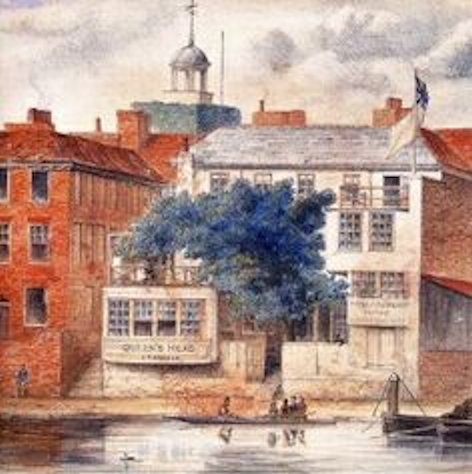
Dee’s house hasn’t survived, but it’s clear from this picture that he didn’t have to go far to use a bit of antiquitech...
Hellfire
The first organisation to be labelled ‘The Hellfire Club’ was created by Philip, 1st Duke of Wharton in London in 1719. It was suppressed by the order of King George I in 1721. Wharton then became a freemason and amazingly, in just one year, 1722, he became the Grand Master of England. Heavily in debt, Wharton sold Montpelier Hill and his estates of Rathfarnhamin in Dublin, Ireland, to William Conolly, Speaker of the Irish House of Commons, in 1725. Conolly used the stones from a cairn on the top of Montpelier Hill to build a hunting lodge, but was apparently forced to abandon it due to supernatural disturbances and he died in 1729.
The first Irish incarnation of The Hellfire Club rented that very same hunting lodge for their meetings from 1735 until 1741. Their motto was “Do what thou wilt” and it’s members were some of the elite of society and included peers of the realm, high ranking army officers as well as wealthy gentlemen and artists (freemasons all). The English painter, James Worsdale, was a founder member. It is claimed that Worsdale is the link between the English and Irish Hellfire Clubs, but there seems to be no evidence for that assumption. He was also instrumental in the foundation of the later Hellfire Club at Askeaton in Limerick, Ireland, in 1740.
The same epithet was accorded to a club called the ‘Beggar's Benison’ which was formed in the 1730s in Anstruther, Scotland. It survived for a century and is claimed to have spawned additional branches in Glasgow and Edinburgh. There is even the suggestion that there was another such club in Paris, so, on the face of it, the Hellfire franchise would seem to be an early version of Starbuck’s.
Many years ago I wasted a lot of hours in libraries digging into the more notorious of the so-called Hellfire Clubs. The founder members were Sir Francis Dashwood and John Montagu, 4th Earl of Sandwich, who had also together founded the Society of Dilettanti in 1734.
John Montagu had quite an illustrious career, being First Lord of the Admiralty, 1748-51, 1763, 1771-82. He was also ‘joint’ Postmaster General from 1768–1771, along with Sir Francis Dashwood, which is a very peculiar arrangement. The Sandwich Islands were named after his habit of snacking on small land masses… not really.
Sir Francis Dashwood was the Member of Parliament for New Romney between 1741 and 1761. He then became Chancellor of the Exchequer during 1762–1763, but was so useless that he had to resign after one year. He became Postmaster-General in 1765, a post he shared with the Earl of Sandwich from 1768 until 1771 after which time he remained in the job alone until 1781.
The Society of Dilettanti was a British society of noblemen and scholars who sponsored the study of ancient Greek and Roman art and the creation of new work in the style. “Grecian Taste and Roman Spirit” was their motto. Rumours abounded concerning perverse rituals and collections of erotica.
However, this was nothing compared to what became known (much later) as The Hellfire Club. It began as the Order of the Knights of St Francis in 1746. The club’s motto was also “Fais ce que tu voudras” (“Do what thou wilt”), from Rabelais' fictional abbey at Thélème and one that would re-emerge in the 20th century as Aleister Crowley’s war-cry. Some of the member’s names were known and many were accused, but the interesting ones include Benjamin Franklin (freemason and inventor of the glass harmonica), John Wilkes (criminal and political agitator) and Horace Walpole (author, politician and son of the first British Prime Minister, Robert Walpole), all of whom are considered as mere ‘guests’ in the modern narrative. Franklin was in England in 1724, then from 1757 until 1762. Then in 1764 he returned to London to represent colonial interests before the Crown. His involvement with the Hellfire Club is these days explained as ‘spying’, which presupposes that there was something worth spying upon, of course.
It’s important to be aware that it’s impossible to be certain of exactly what these Hellfire Clubs were all about. Even in their own time there was much misinformation, some of it created by the members themselves. Allegations of Black Masses and sexual debauchery were and still are, passed off as “jolly japes”, “general bawdiness”, “high jinx” or “rakish behaviour”. That’s not to say that such things didn’t happen at the club’s meetings, but focusing on this alone is to allow other more significant matters to go unnoticed.
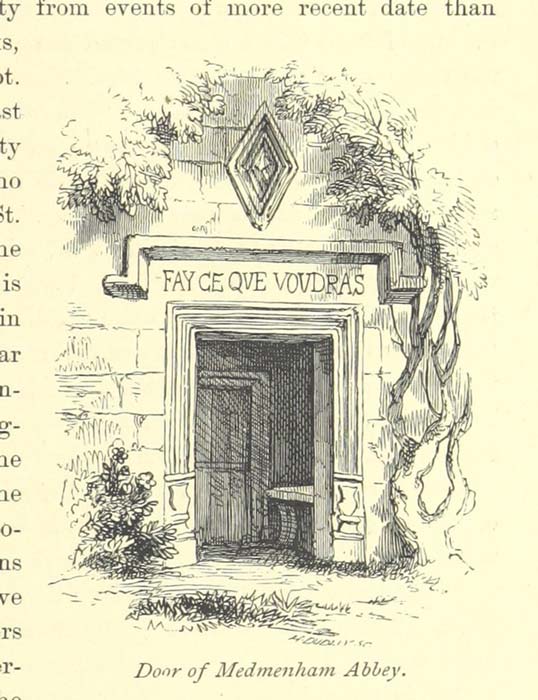
Dashwood and Montagu’s club evolved through a number of names; the Brotherhood of St. Francis of Wycombe, The Order of the Friars of St Francis of Wycombe and upon leasing Medmenham Abbey in 1751, they became the Monks or Friars of Medmenham. The Abbey underwent an expensive rebuild in Gothic revival style with the motto being placed above the door. During its lifetime, the club was never called “Hellfire”, this was appended to the popular narrative later as with most of the other clubs.
By the 1760s meetings were no longer being held at the abbey and all evidence of the club ever having been there was removed. This could have been the result of a highly improbable incident that allegedly involved a Black Mass, a baboon, John Wilkes and The Earl of Sandwich. An account of this was later published by John Wilkes and gave away many ‘secrets’ of the club’s activities at the Abbey. The meetings were now being held in the caves of West Wycombe. These had been excavated between 1748 and 1752 by Dashwood, by extending an ancient chalk and flint mine.
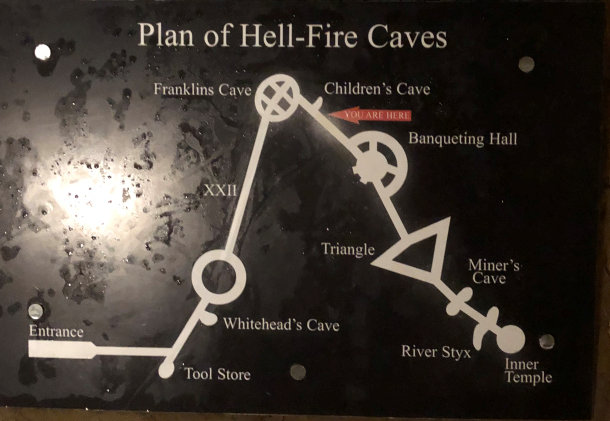
From Wikipedia: “A route through the underground chambers proceeds, from the Entrance Hall, to the Steward's Chamber and Whitehead's Cave, through Lord Sandwich's Circle, ... Franklin's Cave (named after Benjamin Franklin, a friend of Dashwood who visited West Wycombe), the Banqueting Hall (allegedly the largest man-made chalk cavern in the world), the Triangle, to the Miner's Cave; and finally, across a subterranean river named the Styx, lies the final cave, the Inner Temple, where the meetings of the Hellfire Club were held, and which is said to lie 300 feet (90 m) directly beneath the church on top of West Wycombe hill...Considering they were all dug by hand, the caves are often regarded as an incredible feat of engineering.”

Entrance
Franklin’s Cave - it seems odd that someone considered to be guest rather than a member should have an entire cave named after him.
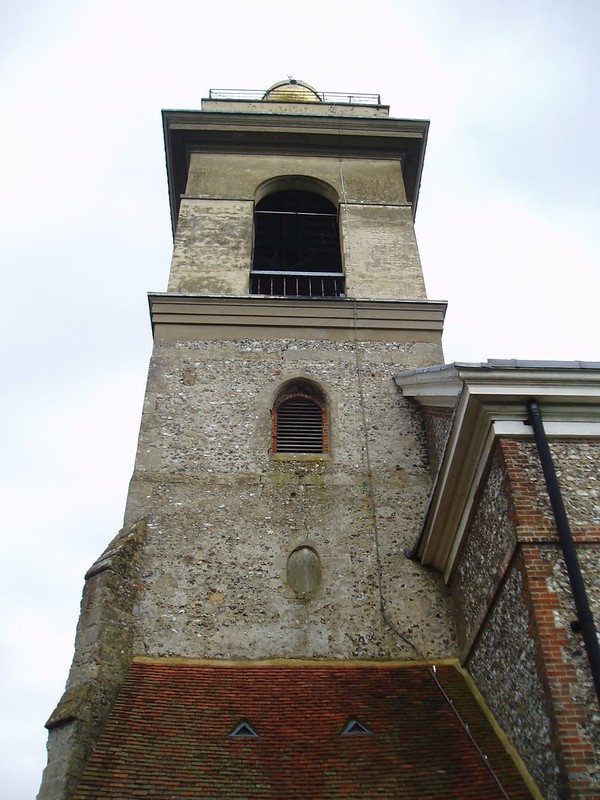
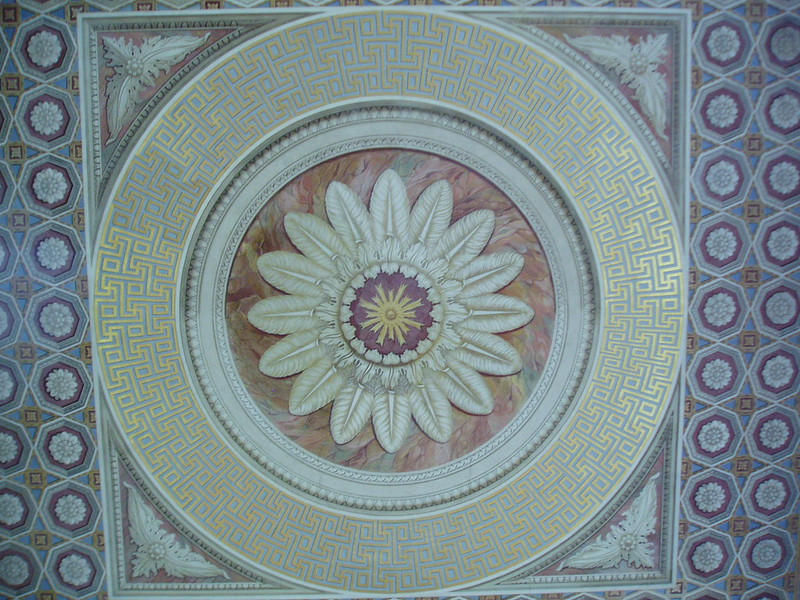
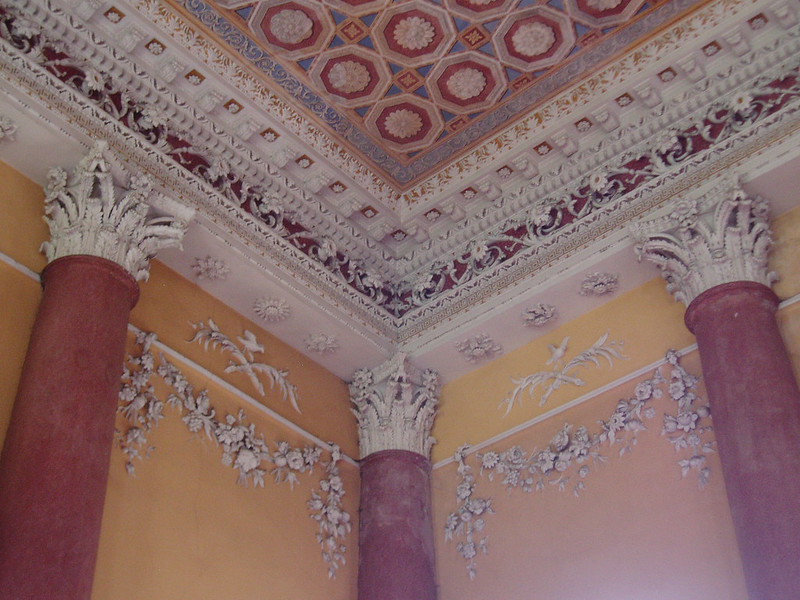
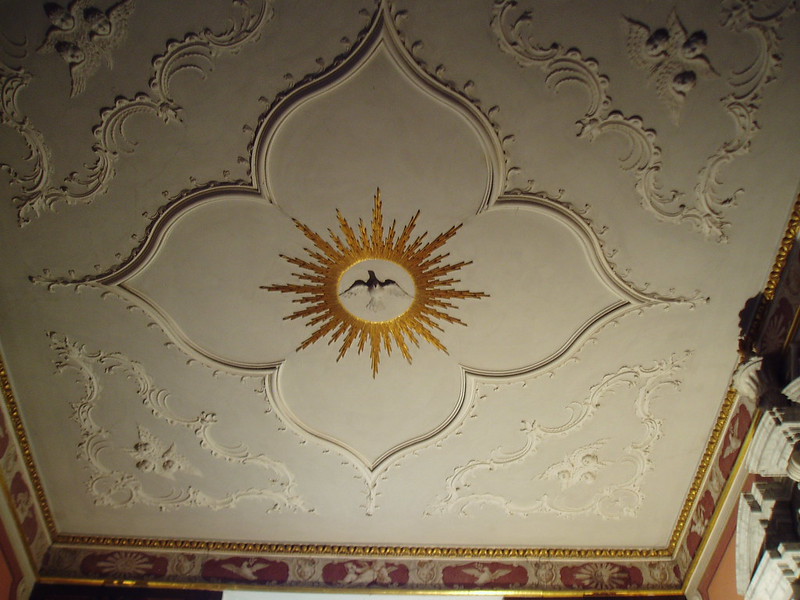
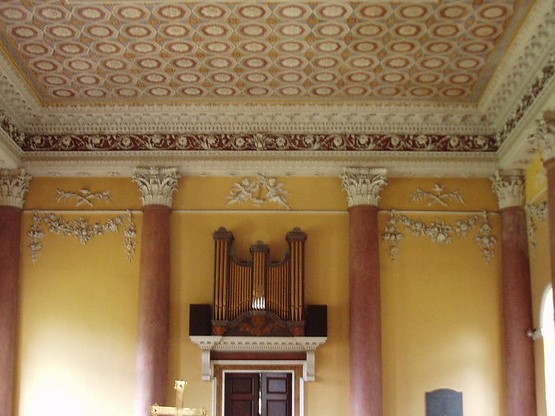
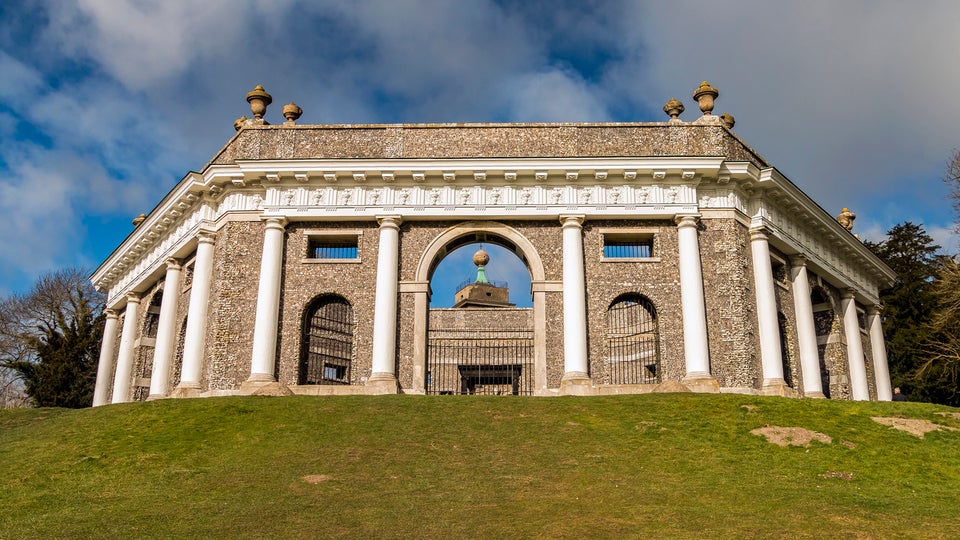
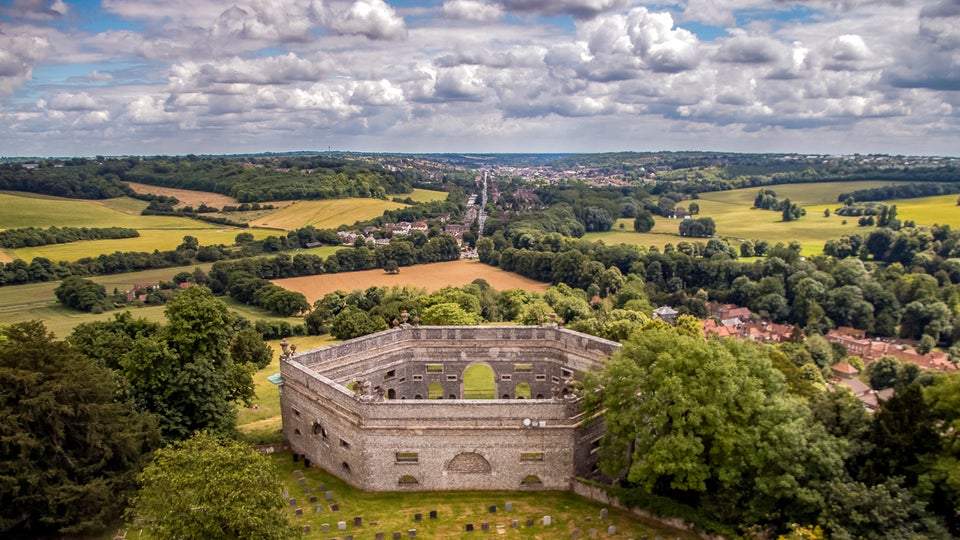
The church directly above the caves is St Lawrence's Church which was remodelled by Sir Francis Dashwood around the same time the caves were being excavated. He also built a Mausoleum there and remodelled the nave into a “very superb Egyptian hall” inspired by the ancient Temple of the Sun in Palmyra. There are many Trompe-l'œil paintings attributed to Giovanni Borgnis and in the centre of the chancel ceiling is a painting of the Last Supper after Rembrant. Spectacular Rococo plasterwork is all over the place. The church had served the lost medieval village of Haveringdon up until around the 14th century. One of Dashwood’s most important improvements was to the medieval west tower, which he made higher.
Antiquitech
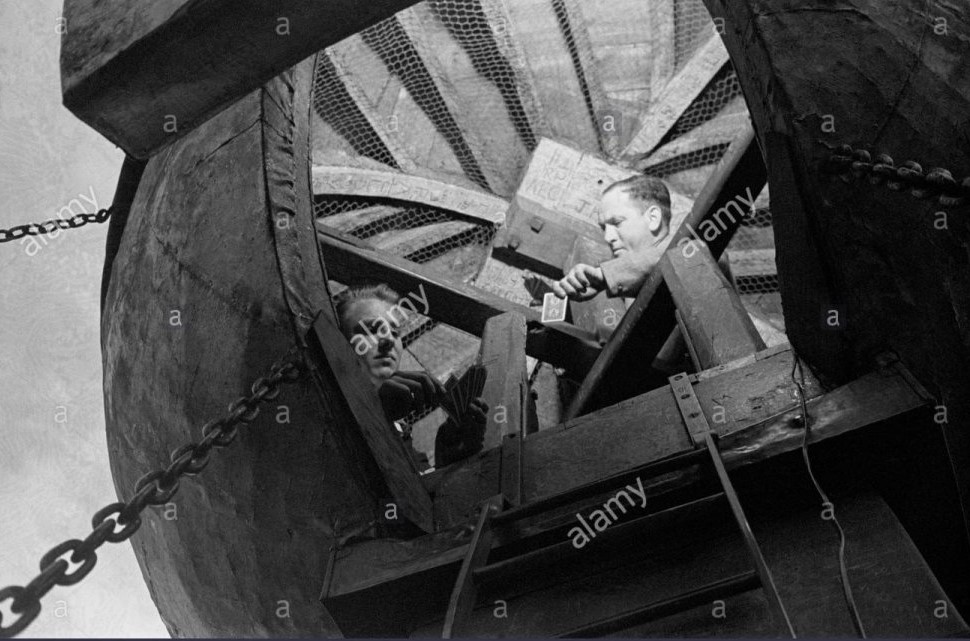
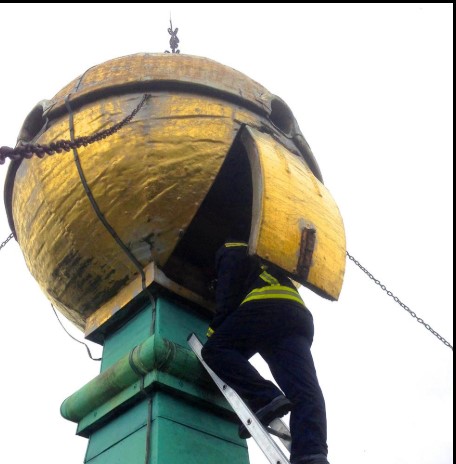
He placed a great golden ball on the top of the tower. The golden ball can be seen for miles. Reputedly, it’s “made from a wooden frame covered in gold leaf, 8 feet in diameter, and contains seating for up to six people.” That gold leaf must have excellent preservative properties if the ball is still the original and truly made of wood...
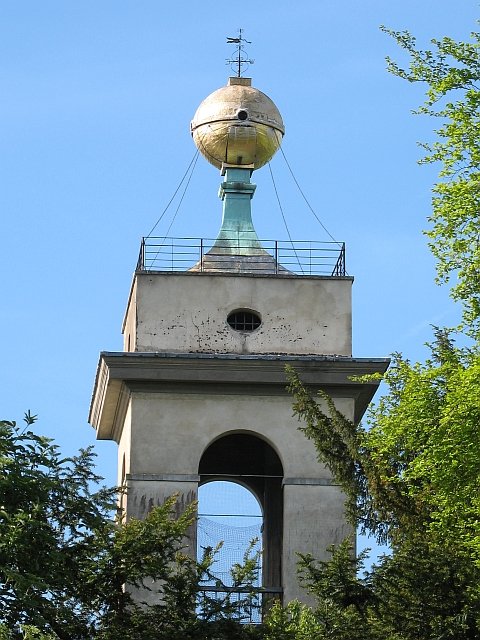
Rumours abound that the golden ball was used as a meeting place by the Hellfire Club, but the modern narrative is very uncomfortable with that notion. In fact, if you look at the previous photo, and the beginning of this video, you can see a hatch or door at the base of the ball. It would also seem that it was once open to the public – not anymore though.
The most interesting tale relating to the ball claims that Dashwood was somehow communicating with a tower, now known as the Camberley Obelisk, near Hawley, Hampshire, 21 miles (34 km) to the south. It’s claimed that the tower was built about 1765–1770 by Dashwood’s friend, John Norris, who was a prosperous merchant, a member of the landed gentry and of course, the Hellfire Club. The tower is situated on top of a hill, about 2 miles (3.2 km) east of Norris' house. At the time of its construction the town of Camberley had not yet been founded and the area was open heathland.
The theory goes that the two men signalled to each other from the top of the two towers, either using flags or heliographs. It’s also suggested that Norris' tower originally had a golden ball on top of it, matching the one on the West Wycombe church tower. However, it’s impossible to be sure as the tower is now a ruin having ‘burned down’ at some point since then.
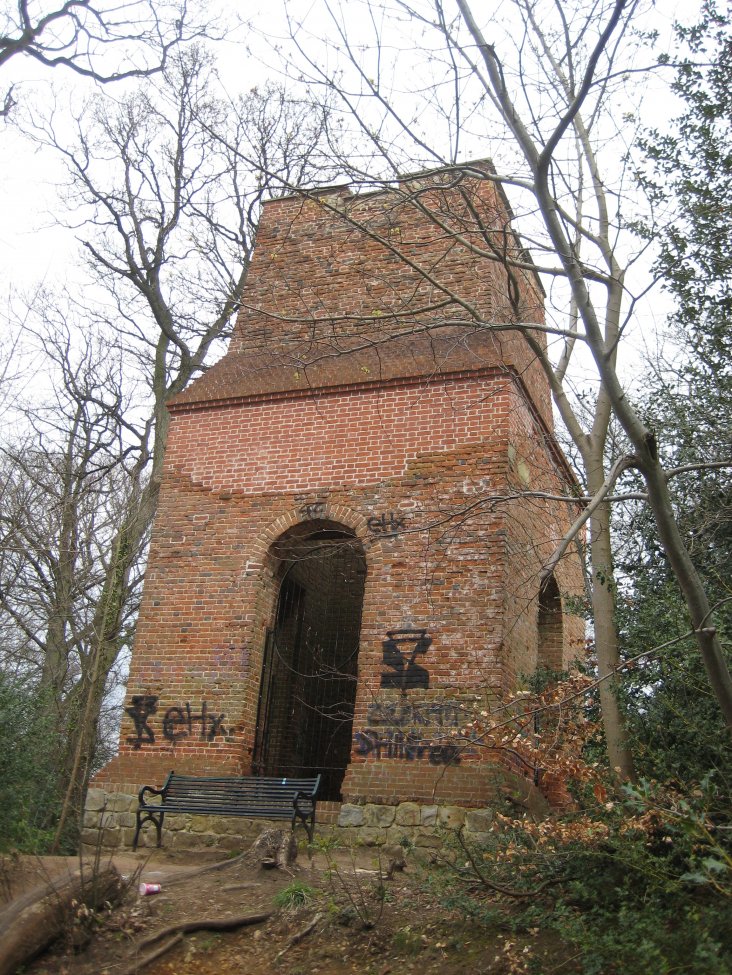
Norris' Tower
As to why Dashwood and Norris needed to signal information between themselves, well, amongst the favourite suggestions on offer we have; placing bets, something to do with the activities of the Hellfire Club and also espionage related to the American War of Independence.
According to Michael Baigent and Richard Leigh in their 1991 book, “The Temple and the Lodge”, (pp. 319–320) Norris passed secret information to Dashwood. This theory is supposedly supported by a letter written by Norris, dated 3 June 1778, in which he notes, "Did this day heliograph intelligence from Dr Franklin in Paris to Wycombe".
There are a few problems with this. For a start, the heliograph wasn’t invented until 1821 when Carl Friedrich Gauss of the University of Göttingen in Germany developed and used a predecessor of the heliograph, the heliotrope. Why didn’t Franklin just send the information straight to Dashwood from Paris? However, the biggest problem is that Baigent and Lee are two-thirds of the team that kicked-off the Priory of Sion / Rennes-Le-Chateau malarkey in “The Holy Blood and the Holy Grail” and therefore cannot be trusted.
It’s unlikely that Norris built any towers anywhere. In fact what we see is the ruin of an obelisk, of which there are thousands all over the UK, all over the world in fact. These are not the ‘genuine magically transported from Egypt’ type obelisks, but locally crafted ones found in not only towns, cities, even villages, but also on the top of all the high-spots in between. We are told they are monuments. They get dedicated to all sorts of things and people – the fallen of WWI/II, Nelson (both the famous sailor and someone’s dog), the spot where Sir Everard Fortesque-Splonge fell from his horse and later died of boredom, etc, etc., but this is just a way of stealing them from history and falsifying their true purpose.
As to what that true purpose is, further examination of the Hellfire Club’s shenanigans is required.
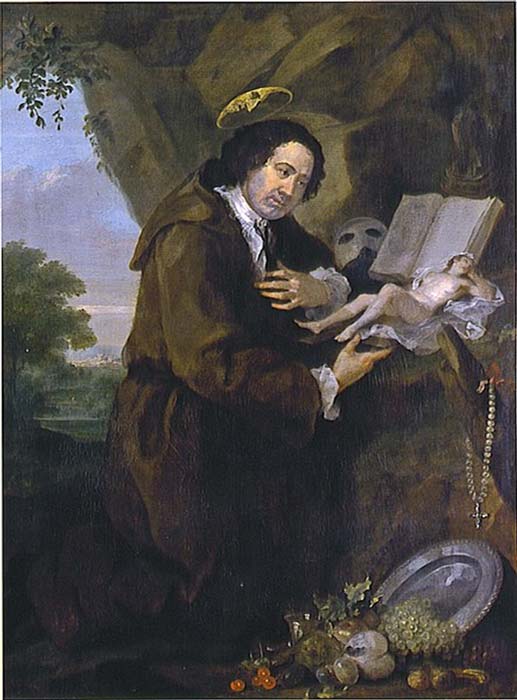
Sir Francis Dashwood by Hogarth
The above is a painting of Francis Dashwood, 11th Baron le Despencer, by the popular 18th century artist (and freemason), William Hogarth. Charles Lamb, a noted art critic of the time, deemed Hogarth's images to be books, filled with "the teeming, fruitful, suggestive meaning of words. Other pictures we look at; his pictures we read." The image is a parody of Renaissance images of Saint Francis of Assisi. It’s claimed that The Bible has been replaced by a copy of the erotic novel Elegantiae Latini sermonis, although it’s impossible to see if that’s true based upon photographic evidence. The object above Dashwood’s head is described as a halo showing the profile of Dashwood's friend, the Earl of Sandwich. It does indeed look like a caricature of him. The traditional baby Jesus has been replaced by what’s described as the naked figure of Venus.
It always fascinates me that these kind of images always come pre-packaged with interpretations designed to lead you to an officially sanctioned set of conclusions. There is another version of this painting…
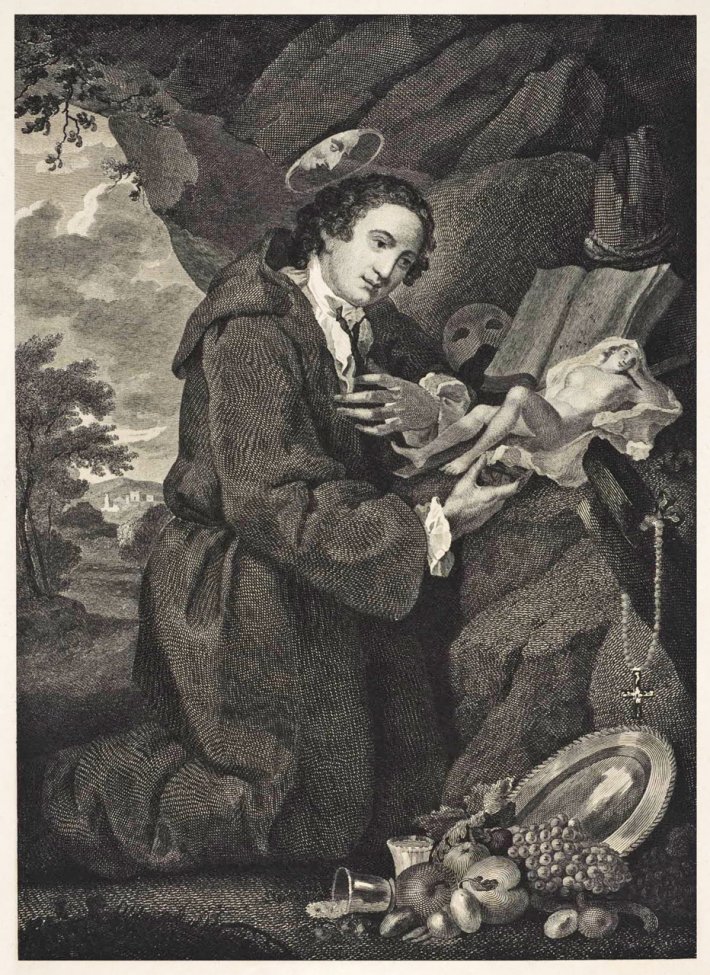
William Platt after Hogarth, 'Sir Francis Dashwood Worshipping Venus'.
This is an engraving by William Platt, after Hogarth. Both images were interchangeably entitled “Sir Francis Dashwood worshipping Venus” or “Sir Francis Dashwood at his devotions”.
The engraving is different. The most obvious difference being Dashwood’s appearance. He would have been around 50+ years old when Hogarth painted his portrait. The William Platt engraving is undated, but Platt wasn’t born until 1775 and Dashwood died in 1781, so the engraving is obviously from about 1785 at the earliest. The platter in the bottom right has a more defined reflection in the engraving, which looks like a figure. On the left in the centre there is what appears to be an obelisk or tower in the engraving, whilst the same scene in the painting is too vague to discern any details. The Earl of Sandwich seems to be watching what Dashwood is doing whilst in the engraving he is looking at the ‘camera’, so to speak. Both images place Dashwood and Sandwich in a cave, therefore the settlement in the background cannot be West Wycombe, as the caves were directly below it. The ‘halo’ really does look like a mirror with Sandwich looking into it to see what Dashwood is doing. Combined with the shiny platter, there is a strong suggestion of scrying or remote viewing in both images. Perhaps far from worshipping Venus, Dashwood is remote viewing the naked woman… which is just the sort of thing he would do given half a chance.
Remote viewing was used successfully during WW2 to locate German U-boats in the Atlantic. Check out Dennis Wheatley’s novel, “Strange Conflict”, which is based on fact. It’s also a widely held belief that all the major secret services are using it today. Espionage and the occult have always gone hand-in-hand. Obviously remote viewing is a major benefit to espionage as is a secure and speedy method of communication - which apparently didn’t exist until fairly recently. Dee was associated with espionage, maybe even its pioneer. Alastair Crowley, a disciple of Dee’s, worked with the British Secret Services before and during WW2. One of the agents he met was a Commander Ian Fleming, the author of the 007 novels. Another was Dennis Wheatley mentioned in the previous paragraph. Crowley’s philosophy was summed up in his motto “Do what thou wilt”.
So, in the 20th century we have a master of Dee’s ‘spirit’ communication technology, whose motto is the same as the Hellfire Club’s, working with the creator of James Bond 007 and a remote viewing specialist. All we need is something to connect The Hellfire Club with Dee…
Dee’s Speculum
Dee's Speculum or Mirror still exists in the British Museum. It was aquired in 1773 by none other than Horace Walpole - author, politician, son of the first British Prime Minister and frequent ‘guest’ of the Hellfire Club. Lord Frederick Campbell had brought "a round piece of shining black marble in a leathern case" to Walpole in an attempt to ascertain the object's provenance. According to Campbell, he responded saying "Oh, Lord, I am the only man in England that can tell you! It is Dr. Dee's black stone".
Just why Horace Walpole should claim to be the only man in England who could recognise Dee’s Speculum is a mystery and will probably remain one forever. It does indicates his prior knowledge and involvement with it though. There is no record of where Lord Frederick Campbell purchased it. He was a Scottish nobleman and is known to have been a member of the Irish House of Commons during 1771… very close to the site of the earlier Dublin Hellfire Club, some of who’s members were also in the Irish House of Commons.
(Just as an aside; it’s really worth looking at Horace Walpole’s house inside and out, it’s something else.)
At this point in time (1771) the Hellfire Club, such as it was by then, was still meeting in the caves at West Wycombe. The Earl of Sandwich became First Lord of the Admiralty for the third and final time, leaving Dashwood as sole Postmaster General and Franklin as his counterpart in America. After being released from prison in 1770, John Wilkes became Sheriff of the City of London, which confirmed where his true allegiance lay. This year saw the end of the ‘War of the Regulation’, an uprising in North and South Carolina which began in 1765 following a massive influx of new settlers from the east… in other words the old civilisation was revolting (if you see what I mean).
From this date, 1771, Dee’s Speculum was available to the Hellfire Club, as was Walpole’s prior knowledge of it. If they were already scrying, as the previous portraits may suggest, then Dee’s mirror would be put to good use… well, maybe not ‘good’ precisely.
The word Speculum is very interesting;
"instrument for rendering a part accessible to observation"
"reflector, looking-glass, mirror" (also "a copy, an imitation")
from specere "to look at, view"
Speculate: 1590s, "view mentally, contemplate"
Also formerly "view as from a watchtower" (1610s).
It would seem that we have a trail that leads from Dee and Kelley in the 16th century to Dashwood’s Hellfire Club in the 18th century (plus maybe the earlier Dublin club) and then on to Aleister Crowley in the 20th. If Dee did have access to communication technology that made use of what we now recognise as antiquitech, it’s highly probable that it was also passed down through the same trail. If the worldwide network of obelisks, towers and star forts was/is capable of transmitting energy then maybe that same energy could be used for instant direct communications or to enhance remote viewing/scrying. Perhaps every Postmaster General was initiated into this technology when he took office. At the very least it seems that there must be some benefit to direct interaction with the etheric network – the idea that 6 people would risk climbing up into a cramped ball on top of the church at West Wycombe just to get pissed and then take an even greater risk climbing down again is ludicrous.
These obelisks, towers and star forts are more than likely to have been placed on ley lines. Michelle Gibson has done a great deal of work to show how such structures are aligned to a worldwide grid based upon the Flower of Life symbol.
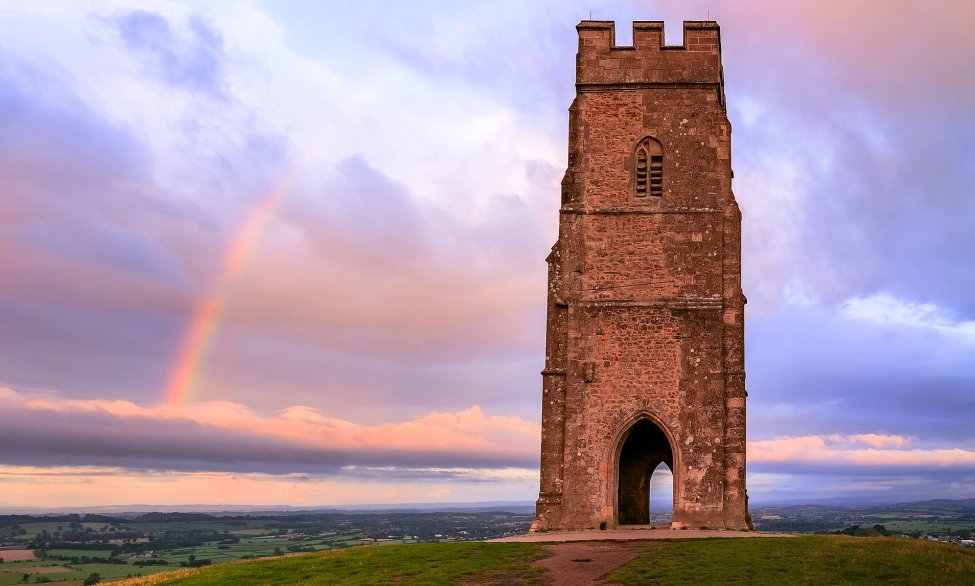
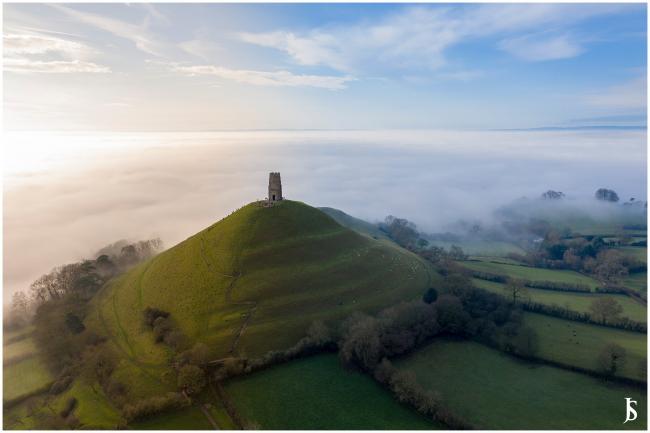
The tower on top of Glastonbury Tor is known as St Michael's Tower. St Michael's Church is claimed to have been built in the 14th century, of stone, but only the roofless tower remains, which has been “restored and partially rebuilt several times”. It was clearly an obelisk and has since been disguised and it’s definitely on a ley line.
The general state of communications during the 16th to 18th centuries is worth consideration. Obviously there was the post – letters/mail. These would be shuffled around the country by coach and horses. Urgent official communications might warrant the exclusive use of a horseman with frequent changes of horse, but overseas communication was via sailing ship. Benjamin Franklin crossed the Atlantic Ocean eight times in his lifetime, the perilous transatlantic crossing usually took at least six weeks and could take as long as two or three months. This all begs the questions, how long did it take to get wars started/stopped and orders transmitted to the armies/navies?
It must have been even worse for Spain and Portugal when communicating with the Americas. Then there’s communications between London and India, China and Australia etc. It seems as if there just wasn’t enough time for all the wars and international political intrigues, because the mail took too damn long.
Conclusions
If John Dee was given the knowledge of how to manipulate the natural world and he really conjured up the tempest that defeated The Armada, then that knowledge and the means to acquire it, has certainly not been lost. It survived either by having been stolen, passed on or reacquired.
The purpose of the Hellfire Clubs is very difficult to pinpoint. Maybe they were recruiting the rich and powerful to the ‘dark side’. Perhaps they were also communicating with ‘various spirits’ and commanding them to do their bidding whilst being manipulated themselves. If the takeover of the existing civilisation in America wasn’t as easy as had been anticipated, it could even be that they were learning how to use the etheric network of obelisks etc. to manipulate the natural world and create targetted liquefaction events, or mud floods, or Great (Hell) Fires, or worse. If resistance increased worldwide further down the line, then the ‘various spirits’ may have called for a complete reset of civilisation.
There is one more consideration. At around exactly the same time as the first Hellfire Club appeared, a serious schism occurred within freemasonry. I know the current reaction to ‘freemasonry’ is that it’s an integral part of the problem and so it is, however, there are theories claiming that what we have today is a twisted, evil version of something that was once honourable. Moorish Science is often cited as one such ‘something’.
In 1717 the Premier Grand Lodge of England was established in the City of London and so-called because it claimed it was the first Masonic Grand Lodge to be created. However, the Most Ancient and Honourable Society of Free and Accepted Masons in York disagreed. The upstart grand lodge was cobbled together from four existing Lodges who gathered at the Goose and Gridiron Ale-house in St. Paul's Church-yard in The City of London where they constituted themselves into a Grand Lodge. These four lodges (or were they mini Hellfire Clubs?) were all named after the pubs where they held their meetings.
The Ancient Grand Lodge of England on the other hand held their meetings in a lodge within York Minster. Their claim was based on a tradition that began in 926 AD when Prince Edwin (he of Edwin’s Burgh or Edinburgh fame) supposedly presided over a meeting of Masons in York, which was seen as the first Grand Lodge in England.
I did a great deal of research into this years ago and found that the York Grand Lodge has verifiable connections to the Knights Templar (whoever they really were), or at least to the symbolism that is associated these days with them. This information has since disappeared from public view, as far as I can ascertain.
The two camps became known as the Antients and Moderns. Interestingly, the Duke of Wharton, founder of the first Hellfire Club, became Grand Master of the Modern’s City of London Grand Lodge having been a mason for just one year in 1722 (as already mentioned). What finer recommendation could you want?
Amazingly the Moderns slowly but surely gained the upper hand over the Antients until eventually in 1813 they united with the Ancient Grand Lodge of England to create the United Grand Lodge of England. It could well be that the various Hellfire Clubs with their ‘Do what thou wilt’ offering had a lot to do with recruiting members to the new, twisted version of freemasonry that’s still with us today.
All of these possibilities exist.
Epilogue
In 1781, Dashwood's nephew Joseph Alderson founded the Phoenix Society (later known as the Phoenix Common Room) at Brasenose College, Oxford, which became a recognised institution in 1786. The Phoenix was established in honour of Sir Francis, who died in 1781, as a symbolic rising from the ashes of Dashwood's earlier institution. To this day, the dining society abides by many of its predecessor's tenets. Its motto uno avulso non deficit alter (when one is torn away another succeeds) is from the sixth book of Virgil's Aeneid and refers to the practice of establishing the continuity of the society through a process of constant renewal of its graduate and undergraduate members. (Wikipedia). Harry Potter anyone?
A number of Hellfire Clubs are still in existence in Ireland and are centred around universities and meet secretly. For example, there is a Hellfire Club at Trinity College that meets in central Dublin, while there is also a Hellfire Club at Maynooth University that meets in Maynooth, as well as one that regularly meets in Cork. These clubs carry out similar actions as the original Hellfire Clubs, including mock ceremonies and drinking alcohol. (Wikipedia)
John Dee & Edward Kelley
Dee was an occultist, mathematician, astrologer, astronomer, alchemist, historian, theologian, philosopher, cryptographer and an expert in the field of navigation. He was a kind of Merlin to Elizabeth I, although not as cuddly. He is attributed with planting the seed of a “British Empire” into the agenda.
Nicholas Dakin’s book, “John Dee of Mortlake” (Barnes and Mortlake Local History Society, 2011), claims that John Dee’s house on the river Thames at Mortlake, with its library and its laboratory, was the centre of a great intellectual network that stretched across Europe, and in a way, across the Atlantic as well. In fact his library was said to have contained the greatest collection of occult manuscripts in the world. He was also very well acquainted with Gerardus Mercator, the cartographer. In fact Dee collaborated with Mercator over the Septentrionalium Terrarum Descriptio (Hyperboria) map.
Dee was Elizabeth I’s Spymaster, as he had a ‘network’ of occult contacts all over the world. In his secret communications with the Queen he always signed himself 007 – and that’s not a joke. He was a real whizz with ciphers and codes. Edward Kelley was his medium, he was a less politically oriented chap some 30 years younger than Dee. Dee’s wife took an instant dislike to Kelley describing him as ‘evil’.
Dee managed to recreate the Enochian language as used by Enoch, star of “The Book of Enoch”, in order to communicate with ‘various angels’. He never referred to this language by the name ‘Enochian’ though. The Book of Enoch was considered ‘lost’ at the time, but Dee considered Enoch to be the last person to have used the language. The ‘Enochian’ alphabet had been published in 1530 by Pantheus in the book “Voarchadomia”. Dee was able to use this alphabet to reconstruct the language by means of Kelley’s mediumship and the use of a black scrying mirror or Speculum. This was given to Dee as a gift by Phillipe II of Spain, alleged occultist and builder of the magnificent Monasterio de San Lorenzo de El Escorial, near Madrid.
These communications resulted in the publication by John Dee in 1583 of “Liber Loagaeth Or Mysteriorum Liber Sextus et Sanctus”which contained the 49 Gates of Wisdom/Understanding . Around the same time he produced “De Heptarchia Mystica” or On the Mystical Rule of the Seven Planets, a book for summoning angels under the guidance of the angel Uriel and containing diagrams and formulae.
It is claimed that later, these ‘various spirits’ managed to convince Dee and Kelley to uproot themselves along with Dee’s beloved library and their families, to Krakow in Poland. Here they received the "Claves Angelicae", or "Angelic Keys" which were supposed to unlock the 49 Gates of Wisdom/Understanding given previously in the Liber Loagaeth. Dee never published these Angelic Keys, but they remained in his personal manuscripts. They have been published since their rediscovery and Enochian Magic found its way into the world.
The supposed move to Poland in 1583 was the beginning of the end for Dee and Kelley. The ‘angels’ made increasingly bizarre demands of them that led them into all kinds of trouble. Kelley eventually died trying to escape from prison, Dee having previously returned to England in 1589. He discovered that his library had been ransacked and many books stolen in his absence… although we are also led to believe that he took them abroad with him. Dee died in 1608… or maybe 1609, he was apparently so unpopular by then that nobody noticed.
Phillipe II of Spain, the same chap who gave Dee the Speculum, sent the Spanish Armada to invade Britain in 1588. For some reason it was a widely held belief that John Dee was responsible for conjuring the tempest that scuppered the Armada. However, if we believe the previous narrative which states that Dee wasn’t even in the country at the time, it would seem unlikely. To be honest, the entire saga of Dee and Kelley wandering around in central Europe, their strange adventures and its infamous wife-swapping ritual, sounds like a cross between Don Quixote and a Dennis Wheatley novel.
What is interesting, on the other hand, is that Shakespeare’s character Prospero, from his play ‘The Tempest’ (1610–1611 only 2 or so years after Dee’s death) is long believed to have been based upon John Dee. In the play Prospero uses magical powers to intimidate his enemies and to manipulate the natural world. He became ‘rapt in secret studies’ and failed to notice that his deceitful brother, Antonio, had achieved undeserved power and influence. Prospero then uses his powers of magic and illusion to shipwreck his brother, punish his adversaries, and regain his dukedom. He achieves this by means of a familiar spirit, called Ariel, who performs magical acts according to Prospero’s instructions. In Dee’s book “De Heptarchia Mystica”, Uriel is the guide for summoning angels.
In The Tempest (III:ii), Caliban – a servant of Prospero and a ‘savage monster’ (Kelley?), notes that Prospero’s library is the source of his power:
“Remember
First to possess his books; for without them
He's but a sot, as I am, nor hath not
One spirit to command.”
It’s easy to imagine that Dee had enemies, rivals and even those who wanted his occult knowledge for themselves. Equally, it’s easy to imagine that Kelley could have betrayed him, which led to the theft of Dee’s library. What’s obvious is that Dee would never have left his library unattended to go abroad and that if he took it with him, his library couldn’t have been ransacked and the books stolen.
Dee and Kelley always claimed that their information came directly from ‘various angels’ in order to ‘usher in the New Age’. Many commentators have suggested that Dee opened up a portal which allowed the ‘macrobes’, ‘archons’, ‘demons’ or other ‘minions of the Lords of Entropy’ into our world. The idea that such beings could wander around freely in our dimension simply by coming through a portal seems unlikely as, if they were physically equipped to do so in the first place, then they wouldn’t need the portal.
What Dee and Kelley did do was establish a means of communication with the ‘various spirits’ and it certainly wasn’t by mail. The important aspect to all of this is that they rediscovered a lost communication technology which may easily have become the means to bring about the later civilisation reset. Dee was also communicating with his worldwide network of occult contacts and informants – was this by post or did he use some other means, some other technology?
Dee’s house hasn’t survived, but it’s clear from this picture that he didn’t have to go far to use a bit of antiquitech...
Hellfire
The first organisation to be labelled ‘The Hellfire Club’ was created by Philip, 1st Duke of Wharton in London in 1719. It was suppressed by the order of King George I in 1721. Wharton then became a freemason and amazingly, in just one year, 1722, he became the Grand Master of England. Heavily in debt, Wharton sold Montpelier Hill and his estates of Rathfarnhamin in Dublin, Ireland, to William Conolly, Speaker of the Irish House of Commons, in 1725. Conolly used the stones from a cairn on the top of Montpelier Hill to build a hunting lodge, but was apparently forced to abandon it due to supernatural disturbances and he died in 1729.
The first Irish incarnation of The Hellfire Club rented that very same hunting lodge for their meetings from 1735 until 1741. Their motto was “Do what thou wilt” and it’s members were some of the elite of society and included peers of the realm, high ranking army officers as well as wealthy gentlemen and artists (freemasons all). The English painter, James Worsdale, was a founder member. It is claimed that Worsdale is the link between the English and Irish Hellfire Clubs, but there seems to be no evidence for that assumption. He was also instrumental in the foundation of the later Hellfire Club at Askeaton in Limerick, Ireland, in 1740.
The same epithet was accorded to a club called the ‘Beggar's Benison’ which was formed in the 1730s in Anstruther, Scotland. It survived for a century and is claimed to have spawned additional branches in Glasgow and Edinburgh. There is even the suggestion that there was another such club in Paris, so, on the face of it, the Hellfire franchise would seem to be an early version of Starbuck’s.
Many years ago I wasted a lot of hours in libraries digging into the more notorious of the so-called Hellfire Clubs. The founder members were Sir Francis Dashwood and John Montagu, 4th Earl of Sandwich, who had also together founded the Society of Dilettanti in 1734.
John Montagu had quite an illustrious career, being First Lord of the Admiralty, 1748-51, 1763, 1771-82. He was also ‘joint’ Postmaster General from 1768–1771, along with Sir Francis Dashwood, which is a very peculiar arrangement. The Sandwich Islands were named after his habit of snacking on small land masses… not really.
Sir Francis Dashwood was the Member of Parliament for New Romney between 1741 and 1761. He then became Chancellor of the Exchequer during 1762–1763, but was so useless that he had to resign after one year. He became Postmaster-General in 1765, a post he shared with the Earl of Sandwich from 1768 until 1771 after which time he remained in the job alone until 1781.
The Society of Dilettanti was a British society of noblemen and scholars who sponsored the study of ancient Greek and Roman art and the creation of new work in the style. “Grecian Taste and Roman Spirit” was their motto. Rumours abounded concerning perverse rituals and collections of erotica.
However, this was nothing compared to what became known (much later) as The Hellfire Club. It began as the Order of the Knights of St Francis in 1746. The club’s motto was also “Fais ce que tu voudras” (“Do what thou wilt”), from Rabelais' fictional abbey at Thélème and one that would re-emerge in the 20th century as Aleister Crowley’s war-cry. Some of the member’s names were known and many were accused, but the interesting ones include Benjamin Franklin (freemason and inventor of the glass harmonica), John Wilkes (criminal and political agitator) and Horace Walpole (author, politician and son of the first British Prime Minister, Robert Walpole), all of whom are considered as mere ‘guests’ in the modern narrative. Franklin was in England in 1724, then from 1757 until 1762. Then in 1764 he returned to London to represent colonial interests before the Crown. His involvement with the Hellfire Club is these days explained as ‘spying’, which presupposes that there was something worth spying upon, of course.
It’s important to be aware that it’s impossible to be certain of exactly what these Hellfire Clubs were all about. Even in their own time there was much misinformation, some of it created by the members themselves. Allegations of Black Masses and sexual debauchery were and still are, passed off as “jolly japes”, “general bawdiness”, “high jinx” or “rakish behaviour”. That’s not to say that such things didn’t happen at the club’s meetings, but focusing on this alone is to allow other more significant matters to go unnoticed.
Dashwood and Montagu’s club evolved through a number of names; the Brotherhood of St. Francis of Wycombe, The Order of the Friars of St Francis of Wycombe and upon leasing Medmenham Abbey in 1751, they became the Monks or Friars of Medmenham. The Abbey underwent an expensive rebuild in Gothic revival style with the motto being placed above the door. During its lifetime, the club was never called “Hellfire”, this was appended to the popular narrative later as with most of the other clubs.
By the 1760s meetings were no longer being held at the abbey and all evidence of the club ever having been there was removed. This could have been the result of a highly improbable incident that allegedly involved a Black Mass, a baboon, John Wilkes and The Earl of Sandwich. An account of this was later published by John Wilkes and gave away many ‘secrets’ of the club’s activities at the Abbey. The meetings were now being held in the caves of West Wycombe. These had been excavated between 1748 and 1752 by Dashwood, by extending an ancient chalk and flint mine.
From Wikipedia: “A route through the underground chambers proceeds, from the Entrance Hall, to the Steward's Chamber and Whitehead's Cave, through Lord Sandwich's Circle, ... Franklin's Cave (named after Benjamin Franklin, a friend of Dashwood who visited West Wycombe), the Banqueting Hall (allegedly the largest man-made chalk cavern in the world), the Triangle, to the Miner's Cave; and finally, across a subterranean river named the Styx, lies the final cave, the Inner Temple, where the meetings of the Hellfire Club were held, and which is said to lie 300 feet (90 m) directly beneath the church on top of West Wycombe hill...Considering they were all dug by hand, the caves are often regarded as an incredible feat of engineering.”
Entrance
Franklin’s Cave - it seems odd that someone considered to be guest rather than a member should have an entire cave named after him.
The church directly above the caves is St Lawrence's Church which was remodelled by Sir Francis Dashwood around the same time the caves were being excavated. He also built a Mausoleum there and remodelled the nave into a “very superb Egyptian hall” inspired by the ancient Temple of the Sun in Palmyra. There are many Trompe-l'œil paintings attributed to Giovanni Borgnis and in the centre of the chancel ceiling is a painting of the Last Supper after Rembrant. Spectacular Rococo plasterwork is all over the place. The church had served the lost medieval village of Haveringdon up until around the 14th century. One of Dashwood’s most important improvements was to the medieval west tower, which he made higher.
Antiquitech
He placed a great golden ball on the top of the tower. The golden ball can be seen for miles. Reputedly, it’s “made from a wooden frame covered in gold leaf, 8 feet in diameter, and contains seating for up to six people.” That gold leaf must have excellent preservative properties if the ball is still the original and truly made of wood...
Rumours abound that the golden ball was used as a meeting place by the Hellfire Club, but the modern narrative is very uncomfortable with that notion. In fact, if you look at the previous photo, and the beginning of this video, you can see a hatch or door at the base of the ball. It would also seem that it was once open to the public – not anymore though.
The most interesting tale relating to the ball claims that Dashwood was somehow communicating with a tower, now known as the Camberley Obelisk, near Hawley, Hampshire, 21 miles (34 km) to the south. It’s claimed that the tower was built about 1765–1770 by Dashwood’s friend, John Norris, who was a prosperous merchant, a member of the landed gentry and of course, the Hellfire Club. The tower is situated on top of a hill, about 2 miles (3.2 km) east of Norris' house. At the time of its construction the town of Camberley had not yet been founded and the area was open heathland.
The theory goes that the two men signalled to each other from the top of the two towers, either using flags or heliographs. It’s also suggested that Norris' tower originally had a golden ball on top of it, matching the one on the West Wycombe church tower. However, it’s impossible to be sure as the tower is now a ruin having ‘burned down’ at some point since then.
Norris' Tower
As to why Dashwood and Norris needed to signal information between themselves, well, amongst the favourite suggestions on offer we have; placing bets, something to do with the activities of the Hellfire Club and also espionage related to the American War of Independence.
According to Michael Baigent and Richard Leigh in their 1991 book, “The Temple and the Lodge”, (pp. 319–320) Norris passed secret information to Dashwood. This theory is supposedly supported by a letter written by Norris, dated 3 June 1778, in which he notes, "Did this day heliograph intelligence from Dr Franklin in Paris to Wycombe".
There are a few problems with this. For a start, the heliograph wasn’t invented until 1821 when Carl Friedrich Gauss of the University of Göttingen in Germany developed and used a predecessor of the heliograph, the heliotrope. Why didn’t Franklin just send the information straight to Dashwood from Paris? However, the biggest problem is that Baigent and Lee are two-thirds of the team that kicked-off the Priory of Sion / Rennes-Le-Chateau malarkey in “The Holy Blood and the Holy Grail” and therefore cannot be trusted.
It’s unlikely that Norris built any towers anywhere. In fact what we see is the ruin of an obelisk, of which there are thousands all over the UK, all over the world in fact. These are not the ‘genuine magically transported from Egypt’ type obelisks, but locally crafted ones found in not only towns, cities, even villages, but also on the top of all the high-spots in between. We are told they are monuments. They get dedicated to all sorts of things and people – the fallen of WWI/II, Nelson (both the famous sailor and someone’s dog), the spot where Sir Everard Fortesque-Splonge fell from his horse and later died of boredom, etc, etc., but this is just a way of stealing them from history and falsifying their true purpose.
As to what that true purpose is, further examination of the Hellfire Club’s shenanigans is required.
Sir Francis Dashwood by Hogarth
The above is a painting of Francis Dashwood, 11th Baron le Despencer, by the popular 18th century artist (and freemason), William Hogarth. Charles Lamb, a noted art critic of the time, deemed Hogarth's images to be books, filled with "the teeming, fruitful, suggestive meaning of words. Other pictures we look at; his pictures we read." The image is a parody of Renaissance images of Saint Francis of Assisi. It’s claimed that The Bible has been replaced by a copy of the erotic novel Elegantiae Latini sermonis, although it’s impossible to see if that’s true based upon photographic evidence. The object above Dashwood’s head is described as a halo showing the profile of Dashwood's friend, the Earl of Sandwich. It does indeed look like a caricature of him. The traditional baby Jesus has been replaced by what’s described as the naked figure of Venus.
It always fascinates me that these kind of images always come pre-packaged with interpretations designed to lead you to an officially sanctioned set of conclusions. There is another version of this painting…
William Platt after Hogarth, 'Sir Francis Dashwood Worshipping Venus'.
This is an engraving by William Platt, after Hogarth. Both images were interchangeably entitled “Sir Francis Dashwood worshipping Venus” or “Sir Francis Dashwood at his devotions”.
The engraving is different. The most obvious difference being Dashwood’s appearance. He would have been around 50+ years old when Hogarth painted his portrait. The William Platt engraving is undated, but Platt wasn’t born until 1775 and Dashwood died in 1781, so the engraving is obviously from about 1785 at the earliest. The platter in the bottom right has a more defined reflection in the engraving, which looks like a figure. On the left in the centre there is what appears to be an obelisk or tower in the engraving, whilst the same scene in the painting is too vague to discern any details. The Earl of Sandwich seems to be watching what Dashwood is doing whilst in the engraving he is looking at the ‘camera’, so to speak. Both images place Dashwood and Sandwich in a cave, therefore the settlement in the background cannot be West Wycombe, as the caves were directly below it. The ‘halo’ really does look like a mirror with Sandwich looking into it to see what Dashwood is doing. Combined with the shiny platter, there is a strong suggestion of scrying or remote viewing in both images. Perhaps far from worshipping Venus, Dashwood is remote viewing the naked woman… which is just the sort of thing he would do given half a chance.
Remote viewing was used successfully during WW2 to locate German U-boats in the Atlantic. Check out Dennis Wheatley’s novel, “Strange Conflict”, which is based on fact. It’s also a widely held belief that all the major secret services are using it today. Espionage and the occult have always gone hand-in-hand. Obviously remote viewing is a major benefit to espionage as is a secure and speedy method of communication - which apparently didn’t exist until fairly recently. Dee was associated with espionage, maybe even its pioneer. Alastair Crowley, a disciple of Dee’s, worked with the British Secret Services before and during WW2. One of the agents he met was a Commander Ian Fleming, the author of the 007 novels. Another was Dennis Wheatley mentioned in the previous paragraph. Crowley’s philosophy was summed up in his motto “Do what thou wilt”.
So, in the 20th century we have a master of Dee’s ‘spirit’ communication technology, whose motto is the same as the Hellfire Club’s, working with the creator of James Bond 007 and a remote viewing specialist. All we need is something to connect The Hellfire Club with Dee…
Dee’s Speculum
Dee's Speculum or Mirror still exists in the British Museum. It was aquired in 1773 by none other than Horace Walpole - author, politician, son of the first British Prime Minister and frequent ‘guest’ of the Hellfire Club. Lord Frederick Campbell had brought "a round piece of shining black marble in a leathern case" to Walpole in an attempt to ascertain the object's provenance. According to Campbell, he responded saying "Oh, Lord, I am the only man in England that can tell you! It is Dr. Dee's black stone".
Just why Horace Walpole should claim to be the only man in England who could recognise Dee’s Speculum is a mystery and will probably remain one forever. It does indicates his prior knowledge and involvement with it though. There is no record of where Lord Frederick Campbell purchased it. He was a Scottish nobleman and is known to have been a member of the Irish House of Commons during 1771… very close to the site of the earlier Dublin Hellfire Club, some of who’s members were also in the Irish House of Commons.
(Just as an aside; it’s really worth looking at Horace Walpole’s house inside and out, it’s something else.)
At this point in time (1771) the Hellfire Club, such as it was by then, was still meeting in the caves at West Wycombe. The Earl of Sandwich became First Lord of the Admiralty for the third and final time, leaving Dashwood as sole Postmaster General and Franklin as his counterpart in America. After being released from prison in 1770, John Wilkes became Sheriff of the City of London, which confirmed where his true allegiance lay. This year saw the end of the ‘War of the Regulation’, an uprising in North and South Carolina which began in 1765 following a massive influx of new settlers from the east… in other words the old civilisation was revolting (if you see what I mean).
From this date, 1771, Dee’s Speculum was available to the Hellfire Club, as was Walpole’s prior knowledge of it. If they were already scrying, as the previous portraits may suggest, then Dee’s mirror would be put to good use… well, maybe not ‘good’ precisely.
The word Speculum is very interesting;
"instrument for rendering a part accessible to observation"
"reflector, looking-glass, mirror" (also "a copy, an imitation")
from specere "to look at, view"
Speculate: 1590s, "view mentally, contemplate"
Also formerly "view as from a watchtower" (1610s).
It would seem that we have a trail that leads from Dee and Kelley in the 16th century to Dashwood’s Hellfire Club in the 18th century (plus maybe the earlier Dublin club) and then on to Aleister Crowley in the 20th. If Dee did have access to communication technology that made use of what we now recognise as antiquitech, it’s highly probable that it was also passed down through the same trail. If the worldwide network of obelisks, towers and star forts was/is capable of transmitting energy then maybe that same energy could be used for instant direct communications or to enhance remote viewing/scrying. Perhaps every Postmaster General was initiated into this technology when he took office. At the very least it seems that there must be some benefit to direct interaction with the etheric network – the idea that 6 people would risk climbing up into a cramped ball on top of the church at West Wycombe just to get pissed and then take an even greater risk climbing down again is ludicrous.
These obelisks, towers and star forts are more than likely to have been placed on ley lines. Michelle Gibson has done a great deal of work to show how such structures are aligned to a worldwide grid based upon the Flower of Life symbol.
The tower on top of Glastonbury Tor is known as St Michael's Tower. St Michael's Church is claimed to have been built in the 14th century, of stone, but only the roofless tower remains, which has been “restored and partially rebuilt several times”. It was clearly an obelisk and has since been disguised and it’s definitely on a ley line.
The general state of communications during the 16th to 18th centuries is worth consideration. Obviously there was the post – letters/mail. These would be shuffled around the country by coach and horses. Urgent official communications might warrant the exclusive use of a horseman with frequent changes of horse, but overseas communication was via sailing ship. Benjamin Franklin crossed the Atlantic Ocean eight times in his lifetime, the perilous transatlantic crossing usually took at least six weeks and could take as long as two or three months. This all begs the questions, how long did it take to get wars started/stopped and orders transmitted to the armies/navies?
It must have been even worse for Spain and Portugal when communicating with the Americas. Then there’s communications between London and India, China and Australia etc. It seems as if there just wasn’t enough time for all the wars and international political intrigues, because the mail took too damn long.
Conclusions
If John Dee was given the knowledge of how to manipulate the natural world and he really conjured up the tempest that defeated The Armada, then that knowledge and the means to acquire it, has certainly not been lost. It survived either by having been stolen, passed on or reacquired.
The purpose of the Hellfire Clubs is very difficult to pinpoint. Maybe they were recruiting the rich and powerful to the ‘dark side’. Perhaps they were also communicating with ‘various spirits’ and commanding them to do their bidding whilst being manipulated themselves. If the takeover of the existing civilisation in America wasn’t as easy as had been anticipated, it could even be that they were learning how to use the etheric network of obelisks etc. to manipulate the natural world and create targetted liquefaction events, or mud floods, or Great (Hell) Fires, or worse. If resistance increased worldwide further down the line, then the ‘various spirits’ may have called for a complete reset of civilisation.
There is one more consideration. At around exactly the same time as the first Hellfire Club appeared, a serious schism occurred within freemasonry. I know the current reaction to ‘freemasonry’ is that it’s an integral part of the problem and so it is, however, there are theories claiming that what we have today is a twisted, evil version of something that was once honourable. Moorish Science is often cited as one such ‘something’.
In 1717 the Premier Grand Lodge of England was established in the City of London and so-called because it claimed it was the first Masonic Grand Lodge to be created. However, the Most Ancient and Honourable Society of Free and Accepted Masons in York disagreed. The upstart grand lodge was cobbled together from four existing Lodges who gathered at the Goose and Gridiron Ale-house in St. Paul's Church-yard in The City of London where they constituted themselves into a Grand Lodge. These four lodges (or were they mini Hellfire Clubs?) were all named after the pubs where they held their meetings.
The Ancient Grand Lodge of England on the other hand held their meetings in a lodge within York Minster. Their claim was based on a tradition that began in 926 AD when Prince Edwin (he of Edwin’s Burgh or Edinburgh fame) supposedly presided over a meeting of Masons in York, which was seen as the first Grand Lodge in England.
I did a great deal of research into this years ago and found that the York Grand Lodge has verifiable connections to the Knights Templar (whoever they really were), or at least to the symbolism that is associated these days with them. This information has since disappeared from public view, as far as I can ascertain.
The two camps became known as the Antients and Moderns. Interestingly, the Duke of Wharton, founder of the first Hellfire Club, became Grand Master of the Modern’s City of London Grand Lodge having been a mason for just one year in 1722 (as already mentioned). What finer recommendation could you want?
Amazingly the Moderns slowly but surely gained the upper hand over the Antients until eventually in 1813 they united with the Ancient Grand Lodge of England to create the United Grand Lodge of England. It could well be that the various Hellfire Clubs with their ‘Do what thou wilt’ offering had a lot to do with recruiting members to the new, twisted version of freemasonry that’s still with us today.
All of these possibilities exist.
Epilogue
In 1781, Dashwood's nephew Joseph Alderson founded the Phoenix Society (later known as the Phoenix Common Room) at Brasenose College, Oxford, which became a recognised institution in 1786. The Phoenix was established in honour of Sir Francis, who died in 1781, as a symbolic rising from the ashes of Dashwood's earlier institution. To this day, the dining society abides by many of its predecessor's tenets. Its motto uno avulso non deficit alter (when one is torn away another succeeds) is from the sixth book of Virgil's Aeneid and refers to the practice of establishing the continuity of the society through a process of constant renewal of its graduate and undergraduate members. (Wikipedia). Harry Potter anyone?
A number of Hellfire Clubs are still in existence in Ireland and are centred around universities and meet secretly. For example, there is a Hellfire Club at Trinity College that meets in central Dublin, while there is also a Hellfire Club at Maynooth University that meets in Maynooth, as well as one that regularly meets in Cork. These clubs carry out similar actions as the original Hellfire Clubs, including mock ceremonies and drinking alcohol. (Wikipedia)
Note: This OP was recovered from the Sh.org archive.
Note: Archived Sh.org replies to this OP are included in this thread.






 ) getting up to trouble...