New radical chronology of history

Mainly the SOIR, Venus ESA Express mission:

Bertaux, J. L., D. Nevejans, O. Korablev, E. Villard, E. Quémerais, E. Neefs, F. Montmessin, F. Leblanc, J. P. Dubois, and E. Dimarellis (2007a), SPICAV on Venus Express: Three spectrometers to study the global structure and composition of the Venus atmosphere, Planet. Space Sci., 55(12), 1673–1700, doi:10.1016/j.pss.2007.01.016

I have seen no proof that Venus or any other planet is a solid object. Thus, the leap in logic of a measurable atmosphere comes into question.

In my own experience and research, I've only been able to confirm lights or 'wandering stars' as has been quoted by ancient biblical sources (not that I would fall back on biblical scripture as proof for anything).

Consequently, I've also seen no valid proof of anything orbiting our 'planet', thereby I am not on board with accepting the data from 'satellites' as proof of anything, first I'd need the solid proof of 'satellites'.

I am not a trusted member, but I can be trusted. As I cannot post in the Coronavirus thread, I will try to put a different spin on the subject:

Advanced Flat Earth Theory (new radical chronology of covid-19)

As you have no access to the thread its understandable you couldn't post there.

The thread has a lot of valuable info regarding opinions on viruses and the existence or non-existence.

According to my research on this subject, which seems to coincide with many others' research in the thread, what the medical establishment calls viruses are;

1. Do not come from external sources (including meteors, space, etc.)
2. Are the product of one's own defense system against bacteria and fungi
3. Are not transmittable.

As I'm always open to correct any hypothesis I may have considered to be true, I will continue to keep an open mind regarding these. If new info is presented that is contrary to these models, I will consider the likelihood of the ideas and will adjust my hypothesis accordingly. Until such a time, I will stick to the hypothesis that best models reality.

As it stands:

No satellites (everything that goes up must come back down).

No solid planets (just lights in the 'heavens' possibly in etheric state)

No viruses (only viromes, phages and exosomes)
 
Satellites use the Biefeld-Brown effect and Tesla's cosmic ray device to orbit. Very easy to accomplish.

Even though planets might not actually have an atmosphere, the official data offered by these space probes contradicts mainstream astrophysics.

To have a virus, one must fulfill Koch's postulates.

That is why virologists have strived to eliminate these four postulates.

Etienne de Harven was the former President of the Electron Microscopy Society of America. He became professor of cell biology at the University of Cornell and later of pathology at the University of Toronto.

Koch's postulates have been modified/changed so as to get away from actually having to prove the existence of a virus:

A nucleic acid sequence belonging to a putative pathogen should be present in most cases of an infectious disease. Microbial nucleic acids should be found preferentially in those organs or gross anatomic sites known to be diseased, and not in those organs that lack pathology.

Fewer, or no, copy numbers of pathogen-associated nucleic acid sequences should occur in hosts or tissues without disease.

With resolution of disease, the copy number of pathogen-associated nucleic acid sequences should decrease or become undetectable. With clinical relapse, the opposite should occur.

When sequence detection predates disease, or sequence copy number correlates with severity of disease or pathology, the sequence-disease association is more likely to be a causal relationship.

The nature of the microorganism inferred from the available sequence should be consistent with the known biological characteristics of that group of organisms.

Tissue-sequence correlates should be sought at the cellular level: efforts should be made to demonstrate specific in situ hybridization of microbial sequence to areas of tissue pathology and to visible microorganisms or to areas where microorganisms are presumed to be located.

These sequence-based forms of evidence for microbial causation should be reproducible.

With these new rules in place, scientists were able to claim that SARS and H1N1 were isolated as viruses.


So, Dr. Stefan Lanka wrote to the CDC, to ask for the original images of the H1N1 virus.

"I wrote to the CDC many times as to who made the H1N1 photos and whether they where scientifically documented as to chemical characteristics and other properties.” There was never any reply. Dr. Lanka concluded “If CDC refuses to cite the source of the photos, they are fake.” Worse yet “The photos are merely liposomes, microscopic artificial sacs whose walls are a double layer of phospholipids, used to carry substances such as drugs, vaccines, and enzymes to specific cells or organs of the body. These have been artificially presented by a process where chick embryos or cell cultures are killed, reduced and then centrifuged with some solvent, to then, in a vacuum, be nanofiltered.”

As if this wasn’t enough, the Dr. Lanka testified that “Such a structure has never been characterized in either an organism or its fluids. Furthermore, if there wasn’t for the centrifuge/solvent/nanofiltration manipulation, not to mention the precipitation procedure, such particles could never be presented under the electron microscope. In conclusion, without the isolation of the H1N1, there is no H1N1 infecting virus”.


Dr. Lawrence Broxmeyer investigated the claims regarding SARS, here are his findings, published in the Medical Hypotheses journal:

http://citeseerx.ist.psu.edu/viewdoc/download?doi=10.1.1.573.8374&rep=rep1&type=pdf


A cell-wall-deficient mycobacterium looks just like a virus and will pass through the samel filters as would a virus.


The point is that the coronavirus has not been around long enough for in-depth study, and should it prove to be merely a “passenger” virus, secondary to an underlying bacterial or mycobacterial cause, such a microbe, perhaps similar to the Beijing strain of mycobacteria isolated in Milan prior to its COVID-19 outbreak, would then assume the mantel of the true “underlying condition” and not the virus.

Today, although tuberculosis is still a global pandemic, it is still treatable, but only if looked for and considered. What is the cause of the present Pandemic/Epidemic? Most are 98% certain that it is a virus. But until we are 100% certain, which we are not, we still need to keep a differential diagnosis open as to the possibility that we are dealing with a “passenger” virus with a deadly underlying cause. To do otherwise, would be a disservice to many.

Dr. Lawrence Broxmeyer

Most PhDs in mycobacteriology/virology cannot tell the difference between mycobacterium and a virus.

"Moreover, the preferred form of both of these pathogens, once inside the body, is their
tiny, hard to diagnose viral like cell‐wall‐deficient (CWD) mycobacterial forms, which require special stains and special culture media, unavailable at most diagnostic centers.
This leaves a situation, in which Mycobacterium avium and its cell‐wall‐deficient forms, highly implicated here in the present pandemic, are being picked up, according to Mattman, only 16% of the time through traditional methods.

Diagnosing a viral disease is no easy matter. Just to name a few instances, Lyme disease, mycoplasma pneumonia and Legionnaires' disease were all thought to be viruses. That is, until their respective bacteria were found. SARS itself, often compared with COVID-19, was misdiagnosed as avian influenzaA (or "bird flu"), the human metapneumoviruses (hMPV),and then a chlamydia-like, bacterial-like organism taken from patients during what later came to be known as the Guangdong outbreak."


MARS’ NITROGEN-15 AGE

S. Yanagita and M. Imamura in Nature, Vol. 274, (1978), p. 234, show nitrogen-15 which is an unstable isotope and does not have a long lived radioactive parent is present in excess amounts in Mars’ atmosphere. It is produced by cosmic radiation interacting with oxygen-16. Therefore, the nitrogen-15 had to be produced quite recently. Cosmic rays do not penetrate a deep atmosphere such as that of the Earth. If Mars’ atmosphere was destroyed recently, cosmic rays could then interact with oxygen-16 to produce the abundant nitrogen-15 which has not decayed. The evidence of carbon monoxide, water vapor and nitrogen-15 all indicate Mars’ atmosphere experienced a very recent catastrophe.


The carbon dioxide problem is also applicable to the planet Mars. Over billions of years its very thin atmosphere of carbon dioxide should have been completely converted to carbon monoxide and oxygen by the Sun’s ultraviolet rays. But like Venus, it is still in the early process of this conversion.

Charles A. Barth in an article titled “The Atmosphere of Mars” in the Annual Review of Earth and Planetary Sciences, Vol. 2, (Palo Alto, CA 1974), edited by F.A. Donath, F.G. Stehli and G.W. Wetherill, p. 356 states:

“Photodissociation of carbon dioxide to produce carbon monoxide and atomic oxygen takes place from the top of the atmosphere all the way down to the surface. In the upper atmosphere the known recombination reactions are not rapid enough to balance the photoproduction of atomic oxygen to explain the low abundances” of carbon monoxide and oxygen. A kind of circulation called Eddy diffusion is invoked to transport oxygen to the lower atmosphere where oxygen would mix with other constituents and become reconverted to carbon dioxide. However, Mars’ atmosphere, even at the surface, is so thin that these recombination processes will occur slowly. Furthermore, ultraviolet radiation which reaches “all the way down to the surface” will photodissociate the carbon dioxide as it reforms and thus the problem remains.
 
The true ages of the planets has much to do with the topic of this thread: a supporting theory for the main theme.

FAINT YOUNG SUN PARADOX

(we find ourselves right at the beginning of the main-sequence lifetime of the Sun, when no fluctuations in luminosity could have taken place); over the past 25 years there have been several attempts made to try to explain the paradox, all such efforts have failed.


http://www.clim-past.net/7/203/2011/cp-7-203-2011.pdf (a classic work)

Young sun paradox - creation.com (takes a look at Toon and Wolf's work, it debunks their earlier work in 2010: Early Earth Haze Likely Provided Ultraviolet Shield for Planet, Says New CU-Boulder Study )


“Paradox Solved” – no, hardly, as the estimates for the young Earth CO2 levels were considerably less as pointed out by a recent paper in GRL, and this paper is based upon climate models which are unable to replicate even the Holocene, RWP, MWP, LIA, 20th and 21st centuries.

A recent paper published in Geophysical Research Letters finds that the ‘Faint young Sun problem’ has become “more severe” because to solve the problem using conventional greenhouse theory would require CO2 to comprise 0.4 bar or about 40% of the young Earth atmosphere, far greater than CO2 partial pressures today [0.014 bar or 28 times less] or those estimated for the young Earth [0.06 bar]. According to the authors, “Our results suggest that currently favored greenhouse [gas] solutions could be in conflict with constraints emerging for the middle and late Archean [young Earth].”

http://onlinelibrary.wiley.com/doi/10.1029/2012GL054381/abstract


CP - Clouds and the Faint Young Sun Paradox

CU: Early Earth Haze Likely Provided Ultraviolet Shield - Starship Asterisk*

CU: Early Earth Haze Likely Provided Ultraviolet Shield - Starship Asterisk*

https://web.archive.org/web/2015051...s.com/ce_encyclopedia/Encyclopedia/06dat4.htm
http://www.nature.com/nature/journal/v474/n7349/full/nature09961.html


(excerpts from two works signed Dr. Danny Faulkner and Dr. Jonathan Sarfati)

Supposedly the Sun has been a main-sequence star since its formation about 4.6 billion years ago. This time represents about half the assumed ten-billion-year main-sequence lifetime of the Sun, so the Sun should have used about half its energy store. This means that about half the hydrogen in the core of the Sun has been used up and replaced by helium. This change in chemical composition changes the structure of the core. The overall structure of the Sun would have to change as well, so that today, the Sun should be nearly 40% brighter than it was 4.6 billion years ago.

This obviously has consequences for the temperatures of the planets. It is generally believed that even small fluctuations in the Sun's luminosity would have devastating consequences on Earth's climate. A 40% change in solar luminosity should have produced dramatic climatic changes.

According to evolution, about four billion years ago when life supposedly first arose on Earth, the temperature had to have been close to what the temperature is today. But if that were the case, the subsequent increase in the Sun's luminosity would have made Earth far too hot for life today. One could naively suggest that Earth began cooler than it is today and has been slowly warming with time. But this is not an option because geologists note that Earth's rock record insists that Earth's average temperature has not varied much over the past four billion years, and biologists require a nearly constant average temperature for the development and evolution of life. This problem is called the early faint Sun paradox.

Evolution proposes that the early atmosphere contained a greater amount of greenhouse gases (such as methane) than today. This would have produced average temperatures close to those today, even with a much fainter Sun. As the Sun gradually increased in luminosity, Earth's atmosphere is supposed to have evolved along with it, so that the amount of greenhouse gases have slowly decreased to compensate for the increasing solar luminosity.

The precise tuning of this alleged co-evolution is nothing short of miraculous. The mechanism driving this would have to be a complex system of negative feedbacks working very gradually, though it is not at all clear how such feedbacks could occur. At any point, a slight positive feedback would have completely disrupted the system, with catastrophic consequences similar to those of Venus or Mars. For instance, the current makeup of Earth's atmosphere is in a non-equilibrium state that is maintained by the widespread diversity of life. There is no evolutionary imperative that this be the case: it is just the way it is. Thus the incredibly unlikely origin and evolution of life had to be accompanied by the evolution of Earth's atmosphere in concert with the Sun.

The implausibility of such a process has caused Lovelock to propose his Gaia hypothesis. According to this, the biosphere (consisting of Earth's oceans, atmosphere, crust, and all living things) constitutes a sort of super organism that has evolved. Life has developed in such a way that the atmosphere has been altered to protect it in the face of increasing solar luminosity. Lovelock's hypothesis has not been generally accepted, largely because of the spiritual implications. Indeed, it does seem to lead to a mystical sort of view.


If billions of years were true, the sun would have been much fainter in the past. However, there is no evidence that the sun was fainter at any time in the earth's history. Astronomers call this the faint young sun paradox.

Evolutionists and long-agers believe that life appeared on the earth about 3.8 billion years ago. But if that timescale were true, the sun would be 25% brighter today than it was back then. This implies that the earth would have been frozen at an average temperature of -3 C. However, most paleontologists believe that, if anything, the earth was warmer in the past. The only way around this is to make arbitrary and unrealistic assumptions of a far greater greenhouse effect at that time than exists today, with about 1,000 times more CO2 in the atmosphere than there is today.

The physical principles that cause the early faint Sun paradox are well established, so astrophysicists are confident that the effect is real. Consequently, evolutionists have a choice of two explanations as to how Earth has maintained nearly constant temperature in spite of a steadily increasing influx of energy. In the first alternative, one can believe that through undirected change, the atmosphere has evolved to counteract heating. At best this means that the atmosphere has evolved through a series of states of unstable equilibrium or even non-equilibrium. Individual living organisms do something akin to this, driven by complex instructions encoded into DNA. Death is a process in which the complex chemical reactions of life ceases and cells rapidly approach chemical equilibrium. Short of some guiding intelligence or design, a similar process for the atmosphere seems incredibly improbable. Any sort of symbioses or true feedback with the Sun is entirely out of the question. On the other hand, one can believe that some sort of life force has directed the atmosphere's evolution through this ordeal. Most find the teleological or spiritual implications of this unpalatable, though there is a trend in this direction in physics.

A much higher concentration of carbon dioxide in Earth's atmosphere has been suggested to maintain a proper temperature. This is an inferrence supported by no geological evidence whatsoever. Studies of iron carbonates by Rye et al. conclusively show that Earth had at most 20 percent the required amount of CO2. We have evidence that Mars also had temperatures suitable for liquid in its distant past. It is unlikely that CO2 would custom-heat both planets.


Conditions on the very early earth that permit the appearance and early evolution of life seem to be achievable without invoking too many improbabilities. As the sun then became hotter, however, we have a problem; if the greenhouse atmosphere is maintained for too long, as the sun brightens, a runaway greenhouse effect may result from positive feedback, creating a Venus-like situation and rendering the earth uninhabitable. A compensating negative feedback is required.

Some geochemical feedback may be possible, but it appears unlikely to be sufficient. Living organisms, too, started converting carbon dioxide into oxygen and organic matter, substantially decreasing the greenhouse effect as soon as photosynthesis got going. There is, however, no obvious reason for this process to keep exactly in step with the sun's increasing luminosity. It may be that we have simply been lucky, but as an explanation that is not entirely satisfactory. If the tuning did need to be very precise, Faulkner would have a point in calling it 'miraculous'.


As a result of a fainter Sun, the temperature on ancient Earth should have been some 25 C lower than today. Such a low temperature should have kept large parts of Earth frozen until about one to two billion years ago. The case for Mars is even more extreme due to its greater distance from the Sun. Yet there is compelling geologic evidence suggesting that liquid water was abundant on both planets three to four billion years ago.

Earth's oldest rocks, which are found in northern Canada and in the southwestern part of Greenland, date back nearly four billion years to the early Archean eon. Within these ancient rock samples are rounded 'pebbles' that appear to be sedimentary, laid down in a liquid-water environment. Rocks as old as 3.2 billion years exhibit mud cracks, ripple marks, and microfossil algae. All of these pieces of evidence indicate that early Earth must have had an abundant supply of liquid water in the form of lakes or oceans.

This apparent contradiction, between the icehouse that one would expect based upon stellar evolution models and the geologic evidence for copious amounts of liquid water, has become known as the 'faint young sun paradox.'


See also: CHAOS AND CREATION: CHAPTER 03: COLLAPSING TESTS OF TIME (collapsing tests of time)
 
Last edited:
The true ages of the planets has much to do with the topic of this thread: a supporting theory for the main theme.

I agree, it does. There is a small problem though, and that is a VALID test based on actual physics to determine this. Until such a test is verified, we just have the usual suspects giving us more crap.

Faint young Sun problem more severe due to ice‐albedo feedback and higher rotation rate of the early Earth

I don't know if you noticed but I see a problem right off the bat in the title. The 'higher rotation of the early Earth' part. That is an unproved assumption.

And the article begins, "During the Archean (3.8–2.5 billion years ago), the Sun was up to 25% less luminous than today "

I can't believe that anyone would accept these numbers coming to this claim. They might as well listen to Carl Sagan.

When 'scientists' start talking about billions of anything, miles, years, whatever, I quickly move on and leave them in their fantasies. I think they need a new measuring stick. :cool:
 
The faint young sun paradox is intractable and unsolvable. Therefore the source of energy for the sun cannot be nuclear fusion.

Where is our universe located?

What is the scale of our universe?

Where is the only three-dimensional setting/place where a universe could have been created?

MARTIAN FAINT YOUNG SUN PARADOX

"Today, Mars has a temperature far too cold to allow water on its surface. Therefore, as one goes back into the past, the temperature of Mars’ atmosphere will become even colder because the Sun was cooler in that far distant period.

Eric Burgess, as early as 1985, addressed this problem:

“The problem with Mars is even more difficult to resolve. Today, Mars is a
frozen world, yet in times past, large quantities of liquid water must have flowed
across its surface to sculpt the erosional features seen today. Yet, at the time of a
lower solar luminosity, Mars would be expected to be much colder than today.”

Jeffrey S. Kargel gives a more in depth description of this problem:
“The emerging vision of a once-watery Mars poses a serious dilemma. Mars is
now so remote from the Sun that water is frozen solid (in equilibrium with the barest
trace of water vapor), and the radiation environment billions of years ago was much
worse. The Sun has steadily brightened with time, and running the clock backward
make the Sun an even fainter object delivering only 70% as much heat and light 4
billion years ago as it does today. Yet, Martian geology indicates that liquid water
was present [then]."

“Mechanisms involving alternatives to ice and water could not explain certain
features and soon fell by the wayside, but so did some of the water – and ice –
related hypotheses. For instance, the wind hypothesis for the origin of [massive
flooding] outflow channels failed to provide a satisfactory explanation for erosional
terraces and ‘high water’ marks [observed] in Martian channels, the transport and
deposition of large boulders and the chaotic nature and origin of chaotic nature and
origin of collapse[d land] of the sources of the [immense] outflow channels. The
proposed eolian [wind sculpted] origin of Martian channels had no sustaining
power and it withered and blew away without a sound foundation; most of these
non-water ideas were soon forgotten.”

Having failed to supply non-water sources to explain the evidence, the scientists tried
to “finagle” with the atmosphere and “rethink” certain gases existed that produced a greenhouse effect to allow water to flow on Mars in its early history.

Careful calculations contradict the early greenhouse effect thesis for Mars. Mars’ atmosphere containing carbon dioxide carbon monoxide and water vapor, would not have been able to last. These gasses, the calculations show, would have condensed out of it quite rapidly and permanently. Therefore, much more carbon dioxide would be required to heat the atmosphere to offset the condensation problem. Secondly, where did all this extra carbon dioxide come from? By analogy with the early Earth, one can get some idea of the enormity of the problem.

Kasting explains:
“Warming early Mars is a challenging problem, both because of the planet’s
distance from the Sun and because the Sun, itself, was less bright. . .
“In climate calculations . . . we initially determined that this low solar flux could
have been offset by a CO2 - H2O atmosphere with a surface pressure of about 5 bars
[5 times that of the Earth]. However, we failed to account for the fact that CO2
should have condensed in the upper parts of our model troposphere . . .
“When we revised our calculations to include this effect, we got a rather
surprising result. We found it was impossible to warm early Mars with CO2! . . .
The results show that for the present [day] solar flux, Mars’ surface temperature
could be raised to arbitrarily high values by adding CO2 to its atmosphere. About
2-3 bars of CO2 would be sufficient to being the average temperatures above the
freezing point of water . . .
“For early Mars, though, the result of increasing atmosphere CO2 levels are
entirely different. At 3.8 Ga [billion years ago], the latest time when most of the
valleys could have formed, the solar flux [to Mars] was still only 75 percent of its
present value . . . and it takes us back to the question: How can we explain the
fluvial features? . . .
“Couldn’t one simply add more CO2 . . . and thereby make them warmer? The
answer is no, for two reasons . . . at high CO2 pressures and low solar fluxes, CO2
. . . forms clouds of CO2 ice . . . surprisingly, CO2 clouds would actually have
warmed Mars’ surface . . . But the process of forming the CO2 clouds would
[remove heat and] have helped limit greenhouse warming . . .
“A second equally important factor in limiting the magnitude of the greenhouse
effect on early Mars is the effect of CO2 on the planet’s albedo [reflection of
sunlight by cloud cover back to space] . . . Hence, when the atmosphere pressure
increases, more sunlight is scattered back into space, and the planetary albedo
increases, cooling the climate [even more greatly]. Both these factors make it
difficult or impossible to warm early Mars.”"

(Charles Ginenthal, from his classic work: Newton, Einstein, Velikovsky)


There would be only one solution, in the heliocentrical context: that Mars was in an orbit closer to the Sun recently.

However, this would shatter the very foundation of the present day approach to celestial mechanics: the stability of the orbits of planets.

Moreover it brings into play the same paradoxes encoutered in describing Earth's past pole shifts (heliocentrical context): how did the Earth (and Mars) manage to REGAIN their rotational speed around their own axis?

The sudden shift in the direction of the axis of Earth (or Mars) would have meant a slowing down of the velocity of the diurnal rotation of the Earth, and there would have no way for the Earth (or Mars) to regain the same velocity of the diurnal rotation as before.
 
Where is our universe located?

What is the scale of our universe?

Where is the only three-dimensional setting/place where a universe could have been created?

Where is God? Who made God? Why did God make us?

The search starts right here in our own backyard. All those questions are the end of the search and so far we haven't gotten off the ground. :)

Today, Mars is a
frozen world

Proof please.

The sudden shift in the direction of the axis of Earth (or Mars) would have meant a slowing down of the velocity of the diurnal rotation of the Earth, and there would have no way for the Earth (or Mars) to regain the same velocity of the diurnal rotation as before.

Proof of either the Earth or Mars rotating (and don't use the RLG).

-------------------------

Seriously, why bother posting all this without ANY proof whatsoever?

What are you trying to accomplish?
 
From my persective , nothing has gone past a certain altitude and space is not "physical" neither are the planets, legit we can only see them as lights and yet everyone pretends they know what they are. This Realm we are in is the only material and space has been described completely different by our ancient ancestors then we think as them today.
"Operation fishbowl" a US nuclear test operation, was probably when they confirmed our earth is some kind of enclosed space.
 
Who made God?

Divinity originates/arises from itself. Everything else is created.

Where is God?

Geographically speaking much closer than you might think.

The Garden of Eden is located in the center of the Earth, north of Egypt, west of the Nile, right next to the sea of Atil.

Proof of either the Earth or Mars rotating (and don't use the RLG).

The atmospheres of Jupiter and Mars are rotating (for those who think that Mars has no atmosphere, let them access the original photographs from the Viking mission, 1976).


From my persective , nothing has gone past a certain altitude and space is not "physical" neither are the planets, legit we can only see them as lights and yet everyone pretends they know what they are.

You cannot go to the meeting of the American Astronomical Society and let them know that planets are lights. You must first take care to debunk the official line (expanding universe, heliocentrism, geology of the Earth, newtonian mechanics, nuclear energy). Then, and only then, you are entitled to offer the real deal concerning astrophysics.


"Winter Solstice 2020: The 'Great Conjunction' of Jupiter and Saturn on December Solstice - December 21. The 'Great Conjunction' of Jupiter and Saturn will be the closest since 1623, which is 13 years after Galileo built his first telescope and discovered four new 'stars' orbiting the Jupiter. "

However, no conjunction could have taken place in 1623 AD.

And Galileo could not have seen his neighbor's cat using that telescope:

http://www.scitechantiques.com/Galileo-Telescope-Anomalies-optics/


MARCH 20, 1662 AD

Each and every controversy/contradiction of science, religion, history could have been well settled on the date of March 20, 1662.

There were to be no more future discussions/debates on vacuum vs. ether, theory of evolution vs. creationism, spherical earth vs. flat surface of the earth, heliocentricity vs. geocentricity: each and every dispute should have been resolved in totality on that very date.

March 20, 1662, represents by far the most important astronomical date in the history of scientific observations, of science in general, of astrophysics, of religion.


Because on that very date, right on the day of the vernal equinox, a total solar eclipse occurred.


And yet, in the official chronology of history, with the exception of a very obscure reference, NONE of the famous astronomers of the day could have cared less about this remarkable celestial phenomenon.

The Jesuits in India/China, F. Verbiest, J. Schall von Bell, even the young N. Flamsteed fail to notice/record this most important of all the total solar eclipses.

It is only in a very brief mention by Domenico Cassini, that this solar eclipse is even recorded at all.

New tables of the sun, based on his observations at San Petronio in 1662: these observations are published in the Catalogue général des livres imprimés de la Bibliothèque Nationale, XXIV (Paris, 1905), cols. 678–682, or in the Table générale des maturès continuesdans l’Histoire et dans les Mémoires de l’Académic Royaledes Sciences, I–III (Paris, 1729–1734).

D. Cassini, Ephemerides nouisssimae motuum coelestium:

Ephemerides nouisssimae motuum coelestium marchioni... | Malvasia, Cornelio (pg. 28, 29, 34, 35)


What should have been by far the most important astronomical event of the millenium, of all time, a chance to settle once and for all the Gregorian calendar reform controversy, the raging debate on heliocentricity vs. geocentricity, aroused no interest at all from the scientific community at that point in time.


And yet, the registered date, for the official chronology of history, for the total solar eclipse which occurred in early 1662, March 20 (right on the vernal equinox) cannot be true.

https://web.archive.org/web/2018041...ear.physik.uni-bremen.de/download/GREGCAL.pdf
The Gregorian calendar was developed in the later part of the 16th century,
mainly by Aloysius Lilius and Christophorus Clavius. It was named after
Pope Gregory XIII who decreed its implementation in 1582. By that time
the Julian calendar had run out of step with the astronomical data in two
ways. In its solar part, it had accumulated an error of ten days; the true
average vernal equinox fell on March 11 rather than March 21 as the calendar
assumed. This was corrected by omitting the ten calendar days October 5
through October 14, 1582.


Papal Bull, Gregory XIII, 1582:

Therefore we took care not only that the vernal equinox returns on its former date, of which it has already deviated approximately ten days since the Nicene Council, and so that the fourteenth day of the Paschal moon is given its rightful place, from which it is now distant four days and more, but also that there is founded a methodical and rational system which ensures, in the future, that the equinox and the fourteenth day of the moon do not move from their appropriate positions.


According to the official chronology and astronomy, the direction of Earth's rotation axis executes a slow precession with a period of approximately 26,000 years.

Therefore, in the year 325 e.n., official date for the Council of Nicaea, the winter solstice MUST HAVE FALLEN on December 21 or December 22; in the year 968 e.n., on December 16; and in the year 1582, on December 11.

We are told that the motivation for the Gregorian reform was that the Julian calendar assumes that the time between vernal equinoxes is 365.25 days, when in fact it is about 11 minutes less. The accumulated error between these values was about 10 days (starting from the Council of Nicaea) when the reform was made, resulting in the equinox occurring on March 11 and moving steadily earlier in the calendar, also by the 16th century AD the winter solstice fell around December 11.


Domenico Cassini, in the official chronology of history, agrees wholeheartedly with the Gregorian calendar reform, and even defends it vigorously.

But it was Cassini who installed the most accurate observatory at San Petronio, and made ample use of it to monitor the accuracy of the new calendar. Cassini’s observations allowed exact calculations of future equinoxes on the Gregorian calendar to be made in advance.

Time and the French Revolution


If the date of the total solar eclipse of the spring in the year 1662 AD really had fallen on March 20, the very day of the vernal equinox, then it would have constituted a perfect, total astronomical verification of the Gregorian calendar reform; also a valid proof that the chronology of history, from Hipparchus to Ptolemy and from Exiguus to Clavius, based on the axial precession of the Earth, was correct (thus resolving once and for all the heliocentricity vs. geocentricity debate).


Same observations can be applied for the March 20, 1643 AD, total solar eclipse.


New radical chronology of history:

March, 20, 1643: first ever solar/lunar eclipses occur (Adam and Eve leave the garden of Eden).

March 20, 1662: first ever cosmic cataclysm


The Bundahishn (the most fantastic treatise in pre-Flood cosmology and astronomy) tells that at a certain time in the past, the Earth had 24 hour a day light, coming from two Suns (the visible Sun and our present Moon) and that there were no solar or lunar eclipses.

Aborigines of the New World: “the Sun and the moon had equal light in the past."


"At the other end of the world the Japanese asserted the same: the Nihongi Chronicle says that in the past "the radiance of the moon was next to that of the sun in splendor."


Traditions of many peoples maintain that the Moon lost a large part of its light and became much dimmer than it had been in earlier ages.


The memory of a world without a moon lives in oral tradition among the Indians. The Indians of the Bogota highlands in the eastern Cordilleras of Colombia relate some of their tribal reminiscences to the time before there was a moon. "In the earliest times, when the moon was not yet in the heavens," say the tribesmen of Chibchas.


Traditions of diverse peoples offer corroborative testimony to the effect that in a very early age, but still in the memory of mankind, no moon accompanied the Earth. "

"The evil spirit [Ahriman] went toward the luminaries." "He stood upon one-third of the inside of the sky, and he sprang, like a snake, out of the sky down to the earth." It was the day of the vernal equinox. "He rushed in at noon," and "the sky was shattered and frightened." "Like a fly, he rushed out upon the whole creation, and he injured the world and made it dark at midday as though it were in dark night. And noxious creatures were diffused by him over the earth, biting and venomous, such as the snake, scorpion, frog, and lizard, so that not so much as the point of a needle remained free from noxious creatures."

There is another work on the Bundahis which gives a different opinion as to the vernal equinox date:

Iran Chamber Society: Old Iranian Calendars

A. Olrik, in the classic work Ragnarok, says that the account given by the Eskimos is as follows: a darkening of the sun and of the moon precedes the end of a world age.
 
"You cannot go to the meeting of the American Astronomical Society and let them know that planets are lights. " I dont need to go thier to form my on opinion and perspective. Also never said they are lights I said we only see them as lights, or have you seen differently?
 
You are correct, but to actually convince a mainstream astronomer that planets can be something else other than spheres of rock and minerals orbiting through space, will be very difficult.

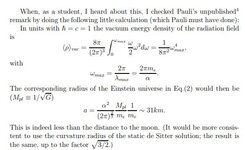
Believe it or not, Wolfgang Pauli carried out a calculation, many decades ago, where he proved that if vacuum energy does exist, then the radius of curvature of the universe must be 31 km.

I think that this kind of argument would be the best way to start a debate with astronomers.

31.jpg

(Pauli's calculation, using what we now know about quantum mechanics, goes even further than that).

That the planets are more than just mere lights in the sky, we know from the accounts left by those who witnessed the last planetary/cosmic cataclysm, where Typhon/Nibiru and Venus almost destroyed the surface of the Earth.

It seems that these two planets and Jupiter can active, directly, the boson strings which flow through the subquark waves, at the end of a world age (700km/hr hurricanes, huge earthquakes, fire drills, pestilences).

The Sun and the Moon can energize the quarks, while the Black Sun and the Shadow Moon influence directly the subquark waves themselves (Allais effect). However, Mercury and Venus are even more powerful.
 
Last edited:
We have two competing timelines in the official chronology of history.

We are told that the motivation for the Gregorian reform was that the Julian calendar assumes that the time between vernal equinoxes is 365.25 days, when in fact it is about 11 minutes less. The accumulated error between these values was about 10 days (starting from the Council of Nicaea) when the reform was made, resulting in the equinox occurring on March 11 and moving steadily earlier in the calendar, also by the 16th century AD the winter solstice fell around December 11.

But, in fact, as we see from the information presented in the preceeding messages, the Council of Nicaea could not have taken place any earlier than the year 876-877 e.n., which means that in the year 1582, the winter solstice would have arrived on December 16, not at all on December 11.

In order to test these hypotheses, both sides had a perfect astronomical occurrence: a total solar eclipse which fell on the vernal equinox (to the day) in the year 1643. Then, nineteen years later, a similar event: a total solar eclipse on March 20, 1662. By that time, there were plenty of well-known astronomers very much able to put the matter to rest once and for all (a difference of five days perfectly noticeable by all parties involved). And both sides had very strong convictions: here was the perfect opportunity for the heliocentrists to destroy geocentrism. And yet, nothing happened, a complete silence from any and all astronomers (D. Cassini did record the total solar eclipse from March 20, 1662, as a casual aside, as nothing out of the ordinary).

What should have been by far the most important astronomical event of the millenium, of all time, a chance to settle once and for all the Gregorian calendar reform controversy, the raging debate on heliocentricity vs. geocentricity, aroused no interest at all from the scientific community at that point in time.

If the date of the total solar eclipse of the spring in the year 1662 AD really had fallen on March 20, the very day of the vernal equinox, then it would have constituted a perfect, total astronomical verification of the Gregorian calendar reform; also a valid proof that the chronology of history, from Hipparchus to Ptolemy and from Exiguus to Clavius, based on the axial precession of the Earth, was correct (thus resolving once and for all the heliocentricity vs. geocentricity debate).
 
In the official chronology of history, the timeline of the discovery of calculus makes little sense. We are told that mathematical analysis had already been developed in India (Kerala school of mathematics) by Madhava and Jyeshtadeva, some 250 years earlier than did Newton or Leibniz. How did calculus reach Europe?

"The famous Matteo Ricci was in the first batch of Jesuits trained in the new mathematics curriculum introduced in the Collegio Romano by Clavius31. He also went to Lisbon to study cosmography and nautical science. Ricci was then sent to India in 1578. While the Portuguese had shifted their headquarters to Goa, the Jesuits maintained a large presence in Cochin (until the Protestant Dutch closed down the Cochin College around 1670). Subsequently many other scientist Jesuits trained both by Clavius or Grienberger were sent to India. Most notable of these, in terms of their scientific activity in India, were Johann Schreck32 and Antonio Rubino33. The former had studied with the French mathematician Viete, well known for his work in algebra and geometry."

Let us suppose now that indeed Ricci and Clavius did learn of the calculus from the translated manuscripts and mathematical texts found in the Malabar coast. This body of knowledge would have been classified at once as a state secret of the highest order; it would have been guarded very closely and divulged to no one. What would the Jesuits teach these formidable tools of calculation freely so that the their enemies would learn of them, and even apply them? The entire storyline makes no sense at all.

Who gave calculus to the Indians? What if the Greeks knew the language of calculus and mechanics well before the Indians did?

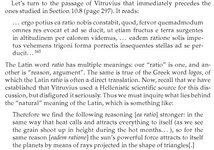
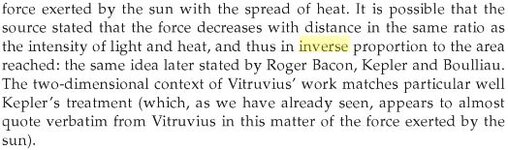
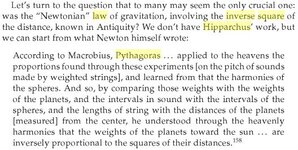
VITRUVIUS' INVERSE SQUARE LAW

vitr1.jpg
vitr2.jpg
vitr3.jpg
vitr4.jpg


Principle of Leonardo da Vinci:

All movement tends to maintenance, or rather all moved bodies continue to move as long as the impression of the force of their motors (original impetus) remains in them.

First law attributed to Newton:

Every body continues in its state of rest, or of uniform motion in a straight line, unless it is compelled to change that state by forces impressed upon it.


Hipparchus and Vitruvius' inverse square law:

The myth of Newton's apple, did Hipparchus discover Newtons gravity and inverse square law? (Hooke and Newton copied the inverse square law)


The Forgotten Revolution (Lucio Russo):

The Forgotten Revolution

Inverse square law: discovered by Vitruvius and Pythagoras
Steam engine: invented by Heron
Centripetal/Centrifugal forces: discovered by Plutarch
Integral calculus: invented by Archimedes

http://www.ams.org/notices/199805/review-graffi.pdf

The Forgotten Revolution
Reviewed by Sandro Graffi

Now, if every heavenly body pulls on every other, this leads to the idea of a dynamic theory of planetary motions, seeing planetary motions as composed of rectilinear inertia and gravitational pull. Indeed we read in Vitruvius: "the sun’s powerful force attracts to itself the planets by means of rays projected in the shape of triangles; as if braking their forward movement or holding them back, the sun does not allow them to go forth but [forces them] to return to it" (297). Pliny likewise has it that planets are "prevented by a triangular solar ray from following a straight path" (298). The reference to triangles suggests an underlying mathematical treatment, and indeed there are further traces of this (298-302). Furthermore, "the technical tool of vector addition for displacements is present in Heron and in the pseudo-Aristotelian Mechanics, and indeed it is used in this latter work to explain how a uniform circular motion can be regarded as a continuous superposition of a displacement 'according to nature', along the tangent, with one 'contrary to nature', directed toward the center." (301-302)


Plutarch and the theory of gravity

http://www.cultureandcosmos.org/pdfs/16/Cappi_INSAPVII_Gravity_before_Newton.pdf


Pythagoras inverse square law and pythagorean triples:

TPISC: The Pythagorean — Inverse Square Connection, Copyright2014, Reginald Brooks. All rights reserved.


Inverse Square Law and Inverse Pythagorean Theorem (theorems 7 and 8 ):

https://www.researchgate.net/publication/333606009_Pi_and_It's_Hidden_Circles


https://physicstoday.scitation.org/doi/pdf/10.1063/1.1306365 (Archimedes' Palimpsest)


A. Fomenko: History: Science or Fiction? vol I

History Fiction or Science? Chronology 1 : Anatoly Fomenko : Free Download, Borrow, and Streaming : Internet Archive

pg 27-28

De Arhitectura by Vitruvius was written during the Renaissance and not two thousand years ago


Now, we know that all of the works attributed to ancient Greece were written during the Renaissance, which for the new radical chronology of history, occurred after 1730 AD.

So, who were the mathematicians and physicists who had such deep knowledge of mathematical analysis, and who wrote the treatises ascribed to Newton, Leibniz, Fermat and much more?
 
Calculus was invented during the 17th century. Calculus was utilized to calculate the angles of the Gizeh Pyramid. That is exactly when that famous pyramid was built.

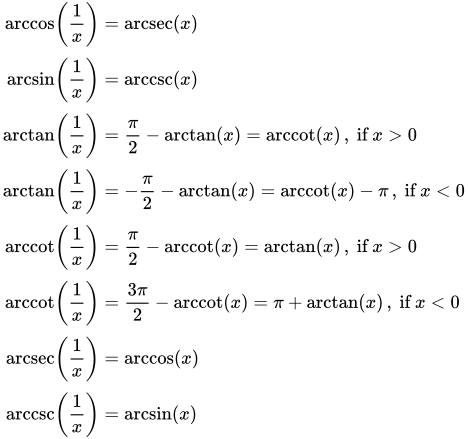
There is no other way to calculate the inverse tangent function of a certain angle (without using a pocket calculator/computer) other than resorting to power series, that is, utilizing calculus. Moreover, one would need a clear understanding of the concept of the radian measure.

The architects of the Giza Pyramid had these choices at their disposal in order to solve the following equation:

TAN X = 1.27330478216 = 0.636652 x 2


1. Maclaurin series in conjunction with the arctan reciprocal formula

1e513f13f671fc98e01e5b25c47a69905ae2fedf


ecb0a376d9148e3cf65ea6e6ed5fb37752a581c7

(equation #3)


51.8554° = 0.907045 radians

1/1.27330478216 = 0.78535

Substituting the value of 0.78535 in the Maclaurin arctan series and solving the reciprocal arctan equation, up to the O(x^11) term we get:

0.905045

This corresponds to a 51.983° value.

Therefore, the builders of the Pyramid must have had at their disposal the notion of the derivative (either the Newton-Leibniz or the Madhava definitions) in order to obtain the arctan Maclaurin series, not to mention the reciprocal arctan equation; even in that case, they had to be able to compute powers of certain numbers, going perhaps all the way to the O(x^17) term (in the Maclaurin series) or even beyond, to obtain a meaningful accuracy.

2. Extended arctangent series

1a65c25333063610ba7ca6aecd562356.png

3. Gauss-Pfaff-Borchardt-Carlson iterative formula

http://www.ams.org/journals/mcom/1972-26-118/S0025-5718-1972-0307438-2/S0025-5718-1972-0307438-2.pdf

This formula necessitates the use of the concept of derivatives for its mathematical proof.

Numerical Methods that Work (pg 6-9)

Other variants of this formula:

http://files.ele-math.com/articles/jmi-09-73.pdf

A more advanced look at this approach:

https://www.math.ust.hk/~machiang/education/enhancement/arithmetic_geometric.pdf

4. My formula

ARCTAN v = 2^n x ((2- {2+ [2+ (2+ 2{1/(1+ v^2)}^1/2)^1/2]...^1/2}))^1/2 (n+1 parentheses to be evaluated)


5.23 + 136.1 + 7.28 = 148.61

5.23 = masonry base = width of the queen's chamber

136.1 = 53.47 x 2.5454

7.28 = 286.1 pyramid inches

[148.61^2 + (233.424/2)^2]^1/2 = 188.962

SIN X = 116.712/188.962 = 0.617648

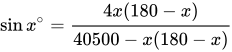
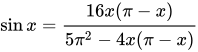
The architects of the Gizeh Pyramid must have had at their disposal the arcsin power series, in order to attain at least three significant digits accuracy.

95f14b98c56e2bd452efa34a7c0d6e0f9542fc70


Not even Bhaskara's formula (or Ptolemy's less accurate table of chords with interpolation approximations) will provide the accuracy needed for the final result (moreover, the second formula involves the radian measure and a very precise approximation of π, using at least 355/113).

c75694bd39c455a7f0a838e8c826592c701ea3b7


6f93842c1e1cce894c281d597de8235a243aa6f3


Substituting the value of 0.617648 on the left side of the equations and solving for x, will lead to an inaccurate result.

In the official chronology of history, ancient Egyptians could barely work out very simple fractions; the 355/113 approximation to π, not to mention raising a number to the 17th power was way beyond their computational capabilities.

51.8554 x 1.618034 = 83.904

1.618034 = PHI

83.904 x 0.6366 = 53.413

53.413 x 0.2548 = 13.61

0.02544 = one sacred inch (0.636/25)

136.1 = height of Gizeh Pyramid without the masonry base


Relationship between the two angles:

The other angle of the triangle, 38.145 degrees, is also closely related to the sacred cubit:

38.13 = 60 sacred cubits

And 51.85/38.1 = 1.361 - therefore, all these measurements/dimensions must have been known well ahead of time to the arhitects of the Gizeh Pyramid; but in order to have the actual angle values, they needed to calculate the arctangent of two sacred cubits.

TAN 51.8554 DEGREES = TWO SACRED CUBITS = 1.27330478216 = 0.636652 x 2


In order to reach the value of 51.8554 degrees, the architects MUST have used the extended arctangent series to achieve the final result.

Just a "very good approximation" won't do it.

One needs the correct value to the fifth decimal, something that can be achieved ONLY by using advanced calculus.


The controversy created by the measurements of the base of the Giza Pyramid made by C. Piazzi Smyth and W.F. Petrie was solved by D. Davidson who discovered the 286.1 displacement factor of the four sides of the base of the pyramid:

I = 35.8 Pyramid Inches
J = 35.8 Pyramid Inches

286.1/8 = 35.7625

The Great Pyramid of Giza - Decoding The Measure of a Monument | Online Version | The Great Pyramid of Giza


http://www.gizapyramid.com/beford article 2.htm

The Great Plan In The Great Pyramid
 
In the official chronology of history, the meter (metre) unit of measure was adopted in 1799 AD in France.

The angle that each face of the Pyramid makes with the base is exactly 51.8554°.

90° - 51.8554° = 38.1446°

pyr1_zps536964c8.jpg

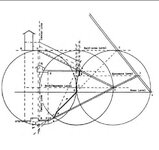
All of the inner and outer measurements of the Gizeh pyramid were determined using three circles each having a radius of 60 sacred cubits = 38.18 meters (one sacred cubit = 0.636363 meters).

The value of 38.18 can only be inferred if, and only if, the 60 sacred cubits are expressed in meters.

Ratio of angles

51.85/38.1 = 1.361

5.23 (masonry base) + 136.1 (pyramid frustum w/o the masonry base) + 7.28 (apex) = 148.61 total height

Again, we can obtain the value of 136.1 meters, if, and only if, we substract from the total height of the frustum of the pyramid, the elevation of the masonry base which is 5.23 meters. The height of the masonry base was obtained, for the first time, in 1985 with the help of the diagram which features the three circles.

The architects of the Gizeh pyramid had to use the extended arctangent series to find the precise values of the angles, but in addition they also knew the value of the most important constant of the eta zeta function (alternating series zeta function): 2π/ln2.

90 - 38.1446 = 51.8554

51.85 x ln2/2π = 2 x 2.86


286.1 is the displacement factor of the Gizeh pyramid.

136.12° radians x 3.81553 = 2π/ln2

That is, 2π/ln2 is the arclength corresponding to the 136.12° expressed in radians multiplied by 6 sacred cubits.


Thus the builders of the pyramid also knew the value of π and made use of the radian measure and of the natural logarithm.

"The concept of radian measure, as opposed to the degree of an angle, is normally credited to Roger Cotes in 1714. He had the radian in everything but name, and he recognized its naturalness as a unit of angular measure

The first mention of the natural logarithm was by Nicholas Mercator in his work Logarithmotechnia published in 1668, although the mathematics teacher John Speidell had already in 1619 compiled a table on the natural logarithm."


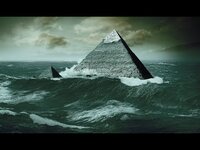
The proofs concerning the fact that the Gizeh pyramid was submerged under sea water for months, up to an elevation of 100 meters, are very precise.

When tourists enter the Grand Gallery and the so-called King's Chamber of the Great Pyramid for the first time, most are surprised to encounter high humidity. In 1974, a joint research project carried out by Stanford Research Institute (SRI International), of Stanford (California) and Ain Shams University, in Cairo, indicated that whereas the bedrock of Giza is dry, the pyramid blocks are full of moisture.

In 1974, a massive 1 million dollar project was launched by the National Science Foundation in the U.S. to locate hidden chambers in the Giza pyramids.

"In 1974, apparently unaware of the pyramid x-raying of Alvarez, the National Science Foundation launched another attempt to x-ray the pyramids.

This time the results were published.

The limestone rocks were too saturated with water to allow penetration by cosmic rays."

"Limestone from all over Egypt was tested against Cheops limestone for water content.

The results were that Great Pyramid limestone is UNIQUE because it is saturated with MOISTURE and not found anywhere else in the world.

It is antediluvian limestone."

A Joint Egyptian-American research team conducted electromagnetic sounder experiments during autumn 1974 with the primary objective of locating archaeologically significant chambers in the Giza area. Radio frequency losses in the limestone rock of the area, ranging from 6 dB/m at 10 MHz to 25 dB/m at 150 MHz, appear to preclude much practical application of radio-frequency sounding in the vicinity of Giza. The high losses are contrary to expectations based on samples analyzed before the Giza experiments, but are consistent with later laboratory analyses made at the high temperature and high humidity characteristic of the Giza environment.

(Electromagnetic Sounder Experiments at the Pyramids of Giza. p. iii).

Electromagnetic Sounder Experiments at the Pyramids of Giza

Electromagnetic Sounder Experiments at the Pyramids of Giza

Stanford University

During its autumn 1974 electromagnetic sounder experiments the joint Egyptian-American research team established that high attenuation due to high water content in the limestone of the Giza area precluded many practical applications of radio-frequency sounding for archaeological purposes in that area.

The 10-MHz transmitter and antenna were carried 100 m up the south face of Cheops' pyramid, and placed by the air shaft from the King's chamber:

fig12.jpg
Even when the receiving antenna in the portable receiver was placed next to the air shaft on the south wall of the King's chamber, no sounder signals could be heard through the intervening 50 m of rock.

These scientific facts, which cannot be denied, are corroborated by other discoveries.


The Menkara petrified shallow marine creature

I have found that the extensive erosion patterns at the lower elevations of the plateau are different to the erosion patterns found at higher elevations. These erosion patterns are due to the Necropolis’s inundation by water. The inundation of water reaches a maximum of 75 meters over our current sea level creating a shoreline at the Khafra enclosure that spans all the way across to the Menkara temple. This shoreline is a 2 meter high intertidal range showing pitting and tidal notches due to seawater, wave mechanics, and tidal ebbing. At the lower levels such as at the Sphinx, the Sphinx temple, the first 20 courses of the Great pyramid including the boat pits; we see erosion due to deeper water saturation, where the stone blocks and wall linings have absorbed sea water. As the waters receded and a dry sunny windy climate took place, these megalithic stone blocks started weathering, creating tafoni erosions which are due to the salt chemically reacting and flaking the limestone with pitting formations. During a catastrophic sea surge and the forthcoming water regression, we clearly observe at certain areas such as corners, outlets, and trenches... horizontal indentures due to water force gushing and turbulence. On the top temple blocks we have sediment and alluvium deposits that have collected on the flat surfaces such as seen in shallow sea beds and lagoons, creating an oozing spongy effect due to the water regression that left these deposits.

hqdefault.jpg
 
image-asset.jpg
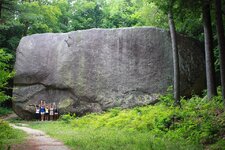
Madison boulder near Conway, New Hampshire, measures 90 by 40 by 38 feet, and weighs 10,000 tons. Unlike the bedrock beneath, it is composed of granite.
"In many places of the world, and especially in the north, large boulders are found in a position which proves that a great force must have lifted them up and carried them long distances before depositing them where they are found today. They are of an entirely different mineral composition than the local rocks, but are akin to formations many miles away. Thus, occasionally an erratic boulder of granite perches on top of a high ridge of dolerite, whereas the nearest outcrops of granite lie far away. These erratic boulders may weigh as much as ten thousand tons, about as much as one hundred thirty thousand people."

"In Britain and Germany are found many such boulders brought across the sea from Norway. Boulders from Finland have been swept over Poland, the site of Moscow, and as far as the River Don. Often they are frighteningly piled up.

Huge blocks from Canada and Labrador lie strewn over North America. Some are plain GIGANTIC.

An erratic boulder in Warren County, Ohio, covers ¾ acre and weighs 13,500 tons (the load of a large cargo ship). And near Malmö, southern Sweden, is a mass of chalk stone 1,000 feet wide, up to 200 feet thick and THREE MILES LONG!"

https://ancientpatriarchs.files.wordpress.com/2019/06/sweden-malmo-limestone-chalk.jpg?w=474&h=328

Glaciers carry stones downhill, not uphill.

Also, erratic bounders are found in places where continental ice could hardly have deposited them… on the Azores, islands separated from the ice cover by a wide expanse of ocean.

Azores islands erratic boulders:

https://books.google.ro/books?id=iGrpHKIdi8IC&pg=PA305&lpg=PA305&dq=azores+island+erratic+boulder&source=bl&ots=ZpgSfZthMP&sig=ACfU3U3lFhrSN10jOATkoGZVN0zxYt8Lnw&hl=en&sa=X&ved=2ahUKEwjWhZGs8tXmAhUjmYsKHU64BO0Q6AEwCXoECAkQAg#v=onepage&q=azores island erratic boulder&f=false

"In Europe, huge rocks (one of them 10,000 cubic feet) were carried from the Alps, across a space now occupied by Lake Geneva, and hurled 2,000 feet up on to the Jura Mountains, where they still sit!"


To explain these facts, the scholars of the first half of the nineteenth century assumed that enormous tides had swept over the continents and carried with them masses of stone. The transfer of the rocks was explained by the tides, but what could have caused those billows to rise high over the continents?

“It was conceived that somehow and somewhere in the far north a series of gigantic waves was mysteriously propagated. These waves were supposed to have precipitated themselves upon the land, and then swept madly on over mountain and valley alike, carrying along with them a mighty burden of rocks and stones and rubbish. Such deluges were styled ‘waves of translation’; and the till was believed to represent the materials which they hurried along with them in their wild course across the country.” The stones and boulders on the hilltops and the mounds of sand and gravel in the lowlands were explained by this theory.


In the heliocentrical setting these enormous tides could have been caused only by a close encounter with another planet.

"The ocean tides are produced by the action of the sun and to a larger extent by that of the moon. A body larger than the moon or one nearer to the earth would act with greater effect. A comet with a head as large as the earth, passing sufficiently close, would raise the waters of the oceans hundreds of meters high."

J. Lalande, Abrege d’astronomie (1795), p. 340, who computed that a comet with a head as large as the earth, at a distance of 13,290 lieues, or about four diameters of the earth, would raise ocean tides 2,000 toises or about four kilometers high.

"The slowing down or stasis of the earth in its rotation would cause a tidal recession of water toward the poles, but the celestial body near by would disturb this poleward recession, drawing the water toward itself. "

"The fact that accumulations of stones were transferred from the equator toward the higher latitudes, an enigmatic problem in the ice theory, can be explained by the poleward recession of the equatorial waters at the moment the velocity of rotation of the earth was reduced or its poles were shifted. In the Northern Hemisphere, in India, the moraines were carried from the equator not only toward higher latitudes, but also toward the Himalaya Mountains, and in the Southern Hemisphere from the equatorial regions of Africa toward the higher latitudes, across the prairies and deserts and forests of the black continent."

A close encounter/collision with another planet, during historical times, nullifies and defies the orbital equations of motion ascribed to the celestial bodies in general (which are based on Newtonian mechanics), and the calculations performed by J. Laskar in particular.

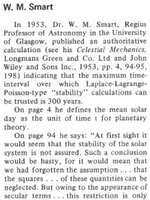
It also illustrates the correctness of the calculations carried out by Dr. Robert Bass and by Dr. W.M. Smart (soon to be posted here).


The Kvarnby chalk quarry from Sweden is three miles long.

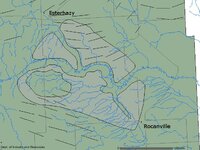
The largest ever concealed megablock/bedrock raft is to be found in Saskatchewan, with dimensions of 30 km x 38 km (volume 60 cubic km, area 1000 square km, maximum thickness 100 m).

Glaciotectonic Landforms and Structures (ch. 6, Megablocks and Rafts)
By J. S. Aber, David G. Croot, Mark M. Fenton

emb.jpg
This map shows the Esterhazy megablock, composed of the Odanah Member of the Pierre Shale, in gray.

"The large masses of Cretaceous bedrock are a puzzling feature of these intertill deposits, and their presence is as yet completely unexplained. The occurrence of these large bedrock masses amid the Pleistocene drift is disconcerting. Slumping takes place with great ease in the soft, easily lubricated bedrock of the area,, but this is not thought to be the cause of their displacement. Slumping should cause more contortion and deformation of the beds than is found, and such extensive but relatively thin blocks would hardly be expected to hold together under such a method of transportation. The chief argument against slumping as then agent of transportation is the apparent lack of proper conditions of gradient necessary to cause such slumping. Shove or pushing by an ice-sheet also seemingly would not allow such widespread thin blocks to retain their shape or even hold together during movement."

1962 Geologic Survey of Canada, A. MacS. Stalker

"The presence of huge slabs of intact bedrock in the drift seems enigmatic and strange in the glacial interpretation. It has been a source of embarrassment to glacialists such as Stalker, who called their presence disconcerting. The glacial theory does not easily accommodate or explain the emplacement of large slabs of rock over drift supposed to have been deposited either directly from ice, or when the proposed ice-sheet finally melted. Where the width to thickness ratio for the bedrock rafts is very large, the idea of glacial transport and deposition is rendered highly unlikely and impractical.

A mechanism for forming similar structures does not seem to exist in existing ice sheets. The presence of bedrock slabs, hundreds of square km in area, being transported in the base of ice sheets in Greenland and Antarctica would show up in seismic profiles, and should be rather easy to detect.

The lateral dimensions of bedrock rafts would probably be limited by the erosion of valleys that cut through them, in the environment of catastrophic erosion due to the currents of retreating flood waters. Also, expansion effects that accompanied the formation of the drift underlying megablocks may have caused lateral movements which could possibly cause extensive rafts to break up into smaller ones.

The sand, clay and gravel of the drift is explained by a disintegration of the sedimentary rocks, during former catastrophic conditions, that accompanied pressure release as overburden was eroded by currents, exposing fresh rock surfaces to lower pressure, and a stress gradient, in which the components of the rocks responded to the altered conditions. The process formed layers as it penetrated from the low pressure surface to the higher pressure."

Formation of the Esterhazy megablock

"While the sediments in the vicinity of the Esterhazy megablock were under hydrostatic stress, an uplift event generated currents which eroded the sediments in the area. Vertical stress was removed by the rapid erosion of overburden. This put the megablock and the surrounding rock under net horizontal compressive stress. Disintegration converted rock surrounding the megablock to drift. The disintegration penetrated deeper on all sides of the megablock, which forms a cap over a raised bedrock platform.

Horizontal compression in the surrounding drift was maintained, because the disintegration was accompanied by expansion. Currents of the retreating flood waters above eroded a valley in the drift, right through the middle of the megablock. This became the Qu'Appelle valley. Erosion and removal of drift in the valley exposed underlying rock to lower pressure so there was further disintegration. The valley was eroded deeper. The erosion removed much of the drift that filled the valley. Meanwhile disintegration also occurred in the buried Rocanville valley south of the megablock, which is roughly parallel to the Qu'Appelle valley, but it was not eroded. The disintegration penetrated to an even greater depth in this buried valley, which was much wider than the Qu'Appelle valley. The depth of the drift here is about 250 m (Figure 8 in Aber, 1989). When the disintegration was penetrating downwards in the buried Rocanville Valley, conditions in the adjacent rock at a particular level were apparently suitable for the disintegration to occur, and so a thin layer of drift was formed at that level, that separated the Odanah Member of the Pierre Shale from its base, forming what is called a megablock."

Have geologists found evidence for a flood?

References on Catastrophic Floods


Flood Evidence in Eastern Washington

Flood Evidence in Eastern Washington


Catastrophic Flood Dynamic Database

Catastrophic Flood Dynamic Database


Michigan's Fossil Whales

Michigan's Fossil Whales

L3ASVPS.jpg
An Erratic Boulder in County Wicklow

"An erratic is a rock or boulder that is found in a location where, geologically speaking, it does not belong. Erratics first entered the scientific arena in the late 18th century when the Swiss geologist and mountaineer Horace-Bénédict de Saussure noticed that the southern slopes of the Jura Mountains were strewn with rocks and boulders of Alpine origin:

One will see that the majority of these stones and boulders are made of granite, foliated rocks, or other rocks of Alpine and primitive origin, while the ground on which they have been deposited is composed of limestone or sandstone, and therefore of a completely different nature. One will observe that these stones and large fragments are only ever found on the surfaces of the limestone or sandstone ridges, and that these same ridges never contain the slightest trace of them in their interiors. On the contrary, if one compares each of these stones with those found in the Alps, one will recognize them almost to the point of being able to identify the very rock from which the stone in question was broken off. One will remark that they do not belong to the soil on which they have been cast, and do not resemble the earth that surrounds them, that this same soil has completely different qualities to them, and finally that one finds none of them on the northern slopes of the Jura, but only on those of its slopes which lie opposite the Alps. After having weighed these considerations, one cannot but recognize that these fragments were not formed in this valley, or on the surrounding mountains; but that they are foreign bodies, adventitious, torn from the Alps, their native land, by a powerful agent, which has transported them, rounded their surfaces and piled them up in confusion. (Saussure §206:201-202)

Saussure had no doubt that this powerful agent was water:

§207: That water was this agent cannot in the least be doubted; because these stones, both large and small, are found deposited on horizontal ridges, mixed with sand and gravel, just as water transports them. For if one sees one of these fragments exposed on a rock, inspection of the site alone clearly demonstrates that rainwater or meltwater has carried off the lightest pieces, which formerly surrounded these large masses. (Saussure §207:202)"

akXInRX.jpg
Pierre à Martin, a large erratic near Ballaison
 
It also illustrates the correctness of the calculations carried out by Dr. Robert Bass and by Dr. W.M. Smart (soon to be posted here).

No historical or astronomical proof exists that before 1700 AD any gradual shift in the orientation of Earth's axis of rotation (axial precession) ever took place. The 10 day cumulative error in the Vernal Equinox date since the Council of Nicaea until the year 1582 AD is due just to the reform of the Julian calendar: if we add the axial precession argument, then the cumulative errors would have added to even more than 10 days, because of the reverse precessional movement.

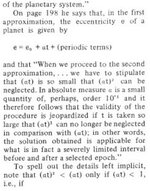
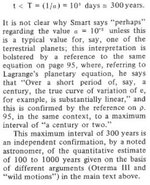
Using only Gauss' Easter formula as a guide, the heliocentrical orbital equations of motion cannot predict the future (or anything related to the past) beyond a time scale of some three hundred years.

Newton agrees with the date of December 11, 1582 as well; moreover, Britain and the British Empire adopted the Gregorian calendar in 1752 (official chronology).

Benjamin Franklin told his readers of the Poor Richard's Almanac to enjoy the extra 11 days in bed and that losing 11 days did not worry him--after all, Europe had managed since 1582.

But in 1752 AD, the error/discrepancy between the false Gregorian calendar reform and the real calendar would have amounted to a full 3 (three) days difference, a thing that could not have been missed by any researcher.

In 1806, Napoleon, we are told, ordered a return to the Gregorian calendar.

In accordance with the Concordat with Pope Pius VII (1742-1823), signed July 15, 1801, a decree put an end to the revolutionary calendar. On 17 Brumaire Year 14 (November 8, 1805) the Minister of Finance announced the January 1, 1806, return to the Gregorian calendar which had been outlawed in October 1793.

But in 1806 AD, the error would have been at least a full 2 (two) days, and no one could have missed this huge discrepancy.


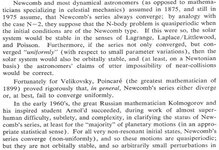
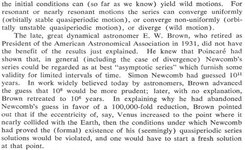
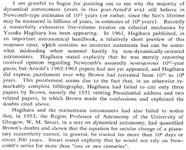
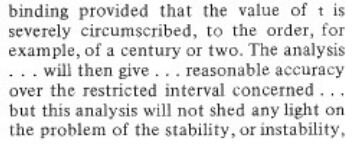
Now, the full mathematical proof of this statement: the interval of assured reliability for Newton's equations of gravitational motion is at most three hundred years.

Dr. Robert W. Bass

Ph.D. (Mathematics) Johns Hopkins University, 1955 [Wintner, Hartman]
A. Wintner, world's leading authority on celestial mechanics
Post-Doctoral Fellow Princeton University, 1955-56 [under S. Lefschetz]
Rhodes Scholar
Professor, Physics & Astronomy, Brigham Young University

Dr. W.M. Smart

Regius Professor of Astronomy at Glasgow University
President of the Royal Astronomical Society from 1949 to 1951


Dr. E.W. Brown

Fellowship, Royal Society
President of the American Mathematical Society
Professor of Mathematics, Yale University
President of the American Astronomical Society


Dr. Bass' basic discovery:

In a resonant, orbitally unstable or "wild" motion, the eccentricities of one or more of the terrestrial planets can increase in a century or two until a near collision occurs. Subsequently the Principle of Least Interaction Action predicts that the planets will rapidly "relax" into a configuration very near to a (presumably orbitally stable) resonant, Bode's-Law type of configuration. Near such a configuration, small, non-gravitational effects such as tidal friction can in a few centuries accumulate effectively to a discontinuous "jump" from the actual phase-space path to a nearby, truly orbitally stable, path. Subsequently, observations and theory would agree that the solar system is in a quasi-periodic motion stable in the sense of Laplace and orbitally stable. Also, numerical integrations backward in time would show that no near collision had ever occurred. Yet in actual fact this deduction would be false."

"I arrived independently at the preceding scenario before learning that dynamical astronomer, E. W. Brown, president of the American Astronomical Society, had already outlined the same possibility in 1931."

Dr. Robert Bass, Stability of the Solar System:

Wayback Machine

bass1.jpg
bass2.jpg
bass3.jpg
bass4.jpg
bass5.jpg
bass6.jpg
bass7.jpg


The astronomers who rely upon Nekhoroshev's theorem regarding the stability of the solar system, must understand that the threshold value of the small parameter ε obtained from various statements of the theorem provide values which, when applied to Solar System dynamics, are very small, and can be hardly compared to the existent perturbations.

Unfortunately, most attempts of application of Nekhoroshev results have turned to frustration. Indeed it is very hard to check if the conditions for the application of Nekhoroshev theorem are fulfilled (in particular the one imposing the non-integrability parameter to be small enough), and to compute analytically the value of the stability time. The results are often unrealistic.

Moreover, any computer-assisted program designed to aid in the verification of Nekhoroshev's theorem does not take into account Professor Bass' basic discovery: observations and theory would agree that the solar system is in a quasi-periodic motion stable in the sense of Laplace and orbitally stable. Also, numerical integrations backward in time would show that no near collision had ever occurred. Yet in actual fact this deduction would be false.

D.G. Saari's theorem (1971) on the collisions in Newtonian gravitational systems suffers from a basic flaw: its very hypothesis stipulates that inverse square law of attractive gravitation plays a crucial role in the proof of the result: it is thus linked to Kepler's fake astronomical data, not to mention counterexamples to attractive gravitation (Allais effect, Biefeld-Brown effect, quantum entanglement gravitation - aether wormholes).

https://web.archive.org/web/2012091...noventek.com:80/Bass1975CanWorldsCollideR.pdf
https://web.archive.org/web/20120916174741/http://www.innoventek.com:80/Bass1974DidWorldsCollide.pdf
https://arxiv.org/ftp/astro-ph/papers/0209/0209276.pdf

Three body problem paradox:

https://www.theflatearthsociety.org/forum/index.php?topic=30499.msg1774581#msg1774581

How Kepler fudged/faked the data in Nova Astronomia:

https://stolenhistory.net/threads/new-radical-chronology-of-history.3767/page-2#post-35850

And Simon Newcomb was correct with regard to another related matter.

Is it not demonstrated that a true flying machine, self-raising, self-sustaining, self-propelling, is physically impossible?
— Joseph LeConte, November 1888

I can state flatly that heavier than air flying machines are impossible.
— Lord Kelvin, 1895

I have not the smallest molecule of faith in aerial navigation other than ballooning, or of the expectation of good results from any of the trials we heard of. So you will understand that I would not care to be a member of the Aeronautical Society.
— Lord Kelvin, 1896

The demonstration that no possible combination of known substances, known forms of machinery and known forms of force, can be united in a practical machine by which men shall fly along distances through the air, seems to the writer as complete as it is possible for the demonstration to be.
— Simon Newcomb, 1900

Flight by machines heavier than air is unpractical and insignificant, if not utterly impossible.
— Simon Newcomb, 1902

Simon Newcomb, directed the American Nautical Almanac Office, professor of mathematics and astronomy at Johns Hopkins University, founder and first president of the American Astronomical Society, vice-president of the National Academy of Sciences.

http://www.garfield.library.upenn.edu/essays/v3p167y1977-78.pdf

The Outlook for the Flying Machine


It turns out that Simon Newcomb was correct in his assertions.

View: https://drive.google.com/file/d/1odAffPmcOhVX9D7wVXXiCS7caNOZywXg/view


Scientific American, February 2020

No one can completely explain why planes stay in the air

By Ed Regis


There is only one physicist who was ever able to explain why airplanes stay in flight. He even invented the jet engine: Viktor Schauberger.

Advanced Flat Earth Theory (V. Schauberger effect, jet engine levitation, part I)
 
Last edited:
A tremendous geological/astronomical upheaval occurred during the 18th century (new radical chronology of history).

Before the occurrence of this cosmic tribulation, California was depicted as an island on over 250 maps prior to 1760 AD.

Before the great upheaval, Siberia had a subtropical climate; after the cosmic cataclysm, Siberia was covered by ice, and the Golden Horde could no longer defend/protect its territories (this is the reason why a large portion of the territory depicting North America is shown as no man's land, since before 1760 AD the Golden Horde would not permit any European explorer to make maps/detailed surveys of their region).

serp.jpg

https://searchworks.stanford.edu/catalog?f[collection][]=zb871zd0767

Glen McLaughlin, California as an Island Collection, 708 items

G. McLaughlin published 249 of these maps in "The Mapping of California As An Island: An Illustrated Checklist ". The entire collection includes over 750 maps.

So, unless there was a colossal stone skipping project (either at the end of the 18th century, or at the beginning of the 19th century) using either ball lightning technology or massive labor for the necessary land mass, historians are going to have to accept the undeniable fact that before 1760 AD California was indeed an island, and that a tremendous geological upheaval pushed the Pacific coast eastward about 200 miles during the same time period.

I hold it to be certain and proven that the whole Kingdom of California discovered on this voyage, is the largest island known or which has been discovered up to the present day, and that it is separated from the provinces of New Mexico by the Mediterranean Sea of California, which some call "Mar de Cortes"

Antonio de la Ascension, assistant cosmographer for Vizcaino's voyage

Wagner, Spanish Voyages

original.jpg
Map of North America (1719 AD), Herman Moll (England's foremost cartographer of his day, geographer to the King)

“California is undoubtedly an island. Why, I have had in my office mariners who have sailed round it.”

Herman Moll, 1711 AD

81020a_2048x2048.jpg
Map of California, 1705 AD, Nicholas de Fer (the most well-known mapmaker of France of his day)

cal1.jpg
cal2.jpg
cal3.jpg
cal4.jpg
cal5.jpg
cal6.jpg
cal7.jpg
cal8.jpg
cal9.jpg
cal10.jpg
cal11.jpg
cal01.jpg
800px-California_island_Vinckeboons5.jpg
Virtually all modern historians simply state that these maps are in error; however, all of these 250 maps portray North America accurately.

Even the proponents of the new chronology of history (Fomenko/Nosovsky) are faced with a dilemma, and also declare that these maps were drawn erroneously. However, they are baffled when they examine the revealing details of these maps, which cannot be denied.

Other researchers have said that these maps belong to an ancient advanced civilization which had the scientific tools at its disposal to create them. Yet, these maps obviously were in common use during the first decades of the 18th century and they do not feature anything out of the ordinary which would not belong to that time period (cartography, geography).

In order to explain the monumental discrepancy featured on these maps (California being depicted as an island), historians in the 19th century invented the legend of Eusebio Kino (the priest who walked from New Mexico to California in 1705 AD). However, as has been precisely proven, there was no Gregorian calendar reform in 1582 AD.
 
An intriguing analysis of Johannes Vingboons' map (1650 AD) by Donald Mark Kennedy.
800px-California_island_Vinckeboons5.jpg

"The Grand Canyon does not appear on any maps of California as an island that I have found, and is certainly not on the map used for this study, the Vingboons map of 1651. In fact, on the Vingboons map, two rivers cross the location of the Grand Canyon.

An even greater problem is that the map also had to predate the uplift of the Nevada-Utah-Wyoming area that followed the end of the latest continental drift event in North America.

The routes of rivers changed. The Rio Grande, shown on the Vingboons map as the Rio de Norte, which used to flow into the Gulf of California, was forced to flow to the Gulf of Mexico. The map places a geologically recent date on continental uplift, the uplift having happened after the map was made, putting it within the historical presence of humans on earth.

In the following series of articles, I analyze the Johannes Vingboons "California as an Island" map area by area. I show that the makers of the original map possessed a detailed knowledge of the geography of western North America. Correlation of features on the map to actual locations demonstrates that the map is very accurate.

The coast of Mexico south of Hermosillo is portrayed close to how it looks today, but with some significant changes due to either an increasing land elevation or a decreasing ocean level (or both) of as much as a few hundred feet. the mountain range on the west side of the Rio del Norte turns out to very accurately map the Wasatch mountains, after one shifts them north three degrees to the correct latitude.

On the sides of the map are latitude marks in degrees. We will find that Vingboons' latitude scale must be shifted in varying amounts because his source maps were in sections pieced together and some sections were not properly placed. But within each area the map is exceptionally accurate, far more accurate than a Spanish explorer in the 1500s could produce.

Besides the obvious fact that California is separated from the mainland, there are a number of other things to note: the Rio Del Norte running prominently south from the lake in Wyoming empties well south of where the Colorado River meets the gulf today, and so is not the Colorado. As we shall see, the path of the central part of the Rio Del Norte matches exactly to the path of the northern part of the Rio Grande, which is also called Rio Del Norte, oddly enough. Also note there is no Grand Canyon or Sierra Nevada range. In fact there are two rivers running through where the Grand Canyon is located. The lack of the Grand Canyon indicates this map was made before the end of the ice age, before the Great Basin area (Utah and Nevada) glaciers broke through their ice dam and carved the canyon in a very short time.
20island%20-%20Rio%20del%20Norte%20southern%20half.jpg


Following the river valley up from Hermosillo we find ourselves following a transverse river valley, cutting through the mountain ranges at right angles. This river valley is now home to the Rio Sonora. This is the path Coronado took on his campaign of conquest in 1540, (The Coronado Expedition to Tierra Nueva, Richard Flint, page 77) Why didn't Coronado mention a river flowing all the way from Hermosillo to the Rockies? And if this river is just a creation of Vingboons or someone else of that time period, how is it that it lines up so well with the delta at Hermosillo and traces the path of the Rio Grande through the Rockies?

Notice where the river intersects the present day Rio Grande just south of "Truth or Consequences", New Mexico (northwest of El Paso). From this point north, the alignment between the Rio del Norte and the Rio Grande is undeniable. We can follow the river up into the large ellipse of the San Luis Valley in southern Colorado, where the Rio Grande turns west. We have a map of the northern part of the Rio Grande long before this area was explored by cartographers equipped to make such a map. Where did this information come from?
%20island%20-%20Rio%20del%20Norte%20thru%20Rockies.jpg

Looking at the entire path of the river, if the Spanish, or other post-Columbus explorers provided the information for Vingboons, why didn't they show the modern path of the Rio Grande, emptying into the Gulf of Mexico? And if they didn't provide the information, then who did? And when? How long ago did the Rockies empty into the Gulf of California?

The Rio del Norte originates from a large lake and drains a large part of the country into the Gulf of California, so we would assume it to be a major river. We would expect to find some evidence of a river delta if we went down the coast of the Gulf looking for it. And indeed, we find at Hermosillo more than we expected. (It was necessary to rotate this part of the Vingboons map by six degrees counterclockwise to align the Vingboons map with the terrain view from Google Earth.)

Hermosillo lies at the top of a delta that extends nearly fifty miles along the coast of the Gulf of Mexico. The delta is comparable in size to the delta of the Mississippi or the Colorado. There is not another delta like it on the Gulf of California coast. The entire delta is being farmed, due to its good quality alluvial soil.
california%20as%20an%20island%20-%20Hermosillo.jpg


This delta was not formed by the present day Sonora River, because I don't believe that the Sonora River drains nearly a large enough area to produce such a delta. The Mississippi river drains a huge area and has no larger of a delta.

Vingboons' coastline of the river at Hermosillo matches up well with the modern banks of the channel in which Hermosillo lies. The bends in the Sonora river match with Vingboons' river also. This information could have been obtained from the Spanish, although, as I have mentioned elsewhere, they would not have given it to him, and they probably didn't have it, as they no details of inland geography show up on any maps of this area that I have found.

Finally, it is obvious that the Vingboons coastline is quite a ways inland of today's coastline. The current elevation of the Vingboons coastline shows that the ocean would have had to have been about 300 feet higher along the delta. The removal of water from the ocean by the current polar ice caps might be have caused this, placing Vingboons's source map before the ice age. Or an upward movement of the tectonic plates could have lifted this entire area as it did all of Nevada, Utah, and Colorado. The Great Basin area of Nevada-Utah-Colorado was uplifted by over 7000 feet, so 300 feet here would not be too hard. The "Gulf of California eastern shore" page looks at the Vingboons coastline south of Hermosillo. We find that it also can be aligned with a line well inland of the present coast corresponding an ocean level about 300 feet higher.
ornia%20as%20an%20island%20-%20wasatch%20mountains.jpg

Looking on the map to the west of the Rio del Norte, we find a mountain range that, when overlaid on the Wasatch mountains of Utah, fits beautifully. Note the alignment of both the Snake River Valley, and the Great Salt Lake. Note the ends of the range on the map line up exactly with the actual north and south extents of the range. The extension of the mountain range to the west lines up with Matterhorn Peak in the Humbolt National Forest, northwest of the Great Salt Lake.

To line up the map's mountain peaks with the actual latitudes of the Wasatch mountains, it was necessary to shift the map image about three degrees north from Vingboon's coordinates. This need for a shift occurs in other areas of the map and is evidence that Vingboon's source map was made from smaller maps pieced together. It is also evidence that Vingboons was not using maps or observations from contemporary sources, or they would have reported the correct latitude.

What then was the source of information when the first California as an Island map was published in the 1620s, or Vingboon's information in 1650? This area was not explored by western people until the following century, and even then the information was not made public until the 1800s:

"Several expeditions,including those of Father Eusebio Kino, José de Urrútia and Nicolás de Lafora, and Father Silvestre Vélez de Escalante, had explored large parts of the southwest. However, the geography of this region remained virtually unknown outside the Spanish empire, since the maps and accounts of Spanish exploration remained in manuscript and were not published. Not until the beginning of the nineteenth century, when the noted German geographer Alexander von Humboldt visited Mexico City and was given access to the Spanish archives, did this information become more widely available."

Obviously a very good map of the Wasatch range was made by someone well before 1620.
ifornia%20as%20an%20island%20-%20Rocky%20Mountains.jpg

Try as one may, and I have, one cannot align the Rocky Mountain range on Vingboons map with our Rocky mountains. There is just no mountain range to the southeast of the Rockies that sticks out into northern Texas and Oklahoma. Having worked the problem over for hours, I finally sat back to try to look at the problem from a different direction. That's when pieces suddenly came together: There is a ridge at the southern end of the great plateau that runs across northern Arizona and New Mexico. I had not found a corresponding mountain range on Vingboons map, but had put the problem aside. Now I noticed that the west end of this ridge curves down and then runs east. Hmmm... the south end of Vingboon's Rockies curves down and then east. Could it be? Let's try taking the southern half of Vingboons' "Rockies" and shifting them west into Arizona.
20island%20-%20Rocky%20Mountains%20southern%20half.jpg


One could not ask for a better fit. We have to raise the section about one degree north, but we have had to do that to other parts of the map already. The person who put together Vingboons' source map simply got a piece in the wrong place. How were they to know? They had never been there. The original mapmakers who had divided up their main map into smaller detailed sections had chosen to split it at a logical break in the mountains at Arizona's northern border.

The eastern shore of the Gulf of California is detailed, on Vingboon's map, with rivers that start in the mountains and run straight southwest to the ocean. Apparently the Spanish names of the rivers were available to Vingboons, because he includes them on his map. As usual, Vingboons seems to be using the Spanish explorer's latitudes of the rivers and towns to place labels on the map.

We can use the rivers as landmarks to make sure we are in the right place. However, the ocean level has lowered or the land has risen several hundred feet since Vingboons' source maps were made, with the result that Vingboons' shoreline is shown well inland of where it is today. It was frustrating trying to match the old map to the new until I understood this.

As reference points, Rio del Norte is lined up with Hermosillo, and the fork in the forked river in the lower left is lined up with the fork in Vingboon's forked river. Shifting the Vingboons map the usual one degree south for this area, we arrive at this view.

20an%20island%20-%20Hermosillo%20coastline%20south.jpg

The coastline between Hermosillo and Guaymas runs along a north to south ridgeline. The coastline turns in to run up into the valley just east of Guaymas, then back south to go around a small hill, then back up the next valley and so on. The match is excellent, it's just that Vingboons' coast matches where the coastline would be if the ocean level were about 300 feet higher. How did he do this from Spanish exploration records? Why would he do this from Spanish exploration record? Obviously he would have no reason to. When was the ocean 300 feet higher? Before the polar caps formed, in the days that Hapgood shows us the mountains under the Antarctica ice cap were mapped, before the ice age, and before the Atlantic Ocean floor cooled and sank.

This exercise can be continued south down the coast but from here we will proceed north toward the most interesting part of the map, the four islands.

rnia%20as%20an%20island%20-%20three%20degree%20gap.jpg

When we try to follow the coastline south from the Phoenix area, we suddenly discover a big problem: the mouth of the Rio del Norte at Hermosillo is in the wrong place. I eventually discovered that there are three degrees of latitude missing somewhere between these two points. I believe the gap should be placed just south of Phoenix as I have shown on the map here. The coastline I have marked in green is the section that needs to be lowered. I have shown it in red at the bottom of the map where it should be.

But what do we do about the missing three degrees? I don't think it is a coincidence that the amount of shift, three degrees, is the difference between the existing north end of the Gulf of California, and the location of the north end of the Gulf found on some maps from the 1500s. I also don't think it is a coincidence that the location of the top of the gap at the latitude of Phoenix corresponds to the latitude of the north end of the Salton Sea. Polk has a map (page 150) by Domingo del Castillo made in 1541 that shows the top of the Gulf of California at 33.5 degrees latitude. That is the latitude of the north end of the present day Salton Sea. Looking at elevations of this area on Google Earth, it looks like the land needs to be only about 40 feet lower for the Gulf to encroach all the way to the Salton Sea. Check into the USGS map of earthquakes in California and you will find that the fault on the west side of the Imperial Valley is one of the most active in the country. A forty foot change in elevation over time is not out of the question. If Vingboons, or whoever put the maps together, had conflicting maps of this area showing a three degree difference in the location of the north end of the gulf, it could have been the cause of his arranging the maps with the Wasatch mountains three degrees too far south, and the other related errors.
california%20as%20an%20island%20-%20four%20islands.jpg
%20as%20an%20island%20-%20island%20A%20enlargement.jpg

Now we will venture north from the Gulf of California into what will be the most fascinating areas of the map: the channel separating the island of California from the continent. The locations of the four islands in Vingboons' passage prompted this entire study. My stumbling on their locations was as much divine guidance as perseverance. Once one figures out some reference points, the process of identifying ancient map features within the modern mountain terrain is much easier.

This is a very busy section of Vingboons' map. Let's start with an easy to see reference point, and one of the jewels of the map, the northern island, which I have dubbed Island A. I was happy to find exactly what I was looking for, but I didn't expect such a good fit. For reference, at the southern end of the island is George BM peak. The mountain range extending north from George BM forms the east side of the island. A prominent peak whose name I have yet to find marks the northern tip. The west side of the island is formed by the next range to the west. The valley between the two ranges causes the characteristic dent in the north end of the island.

Other features line up well with the modern landscape. The lake, Lago de Ora, lines up with with the valley containing Lund, Nevada, just southwest of Ely. The second from north island, which I have dubbed island B, lines up with with Burnt Mountain, near the nuclear testing facility. In general identifying exact features on the western shore of the passage is difficult, but here at least, the Weepah Hills, west of Tonapah look like a good fit with the bulge in the coastline. The entire inland passage has suffered a huge upheaval of thousands of feet, so getting even a general fit is gratifying. As has been the case for most of the map, alignment for this section required shifting Vingboon's map about one degree north. The Vingboons map was also rotated two degrees clockwise.

On the coastline between Island B and Lago de Ora (the lake east of island A) is a point of land that matches well with Stairstep Mountain in Humboldt National Forest.

Island C, third from the north, matches very nicely with Mt. Charleston, just west of Las Vegas, NV. Just east of Las Vegas is a point of land that corresponds to Muddy Mountains on the west side of Lake Mead. The north branch of the lake follows what Vingboons labels Rio de Anguch, which drains what is now Nevada desert.

Island D lies at the southern tip of Nevada, and has no distinguishing mountain, so I suppose it was just a flat sort of island that blends in with the terrain now.

Just east of island D is a point of land that matches up with Hualapai Mountain, just southeast of Kingman, AZ. And just off the tip is an island that matches up with a little bump of land that has no name on Google Earth or Google maps, but it is a good match all the same. This point of land is the west side of an inlet that Vingboons names R. del Thicon or Thiron (I have trouble with some of Vingboons letters). This river may have gotten its name from the Rio del Tizon that Hernando de Alarcon sailed up to sometime shortly after 1538 (Polk, page 146) which was probably the Colorado before it enters the Grand Canyon. This river extends north through the pass at the Finger Canyons of Zion National park, just northeast of St. George, UT to the Salt Lake area where it drains an area that is now landlocked. There will be a better view of this in "The North End of the Passage" section. This river also passes right through the middle of the Grand Canyon. This presents a problem, for either the mapmakers missed the Grand Canyon, which is hard to believe, or it wasn't there yet. And if it wasn't there yet, then, as I mentioned earlier, this map predates the end of the ice age, for it was the breaking of the ice dam at the end of the ice age that drained the great lake to the north east and carved the Grand Canyon. To add to the mystery, the other river branching off the inlet, R. de Coral, also crosses the Grand Canyon, giving us a second instance of the same problem."
20-%20inland%20east%20coast%20boise%20to%20pheonix.jpg

"Now let's look at the eastern side of the north end of the inland passage. I have shown the entire east coast from Phoenix at the south end to Boise at the north in order to show that the map scale is consistent throughout the entire east coast of the passage. The islands line up correctly, as does Phoenix at the south end of this map. The background map is from Marble with Mercator projection, which gives very good alignment with Vingboons all the way up the east coast.
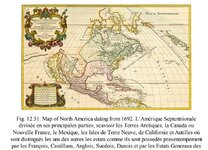
The north end of Vingboons' eastern coastline fits nicely into the valley that Boise, Idaho rests in. The little bit of coastline north of Boise follows the base of the mountains. The bump in the coastline just southwest of Boise wraps nicely around the Owyhee mountains in the southwest corner of Idaho. Vingboons' unnamed river northeast of the north most island runs northeast up the valley toward Elko, Nevada. Today a river runs down this valley through Elko. To the north of Boise the Vingboons map trails off into nothingness. However, some other maps of the time, such as the Sanson map of 1657, show a rectangular peninsula pointing west from the end of Vingboons' coastline. I have so far avoided branching off into other maps because this project was so large by itself, but here I will just point out this one feature. The name of the peninsula on the Sanson map is Agubela de Cato. It points generally northwest on Sanson's and most all other maps of the era, but it points more southwest in the Louis Hennepin map of 1697 (or 1698 depending on your source). I think that it matches up well enough with the rectangular plateau northwest of Boise to be more than a coincidence. You can see the plateau in the very upper left corner of the above image.
California_island_Vinckeboons%20northern%20coast.jpg

This section has been rewritten extensively as I now better understand what the map is telling us about the changes to the Pacific coastline over time. Since the map was made, the Pacific coast has been pushed eastward about 200 miles. The area that was pushed eastward extends from Point Concepcion at the south end to the top of the island at the north. This section of the coastline bears no relation to today's coastline.

The oceans were about 300 feet higher at the time the map was made. As the ocean level dropped, the lower levels of the mountains north of this flat coastline were exposed, with Willamette Valley between the two ranges. A great deal of variations in other California as an island maps can be accounted for by changing ocean level during the ice age, as the ocean water was transferred to the land in the form of the great glaciers, and as the Atlantic Ocean floor gradually dropped after the flood. Equally important would have been the uplift of the western states caused by rising magma under Yellowstone.

The salt lakes east of the northeast corner are evidence that there was a lot of salt water left there after the ocean receeded.

South on the Pacific side from the flat island top, we find the section from the top of the map to Point Concepcion that extends 200 miles farther out into the Pacific than it does today. Because the geography of the coastline is so different from the present day, the Vingboons map of the central coast of California offers no points of alignment with modern landmarks. Vingboons adorned this section of the coast with many names of features that could not have had any resemblance to what the early explorers saw, but gave the ancient features the names given by the Spanish to the modern features found by the Spanish at each latitude.

What caused this 200 mile eastward movement of the coastline? While changing ocean level played a small part in the shape of the coast, the biggest cause was plate movement of the Pacific seafloor. Two significant rifts extend across the Pacific, starting at the Hawaiian Islands chain and meeting the continent near Eureka and Point Conception. These rifts do not stop at the Pacific coastline. The northern rift continues to the Atlantic Ocean at New York, and the southern rift continues to the active earthquake zone at the coast of North Carolina. These rifts gradually buckled the continent from east to west, starting during the Flood with the Appalachians. The Rockies were pushed up next, after the flood, then the Wasatch range and the folded ridges of Nevada. Finally, later, after the Flood, and after the Vingboons map was made, the Sierra Nevada and California Coastal ranges were pushed up. The formation of these last two ranges pushed the coastline of the map east by over 200 miles to where it is today.
california%20as%20an%20island%20-%20baja.jpg

The latitude of the southern tip of Baja lines up exactly with the true latitude. This is reasonable given that most of the Spanish activity in the area was inside the Gulf of California, so it was a well known feature. The shape of Vingboons' map, however doesn't really look like Baja California as we know it. Interestingly, though, it does look quite a bit like the Baja continental shelf. For the Spanish to map the continental shelf and send that information back to Europe for Vingboons to put it on his map obviously would never have happened. But due to changing ocean levels the ancient mapmakers saw a much different coastline than we see today. That the Vingboons coastline follows the continental shelf implies that in this area, since the ocean level was higher by 300 feet, the peninsula was even more than 300 feet higher and has since sunk considerably. There may be a geologic connection to the continental shelf off Southern California sinking a couple thousand feet."
 
http://californiaasanisland.org/
The best work on the California as an island maps matter.

No other researcher on the subject of the new chronology of history (including Fomenko/Nosovsky) would dare to acknowledge that as recently as 1760, California was actually an island. With my exception. That is when the Grand Canyon was formed and Siberia became a frozen desert: 1761-1769 AD.

That is when the last great cosmic/geological cataclysm occurred (end of age #4).
 
Tips
Tips
Please respect our Posting Rules.
Back
Top