Note: This post was recovered from the Sh.org archive.
Username: Mabzynn
Date: 2019-05-27 21:18:05
Reaction Score: 5
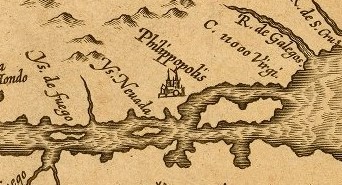
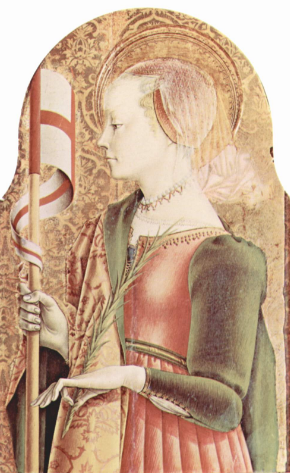
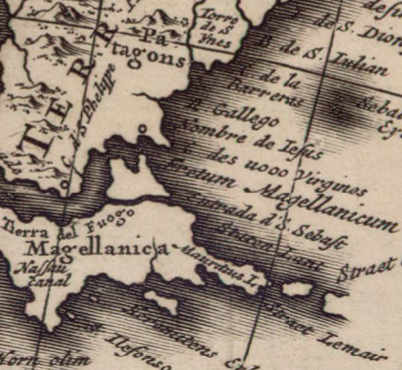
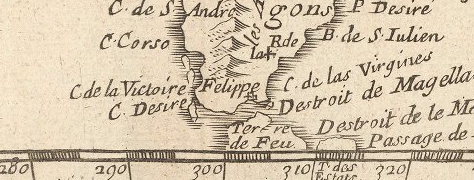
side note - Is that C. 11,000 Virginum really marking the location of 11,000 virgins? I thought Saint Ursula was in Cologne.
From wiki: Her legendary status comes from a medieval story
[5] that she was a princess who, at the request of her father King
Dionotus of
Dumnonia in south-west Britain, set sail along with 11,000 virginal handmaidens to join her future husband, the pagan governor
Conan Meriadoc of
Armorica. After a miraculous storm brought them over the sea in a single day to a Gaulish port, Ursula declared that before her marriage she would undertake a pan-European
pilgrimage. She headed for Rome with her followers and persuaded the Pope,
Cyriacus (unknown in the pontifical records, though from late 384 AD there was a
Pope Siricius), and Sulpicius,
bishop of Ravenna, to join them. After setting out for Cologne, which was being besieged by
Huns, all the virgins were beheaded in a massacre. The Huns' leader fatally shot Ursula with a bow and arrow in about 383 AD (the date varies).
Looks like "Conan Meriadoc" could have been a pagan governor in America.
Edit nevermind:
The source above
The Spanish Lake - OAPEN states Magellan named it this after St. Ursula.
Anyway, here's more:
This guy then copied it:
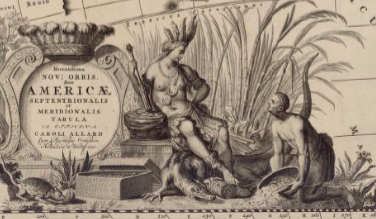
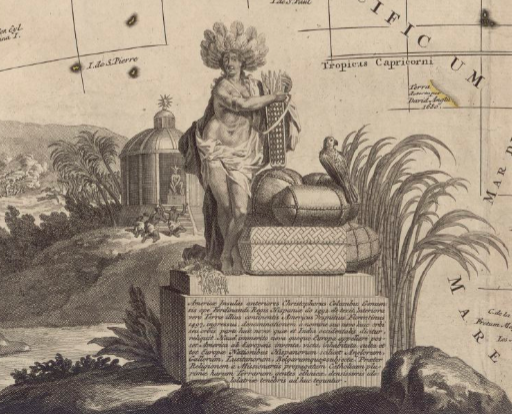
Zuerner, Adam Friedrich (1680-1742).
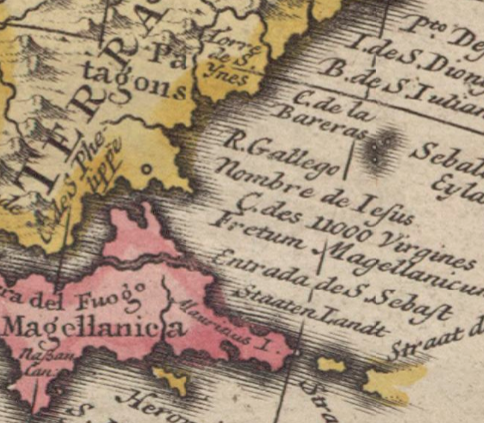
Changed this part and adds a part about Christopher Columbus in 1492.
Another:
Sanson, Guillaume (i668)
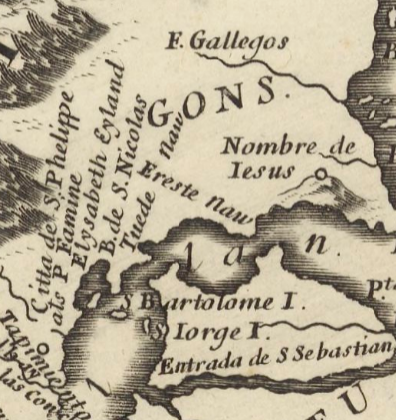
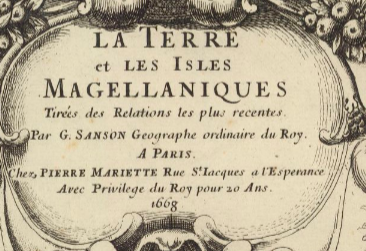 La Terre et les Isles Magellaniques tirées des relations les plus récentes / par G. Sanson,... | Gallica
Duval, P. (Pierre), 1619-1682, cartographer.
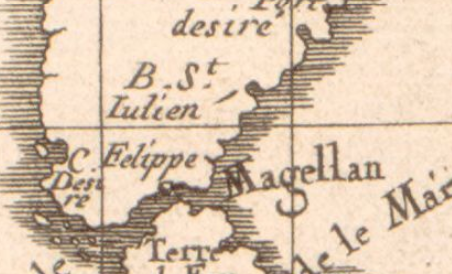 Carte vniverselle du commerce, c'est à dire carte hidrographique, où sont exactement decrites les costes des 4 parties du monde, avecque les routes pour la navigation des Indes occidentales et orientales
H. Jaillot, 1694.
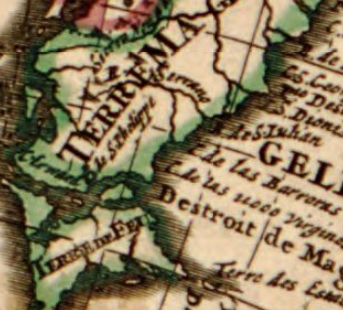 Nova orbis tabula, ad usum serenissimi Burgundiae Ducis
Contributor Names: Nolin, Jean Baptiste, 1648-1708.Bocquet, Nicolas François, -1716.
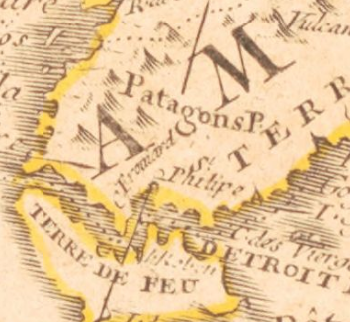 Le globe terrestre représenté en deux plans-hémisphères : dressé sur la projection de Mr. de la Hyre de l'Académie Royale des Sciences, et sur plusieurs routiers et mémoires des plus habiles pilotes et savans voyageurs le tout rectifié et calculé selon les dernières observations, et dédié à Mgr. l'Abbé Bignon, conseiller d'état ordinaire
Contributor Names: Duval, P. (Pierre), 1619-1682. Berey, Nicolas, 1606-1665.
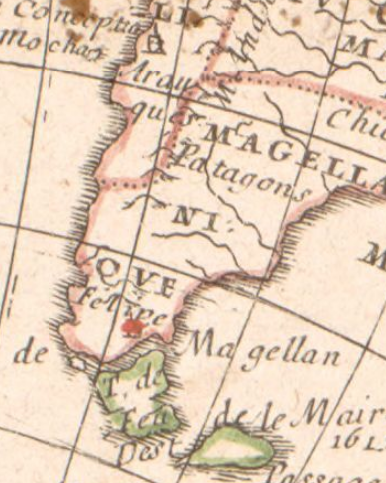
The Spanish Lake - OAPEN
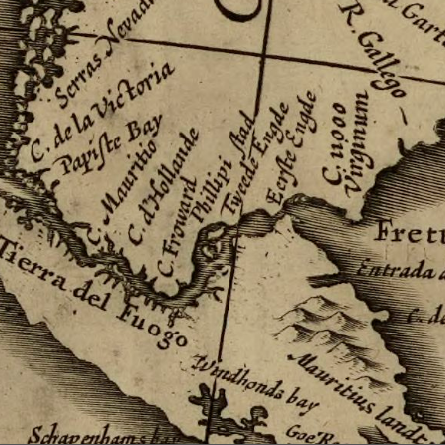
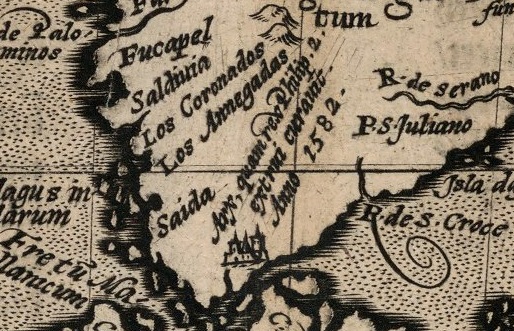
If you go to page 277 in here it suggests that Philippopolis may be more commonly known as Sarmiento. It may have been a colony, set up by Magellan.
Edit - it appears that Sarmiento set up the colony at Philippopolis as opposed to being an alternative name. There are loose references to giants, gold, a dream of a city, a reality of wretched colonists, an Indian called Tupac. Not much detail but plenty of fill around the edges.
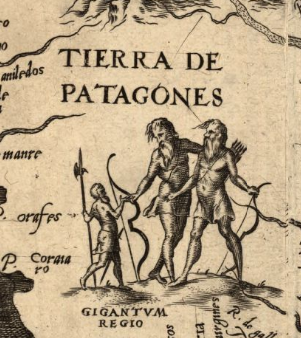
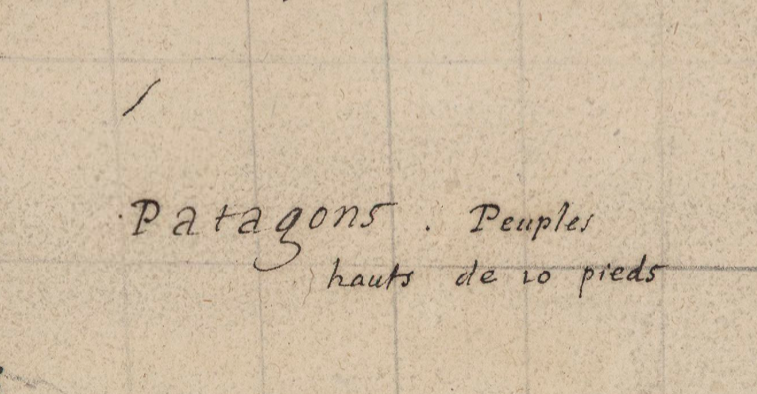
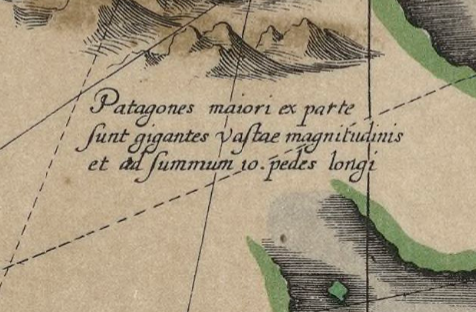
The giants are here:
It looks like the giants were killed off by the 1580's.
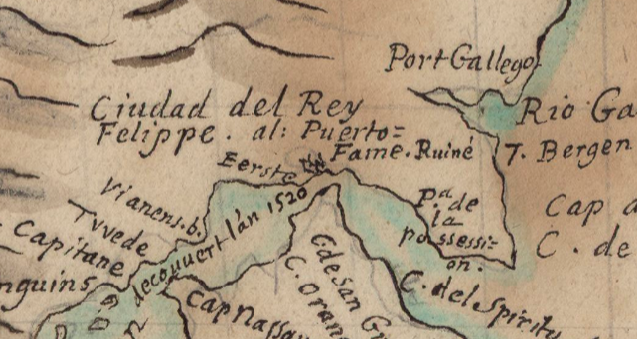
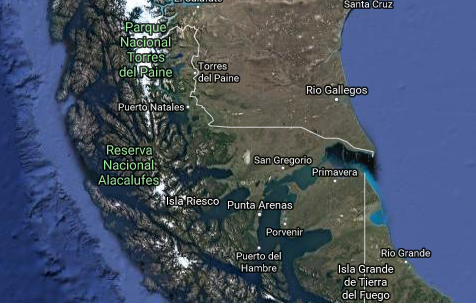
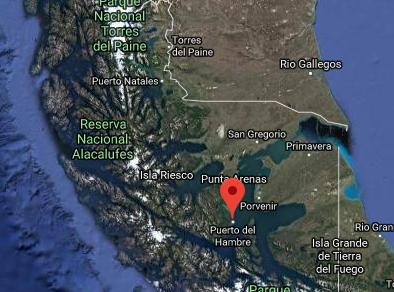
From Wiki: In March 1584 Sarmiento founded the Spanish settlement of
Rey Don Felipe with around 300 settlers. Conditions were harsh and local vegetation sparse, and the settlers starved or froze to death. When the next English navigator,
Thomas Cavendish, landed at the site in 1587, he found only ruins of the settlement. He renamed the place "Port Famine". In the 19th century, it was developed as a naval base used by the British
Royal Navy. The name was subsequently translated into Spanish as
Puerto Hambre or
Puerto del Hambre, and these names are still in use.
According to archeological finds in the 1970s, the base established by Cavendish was located in the Bahía San Juan, just south of the Bahía San Blas where the Ciudad del Rey Felipe had been.
This area was influenced heavily by Sebalt de Weert a Dutch East India Company man:
From Wiki: During De Weert's time in the Magellan Straits there were some anthropologically noteworthy events that are associated with him. One instance of which is that De Weert and several crew claimed to have seen members of a “race of giants” while there. De Weert described a particular incident when he was with his men in boats rowing to an island in the Magellan Strait. The Dutch claimed to have seen seven odd-looking boats approaching with were full of naked giants. These giants supposedly had long hair and reddish-brown skin. The Dutch claim to have shot three of the giants dead with their muskets before the giants finally retreated to the shore. On the shore the giants were apparently able to uproot trees from the ground to protect themselves from the musket fire and they waited with spears and stones so they could attack the Dutch intruders should they make a beach head. In fear of the giants, the Dutch dared not land.
De Weert's claims to sightings of giants were not totally unusual for this region as
Magellan also first recorded sighting them in 1520 in the straits at San Julian. It was also claimed that Magellan captured two male giants as specimens to return to Europe, but the giants died en route. These creatures were supposedly over three meters tall. Many others including
Francis Drake,
Pedro Sarmiento,
Tome Hernandez, and
Anthony Knyvet claimed to have seen giants in the Straits of Magellan with the last sighting have been at Cabo Virgines in 1764 by
Commodore John “Foul Weather Jack” Byron. De Weert's expedition is the only one to have claimed to have witnessed aggressive behavior on behalf of the giants.
Also according to
Theodore de Bry (1528–98) in Part IX of his landmark
Historia Americae Sive Novi Orbis (History of American Grand Voyages), Sebald de Weert reported how his crew had captured and imprisoned a
Tierra del Fuegan mother with two children on the south side of the Magellan route heading eastward. While they released the mother and the younger child, they carried the older daughter forward to Europe, where she soon died. De Weert noted that the mother had fed the children on raw birds, which was an oddity well noted in de Bry's work.
P. Famine appears on maps long before the 19th century. Someone should let Wiki know, but I'm assuming this is who stole the history of this region.