

- Joined
- Jul 28, 2022
- Messages
- 80
- Reaction score
- 232
I give a brief summary of what I have written in detail in these posts starting here here here and here because the “Gregorian 10 days calendar” hoax deserves its own thread.
The Easter Tables or Paschal Calendario, cast in stone in the Museum Cathedral of Ravenna in Italy display the calculated Easter Sunday dates NOT for 532 til 625 but for the years 1487 – 1581, a period of 95 years. It was really important because it would set the calendar again synchron with the solar cycle.
The Pasquale Calendario starts with Easter Sunday being calculated as the first Sunday after new moon, which was Luna 14 or Luna Paschal after a Full moon on Equinox.
The dates are indicated with the roman Kalens/Nonae /Ides system. All displayed dates are Julian Sundays, except for the last 3 years. Those are yet Gregorian Sundays and Julian Wednesdays.
8. April 1579 being the first corrected Sunday after Full Moon that follows a new moon on equinox.

They advanced by 3 days in 1578, probably in October, but who knows ? and changed the Easter Sunday from after new moon to after full moon. The difference were 3 days, not 10 and it was fixed in 1578 not 1582. The Gregorian forgeries happened later.
The 3 days are the difference accumulated in 3 x 128 years, since the start of the Julian Calendar, which had a leap year every 4 years. And that was 3 x too often in 400 years. When they noticed, they decided to fix it as soon as the 3 days were completed in 1578. Cast in stone, to not forget, because the ones that calculated this around 1480 were no longer alive in 1578.
In 1579 til 1581 the roman calendar day numbering was still in use.
The fixed 7 days week with day names was introduced probably in 1582, as well as the day names related to the planetary gods. This might in fact have been the time when Antoninous Pius released the Zodiac coins. There is sth I don’t buy … they could allegedly struck coins in their forged chronology yet 3 centuries BC but for almost 2 millennia noone had the idea to put color pigments on the dies & see what it would leave on textil or paper or papyrus ? I don’t buy that, both techniques were brought or were invented at the same time !
And they added 1 extra day as leap day, the 29th February, as before the 6. Day before Kalens March was doubled. VI K March is 24 February.
When was the J.ulian C.alendar exactly “birthed”?
The year-calculation system always starts with a dominical letter G. Leap years have 2 letters. Btw, 1579 was a G year, not 1582.
Possible starts of the ancient J.C.alendar, considering that the accumulated difference in 1578 was 3 days, for which it takes 3 x 128 = 384 years.
1578-384 = 1194, when that calendar must have been synchron with the solar cycle.
G Years in 1100: 6/34/62/90 17/45/73 22/50/78
G Years in 1200: 01/29/57/85 7/35/63/91 18/46/74
If the calendar started with a leap year if would have been a G/F year
For 1100: 12/40/68/96 and for 1200: 24/52/80
The closest to the result of 1194 is the G/F year 1196, then the G years 1190 and 1201
I don’t think it started with a Leap Year, so I pick 1190 … maybe due to the importance of the numbers 9 and 11
It was very likely in 1190 when the 12 months instead of 10 or 11 were implemented with the roman Kalens, Nonae, Ides day numbering. Creating a luni-solar calendar synchron with the solar cycle.
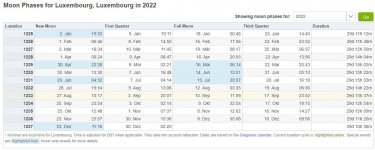
The Ides fell on the 15th for months with 31 days and 13th for months with 30 days incl 28 day February. This is to get the mean average of 14 days separating the new/full moon phases. The official mean revolution is 29,53058 days .. but a synodic revolution can actually vary from 29 days 6 hours 50 min to 29 days 19 hours 32 min as shown in this example for 2026 and attached below 2022 to compare the monthly durations. I’m sure there is a pattern !
Dionysius Exiguus calculation of the “incarnation of Our Lord Jesus Christ” was allegedly 525 years prior to the year he made his calculations for his Paschal Tables starting in 532 til 625. The (accidental) discovery of the birth of JC started a new AD numbering system. OFFICIAL HIStory. Or rather OFFICIAL FORGERY.
I do not know if the Easter table of Ravenna is supposed to be the one of Dionysius?
So, if we take 1190 + 525 = 1715
1715 is imo very likely the time when the “Gregorian” calendar forgeries were created (and more HIStorical events invented). Adding 7 imaginary days to the real 3 to get the official promoted difference of 10 days, postpone the correction event by 4 years to 1582, as the other changes being done …. or maybe even that happened later than 1582 ? Who knows ?
1715, THEY were busy creating this HIStorical map “Mappe Monde Celeste Terreste et Historique 1787” which was first released in 1719 with CALENDAR and updated several times until 1786.
The Easter Tables or Paschal Calendario, cast in stone in the Museum Cathedral of Ravenna in Italy display the calculated Easter Sunday dates NOT for 532 til 625 but for the years 1487 – 1581, a period of 95 years. It was really important because it would set the calendar again synchron with the solar cycle.
The Pasquale Calendario starts with Easter Sunday being calculated as the first Sunday after new moon, which was Luna 14 or Luna Paschal after a Full moon on Equinox.
The dates are indicated with the roman Kalens/Nonae /Ides system. All displayed dates are Julian Sundays, except for the last 3 years. Those are yet Gregorian Sundays and Julian Wednesdays.
8. April 1579 being the first corrected Sunday after Full Moon that follows a new moon on equinox.
They advanced by 3 days in 1578, probably in October, but who knows ? and changed the Easter Sunday from after new moon to after full moon. The difference were 3 days, not 10 and it was fixed in 1578 not 1582. The Gregorian forgeries happened later.
The 3 days are the difference accumulated in 3 x 128 years, since the start of the Julian Calendar, which had a leap year every 4 years. And that was 3 x too often in 400 years. When they noticed, they decided to fix it as soon as the 3 days were completed in 1578. Cast in stone, to not forget, because the ones that calculated this around 1480 were no longer alive in 1578.
In 1579 til 1581 the roman calendar day numbering was still in use.
The fixed 7 days week with day names was introduced probably in 1582, as well as the day names related to the planetary gods. This might in fact have been the time when Antoninous Pius released the Zodiac coins. There is sth I don’t buy … they could allegedly struck coins in their forged chronology yet 3 centuries BC but for almost 2 millennia noone had the idea to put color pigments on the dies & see what it would leave on textil or paper or papyrus ? I don’t buy that, both techniques were brought or were invented at the same time !
And they added 1 extra day as leap day, the 29th February, as before the 6. Day before Kalens March was doubled. VI K March is 24 February.
When was the J.ulian C.alendar exactly “birthed”?
The year-calculation system always starts with a dominical letter G. Leap years have 2 letters. Btw, 1579 was a G year, not 1582.
Possible starts of the ancient J.C.alendar, considering that the accumulated difference in 1578 was 3 days, for which it takes 3 x 128 = 384 years.
1578-384 = 1194, when that calendar must have been synchron with the solar cycle.
G Years in 1100: 6/34/62/90 17/45/73 22/50/78
G Years in 1200: 01/29/57/85 7/35/63/91 18/46/74
If the calendar started with a leap year if would have been a G/F year
For 1100: 12/40/68/96 and for 1200: 24/52/80
The closest to the result of 1194 is the G/F year 1196, then the G years 1190 and 1201
I don’t think it started with a Leap Year, so I pick 1190 … maybe due to the importance of the numbers 9 and 11
It was very likely in 1190 when the 12 months instead of 10 or 11 were implemented with the roman Kalens, Nonae, Ides day numbering. Creating a luni-solar calendar synchron with the solar cycle.
The Ides fell on the 15th for months with 31 days and 13th for months with 30 days incl 28 day February. This is to get the mean average of 14 days separating the new/full moon phases. The official mean revolution is 29,53058 days .. but a synodic revolution can actually vary from 29 days 6 hours 50 min to 29 days 19 hours 32 min as shown in this example for 2026 and attached below 2022 to compare the monthly durations. I’m sure there is a pattern !
Dionysius Exiguus calculation of the “incarnation of Our Lord Jesus Christ” was allegedly 525 years prior to the year he made his calculations for his Paschal Tables starting in 532 til 625. The (accidental) discovery of the birth of JC started a new AD numbering system. OFFICIAL HIStory. Or rather OFFICIAL FORGERY.
I do not know if the Easter table of Ravenna is supposed to be the one of Dionysius?
So, if we take 1190 + 525 = 1715
1715 is imo very likely the time when the “Gregorian” calendar forgeries were created (and more HIStorical events invented). Adding 7 imaginary days to the real 3 to get the official promoted difference of 10 days, postpone the correction event by 4 years to 1582, as the other changes being done …. or maybe even that happened later than 1582 ? Who knows ?
1715, THEY were busy creating this HIStorical map “Mappe Monde Celeste Terreste et Historique 1787” which was first released in 1719 with CALENDAR and updated several times until 1786.
 unless this is forged !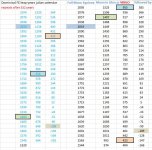
 world agrees with the official HIStory.

 !
! ), it would not be possible to ever arrive at a difference of 10 days for Equinox (or Easter) !
  …. allegedly noted in the "ancient" Mul.Apin tablets, the "correction for the year" was 10 days.


