Setting the FORGED CHRONOLOGY straight – the “Gregorian” 10 day hoax

PuzzleBear

Well-Known Member
Active Member
Joined
Jul 28, 2022
Messages
80
Reaction score
232
I give a brief summary of what I have written in detail in these posts starting here here here and here because the “Gregorian 10 days calendar” hoax deserves its own thread.

The Easter Tables or Paschal Calendario, cast in stone in the Museum Cathedral of Ravenna in Italy display the calculated Easter Sunday dates NOT for 532 til 625 but for the years 1487 – 1581, a period of 95 years. It was really important because it would set the calendar again synchron with the solar cycle.

The Pasquale Calendario starts with Easter Sunday being calculated as the first Sunday after new moon, which was Luna 14 or Luna Paschal after a Full moon on Equinox.

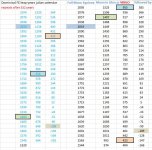
The dates are indicated with the roman Kalens/Nonae /Ides system. All displayed dates are Julian Sundays, except for the last 3 years. Those are yet Gregorian Sundays and Julian Wednesdays.
8. April 1579 being the first corrected Sunday after Full Moon that follows a new moon on equinox.

gregorian-sundays.JPG

They advanced by 3 days in 1578, probably in October, but who knows ? and changed the Easter Sunday from after new moon to after full moon. The difference were 3 days, not 10 and it was fixed in 1578 not 1582. The Gregorian forgeries happened later.

The 3 days are the difference accumulated in 3 x 128 years, since the start of the Julian Calendar, which had a leap year every 4 years. And that was 3 x too often in 400 years. When they noticed, they decided to fix it as soon as the 3 days were completed in 1578. Cast in stone, to not forget, because the ones that calculated this around 1480 were no longer alive in 1578.

In 1579 til 1581 the roman calendar day numbering was still in use.

The fixed 7 days week with day names was introduced probably in 1582, as well as the day names related to the planetary gods. This might in fact have been the time when Antoninous Pius released the Zodiac coins. There is sth I don’t buy … they could allegedly struck coins in their forged chronology yet 3 centuries BC but for almost 2 millennia noone had the idea to put color pigments on the dies & see what it would leave on textil or paper or papyrus ? I don’t buy that, both techniques were brought or were invented at the same time !

And they added 1 extra day as leap day, the 29th February, as before the 6. Day before Kalens March was doubled. VI K March is 24 February.

When was the J.ulian C.alendar exactly “birthed”?

The year-calculation system always starts with a dominical letter G. Leap years have 2 letters. Btw, 1579 was a G year, not 1582.

Possible starts of the ancient J.C.alendar, considering that the accumulated difference in 1578 was 3 days, for which it takes 3 x 128 = 384 years.
1578-384 = 1194, when that calendar must have been synchron with the solar cycle.

G Years in 1100: 6/34/62/90 17/45/73 22/50/78
G Years in 1200: 01/29/57/85 7/35/63/91 18/46/74
If the calendar started with a leap year if would have been a G/F year
For 1100: 12/40/68/96 and for 1200: 24/52/80

The closest to the result of 1194 is the G/F year 1196, then the G years 1190 and 1201

I don’t think it started with a Leap Year, so I pick 1190 … maybe due to the importance of the numbers 9 and 11

It was very likely in 1190 when the 12 months instead of 10 or 11 were implemented with the roman Kalens, Nonae, Ides day numbering. Creating a luni-solar calendar synchron with the solar cycle.

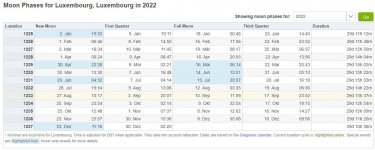
The Ides fell on the 15th for months with 31 days and 13th for months with 30 days incl 28 day February. This is to get the mean average of 14 days separating the new/full moon phases. The official mean revolution is 29,53058 days .. but a synodic revolution can actually vary from 29 days 6 hours 50 min to 29 days 19 hours 32 min as shown in this example for 2026 and attached below 2022 to compare the monthly durations. I’m sure there is a pattern !


Dionysius Exiguus calculation of the “incarnation of Our Lord Jesus Christ” was allegedly 525 years prior to the year he made his calculations for his Paschal Tables starting in 532 til 625. The (accidental) discovery of the birth of JC started a new AD numbering system. OFFICIAL HIStory. Or rather OFFICIAL FORGERY.

I do not know if the Easter table of Ravenna is supposed to be the one of Dionysius?

So, if we take 1190 + 525 = 1715

1715 is imo very likely the time when the “Gregorian” calendar forgeries were created (and more HIStorical events invented). Adding 7 imaginary days to the real 3 to get the official promoted difference of 10 days, postpone the correction event by 4 years to 1582, as the other changes being done …. or maybe even that happened later than 1582 ? Who knows ?

1715, THEY were busy creating this HIStorical map “Mappe Monde Celeste Terreste et Historique 1787” which was first released in 1719 with CALENDAR and updated several times until 1786.
 

Attachments

  • moonphases2022.JPG
    moonphases2022.JPG
    109.4 KB · Views: 212
The Napoleonic Wars, according to "Official HIStory":

“The Napoleonic Wars (1803–1815) were a series of major global conflicts pitting the French Empire and its allies, led by Napoleon I, against a fluctuating array of European states formed into various coalitions. It produced a period of French domination over most of continental Europe”

I am not aware of any other Napoleonic war. But THEY missed this one ;) unless this is forged !

If not, it is very likely the Napoleonic war happened a century earlier, from 1691 til 1703 and Napoleon might just have played a part in the later years.

While searching for Churchbooks from before 1600, I found this list of 7 people that died in a war against France (and Napoleonic war), from 1691 til 1703. Napoleonic war is between (brackets) .. same, same, but different war? It started with someone else, ended with Napoleon ?

These people were somehow related to or of the family Welz from Burggen, in Bavaria Germany. It was a family of judges.

Translation as far as I can decipher: War against France (and Napoleonic war)

26. ? 1691 died in a foreign country Matthias Helmer (page 124)
18 April 1692 died as soldier in a foreign country Ignatius Welz written above: the brother of (p.124)
2. June 1694 died in foreign country lad Conrad Amberg (page 128)
4. June 1694 died in foreign country Joseph Steger (p.128)
11. March 1695 died in foreign country as soldier Christoph Astaler (p.130)
6. October 1703 died the host Franz Welz from the Bavarians ?? ?? bullet ?? (p137)
20. October 1703 died Georg Socker, from the ? Husaron on the field called Wasslosfield? or Waplasfield? seriously wounded through a bullet (p.137)
 
So I really appreciate your interest in chronological matters and you managed to revive some interest in me, so thank you very much. Since you started your posts I have bit by bit taken back what I had already forgot and added something new in order to understand what you were saying. In doing so I've found various problematic things that I wish to make you acquainted. I'm going to insert some of your comments in those posts and then explain my perplexities.

Luna 14 should stand for New moon, counted being 14 days later than Full moon.
These are the years with Full Moon on 20 and 21 March and the following New Moon on 4. or 5. April
The Pasquale Calendario starts with Easter Sunday being calculated as the first Sunday after new moon, which was Luna 14 or Luna Paschal after a Full moon on Equinox.
This is the first problem. Everywhere I look and by personal knowledge I can say that Pascha/Easter happens the first Sunday after the full moon, not after the new moon. That full moon recurred on the 14th day of the ecclesiastical lunar month (LUNA 14) and was called an 'ecclesiastical full moon' (Ecclesiastical full moon - Wikipedia) because it didn't exactly corresponded with the astronomical full moon. Therefore I think you inverted the full oon with the new moon.

There is something bizarre: no 19/3 equinox for 2 consecutive centuries, except for 1500-1600, just for one century ??? Okay, it’s a very SPECIAL century, isn’t it ?
I don't know if I'm getting right this premise that you did to your thoughts, but I used the 'calculator' you suggested (Data.GISS: Time and Date of Vernal Equinox) and found that there's no 3/19 for the century 1400-1500 too. So I frankly don't see any anomaly since the 'rule' of two centuries without 3/19 is respected!

Immagine 2022-09-20 062132.png
Immagine 2022-09-20 062158.png


These are the years with Full Moon on 20 and 21 March and the following New Moon on 4. or 5. April
So I made a list of the Julian leap years and compared it to the List of the Full moons. FE year is Primus year plus 1.

532-year-cycle-jpg.jpg
There's many things I don't get from this table:
  1. The table reports full moons and positions of the moon in relation to zodiac signs, but I don’t understand if those positions are relative to the phases of the moon and if so, what exact phases correspond to what signs.
  2. The table evidently considers astronomical phases of the moon, but the paschal calendar is about ecclesiastical phases. Was it already considered? In that case there was no explanation in the various posts.
  3. The table doesn’t consider the traditional year of 535 AD for the start of the metonic cycle. I wonder if this is connected to the previous declaration that there are no 3/19 to be found between 1500 and 1600 for just one century. But I found out that there’s no 3/19 for 1400-1500 too!
  4. This was probably already addressed when you said that you don’t consider the precession of the equinoxes, but doesn’t that mean that with the passing of time the various dates attributed to the 14th moon change over time? And this is why tables lasted ‘only’ 95 years? Correct me if I’m wrong.
In any case I can't figure out where did you take the 'new moon' (ecclesiastical full moon really) on April 4 or 5, since you describe your table as a representation of the first year of the metonic cycle (LUNA PRIMUS) which started in the year 535 AD and whose Luna XIIII began on IIII nones April which is April, 2.

That said I finally can't figure out how and why we arrived at 1487 AD. Hope my remarks were clear and waiting for some details. Bye
 
@Silveryou

Did you have the time yet to check the last 4 or 6 dates from the Ravenna Easter Table with what day of the week was for the years from 1576/8 til 1581?

gregorian-sundays.JPG

Check also dates 95 years prior (& multiples)

The last 3 dates, starting 1579 were yet Gregorian Sundays, while the previous dates were Julian Sundays. This fits for when this 19x5 years Metonic cycle ended in 1581, not any other time.

The Easter Tables were used only once to not forget the correction of the 3 days that accumulated due to having a leap year every 4 years, which is 3 too much in 400 years, and that correction was done in 1578 not 1582. And was calculated prior to the start of the cycle.


Luna 14 is 14 days after Full moon (observable). How to count a cycle starting from sth invisible ? If you think the Ancients, while trying to figure out exact cycles, started counting from the invisible new moon, OK. I won’t argue with you about that, everyone beLIEves this.

But it is cast in stone in Knowth, Ireland. One just needs to KNOW what the waning and waxing moon crescents look like. The lunation cycle above has been modified by me to fit the curbstone.

fullmoon_is_newmoon_oob.jpg


Source pic plus more info​


Year 4 (AN IIII) is written below Luna Primus, the start of that cycle. I first thought it was the number of the Indiction year, but it goes til 19. It is the counting of the new Metonic cycle starting at the end of that cycle with the year 1579. The new AN I, ýear 1, the first lunar cycle after the correction of days being done. And the change from Easter Sunday after new moon to Sunday after full moon in ARIES, as it is still today. AN I is at the 12 o clock position and AN IIII, the first „old“ Lunar moon cycle is at 2 o clock.

For me the Easter Tables from Ravenna is the calendar prooving this, cast in stone to not forget. Not paper, that could be lost or modified, not a COPY of a COPY. But I will not spend more time with „convincing“ anyone. Whoever thinks this was Dionysius Exiguus in 525 preparing for 532, that’s OK for me, as the whole 🤡 world agrees with the official HIStory.

Would it even change sth ? Not at all !
 
@Silveryou

Did you have the time yet to check the last 4 or 6 dates from the Ravenna Easter Table with what day of the week was for the years from 1576/8 til 1581?


Check also dates 95 years prior (& multiples)

The last 3 dates, starting 1579 were yet Gregorian Sundays, while the previous dates were Julian Sundays. This fits for when this 19x5 years Metonic cycle ended in 1581, not any other time.

The Easter Tables were used only once to not forget the correction of the 3 days that accumulated due to having a leap year every 4 years, which is 3 too much in 400 years, and that correction was done in 1578 not 1582. And was calculated prior to the start of the cycle.


Luna 14 is 14 days after Full moon (observable). How to count a cycle starting from sth invisible ? If you think the Ancients, while trying to figure out exact cycles, started counting from the invisible new moon, OK. I won’t argue with you about that, everyone beLIEves this.

But it is cast in stone in Knowth, Ireland. One just needs to KNOW what the waning and waxing moon crescents look like. The lunation cycle above has been modified by me to fit the curbstone.


Year 4 (AN IIII) is written below Luna Primus, the start of that cycle. I first thought it was the number of the Indiction year, but it goes til 19. It is the counting of the new Metonic cycle starting at the end of that cycle with the year 1579. The new AN I, ýear 1, the first lunar cycle after the correction of days being done. And the change from Easter Sunday after new moon to Sunday after full moon in ARIES, as it is still today. AN I is at the 12 o clock position and AN IIII, the first „old“ Lunar moon cycle is at 2 o clock.

For me the Easter Tables from Ravenna is the calendar prooving this, cast in stone to not forget. Not paper, that could be lost or modified, not a COPY of a COPY. But I will not spend more time with „convincing“ anyone. Whoever thinks this was Dionysius Exiguus in 525 preparing for 532, that’s OK for me, as the whole 🤡 world agrees with the official HIStory.

Would it even change sth ? Not at all !
So what year are we actually currently in if not 2022? The Freemasons say it’s the year 6,022 AL. They also have other “calendars” like the AN and AO. Where can I find more information on syncing my personal life to the real lunar and solar years?
 
So what year are we actually currently in if not 2022? The Freemasons say it’s the year 6,022 AL. They also have other “calendars” like the AN and AO. Where can I find more information on syncing my personal life to the real lunar and solar years?
I don't know what year we have, we can start calculating and say this event happened 380 years ago
It's a bit like finding a corner in a circle .. a zero-point and there have been several zero-points
I start wondering if THEY want to hide the fact that this realm has an expiration date ?

I found this book Science of numerology very interesting to find out about oneself. Numbers can tell stories ;)
 
It's getting FUNNIER with years whatever CE, BCE, AD, AM, AUC, AC/DC .. :LOL:

I've been reading that the star constellation LIBRA was formed later out of the claws of SCORPIO and then I remembered having seen this astronomical clock from Padua, that misses the sign of LIBRA, but the claws of Scorpio are there to be seen.

zodiak-clock-padua-italy-38233179.jpg

Notice something ????

Official History:
Sitting on the clock tower in Piazza dei Signori, the astronomical clock of Padua was built in 1344 and is one of the oldest clocks in the world still in working order. The designer, Jacopo de’Dondi, became so famous for this work that his family name was later changed to “Dondi dell’Orologio,” or “Dondi of the Clock.”

The magnificent timepiece has a 24-hour dial, so the hour hand makes a full rotation only once a day, not twice, moving at half the usual speed and starting at the right (“zero hour”) rather than at the top. The clock also strikes the hours on a bell from 1 to 24. The dial shows the day of the month, the current phase of the Moon, the motion of the planets, and the position of the Sun in the Zodiac.

After the original clock was destroyed at the end of the 14th century, a replacement was built in 1423 as a faithful copy of the original, with one exception: It was missing one of Zodiac signs, Libra. There are various stories about the origin of this curious lack, the most famous saying that the builder deliberately omitted the symbol, which is an emblem of justice, because he was not paid the amount of money he was promised. Another version of the story says that the symbol was also missing from the original clock as a protest by the designer against the rule of the Carraresi family.

In reality, this missing symbol comes from the use of the pre-Roman Zodiacal system, which united the constellations of Scorpio and Libra. The two halves of Libra were seen as the Scorpio’s claws and later became the scales, but even today the name of the two most luminous stars in Libra are the Arabic names for “northern claw” and “southern claw.” Anyway, some people say that the Libra sign is actually hidden somewhere in Piazza dei Signori—try looking for it!

:ROFLMAO::ROFLMAO::ROFLMAO: a faithful copy of the original, with one exception, it was missing LIBRA .. ofc, because LIBRA DID NOT YET EXIST !!! Libra an emblem of JUStice, thus a heavenly symbol of the implementation of the JUS.tinian Codex ??

Besides the XIIII instead of XIV ... Did you notice the date ?
MMDCCXXX below
DECVRIO OPV PPQR, the times of city-states that UNITED under Roman Authority
2730 ... but there might be something missing, although it was anyway before 2750 ! as 50= L

MMDCCXXX.JPG

THEY destroyed the inscription with ANNO when building the new bulls eyes.
see below
anno-destroyed.JPG

Maybe MMDCCXXXIX ? But that is a later used form to write IX than VIIII .. so that might be from the reconstruction in 1423 ?

In any case, such astronomical clocks could only have been built, after figuring out the exact cycle of the moon.
 
a faithful copy of the original, with one exception, it was missing LIBRA .. ofc, because LIBRA DID NOT YET EXIST !!! Libra an emblem of JUStice, thus a heavenly symbol of the implementation of the JUS.tinian Codex ??

Besides the XIIII instead of XIV ... Did you notice the date ?
MMDCCXXX below
DECVRIO OPV PPQR, the times of city-states that UNITED under Roman Authority
2730 ... but there might be something missing, although it was anyway before 2750 !
This is fascinating. I ran the phrase “DECURIO OPU PROR” thru a translator and it apparantly means “Councilor for the work of”, and then immediately following is the MMDCCXXX. So- Councilor for the work of 2730.

I’m stunned!

btw, “council” and “councilor” appear to be interchangeable here.
 
This is fascinating. I ran the phrase “DECURIO OPU PROR” thru a translator and it apparantly means “Councilor for the work of”, and then immediately following is the MMDCCXXX. So- Councilor for the work of 2730.

I’m stunned!

btw, “council” and “councilor” appear to be interchangeable here.

I first thought it was PPQR, (like SPQR) it was late .. and I need glasses ;)

You’re right, the second letter is an R, but then the last one must be a B, PROB for approved

ab-u-c.JPG

at the left side (Ann)O AB V C (Ab Urbe Condita) MMDCCXXX ??

Official story that Ab Urbe Condita was the year count after the foundation of Rome in 753 BCE ..
but maybe the real end was in 2753 ? AB.V.C
And that would have been quite recently, have a look at the name of whose work was approved. :LOL:

alOYISIUS.JPG

AL is missing but you can make out OYSIVS CORRADINVS

The work of ALOYSIUS CORRADINUS PATAVINUS a JURIS & PROFESSOR


Born 1562 in Padua Died 1618 These dates are on that german site, no other info and I can't find much more info about Aloysius

So the clock was created during his lifetime ? Or was restored during his lifetime ? Anyway it was still AB.V.C !!
It is interesting to note that the "Gregorian" Calendar implementation falls in that period.

EDIT to add:

ioann-carleschi.JPG
I can decypher:

EST
AMPLI VE AMPLIU? like french amélioré = improved ?
HOROLOG
AR TIFI GE ???
IOANN (ES)?
CARLESCHI
PATAVINO
(A)NNO
STI
XIX

I would translate as: Is (an) improved? clock from .. IOANN CARLESCHI, a PATAVINO = from Padua
Ioann Carleschi = I.C.

EDIT 2 to add:

What does Anno AB V.C. really stands for ?

Official story counting from the foundation of Rome 753 BCE does not fit. Adding 2730 years we end in 1977 .. not around 1600, when Aloysius Corradinus lived. THEY make-believe !

Aloysius Corradinus lived 1562-1618. It was under his “authority” that the clock was restored. And the work was done by Ioann Carleschi or under his supervision. Nothing to be found about the artist. Carleschi is an Italian surname.

Aloysius Corradinus is not mentioned among the “notable peoples” of Padua, although it was once worth to cast his NAME in stone !!!

So if I take 1600 (+/-18 years) and take the years 2730 until 2749, then in 2022 those years AB V C would be from 3134 to 3189.

greg-ABVC.JPG

I looked for the different calendars that exist and found this


Never heard of Discordia or Discordians, and what I read about it here, I wonder if it is SA-TYRE ?? :oops::unsure:


It seems to have originated in the early 1960s, but the Bavarian Illuminati are also mentionned.

I do not know if it could be related, although the years would match, as the Discordian calendar is in 3188. I have to read it again and try to sort those "discordian" puzzlepieces.

What a 🤡🌍 !
 
Last edited:
This was a fascinating and funny read, PRINCIPIA DISCORDIA. Exposing absurdities. ABSOLUTELY WORTH READING ! There are many truths to be found.

The info about Greyface and the year 1166 BCE is awesome. I wonder where Malaclypse got that info, the answer would be: From Eris !
If greg.1582 was AB V.C. 2748 the discordian calendar matches with 2022 being 3188. It is listed with many other calendars in use. And with 5 seasons à 73 days (VENUS numbers) it matches the 365 days/year. St Tibs day BALANCES after 4 years.

greyface.JPG

source

Who was greyface? He was starting the Anno AB V.C. count, an ORDERLY consecutive numbering of years. Which might well have been in use until about 400 years ago.
 
Have been looking for the most ancients books (due to Thurneysser about Alchemy) to compare printing techniques and so I found the book "De Alchimia Opvscvla Complvra Vetervm Philosophorum", allegedly from 1550.

A server error occured. I could not upload the screenshot. I might try again later.
It's written in latin, but the most interesting is the date at the end of a preface ! There is no 1550 to be found, but

A server error occured. I could not upload the screenshot. I might try again later.
or: source

written in Frankfurt am Main
Undecimo Calendas Aprilis Anno domini 50

the eleventh day before 1. April, Roman day numbering !
Year 50 of the Roman Empire ?

EDITED to try to upload again the pics, still access denied & added "domini" after Anno

EDIT2 .. to add the pics :

1550-print.JPG
undecimo-calendas-aprilisad50.JPG
 
Last edited:
Stumbled upon this quote in another thread and wanted to share it here.
“The later priests of this holy place, the Druids, were also Hyperboreans, according to Greek legends. The legends also state that Apollo visits their land every 19 years. It is a fact that the Druids created a 19-year calendar to reconcile the solar and lunar calendars, and this fact seems to connect them to the Hyperborean legend.”
 
I have tried to find again a few lines of text that I read in one of Leonhardt Thurneysser‘s books (allegedly printed around 1580), that „it is wellknown, that if you are deep enough in a well, you can see the nightsky during day time.“ Search does not work properly with Old Fraktur font, so re-reading partially and I hope to catch that text again for a screenshot.

Is it possible to see the nightsky during daytime ?

Nowadays statement: NO, it is not possible to see the stars during day from a deep well.

deep-in-well-.JPG

Example .. fact-checking ;-)

But … it was once well-known, at least among alchemists and stargazers and YES it is possible ! Not by looking up into the sky, but looking down in the water of the well !!! The stars shine their own light, also during daytime. Solar rays render them just invisible.

Starlight mirrors in the water, but ofc only those right above that are able to have their light reflected right into the well. Therefor it would be important (for stargazer organisations) where to dig your well to be able to observe your chosen star, out of bound moon and planets, solstices, …

For example an „equinox-star“ that culminates preferably the same time = same longitude or at a small known measurable difference apart, as the sun culminates on the day of spring Equinox. Culmination at 180° S, exact midday.

Example Spring equinox 2022 for Gizeh (Kairo), here exact midday = sun at 180° S, exact equinox was 5 h 33m later that day.

alpheratz-mars22-gizeh-121152.JPG

Marked star Alpheratz, Andromeda, located at 00h 08 minutes 23 seconds, culminates 8 m 23 s after the zero-point 00h00 culminates. Its declination is 29° N, culmination at 89° above the heaven in Gizeh (30° N) almost zenith, and should reflect its light into the water of a deep well.

alpha-andromeda-00h08m.JPG

Source Wiki​

Distance = Time

„Ancient Babylonians“ had allegedly divided the hour into minutes centuries BC. (Before Columbus ???) They knew about the 19 year Moon cycle and about the 33 year cycle of the Sun/Son. They could predict (calculate) eclipses. Imo, the mapping of the stars and the invention of a mechanical time measure device happened the same time. Which must have been shortly before when they found the lenght of a solar year to be 365,25 days. That error is about 11 minutes.

They must have had a mechanical device to measure/count minutes quite accurably and if you can measure minutes, dividing that interval again like for minutes, you should be able to measure/count seconds too. Maybe that device was still very large.

That was, imo, not too long before the first mechanical astronomical clocks on towers appeared. The oldest one in Padua still without LIBRA, but the Claws of Scorpio instead ! Astronomical clocks were used before the clock as we know it came into existence.

Obelisks were used as sundials before astronomical clocks appeared. Measuring the shadow of the sun on the longest and shortest days, equinox would also be marked. Simple observation. Unless this knowledge (to observe) got lost (🤣), it would not be possible to ever arrive at a difference of 10 days for Equinox (or Easter) ! 🤡

😂 …. allegedly noted in the "ancient" Mul.Apin tablets, the "correction for the year" was 10 days.

brown-mulapin.JPG

brown-mulapin2.JPG


Source Brown Mesopotamian astronomy 119-120, pdf attached

The difference of the lunar year (12 lunations = 354,3 days) to the solar year 365 days is indeed 10 days. Therefor every 3 years a leap month (3 x 10 days difference) was introduced to stay synchron. But the Gregorian 10 days correction, it’s mockery !

First Clocks were installed in towers before clocks in pocket or on wrist were invented. The technology had to become smaller, but keep accuracy.

LIBRA was put as zodiac sign in the heaven, replacing the Claws of Scorpio to show (as above, so below) the implementation of the JUSTINIAN CODEX. In the late 1500s or early 1600s. When REGIStration started.


Where and when did these „ancient“ stargazer really live? Maybe they were the not so „ancient Egyptians“? Or ... who knows ?

There is a district located on the eastern bank of the Nile in Old Kairo called Babylon, with remains of a „forteress“ and round „roman“ tower. The tower of Babylon ?! :oops:

forteress-of-babylon.JPG

Source Googlemaps​

A star constellation (30°) rises in 2 hours. 15° rise in 1 hour. Thus 1° rises in 4 minutes.

The sun moves almost 1° per day (0.98°).

In 2 days the difference of culmination time for an „equinox-star“ at same longitude and the sun will be almost 8 minutes apart. It means the „equinox-star“ will pass zenith then almost 8 minutes before the sun does. And that’s well noteable, for real experts !

„Ancient Babylonian" astronomy, reading about it I see the usual template for the discovered clay tables called „Enuma Elish“ in the 1800s. It’s like literally everything „antique“ turns into recent forgery once you have a closer look. Created to be discovered around the same time as „ancient Egypt“ et al. of “Antiquity“. Or even later. THEY make-believe. 🤡🌍

….

What’s HIStory before the „discovery“ [or conquest ?] of America ? … Australia ? ... Europe ? … Africa ? … Asia ?

There was none, it had to be invented. To legitimize THEY hierarchy & power.

assyrian-palace.jpg


Did you choose the right country to visit this "Assyrian Palace"?​
 

Attachments

  • Brown_Mesopotamian astronomy 113-120.pdf
    286.8 KB · Views: 270
So what year are we actually currently in if not 2022? The Freemasons say it’s the year 6,022 AL. They also have other “calendars” like the AN and AO. Where can I find more information on syncing my personal life to the real lunar and solar years?
I have a freemason text from 1879 AD and it also notes the year as 5879 AL? whats AL for one and whats then time scale based on and where's the starting point. What does it matter to us also were hear and now today. the year and day that we arbitrarily call today could literally be any year and any day based on any time scale and it doesn't make a difference eitherway as we experience each new day.
 
A.L. stands for Anno Lucis, the "Year of the Light", used by Masons, a year that is 4000 years beyond A.D. Anno Domini the "Year of Our Lord".
:unsure: Btw, Domini is plural, no ?
Another also not so known abreviation is:
A.O. which stands for Anno Ordinis, the "Year of the Order", used in Knight Templary and is found by substracting 1118 from the everyday calendar
source

I guess there have been many starting points, regional countings from some important event, or 60 year cycles like the Chinese use, or other ... until the back-calculated current starting-point could be STANDARDIZED all over, step by step. Other starting-points were abandonned quickly, like the French Revolution Calendar.

What does it matter ?
No, it doesn't really matter what year we have, the seasons follow each other endlessly (unless there was an expiration date ?)
... but what matters is fakery, fraud, lies, ... , especially if such serves as foundation to legitimize "governance", power
 
The Napoleonic Wars, according to "Official HIStory":


I am not aware of any other Napoleonic war. But THEY missed this one ;) unless this is forged !

If not, it is very likely the Napoleonic war happened a century earlier, from 1691 til 1703 and Napoleon might just have played a part in the later years.

While searching for Churchbooks from before 1600, I found this list of 7 people that died in a war against France (and Napoleonic war), from 1691 til 1703. Napoleonic war is between (brackets) .. same, same, but different war? It started with someone else, ended with Napoleon ?

These people were somehow related to or of the family Welz from Burggen, in Bavaria Germany. It was a family of judges.

Translation as far as I can decipher: War against France (and Napoleonic war)

26. ? 1691 died in a foreign country Matthias Helmer (page 124)
18 April 1692 died as soldier in a foreign country Ignatius Welz written above: the brother of (p.124)
2. June 1694 died in foreign country lad Conrad Amberg (page 128)
4. June 1694 died in foreign country Joseph Steger (p.128)
11. March 1695 died in foreign country as soldier Christoph Astaler (p.130)
6. October 1703 died the host Franz Welz from the Bavarians ?? ?? bullet ?? (p137)
20. October 1703 died Georg Socker, from the ? Husaron on the field called Wasslosfield? or Waplasfield? seriously wounded through a bullet (p.137)
Those are not 1's before the six hundred numbers. That is a marker meaning something and the six hundred numbers are counted from that. Could be an I, J, or another symbol. Anyway if that is true then it seems to be a 112 year gap in time from the symbol changing to a 1. So symbol then 691 equates to 1803.
 
I was reading Christoph Pfister's 'Matrix of Ancient History', and found his reasoning illuminating

Today’s calendar is said to be the work of Pope Gregory XI’s calendar reform. from the year “1582.”
But there are no reliable records of this reform and its causes — the date given is absurdly early.
A first consideration must be to view the Gregorian reform as a Catholic back-projection of the “1700” Protestant calendar reform.

to give some context:
"In Germany, Gottfried W. Leibniz (1646-1716) advocated a reform based on the proposal of the astronomer Erhard Weigel. This reform, established in 1700, made the same changes as the Gregorian reform with regards to dropping days from the calendar and adjusting the leap years, but used Kepler's Rudolphine Tables, rather than the epacts, to calculate Easter (thus avoiding using a Roman Catholic method for determining the date of Easter, and thereby denying the authority of the Pope in such matters). This brought the calendar into step with countries that had adopted the Gregorian calendar, with the exception that Easter occasionally fell on different dates under the two calendars (this problem was corrected later in the century). "

The Gregorian Reform of the Calendar | Encyclopedia.com


The calendar reform is said to have been about improving a calendar whose imperfect switching rule finally pushed the Easter date into early summer.
And the purpose stated specifically was to restore heaven at the time of the Council of Nicaea “325 AD.” Because at this church meeting an incorrect Easter date was fixed. Up until 1582, the incorrect switching rule resulted in a ten-day overhang that should be corrected.
The only thing that is certain about this story is that in ancient times in Europe a calendar was in use that was much longer than the natural length of the day. The reference to Nicaea, on the other hand, is arbitrary because such a council was part of historical fiction at such a distant time.
The old calendar was called the Julian because Julius Caesar “45 AC” is said to have introduced it.—This fact is also fictitious and only had the purpose of connecting the reform with an unreal story.

Incidentally, the name of the Julian calendar does not go back to the famous Roman, but to Josef Justus Scaliger (alleged dates of his life: 1540—1609), the “father of modern chronology,” who is still spoken of. The latter names a philologist JULIUS CAESAR Scaliger as his father

Allegedly, a Scythian (!) monk in Rome named Dionysius Exiguus “around 525 AD” developed a new 532-year Easter cycle that no longer dated from the founding of Rome or the Diocletian martyr era, but from the birth of Christ
...

The true time of origin of the year count after the birth of Christ can be reached by analyzing the name of the “Scythian” monk mentioned. Fomenko has unraveled the legend behind it (Fomenko, II, 77 f.).
As the founder of historical chronology, the aforementioned Josef Justus Scaliger had a no less important contemporary in the Jesuit Denis Pétau, who called himself Dionysius Petavius in Latin.
In the name PÉTAU one reads French petit = small . But that can be translated into Latin as exiguus . The legendary monk named DIONYSIUS EXIGUUS had a modern alter ego in the clergyman DENIS PETAVIUS
= Pétau = petit - with the trifle of a time interval of well over 1000 years
 
there is a russian who took out that even this ''Gregorian correction'' is fake too; i knew this from a guy who translated the Fomenko videos to hungarian and he was on some rus sites and saw that and that - but unfortunately i have no contact with him so i donno more about it
 
I give a brief summary of what I have written in detail in these posts starting here here here and here because the “Gregorian 10 days calendar” hoax deserves its own thread.

The Easter Tables or Paschal Calendario, cast in stone in the Museum Cathedral of Ravenna in Italy display the calculated Easter Sunday dates NOT for 532 til 625 but for the years 1487 – 1581, a period of 95 years. It was really important because it would set the calendar again synchron with the solar cycle.

The Pasquale Calendario starts with Easter Sunday being calculated as the first Sunday after new moon, which was Luna 14 or Luna Paschal after a Full moon on Equinox.

The dates are indicated with the roman Kalens/Nonae /Ides system. All displayed dates are Julian Sundays, except for the last 3 years. Those are yet Gregorian Sundays and Julian Wednesdays.
8. April 1579 being the first corrected Sunday after Full Moon that follows a new moon on equinox.


They advanced by 3 days in 1578, probably in October, but who knows ? and changed the Easter Sunday from after new moon to after full moon. The difference were 3 days, not 10 and it was fixed in 1578 not 1582. The Gregorian forgeries happened later.

The 3 days are the difference accumulated in 3 x 128 years, since the start of the Julian Calendar, which had a leap year every 4 years. And that was 3 x too often in 400 years. When they noticed, they decided to fix it as soon as the 3 days were completed in 1578. Cast in stone, to not forget, because the ones that calculated this around 1480 were no longer alive in 1578.

In 1579 til 1581 the roman calendar day numbering was still in use.

The fixed 7 days week with day names was introduced probably in 1582, as well as the day names related to the planetary gods. This might in fact have been the time when Antoninous Pius released the Zodiac coins. There is sth I don’t buy … they could allegedly struck coins in their forged chronology yet 3 centuries BC but for almost 2 millennia noone had the idea to put color pigments on the dies & see what it would leave on textil or paper or papyrus ? I don’t buy that, both techniques were brought or were invented at the same time !

And they added 1 extra day as leap day, the 29th February, as before the 6. Day before Kalens March was doubled. VI K March is 24 February.

When was the J.ulian C.alendar exactly “birthed”?

The year-calculation system always starts with a dominical letter G. Leap years have 2 letters. Btw, 1579 was a G year, not 1582.

Possible starts of the ancient J.C.alendar, considering that the accumulated difference in 1578 was 3 days, for which it takes 3 x 128 = 384 years.
1578-384 = 1194, when that calendar must have been synchron with the solar cycle.

G Years in 1100: 6/34/62/90 17/45/73 22/50/78
G Years in 1200: 01/29/57/85 7/35/63/91 18/46/74
If the calendar started with a leap year if would have been a G/F year
For 1100: 12/40/68/96 and for 1200: 24/52/80

The closest to the result of 1194 is the G/F year 1196, then the G years 1190 and 1201

I don’t think it started with a Leap Year, so I pick 1190 … maybe due to the importance of the numbers 9 and 11

It was very likely in 1190 when the 12 months instead of 10 or 11 were implemented with the roman Kalens, Nonae, Ides day numbering. Creating a luni-solar calendar synchron with the solar cycle.

The Ides fell on the 15th for months with 31 days and 13th for months with 30 days incl 28 day February. This is to get the mean average of 14 days separating the new/full moon phases. The official mean revolution is 29,53058 days .. but a synodic revolution can actually vary from 29 days 6 hours 50 min to 29 days 19 hours 32 min as shown in this example for 2026 and attached below 2022 to compare the monthly durations. I’m sure there is a pattern !


Dionysius Exiguus calculation of the “incarnation of Our Lord Jesus Christ” was allegedly 525 years prior to the year he made his calculations for his Paschal Tables starting in 532 til 625. The (accidental) discovery of the birth of JC started a new AD numbering system. OFFICIAL HIStory. Or rather OFFICIAL FORGERY.

I do not know if the Easter table of Ravenna is supposed to be the one of Dionysius?

So, if we take 1190 + 525 = 1715

1715 is imo very likely the time when the “Gregorian” calendar forgeries were created (and more HIStorical events invented). Adding 7 imaginary days to the real 3 to get the official promoted difference of 10 days, postpone the correction event by 4 years to 1582, as the other changes being done …. or maybe even that happened later than 1582 ? Who knows ?

1715, THEY were busy creating this HIStorical map “Mappe Monde Celeste Terreste et Historique 1787” which was first released in 1719 with CALENDAR and updated several times until 1786.
There's there's a simpler way to show that the 10 days were never added to the calendar, it uses Julian day numbers, working forward from the most ancient calendars of the Romans.
 
Tips
Tips
Please respect our Posting Rules.
Back
Top