Seems like every time I dig into research on my city of birth I always dig up some interesting stuff for this forum. Hopefully some enterprising Buffalonians can help me out with this, as yet again we have examples of some amazing buildings with very little explanation on how they were built. This post is a bit looser than usual, hopefully those familiar with my previous material and many other posts on this forum will follow the logical progression of these finds.
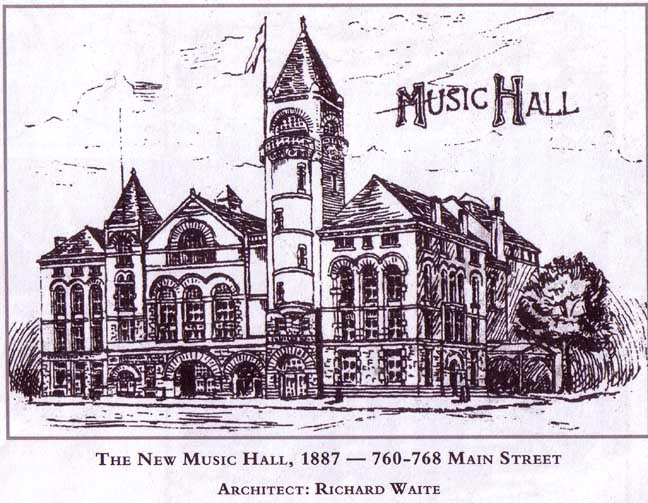
From Performing Arts Archive:
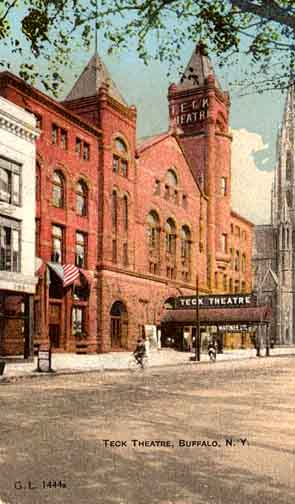
Also known as: Music Hall, Shubert Teck, Loew's Teck.
Location: 766 Main Street, Buffalo, NY
(Southwest corner of Main and Edward Streets, across the street from St. Louis RC Church)
Architect: August Esenwein Style: French Renaissance Revival
Status: Closed/Demolished
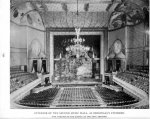
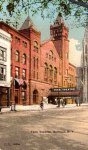
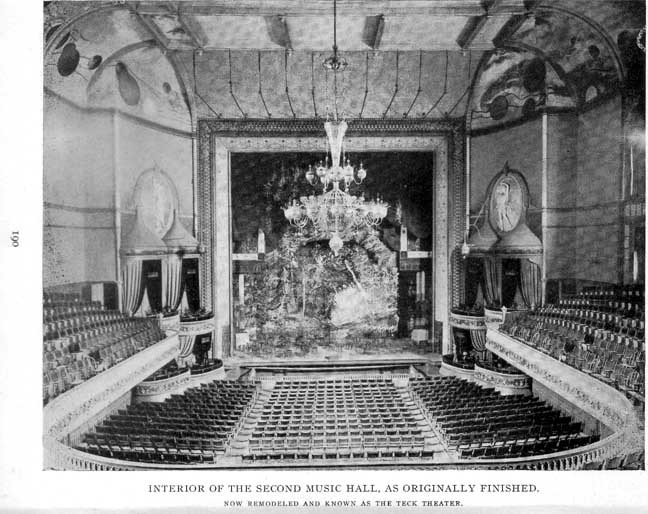
The Teck Theatre was built on the site of the great 1883 Greman Saengerhalle (a concert venue which was destroyed by fire in 1885). The Music Hall opened on October 18, 1887 and later was completely remodeled into Shea's Teck Theater in 1900, with a seating capacity in two separate halls of 3,350. In 1908 it was taken over by the Shubert organization, which ran it as a live theatre until 1933 when it was closed during the Depression.
Mainstream Timeline:

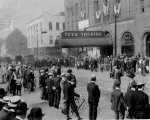
Also, note yet another example of a cable-less trolley in the foreground. Guess they figure that most people just won't ask questions about the tech of that time which is why you can still find these photos...
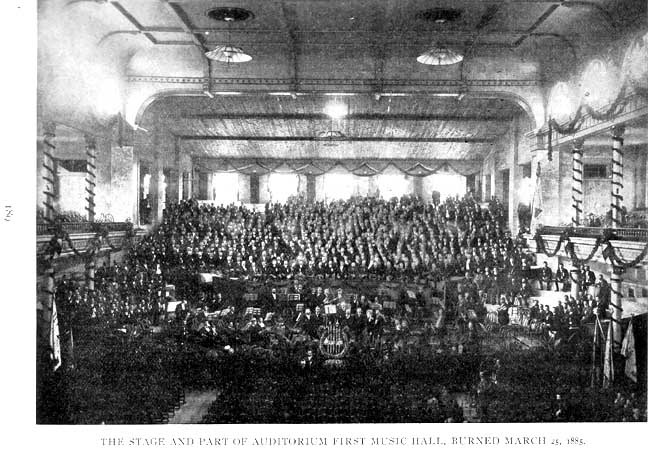
Sængerhalle (German Young Men’s Association Building Concert Hall) included:
Concert Hall 16 July or 7 December 1883–25 March 1885
760–768 Main Street,
SW corner Edward Street
ARCHITECT: August C. Esenwein
NOTE: Capacity of 2500 seats. Seating arrangement varied to accommodate different shows. Concert Hall occupied the upper two stories above the lobby, and had 1100 seats. The Buffalo Orpheus society moved here from Riegelmann’s Hall upon the opening in November 1883. Burned down in 1885. Buffalo Orpheus then moved to Bächer’s Halle. Replaced by a more elaborate building. OTHER THEATRES WITH THE SAME NAME: Not to be confused with Shea’s Music Hall, with Concert Hall at 155 Main Street., or with the later Concert Halls here.
CURRENT STATUS: Empty lot and Pearl Street.
August C. Esenwein
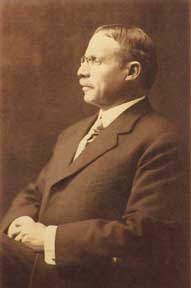

After Green & Wicks, Esenwein & Johnson enjoyed the most active architectural practice in Buffalo, New York, at the turn of the twentieth century. The firm had offices at 775-793 Ellicott Square.
The firm was one of the eight official architects for the Pan-American Exposition. Its most notorious structure was also the shortest lived. The Temple of Music was the site of President McKinley's ill-fated meeting with assassin Leon Czolgosz in September 1901.
TMG: Please read through the Buffalo Pan-Am post on SH, if you haven't already, as to why this is a somewhat noticeable find.
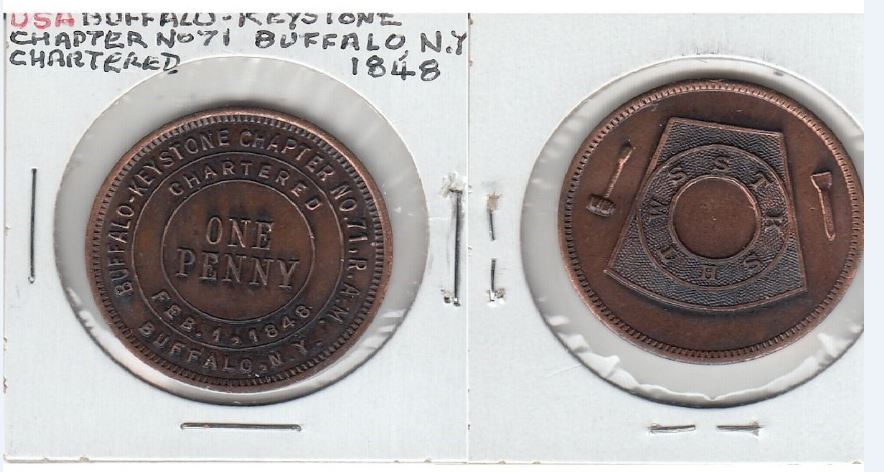
Ostensibly, this seal was created to commemorate the opening of Teck theatre on the grounds of the Saengerhalle. Can any other armchair symbologists help me break this one down? Also, what is the significance of holding chisels and hammers? I think it's pretty clear that they did not just finish chiseling that seal before they took the photo. Is that a freemason thing?
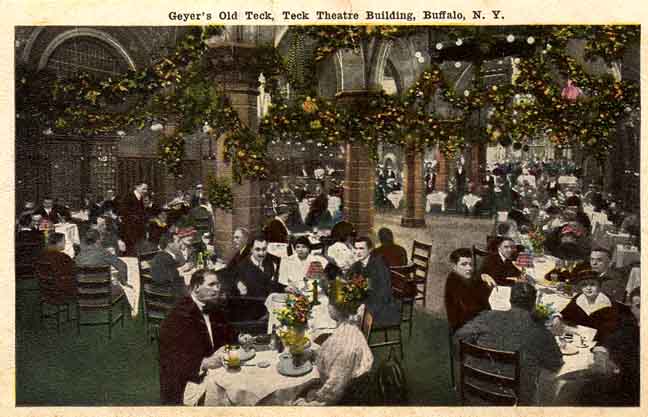
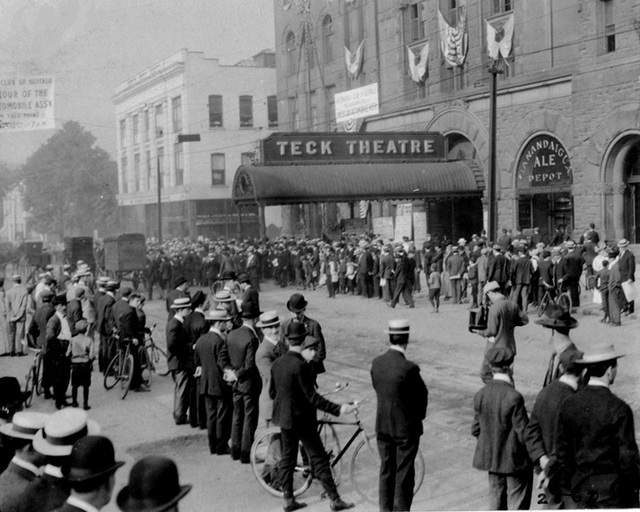
Also known as: Music Hall, Shubert Teck, Loew's Teck.
Location: 766 Main Street, Buffalo, NY
(Southwest corner of Main and Edward Streets, across the street from St. Louis RC Church)
Architect: August Esenwein Style: French Renaissance Revival
Status: Closed/Demolished
The Teck Theatre was built on the site of the great 1883 Greman Saengerhalle (a concert venue which was destroyed by fire in 1885). The Music Hall opened on October 18, 1887 and later was completely remodeled into Shea's Teck Theater in 1900, with a seating capacity in two separate halls of 3,350. In 1908 it was taken over by the Shubert organization, which ran it as a live theatre until 1933 when it was closed during the Depression.
Mainstream Timeline:
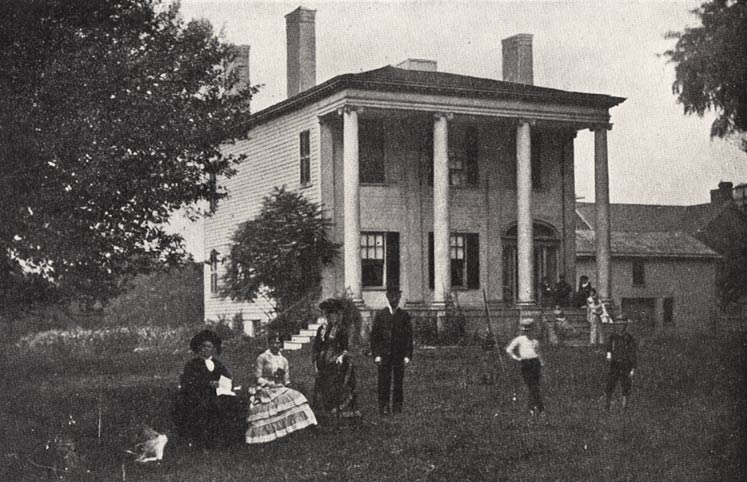
- 1882 - Home of Judge Ebenezer Walden, mayor of Buffalo 1838-1839, demolished for the Music Hall
- 1883 - Music Hall designed by August Esenwein and built by the German Young Men's Association
- March 25th, 1885 - Fire destroys first Music Hall
- 1887 - Construction of second Music Hall, designed by Richard Waite
- 1900 - Building became known as the Teck Theatre
- 1933 - The theater closed
- 1945 - The building became a movie theater, also named Teck. The building underwent significant interior and exterior changes.
- 1980s - The rear of the building was demolished to make way for a Pearl Street connector as a drain from the 33 into downtown
- 1992 - The remainder of the theater was demolished
Greman Saengerhalle
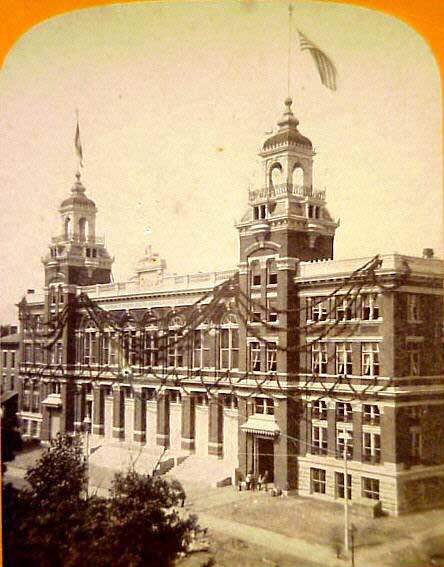
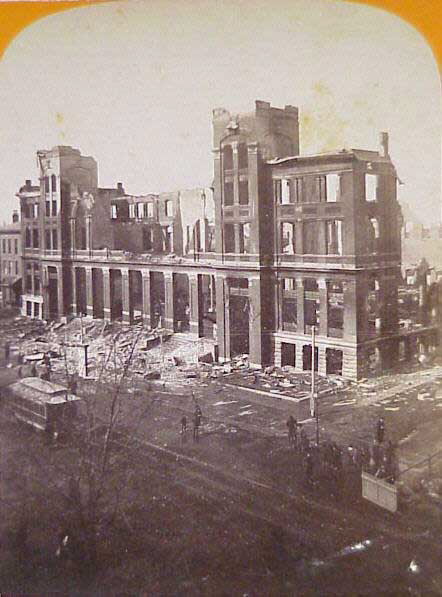
TMG: That's one hell of a fire they had there. Wonder how much dynamite it took to put that fire out...
Also, note yet another example of a cable-less trolley in the foreground. Guess they figure that most people just won't ask questions about the tech of that time which is why you can still find these photos...
From bscottholmes.com:Sængerhalle (German Young Men’s Association Building Concert Hall) included:
Concert Hall 16 July or 7 December 1883–25 March 1885
760–768 Main Street,
SW corner Edward Street
ARCHITECT: August C. Esenwein
NOTE: Capacity of 2500 seats. Seating arrangement varied to accommodate different shows. Concert Hall occupied the upper two stories above the lobby, and had 1100 seats. The Buffalo Orpheus society moved here from Riegelmann’s Hall upon the opening in November 1883. Burned down in 1885. Buffalo Orpheus then moved to Bächer’s Halle. Replaced by a more elaborate building. OTHER THEATRES WITH THE SAME NAME: Not to be confused with Shea’s Music Hall, with Concert Hall at 155 Main Street., or with the later Concert Halls here.
CURRENT STATUS: Empty lot and Pearl Street.
August C. Esenwein
TMG: While it is not explicitly mentioned, dollars to donuts the above bolded statement refers to the architectural school L'ecole des Beaux Arts.August Esenwein (1856-1926)
His family, which belonged to the knightly order, lived for more than 500 years on its ancestral estates called Esenwein-Virnsberg, in the Kingdom of Wuertemburg, South Germany. Esenwein's father came to America in 1861, stayed ten years, but then returned to Germany with his wife.
Esenwein was born in Esenwein-Virnsberg. His rudimentary education was obtained at private schools, and later he entered the Gymnasium at Stuttgart, and was there prepared for the University at Stuttgart. In 1874 he became a student in the Stuttgart Polytechnic University, where he remained for five years, also serving a year in the German army. While at Stuttgart he pursued courses in architecture and engineering, graduating in 1879. He then went to Paris, the world center for architectural theory and education at that time, where for two years he worked in an architect's studio as a draughtsman.
From Buffalo as an Architectural Museum:After Green & Wicks, Esenwein & Johnson enjoyed the most active architectural practice in Buffalo, New York, at the turn of the twentieth century. The firm had offices at 775-793 Ellicott Square.
The firm was one of the eight official architects for the Pan-American Exposition. Its most notorious structure was also the shortest lived. The Temple of Music was the site of President McKinley's ill-fated meeting with assassin Leon Czolgosz in September 1901.
TMG: Please read through the Buffalo Pan-Am post on SH, if you haven't already, as to why this is a somewhat noticeable find.
Like a Phoenix/Griffin From the Ashes...
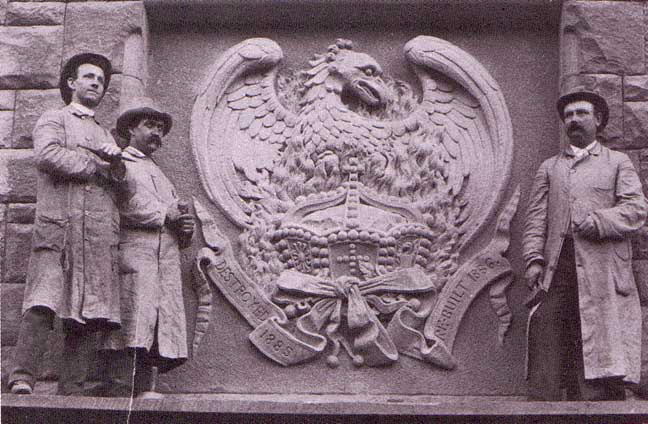
Ostensibly, this seal was created to commemorate the opening of Teck theatre on the grounds of the Saengerhalle. Can any other armchair symbologists help me break this one down? Also, what is the significance of holding chisels and hammers? I think it's pretty clear that they did not just finish chiseling that seal before they took the photo. Is that a freemason thing?
Note: This OP was recovered from the Wayback Archive.
Note: Archived Sh.org replies to this OP are included in this thread.