SH Archive Single Photo: 1864 - Destruction of Hood's Ordinance Train

SH.org OP Username
KorbenDallas
SH.org OP Date
2019-05-23 01:01:18
SH.org Reaction Score
19
SH.org Reply Count
19

KD Archive

Not actually KorbenDallas
Active Member
Joined
Sep 22, 2020
Messages
4,691
Reaction score
1,500
The official description to the below 1864 photograph:
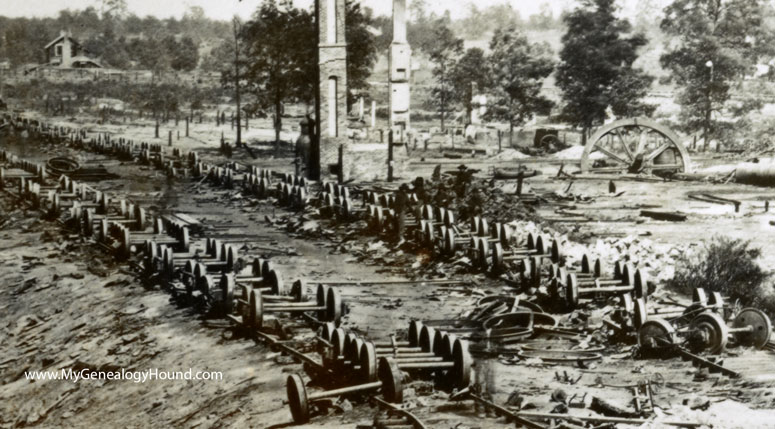
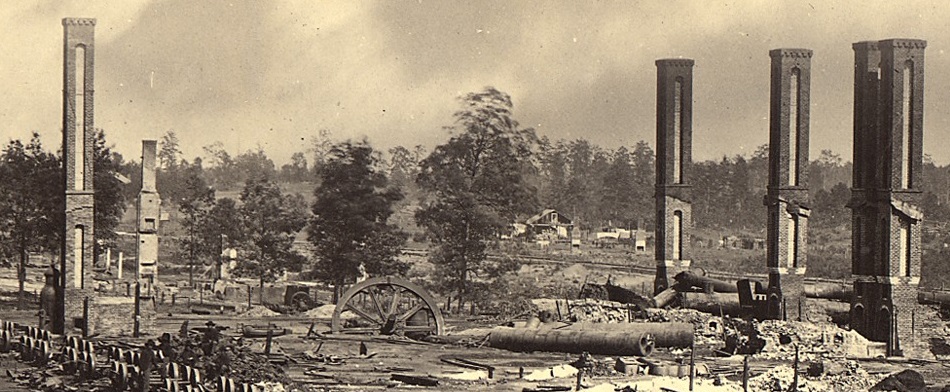
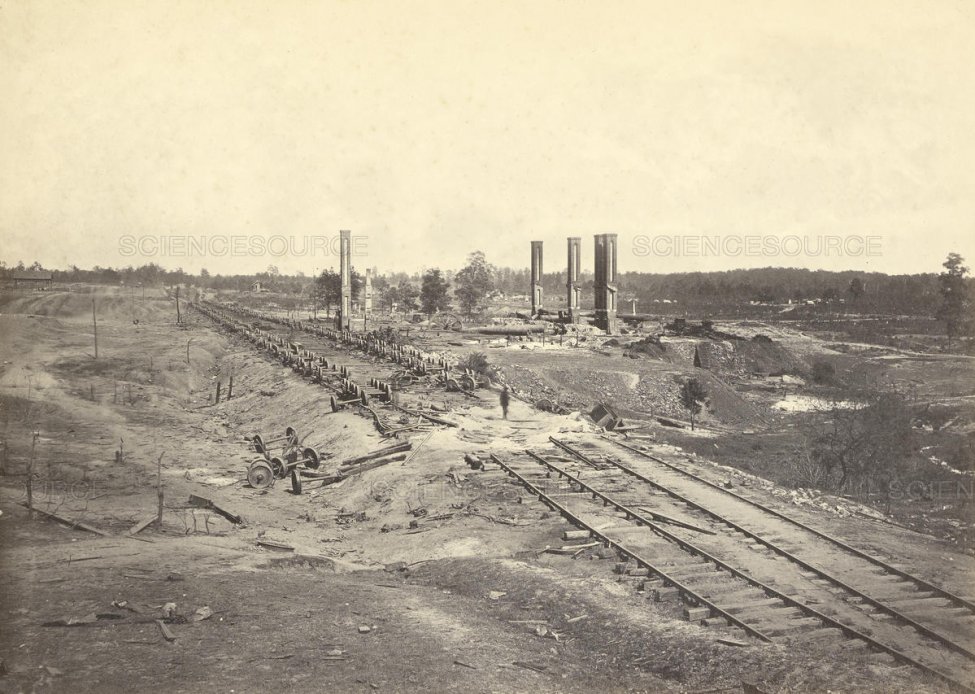
  • Destruction of Hood's Ordinance Train, American Civil War, 1864. Taken by George N. Barnard (American, 1819 - 1902); Atlanta, Georgia, United States. Albumen silver print. When the Confederate Army abandoned Atlanta, they set a train filled with gunpowder on fire, resulting in enormous explosions. They wanted to keep the gunpowder out of Union hands.
Destruction of Hood's Ordinance Train.jpg

Source
KD: There is no information pertaining to a possible clean up, or any rearrangement of the train remains that I know off. So...
  • Where did the train go? Evaporated?
  • Why are them train wheels arranged in this bizarre fashion? The only guess of mine would consist of those cars being made entirely out of wood.
  • Any opinions?
Note: This OP was recovered from the Wayback Archive.
Note: Archived Sh.org replies to this OP are included in this thread.
 
Note: This post was recovered from the Sh.org archive.
Username: RecycledSoul
Date: 2019-05-23 02:22:38
Reaction Score: 1
Same questions popped up to me with the addition of:
How did steel tracks get obliterated where the person is standing, but not the steel wheels?
What is the 10-12 ft tall steel wheel inside the burned building for?
Why are the smoke stacks so high & so many for an apparent train station? Several old train platforms still in existence are not of that magnitude.
Why are the sets of wheels so close together? It seems that train cars were only 5 or so feet long if the cars burned and the wheels are pictured where they were parked. Several things in the picture don’t add up.
 
Note: This post was recovered from the Sh.org archive.
Username: WarningGuy
Date: 2019-05-23 10:53:38
Reaction Score: 1
I have seen a picture of that building once before. The building or whats left of it is where they made the wheels and axles you see lined up on the track. So i would say there never was a train loaded with gun powder and set alight in the first place. Thats why you don't see any train, there was none.
The picture i seen was a closeup of the destroyed building and that 12 ft tall wheel is a hell of a lot bigger than 12ft. I think the building was from a time past, like from before the last reset.
Edit
There not smoke stacks. There the last of the columns that are still standing. Wish i could remember where i seen the photo
 
Note: This post was recovered from the Sh.org archive.
Username: jd755
Date: 2019-05-23 11:53:31
Reaction Score: 3
This it?

I too have seen that picture before and indeed the wheels and axles are new never being fixed to wagons or carriages as evidenced by the close proximity of the pairs of wheels to each other.
There are no big driving wheels of the locomotives visible ergo there were none and no damaged boilers either.
The single smoke stack is the smaller thing at the back and you can see a fireplace half way up so where it was it was a two story (ground and first floor) building most likely off the back of the main building. The shoulders are the evidence it is a chimney.

Thing is why does the caption say what it does?
Who lays down the bullshit, so too speak?

GA-Atlanta-Georgia-Detail-of-Destroyed-Hoods-Ordnance-Train-historic-photo.jpg
 
Note: This post was recovered from the Sh.org archive.
Username: RecycledSoul
Date: 2019-05-23 16:16:06
Reaction Score: 1
The others look like they possibly have an opening on the ground floor, resembling the enormous incinerators in the older buildings at the University here. If that is the case, could this be a cadaver inceneration center? How can the cotton mill / train axle factory theory be proven / disproven. If a reset is in progress, the cadavers and bodies had to be disposed of somehow. What better way than to arrive by the train load and incineration with no trace. It is apparent from the photo that something went wrong one way or another.
 
Note: This post was recovered from the Sh.org archive.
Username: jd755
Date: 2019-05-23 16:34:48
Reaction Score: 1
There is no proof of anything just the balance of probabilities.
As for the images above the only standing structure that looks to me to be a chimney is the one I mentioned for the reasons mentioned and standing examples of chimney construction on the dwindling number of railway buildings around these parts.
Same goes for the wheels on the tracks. As a boy I stayed in a holiday camp next to Barry Island scrapyard in Wales where they were scrapping old rolling stock from the steam and early diesel eras and there were lines of wheels on rails within the scrapyard.
As for the cotton mill, on the other thread, it looks very similar to still standing mills in and around Manchester and Lancashire.
So for me, always for me, its a wheel works that was destroyed by means unknown and a mill, probably cotton, that was destroyed by means unknown, neither description on the official sources is true and there is no way to know the date of the photograph and with it the date of the event. They seem to be carefully composed so as to not be able to hazard a guess from the foliage/clothing and any other marker that may place them in season if nothing else, but that's probably my cynical nature coming to the fore once again.

Here's a massive copy of the image (in the download selection) Destruction of Hood's Ordinance Train (Getty Museum)
 
Note: This post was recovered from the Sh.org archive.
Username: KorbenDallas
Date: 2019-05-23 16:44:06
Reaction Score: 6
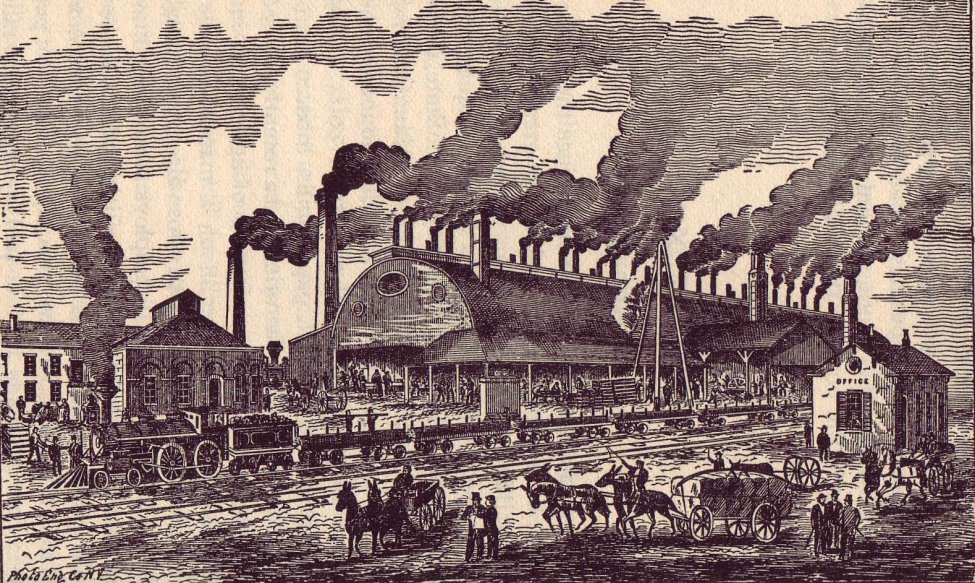
This is what allegedly was there prior to the explosion.
  • Atlanta Rolling Mill - Wikipedia
  • A better quality OP image.
  • The Atlanta Rolling Mill was constructed in 1858 by Lewis Schofield and James Blake and soon after, Schofield and William Markham took it over and transformed it into the South's second most productive rolling mill, after the Tredegar Iron Works in Richmond, Virginia.
  • Their specialty was re-rolling worn out railroad rails but during the American Civil War it also rolled out cannon, iron rail, and 2-inch-thick (51 mm) sheets of iron to clad the CSS Virginia for the Confederate navy.
  • It was bought out by Charleston, SC interests in 1863 and became known as the Confederate Rolling Mill when it produced the former products as well as cannon.
  • Shortly after midnight on September 1, 1864, cavalrymen under the command of the retreating Confederate General J.B. Hood set fire to 81 ammunition train cars parked outside the mill to prevent them from being acquired by General Sherman. The ensuing explosions destroyed the mill and destroyed or greatly damaged structures within 1/4 mile. The events were so loud that Sherman himself heard the explosions from approximately 23 miles away at Lovejoy's Station.
  • Part of what is now Boulevard was named Rolling Mill Street, when the street was extended north of the railroad in the late 1860s, thus commemorating the already destroyed mill. The name was changed to Boulevard around 1880.
Atlanta-rolling.jpg

Trees
How come trees always survive? In this case with leaves? It's almost like this place was in this condition for decades.
 
Note: This post was recovered from the Sh.org archive.
Username: jd755
Date: 2019-05-23 16:54:41
Reaction Score: 0
That big wheel in its wheel pit is I feel connected to those big rollers, at least they look like rollers to me, as is the smaller wheel beyond it. Close up all the standing remains appear to be chimneys. I wonder if a furnace or steam pressure vessel or boiler exploded and destroyed the place. The bottle shaped thing stood behind the left hand standing remains could be a steam boiler or a compressed pressure vessel.
 
Note: This post was recovered from the Sh.org archive.
Username: BrokenAgate
Date: 2019-05-23 16:55:32
Reaction Score: 2
Gotta wonder why some photos were destroyed and others, such as this one, were preserved. My guess is that some images are better than others at preserving the narrative that the controllers want us to believe. With this photo, they could say that it was a train that was blown up to keep the ammunition out of the hands of the enemies. Since most of us have no experience with trains, other than riding one occasionally, we never questioned the explanation. We are taught certain things in school, which we must memorize in order to pass the exams, and once we accomplish that, we tend to forget all about it. I think this is deliberate, all done in order to keep us from questioning anything when we're older. Well, obviously, that is changing. I guess that means they'll have to reset our asses again and make up a whole new historical record. ?
 
Note: This post was recovered from the Sh.org archive.
Username: RecycledSoul
Date: 2019-05-23 16:56:09
Reaction Score: 2
And what evidence do we have that this photo was actually taken in the Continental US? ? This COULD be anywhere in the world. The whole world is a stage. KD, in your last post I see at least 25 stacks/chimneys in the top pic, yet no “pile” of toppled bricks/chimneys in the post pic. With the scale of stacks/chimneys, I would expect a much larger rubble pile.
 
Note: This post was recovered from the Sh.org archive.
Username: jd755
Date: 2019-05-23 17:09:39
Reaction Score: 1
Well at least the covered wagons and uniforms of the few figures visible in the getty images big picture match these on this site The Last Days Of The Civil War In Atlanta (12 Photos)
Not that this is proof of anything which also states;
Ruins of Rolling Mill and cars destroyed by rebels on evacuation of Atlanta, Ga., 1864

Now it gets interesting.
Here is picture of the site without any soldiers in it.

rolling-mill-700x_0.jpg

The credit is given to National Archives. So going to National Archives the picture they have IS the one with the soldiers in it!
 
Note: This post was recovered from the Sh.org archive.
Username: RecycledSoul
Date: 2019-05-23 18:50:10
Reaction Score: 1
Odd that we have the exact photo with no humans superimposed, then, Viola!
 
Note: This post was recovered from the Sh.org archive.
Username: jd755
Date: 2019-05-24 10:39:18
Reaction Score: 1
It's not the exact same as the op photo. The camera position is different in the 'empty' one. Point being Mr Barnard the photographer, we are told, used glass plate negatives and developed them on site in his mobile darkroom and yet he used up two just on this one site from the lighting they suggest they were taken the same day, which to me begs the question why waste one and why was this site chosen?
There are what looks like a column or two of covered wagons in the background which suggests troops possibly being present although we see precious few in the op photograph and try as we might duckduckgo and I cannot find any bigger version of the empty picture, indeed the empty picture seems to be unique.
 
Note: This post was recovered from the Sh.org archive.
Username: WarningGuy
Date: 2019-05-24 12:26:48
Reaction Score: 1
There is not much rubble around where the building once stood for the size it would of been. Also the small tree to the right of the damaged track is still totally intact.
 
Note: This post was recovered from the Sh.org archive.
Username: jd755
Date: 2019-05-25 06:46:08
Reaction Score: 0
Came to me last night after another fruitless image search looking for a bigger version of Barnard's empty photo that "Hoods train" is not a railway train but a wagon train there were thousands of the things in use in Atlanta.
To the left of the mangled rails is what could be a dirt road so it wouldn't have been hard to pull up a couple of wagons of gunpowder/explosives of the day across the rail lines and detonate them to mangle the tracks. Hood was pulling out of Atlanta not by rail by horse and cart.
Doesn't explain the building though which is looking more and more like it has been demolished rather than destroyed and all usable materials taken away to use elsewhere.
Post automatically merged:

Looking into the man behind the pictures using duckduckgo and giberu produces startling, to me, differences in results.
duckduckgo served up this story of his life George N. Barnard | Selected Photographers and Examples of Their Work | Articles and Essays | Panoramic Photographs | Digital Collections | Library of Congress
giberu this one https://www.georgiaencyclopedia.org/articles/history-archaeology/george-n-barnard-georgia

Basically at the time of the Hood picture Barnard was in the employ of the Union army on recording and topographical duties. Not that he had any prior topographical experience, at least according to that pair of articles which is akin to putting a painter and decorator to work in the Sistine chapel.
It seems he went back and photographed places some months after the events are said to have occurred.

But best of all I found this site which has download links to all of his military work in three albums. Barnard and Gardner Civil War Photographs / Digital Collections / Duke Digital Repository
 
Note: This post was recovered from the Sh.org archive.
Username: wizz33
Date: 2019-05-25 08:45:03
Reaction Score: 0
it looks like there are 2 railroad track sizes 1 standard with the wheels on it and another of at least 1.70 cm
 
Note: This post was recovered from the Sh.org archive.
Username: jd755
Date: 2019-05-25 10:16:43
Reaction Score: 0
There is another railway line in the mid ground to the right of the remains of the rolling mill. No way to tell if it too is damaged.

On page 97 of the first album at the link one can zoom in to the image bearing the workers. The people in the picture are not union soldiers as I first thought. Obvious also in that zooming is the site is in the process of being cleared.
After further reading of those articles I feel it fair to suggest Sherman and his army did the demolishing of the rolling mill after they took possession of Atlanta, assuming the official narrative is on the money, to remove the industrial capacity of 'the South' to rebuild its infrastructure. He and his army certainly seemed to have had a jolly good time trashing Johnny Reb's backyard.
A probable timeline of sorts?
Hood's soldiers destroy the railway tracks as they leave Atlanta >
Sherman and his soldiers appear and proceed to demolish and strip the rolling mill >
Barnard under orders of Sherman and his travelling darkroom turns up, takes and process pictures ready for pushing the agenda, whatever it was.
 
Note: This post was recovered from the Sh.org archive.
Username: Jim Duyer
Date: 2019-05-25 21:02:38
Reaction Score: 0
The tall steel wheel inside the burned building, plus the extensive damage to the front of the building, probably speaks of a flour mill, which would have added to the force of the blast. They often put them near the rail lines for easy transport. Or it could even have been a cotton gin, same answers. The wheels might be close together since they would want to salvage them - metal being scarcer than normal.
Yes the cars were wooden in those times. Part of one car seems to be leaning on the right side of the rails. But yes, something strikes me as hinky about this whole picture.
 
Note: This post was recovered from the Sh.org archive.
Username: BrokenAgate
Date: 2019-05-26 16:53:12
Reaction Score: 1
The presence of undamaged trees suggests that this happened some time ago, long enough for trees to grow back...or that the weapons used were selective in choosing their targets. Probably the former. The whole place just looks old, like you said, as if it was like this for a long time.
 
Note: This post was recovered from the Sh.org archive.
Username: jd755
Date: 2019-05-26 18:12:30
Reaction Score: 1
Amazing what you can find on the internet!
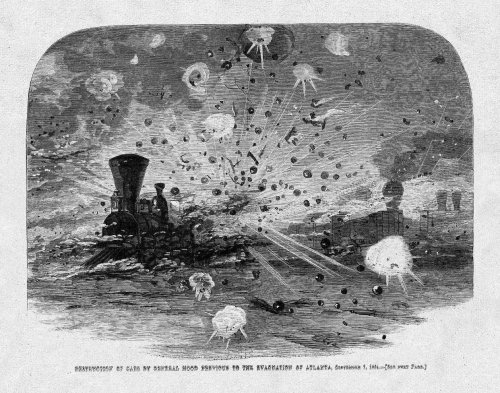
DestructionOfLocomotives0637w500.jpg

Source Mining Life In California BI
Hood leaves 1st September 1864, Harpers Weekly A Union paper, runs the engraving 1st October 1864 so it must be true. Who needs an internet!

Well me obviously 'cos I then find this Sherman's Attack on Atlanta

Hardly had the contest been decided at Jonesborough before Hood made preparations to evacuate Atlanta. The immense destruction of property which preceded the evacuation of the city is illustrated on page 637, especially the destruction of nearly a hundred cars loaded with fixed ammunition which were set on fire, on the Augusta Railroad, one mile from the city. The scene is thus described in the correspondence above quoted :

" The detonation of the bursting shells shook the city to its foundations, and filled the air continually for the space of several hours with fragments and the debris of the general wreck. The explosions were heard twenty-five miles from the city. Visiting this spot, I saw the naked trunks and axles of cars for near a half mile in extent, the ground for a long distance on both sides of the track covered over with the evidences of the terrible agents which had been at work. A large locomotive had been thrown off the track at one end by the explosions. Three locomotives are said to have been captured in running order. Four field-guns were lying near the track in one place, and four 32-pounders in another place. The latter had but recently been brought up for siege guns. A considerable number of guns which the rebels could not take away in their hurried flight from the city were buried, and head boards with lying epitaphs placed above them to personate graves of old soldiers. General Sherman states the number of guns captured as 27 ; and 7 locomotives."


Clearly I've been talking through my backside, sorry 'bout that.
 
Tips
Tips
Please respect our Posting Rules.
Back
Top