

- Joined
- Sep 24, 2020
- Messages
- 38
- Reaction score
- 210
The most efficient of the manipulation and coercion tools are revolutions and mass movements. Famous examples are the first republican movements and the various communist uprisings during the Cold War. The masses contrary to modern psychological operations are made to believe that they are the ones truly in power and are moving towards are viable goal (such as freedom or economic equality). As well known to the avid reader of contemporary history, these mass movements facilitate the most defining censures of human history.
This erasure of history will be explored in this post using the Soviet Union as a case example. The post will assume the following points for this analysis:
(1) The Soviet Union (and all of their ruling class/party cadres) were either appointed by external forces or were already part of those. (see Lenin-German connection, Politbüro / NKVD organisation, publicly available comments of certain uberrich people)
(2) The application of Marxist-Leninist thought and the subsequent inhumane atrocities was facilitated to experiment with a possible totalitarian system. (see stalinist industrialisation, NKVD, KGB, early communist education)
(3) The failure of the planned state economy in 1985-1991 was used to affirm the current free market capitalist system. The economic reforms in mainland China under the Dengist Committee (with the helping hand of the external forces; Western loans given to the CCP) was further initiated for that particular goal.
(4) China is now the prime example for the future. It is ruled by a totalitarian system completely governing all the citizens, run by a small elite kept afloat by external loans.
With the Leninist revolution in the Russian heartland and the consolidation of power, the communist elite first set their sights on the remaining centers of (non-conforming) knowledge. Keep in mind, the Romanovs were not independent either – as many Russians and Orthodox christians might claim – and had tried the exact same things, but then merely under a absolutist monarchy constraint by the technology of their time (see French invasion of 1812).
In the Russian Civil War, the burning of libraries (public and private) and the bombing of traditional education institutions (monasteries, mosques dating to premodern times) became common place. The conscripted peasant army believing they were fighting against the corrupt aristocracy was used to systematically destroy their own culture and history.
To quote The Guardian:
Pictures of these events do not exist or at least are not publicly available. In comparison, pictures of book burnings in Hitlerite Germany are freely available. A coordinated scrubbing by mainstream historians may very well be possible.
To quote censorshipissues.wordpress.com:
To quote further:
The last quote of Krupskaia stands in contrast to common communist propaganda (education for the masses campaign), rather it displays a profound smug elitist attitude (one might say a Freudian slip).
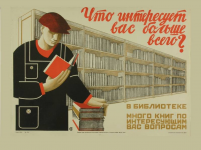
Soviet Propaganda "Which books interests you most?"
Source
Did E. Proskuriakova even exist? Taking into account the rigorous documentation of Soviet intelligence his name does not appear in any accessible historical publication. Secondly, why would Lenins wife be in charge of book burning and banning? She is described as an active CCCP member during the early Soviet Union and was supposedly installed as deputy education minister by her husband.
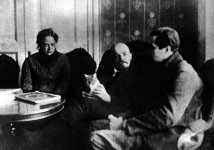
Krupskaia (left), Lenin (middle, with cat), unnamed American journalist (right)
Source
The more likely scenario is that this destructive process was fully controlled by the ruling class with the personalities Proskuriakova and Krupskaia merely functioning as strawmen. These book burning lists possibly predated even the revolution itself.
A corresponding process was later initiated in China during the Cultural Revolution. The target of the Maoist forces were not merely cultural and historical goods, but especially personal genealogy books (displaying family heritage, as it was commonplace in China). One can assume that this was an deliberate attempt by the elite to render an identification of their operatives as impossible.
Why you might ask? There was lots of intermarriage between British (East India Company) imperialists, Italian immigrants and the Chinese ruling class from the Qing dynasty onward till the Kuomintang rule. This intermarried class was mostly based in Hongkong, Beijing and Macao. You can guess whose descendents rule modern day China.
YouTube Documentary about an Italian man growing up in rural China
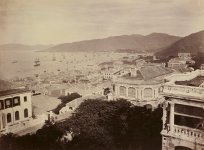
Fully europeanized Hongkong (in 1868)
Source
Wikipedia Source (Chinese Book Burning)
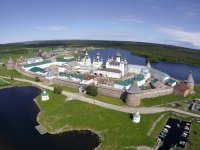
One major recorded event during the Soviet consolidation was the bombing and destruction of the Solovetsky monastery. This particular monastery is located on the Solovki island in Northern Russia. During Tsarist rule there was an attempt by British forces to conquer the island in 1854 (by firing artillery from battleships).
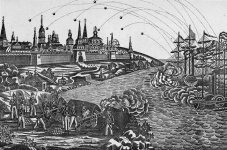
British bombing of the island (1854)
Source
Modern day reconstruction
Source
The Soviet looting and subsequent burning of the monastery caused unimaginable amounts of literature and cultural-religious artefactes to get lost. The priests and teachers were either deported or shot on the spot. An early Soviet gulag was then constructed on the monastery grounds.

Gulag building (museum style, open for sightseeing)
Source
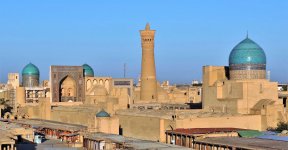
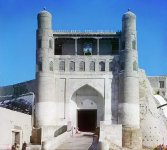
During the Russian Civil War Soviet forces under General Frunze were dispatched to destroy the supposed reactionary forces in Central Asia (mainly muslims, also cossacks). Although there were not many White Russian forces located in this region, this military operation was accompanied by excessive burning and looting in the few bigger settlements of the Kazakh plains. The main target was the former Tsarist province of Turkestan, divided into several Turkic muslim khanates. These included the prestigious cities of Islamic thought, Khiva and Bukhara dating back to the Islamic empires of old.
Source Modern Day Bukhara
Source Imperial Bukhara Palace (1909, colorized)
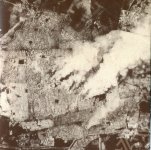
The Soviet forces employed a similar reconquest strategy as in Central Russia. First these historic cities were bombed to the ground (especially targeting historical mosques and Turkic imperial buildings). Second the buildings were secured through human wave attacks, people of importance (teachers, elders) were then identified and executed on the spot.
Source Burning of Bukhara 1920
The third and last step was the systematic burning of historic books. Records dating back to the Early Middle Ages, scientific books written in the 15th century et cetera, an imaginable number of books, all gone. If complete records of the Tatars existed, these were probably it.
A similar picture can be found analysing the Soviet Invasion of Afghanistan. To quickly summarize Afghanistan is a construct with its borders being drawn by the Great Game between Great Britain (British Raj) and Imperial Russia. Naturally – before the meddling of external powers – this region was not divided by artificial borders and thus people could freely travel through. One can therefore assume that many books were copied or carried over into modern day Afghanistan.
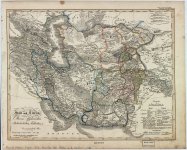
Source German-made map (1835)
Soviet forces invaded Afghanistan in 1979, supposedly to assist the communist revolutionaries in suppressing local revolts. Keep in mind, these local revolts started after the communist rulership air-bombed a protest in the city of Herat (killing 50,000). As a quick side note, Afghanistan is home to the largest rare earth mineral deposits in the world (a natural target for outside powers).
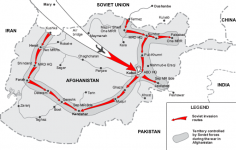
Source Soviet invasion plans
Thus orchestrated by the KGB and executed by its Afghan copy KhAD an elaborate system of state repression and torture was put in place. Book burnings and library confiscations became commonplace.
To quote from Afghanistan - The Soviet Invasion and the Afghan Response, 1979-1982:
To quote further from the same book:
A state above the state? A torture agency working on behalf of the KGB (another torture agency)? Afghans -> Communists -> KhAD -> KGB -> Soviet Union?
Why was book burning and confiscation so important for the Soviet forces?
(1) To identify possible local intelligentsia (locals owning such literature do not comply and can teach this knowledge to the newer generations)
(2) To cut links between the past and the present (thus making the locals more compliant)
(3) To find and use Old World literature
What does that mean for the present? The application of repression might change, but its underlying methodology does not. As the Soviet system has suppressed and redefined reality as it seemed fit, similar structures (with the same end goal) may be build in the future.
This post was mainly written to display the importance of books in the modern age and past attempts at suppressing knowledge.
This erasure of history will be explored in this post using the Soviet Union as a case example. The post will assume the following points for this analysis:
(1) The Soviet Union (and all of their ruling class/party cadres) were either appointed by external forces or were already part of those. (see Lenin-German connection, Politbüro / NKVD organisation, publicly available comments of certain uberrich people)
(2) The application of Marxist-Leninist thought and the subsequent inhumane atrocities was facilitated to experiment with a possible totalitarian system. (see stalinist industrialisation, NKVD, KGB, early communist education)
(3) The failure of the planned state economy in 1985-1991 was used to affirm the current free market capitalist system. The economic reforms in mainland China under the Dengist Committee (with the helping hand of the external forces; Western loans given to the CCP) was further initiated for that particular goal.
(4) China is now the prime example for the future. It is ruled by a totalitarian system completely governing all the citizens, run by a small elite kept afloat by external loans.
Soviet Book Burnings
With the Leninist revolution in the Russian heartland and the consolidation of power, the communist elite first set their sights on the remaining centers of (non-conforming) knowledge. Keep in mind, the Romanovs were not independent either – as many Russians and Orthodox christians might claim – and had tried the exact same things, but then merely under a absolutist monarchy constraint by the technology of their time (see French invasion of 1812).
In the Russian Civil War, the burning of libraries (public and private) and the bombing of traditional education institutions (monasteries, mosques dating to premodern times) became common place. The conscripted peasant army believing they were fighting against the corrupt aristocracy was used to systematically destroy their own culture and history.
To quote The Guardian:
The communists burned untold numbers of decadent western books and writings in the Soviet Union from the 1920s on (...)
Pictures of these events do not exist or at least are not publicly available. In comparison, pictures of book burnings in Hitlerite Germany are freely available. A coordinated scrubbing by mainstream historians may very well be possible.
To quote censorshipissues.wordpress.com:
This purge was followed by another in 1927, where sixty percent of all books were eliminated in most Soviet libraries. Yet again, in 1929 libraries were forced to censor their collections further by party demand. In the 1930’s book censorship in the Soviet Union did not stop; between 1930 and 1932, libraries lost sixty percent more of their stock that was already purged at least three times. During just one year in Moscow over 779,579 books were lost and most books were never reprinted.
To quote further:
In 1923, a man named E. Proskuriakova outlined the characteristics of books that were considered “harmful” to the Soviet Union. On this list was: Failure to promote the worker’s class consciousness and willingness to work hard, religious propaganda, pro-tsarist ideas, opposition to revolutionary class struggle, and promoting national hatred. It was this same year that Krupskaia (Lenin’s wife) started a book purge which banned “Plato, Descartes, Kant, the Gospels, the Koran, the Talmud, Carlyle, Tolstoy and William James.” When ask for reasons why, Kruspskia replied, “The masses do not read Kant.”
The last quote of Krupskaia stands in contrast to common communist propaganda (education for the masses campaign), rather it displays a profound smug elitist attitude (one might say a Freudian slip).
Soviet Propaganda "Which books interests you most?"
Source
Did E. Proskuriakova even exist? Taking into account the rigorous documentation of Soviet intelligence his name does not appear in any accessible historical publication. Secondly, why would Lenins wife be in charge of book burning and banning? She is described as an active CCCP member during the early Soviet Union and was supposedly installed as deputy education minister by her husband.
Krupskaia (left), Lenin (middle, with cat), unnamed American journalist (right)
Source
The more likely scenario is that this destructive process was fully controlled by the ruling class with the personalities Proskuriakova and Krupskaia merely functioning as strawmen. These book burning lists possibly predated even the revolution itself.
A corresponding process was later initiated in China during the Cultural Revolution. The target of the Maoist forces were not merely cultural and historical goods, but especially personal genealogy books (displaying family heritage, as it was commonplace in China). One can assume that this was an deliberate attempt by the elite to render an identification of their operatives as impossible.
Why you might ask? There was lots of intermarriage between British (East India Company) imperialists, Italian immigrants and the Chinese ruling class from the Qing dynasty onward till the Kuomintang rule. This intermarried class was mostly based in Hongkong, Beijing and Macao. You can guess whose descendents rule modern day China.
YouTube Documentary about an Italian man growing up in rural China
Fully europeanized Hongkong (in 1868)
Source
Wikipedia Source (Chinese Book Burning)
Burning of the Solovetsky Monastery
One major recorded event during the Soviet consolidation was the bombing and destruction of the Solovetsky monastery. This particular monastery is located on the Solovki island in Northern Russia. During Tsarist rule there was an attempt by British forces to conquer the island in 1854 (by firing artillery from battleships).
British bombing of the island (1854)
Source
Modern day reconstruction
Source
The Soviet looting and subsequent burning of the monastery caused unimaginable amounts of literature and cultural-religious artefactes to get lost. The priests and teachers were either deported or shot on the spot. An early Soviet gulag was then constructed on the monastery grounds.
Gulag building (museum style, open for sightseeing)
Source
Soviet Invasion of Central Asia
During the Russian Civil War Soviet forces under General Frunze were dispatched to destroy the supposed reactionary forces in Central Asia (mainly muslims, also cossacks). Although there were not many White Russian forces located in this region, this military operation was accompanied by excessive burning and looting in the few bigger settlements of the Kazakh plains. The main target was the former Tsarist province of Turkestan, divided into several Turkic muslim khanates. These included the prestigious cities of Islamic thought, Khiva and Bukhara dating back to the Islamic empires of old.
Source Modern Day Bukhara
Source Imperial Bukhara Palace (1909, colorized)
The Soviet forces employed a similar reconquest strategy as in Central Russia. First these historic cities were bombed to the ground (especially targeting historical mosques and Turkic imperial buildings). Second the buildings were secured through human wave attacks, people of importance (teachers, elders) were then identified and executed on the spot.
Source Burning of Bukhara 1920
The third and last step was the systematic burning of historic books. Records dating back to the Early Middle Ages, scientific books written in the 15th century et cetera, an imaginable number of books, all gone. If complete records of the Tatars existed, these were probably it.
Soviet Invasion of Afghanistan
A similar picture can be found analysing the Soviet Invasion of Afghanistan. To quickly summarize Afghanistan is a construct with its borders being drawn by the Great Game between Great Britain (British Raj) and Imperial Russia. Naturally – before the meddling of external powers – this region was not divided by artificial borders and thus people could freely travel through. One can therefore assume that many books were copied or carried over into modern day Afghanistan.
Source German-made map (1835)
Soviet forces invaded Afghanistan in 1979, supposedly to assist the communist revolutionaries in suppressing local revolts. Keep in mind, these local revolts started after the communist rulership air-bombed a protest in the city of Herat (killing 50,000). As a quick side note, Afghanistan is home to the largest rare earth mineral deposits in the world (a natural target for outside powers).
Source Soviet invasion plans
Thus orchestrated by the KGB and executed by its Afghan copy KhAD an elaborate system of state repression and torture was put in place. Book burnings and library confiscations became commonplace.
To quote from Afghanistan - The Soviet Invasion and the Afghan Response, 1979-1982:
The search of the apartment of Fahima Nassiry, a schoolteacher, was typical. “They cracked open the walls with the bayonets of their automatic rifles. They cut open all the mattresses. They broke the toilet. They poured out the cooking oil from the jars in her kitchen and tipped over bags of rice.” In a larger house search many more things were usually looked into. Anything that could incriminate the accused would be confiscated. Books—particularly the works of Sayyed Qutb and Mao—would be taken as proof of the accused person’s “guilt.” Under Khalqi and Parchami rule, private libraries were also confiscated. In most cases whole libraries were taken away; fortunately, my own library was spared. In 1973 the Parchami police had set the precedent of confiscating private libraries. At that time they confiscated the entire library of former Prime Minister Maiwandwal; among the works in the library were seven volumes in Maiwandwal’s handwriting on Afghan history.
In contrast with the Khalqi period, when detainees were treated violently during their interrogations, in the Parchami period torture became “part of a scientific system of intelligence rather than just a form of sadistic punishment.” Interrogation and torture were prolonged with the intention of forcing the detainee to implicate others. In theory, the interrogators were not to break detainees physically but to hurt them psychologically, breaking their personalities so they would admit to the crimes of which they were accused. In practice, though, interrogators did not observe these limits, sometimes going so far as to kill detainees. Among those who lost their lives under torture was the famous poet and journalist Ghulam Shah Sarshar Shamali, who, while under interrogation in Sadarat in 1982, was kicked to death.
To quote further from the same book:
(...) no Afghan under the regime was beyond its reach. It had the power and the means to torture men and women to the point of death with impunity. Although by law the execution of a prisoner after his trial in court was the prerogative of the head of state, KhAD determined the case one way or another. In the few cases when the head of state commuted death sentences to terms of imprisonment, he did so only with KhAD’s permission. KhAD was said to be a state within a state. This was true, but only partly. If the Kabul regime may be called a state, then KhAD was an agency above the state.
A state above the state? A torture agency working on behalf of the KGB (another torture agency)? Afghans -> Communists -> KhAD -> KGB -> Soviet Union?
Why was book burning and confiscation so important for the Soviet forces?
(1) To identify possible local intelligentsia (locals owning such literature do not comply and can teach this knowledge to the newer generations)
(2) To cut links between the past and the present (thus making the locals more compliant)
(3) To find and use Old World literature
What does that mean for the present? The application of repression might change, but its underlying methodology does not. As the Soviet system has suppressed and redefined reality as it seemed fit, similar structures (with the same end goal) may be build in the future.
This post was mainly written to display the importance of books in the modern age and past attempts at suppressing knowledge.


