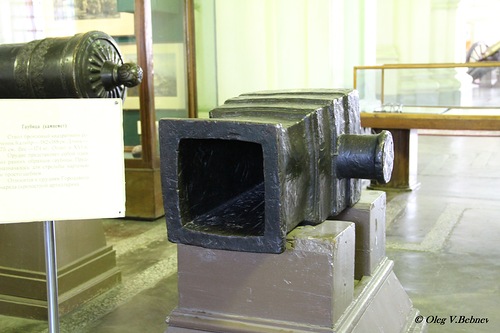
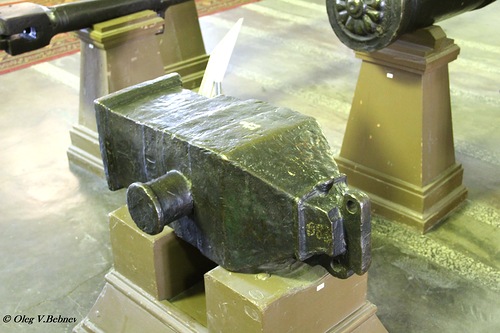
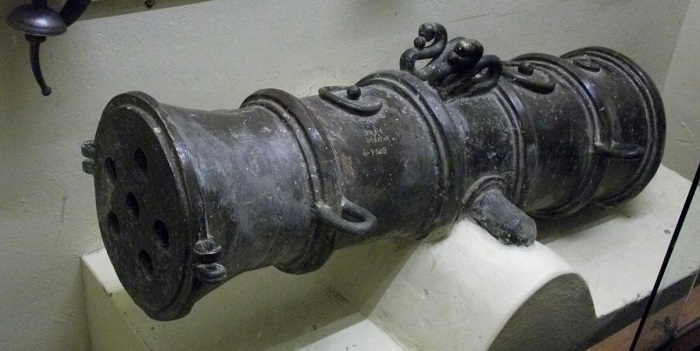
Square cannon? What about "ninety-degree-corner-cannon"?
Stumbled over
this image here on this antique prints online shop. It's a page out of the
Encyclopaedia Londinensis from 1810...
Fig.1 is kind of goofy but Fig.8 looks more like some aparatus that could be used for some kind of galvanic process.
Description:
Artillery. Original and curious Cannon.
Upper Right: Plate IV. Lower Center: London, Published as the Act directs, June 30, 1798, by J. Wilkes. Lower Right: J. Chapman sculp.
Author: John Wilkes
Source / Publication: Encyclopaedia Londinensis; or, Universal Dictionary of Arts, Sciences, and Literature, Comprehending, Under One General Alphabetical Arrangement, all the Words and Substance of Every Kind of Dictionary Extant in the English Language. In which the Improved Departments of the Mechanical Arts, the Liberal Sciences, the Higher Mathematics, and the Several Branches of Polite Literature, are Selected from the Acts, Memoirs, and Transactions, of the Most Eminent Literary Societies, in Europe, Asia, and America
Publisher: J. Adlard
Place of Publication: London
Date: June 30th, 1798
Plate Number: 4
Engraver: J. Chapman
Paper Dimensions: 10 7/8 x 8 3/8 inches.
Platemark Dimensions: 9 7/8 x 7 5/8 inches.
Medium: Copperplate engraving
Language: English
Coloured: Black and white
Condition: The print is in great condition with some wear around the edges, including a tear into the top of the print, as can be seen.
Keywords: Artillery, Original cannons, Cannon, Cannons, Curious Cannon, design, detail, cannon balls, engraved cannons, war, wars, weapons, weaponry,
[automerge]1605823262[/automerge]
Sorry for the double post, but something that came to mind when seeing that "square cannon" from the OP: What if it is a
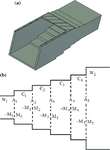
Waveguide/hollow conductor? Maybe that square cannon we are looking at, is just a piece of a set?
A waveguide filter?
Orthomode Transducer