SH Archive Staff at the 1904 Louisiana Exposition

SH.org OP Username
jd755
SH.org OP Date
2019-06-13 10:31:14
SH.org Reaction Score
8
SH.org Reply Count
2

Jd755

Core Member
Active Member
Joined
Dec 23, 2022
Messages
2,690
Reaction score
5,090
I was going to drop a picture of staff decorations into the upcoming post on the inventions that were or weren't there at the exposition on this thread
Steam power at St Louis Exposition 1904
but frankly there is too much to choose from so here is my pick of the evidence for staff being used at the expo, which in turn suggests that the buildings were indeed of timber construction, as bizarre as that sounds to those alive today, put up by skilled and unskilled labour using machines powered by steam, horse and cart, men using hand tools and made to appear to be of stone construction and decoration.
Wood is also used for the copious amounts of scaffolding, for the numerous train track sleepers, piles, in fact pretty much everything that isn't metal, glass or actual stone including the staff moulds and the aramtures.
There is of course no way to date these images, none whatsoever but I have yet to find any 'fiddling about' in the images so they seem to be authentic and of the time, whenever that time was.

It was in essence a huge stage set that actually existed for two or three years prior in an increasing order of scale, not just the few months the finished Exposition site was open to the public.

When I look at these pictures it really does beg the question how much of what we are told is ancient structures, sculptures, decorations etc is nothing more than various recipes of staff knocked up as and when needed and the imaginings of the Beaux Arts school in France and the people who were/are taught there.

Eagles and vases and check out the ladies hats and blouses in the left background are they 1902/3/4 vintage?
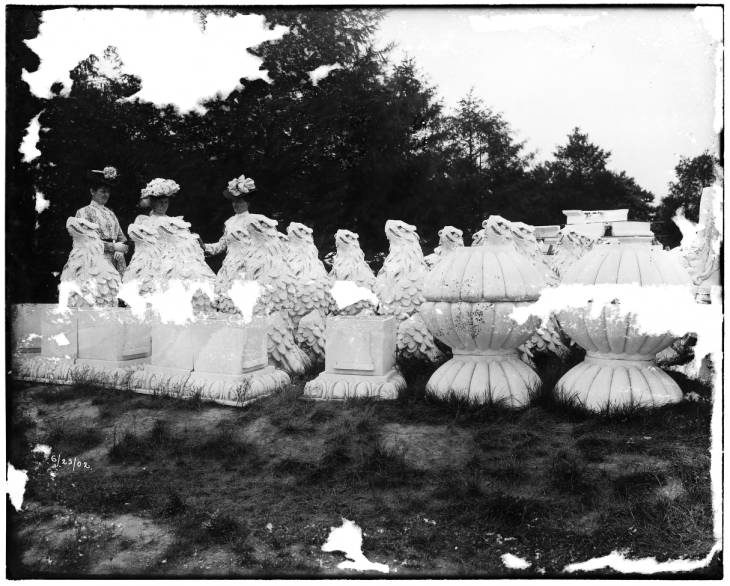
eagles.jpg


Easy to make the big one when you have a small one to scale off of. Makes me wonder why we need computers and 3d printers, could it be we have been made to accept 'dumb' we can no longer work this stuff out for ourselves?
easyreally.jpg


Three columns or rather half columns lying in the shade of the trees and check out the amount of panels, corbels, lintels etc in the background and the rail cars are a handy reference for the scale of these things.
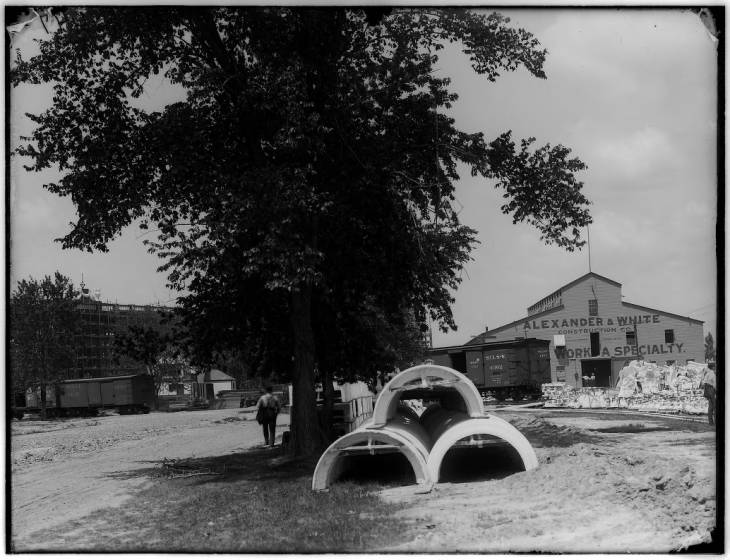
giantstaff.jpg


For those who still feel these buildings were dug out or that they could survive being buried look away now. There in that one photograph is the structure of what will appear as stone going up. Staff panels on timber which in turn is on a structural timber framework.
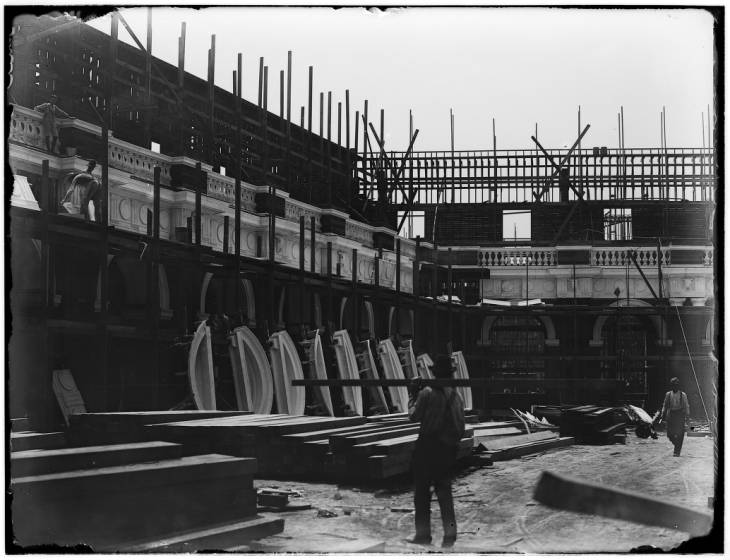
goingup.jpg


No idea how tall this bloke is but look at the size of the panel and once again the smaller panel used for scaling to the right. Are these skills all but non existent today, human skills and yet we marvel at a computer controlled printing machine knocking out a plastic component/toy/ornament in 3D, something is very wrong with contemporary society.
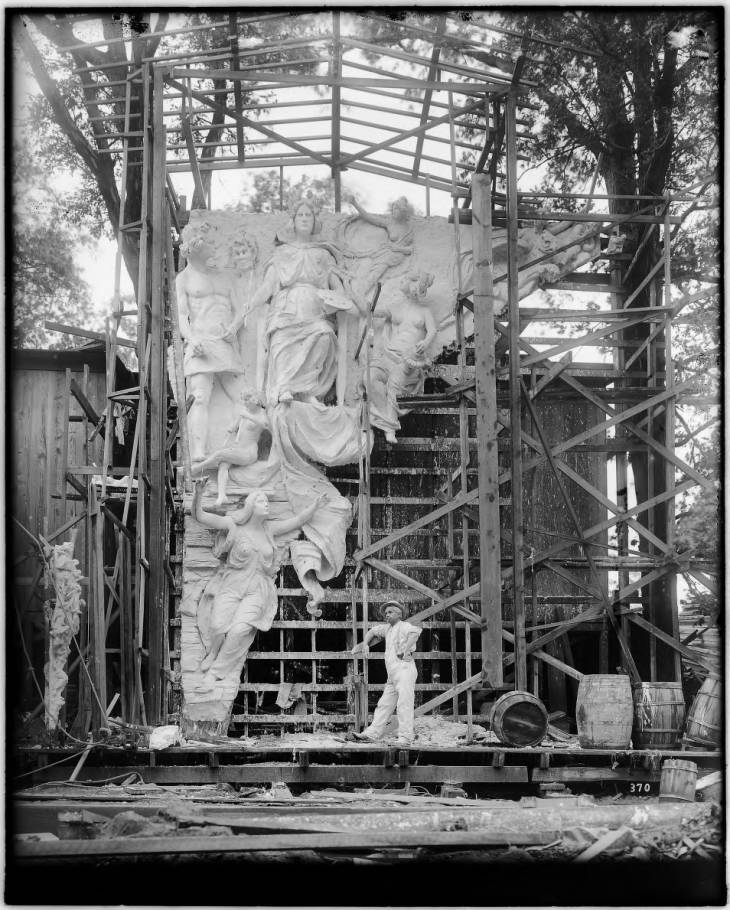
massive.jpg


For example could we make these wooden moulds today?
I'm sure some people could, these skills must survive somewhere but not sure many would want to bother learning and of course the evil of commerce means a human cannot compete with a machine as the machine doesn't take a wage, so human labour is a cost where as machine labour is a profit. Who dreamt up buying and selling and perhap more importantly why?
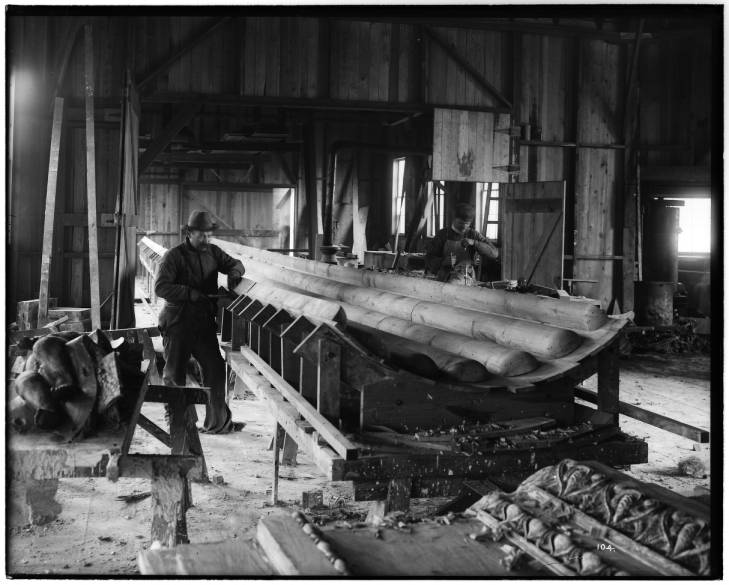
moulding.jpg


Just made as evidenced by the cover of pilaster but my god look at the detail. The skill of the mould maker is awesome.
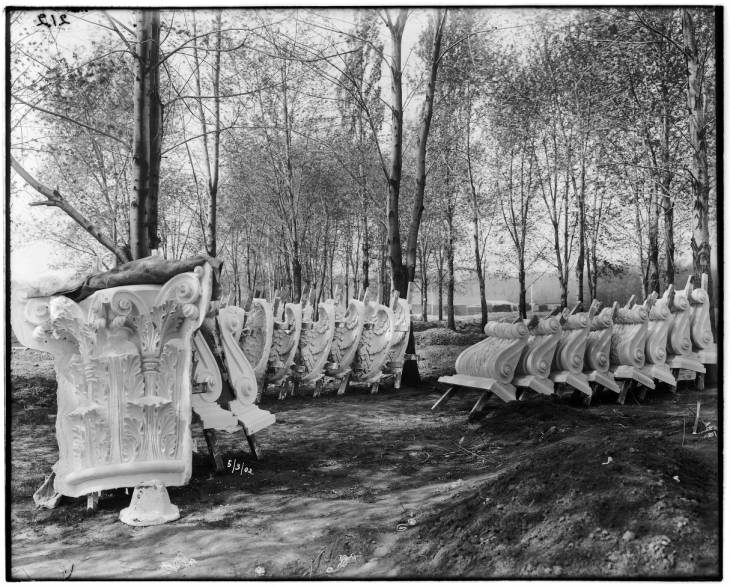
moulding2.jpg


Is the bloke craning his neck saying "Bloody hell she's massive."?
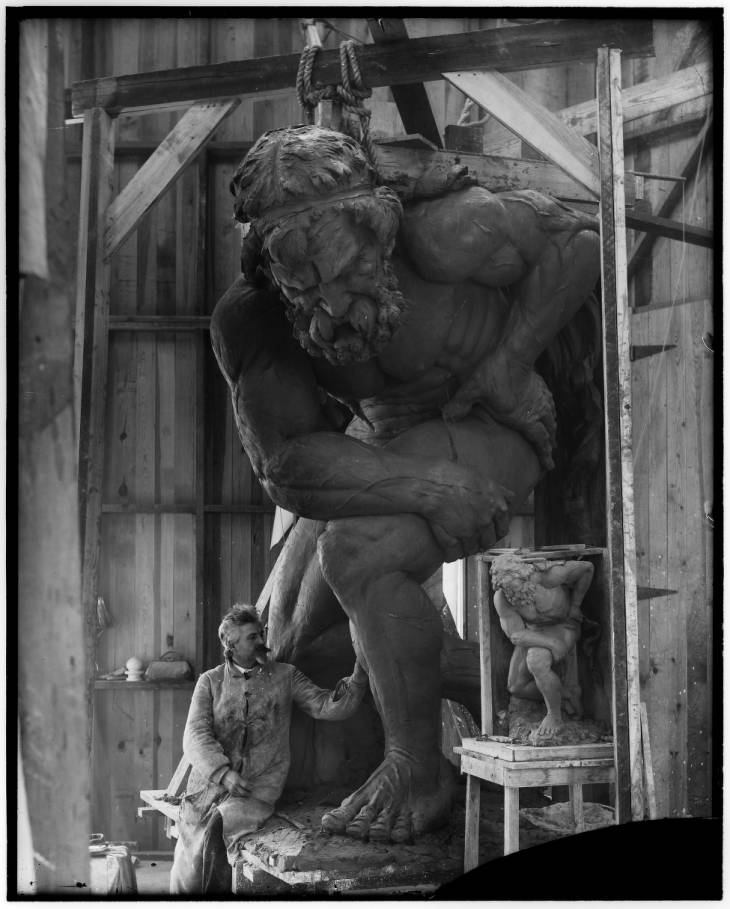
Humans always make things that are massive but and to me this is the but that makes difference, they are always within the human scale even though they are scaled up. So these huge sculptures four or five times bigger than the men in the picture still have the human proportions to them.
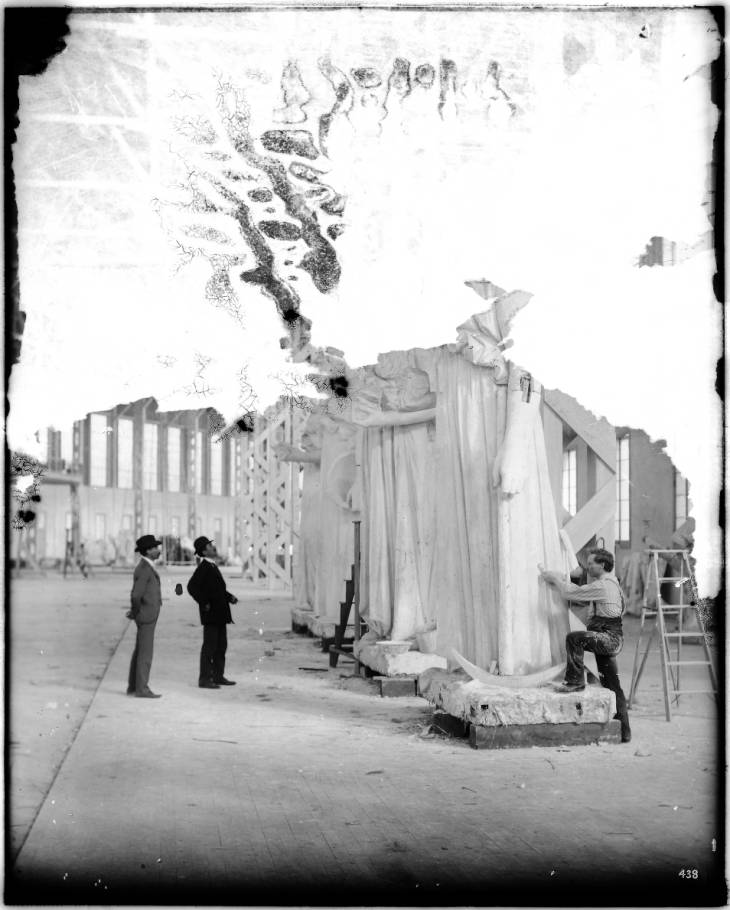
sheisbig.jpg


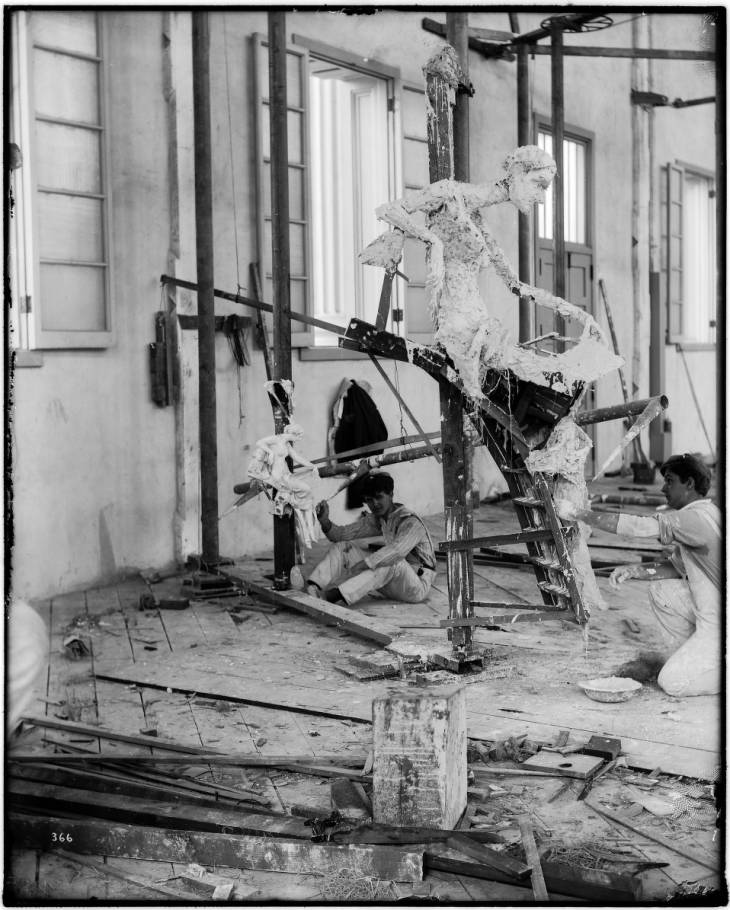
Scratching the itch. A true giant but made of clay over an armature presumably by the bloke in the photo. Look at the scale of the support timber, its massive yet once again in perfect human proportion.
scratch.jpg


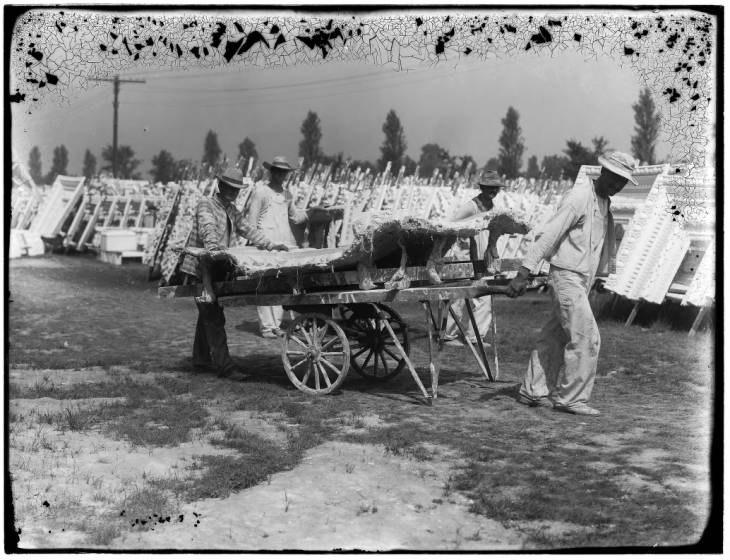
And smile! Look at it all. The background has everything, panles, corbles, freplaces, lintels, friezes etc stood out to dry. The production of staff was impressive to say the least. Again is the mens dress of the age?
smile.jpg


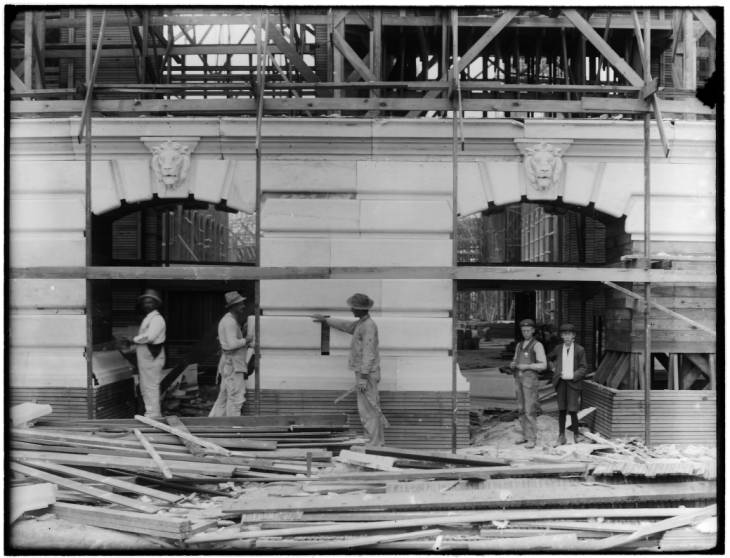
This is fantastic. Sliding a fake stone block aka staff panel into place, the men doing it, the underpinning of a lath and render base probably a cement render base as its the bit in contact with the ground, wooden scaffolding, a good view of just how effective fakery is.
staffpanels.jpg


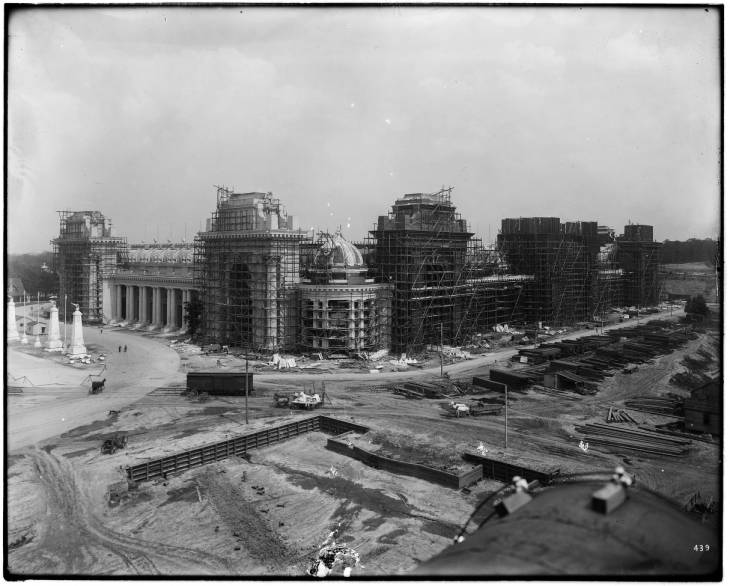
And finally just how much timber went into this thing truly boggles my mind. Then pondering how many trees went into it boggles it further. Then how much land was deforested to supply the timber boggles it even further. Then how much tree coverage was there on the American land mass boggle it beyond knowing. Mud flood by deforestation is not a guess, not a myth, its an actual event. The changing of the climate by deforestation is an event and one whose impact as far as I can tell has ever been studied for the change it brings about in the human. Scary shit and no mistake.
scaffolding.jpg
Note: This OP was recovered from the KeeperOfTheKnowledge archive.
Note: Archived Sh.org replies to this OP are included in this thread.
 
Note: This post was recovered from the Sh.org archive.
Username: Ice Nine
Date: 2019-06-13 12:21:43
Reaction Score: 5
Excellent! @jd755

I'll just quote this one of the many good ideas of yours.

"And finally just how much timber went into this thing truly boggles my mind. Then pondering how many trees went into it boggles it further. Then how much land was deforested to supply the timber boggles it even further. Then how much tree coverage was there on the American land mass boggle it beyond knowing. Mud flood by deforestation is not a guess, not a myth, its an actual event. The changing of the climate by deforestation is an event and one whose impact as far as I can tell has ever been studied for the change it brings about in the human. Scary shit and no mistake."

Plus I already believe by the time we were doing that stuff, Earth had already been mined and logged in antediluvian times. So humans continued with the deforestation removing what had managed to grow back.

From all the photos you supplied, our ancestors where clearly better craftsman than we are today. We have to rely more and more on machines to do everything for us. And to me that is scary shit too.

I've never thought the Expositions were dug out and also can't wrap my head around the notion that these were pre existing "old world" buildings. I think the pictures you supplied for us are a real eye opener. The certainly don't look faked or photoshopped.
What I think were dug out are the places like Petra, cave towns etc. And they go back much further in time than Exposition buildings.

Much food for thought after seeing these pictures.
 
Note: This post was recovered from the Sh.org archive.
Username: anotherlayer
Date: 2019-06-13 14:34:36
Reaction Score: 1
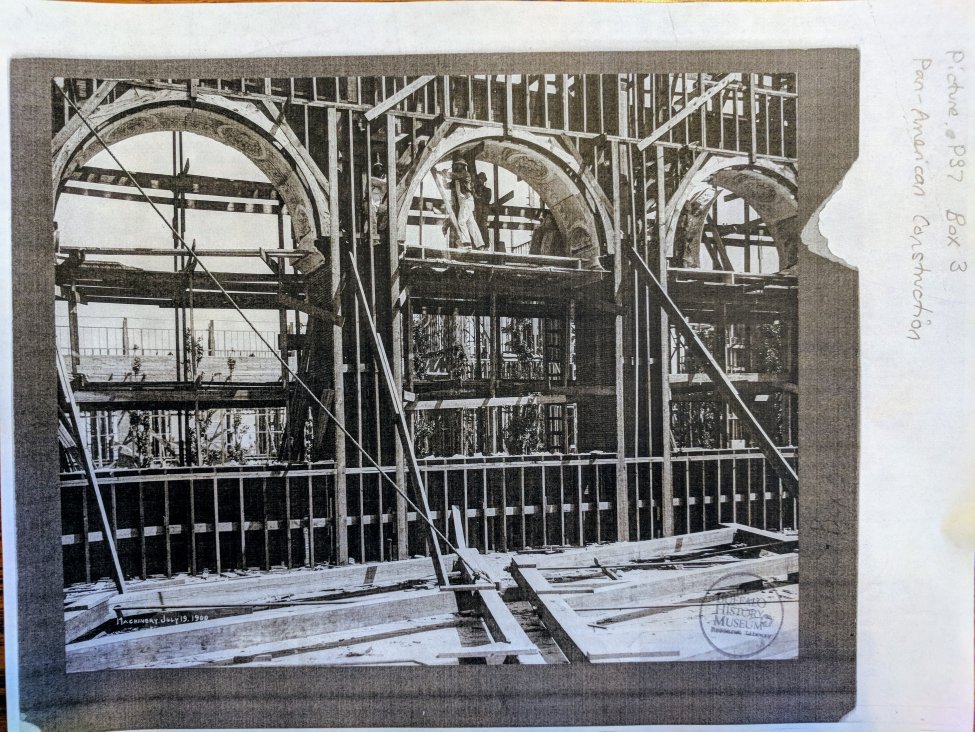
Just to throw sticks on the fire, this was a shot from the 1901 Pan-Am which shows the exact style used in the 1904 expo. The pictures you have posted for the 1904 are pretty identical to the construction set of photos for the 1901 Pan-Am. I am pretty sure these photos exist for all of these expos, we just need to do the leg work.

We built this stuff. It was 100 years ago.

pan_am_staff.jpg

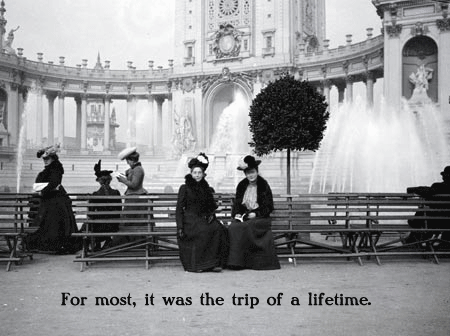
And a ladies hat reference from 3 years earlier at the Pan-Am. They seem consistent.

pan-am-women.png
 
Note: This post was recovered from the Sh.org archive.
Username: Incitatus
Date: 2019-10-02 11:34:08
Reaction Score: 1
Wondering what exactly 'staff' is? I'm not finding anything via Google.
Also, how exactly is the outdoor stuff waterproofed? Plaster statues won't hold up for very long outdoors, in fact even today, one of the most frequently asked questions is 'how do I waterproof my sculpture?' Basically if your not using fibreglass, bronze, stone or concrete nobody seems to know.
 
Note: This post was recovered from the Sh.org archive.
Username: Incitatus
Date: 2019-10-03 07:33:45
Reaction Score: 1
Interesting, I'm guessing the sugar acted as some sort of retardant, otherwise you wouldn't get very much working time with that mix. I wonder what they used as a mould release?
 
Note: This post was recovered from the Sh.org archive.
Username: BStankman
Date: 2019-10-05 11:17:01
Reaction Score: 9
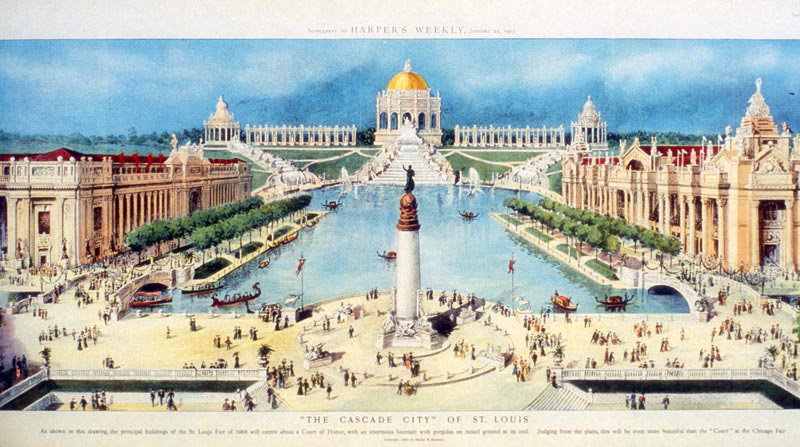
OK sure. The 1904 St Louis was made from staff.
That would mean these magnificent white cities were built by a civilization of artists.

Not day laborers, not hired hands, not slaves, and not transients, not the business development committee.

st-louis-1904.jpg

I have said it before. When energy was free, everyone was an artist.
That would remove these expos from an economic motivation. And place them closer to an artistic world competition.

We couldn't replicate a city like this if we tried.
It seems rather shocking to me that our civilization could have devolved that much in just 105 years.
But it does seem to be backed up by the evidence we have been given.
 
Note: This post was recovered from the Sh.org archive.
Username: jd755
Date: 2019-10-05 12:06:52
Reaction Score: 5
It's being deliberately bred out of us, or so it seems to me or the climate we live in is being fundamentally altered. Skills, appreciations, grace, elegance, compassion are all but non existent today in a world where we seek a technological aka outside of ourselves answer to whatever we get told is 'a problem'. These expositions feel like a last hurrah so too speak.
But I feel we have simply been made to appear to forget by whoever is wringing these changes out.
From memory plaster casting I did as a kid used neat plaster of paris in plastic/foil and later silicone moulds none of which required a release agent of any sort.
As a slight aside when casting lead blocks into steel moulds for ballast block creation the mould was sloshed around with soft soap as the release agent although again casting lead into fishing weight moulds, made of aluminium, no release agent was needed.
 
Note: This post was recovered from the Sh.org archive.
Username: EUAFU
Date: 2019-12-28 16:51:29
Reaction Score: 0
I don't know, it seems unlikely that there were so many anonymous artists out there to create it all in a few months. But who knows what the educational system was like at the time. Perhaps one in which all students were required to study Tartary sculpture, drawing, architecture, and mythology. And so this skilled labor would be abundant and cheap.
 
Just a follow up.
Staff is in use today.
Stuc & Staff - Gypsum and fake marble know-how - Socra
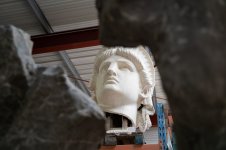
Check this head. Look familiar?
2.-Copie2-1280x853.jpg
SAVOIR-FAIRE OF STAFF AND STUCCO - Fondation Rémy Cointreau

Staff and stucco​

Stucco emerges at the same period and reaches its golden age in the 17th Century. This material is a mix of plaster, pigments and rabbit-skin glue. After the Great Fire of London in 1666, stucco has significantly expanded because of its great imitation skills : simulating marble, tuffeau and granit, etc.
Staff is a contemporary discovery appeared in 1850 and created by M. Mézier. It is made of plaster and jute fabric and has the form of a pre-made ledges. « Staff » is a term invented by Alexandre Dessachy. This technique finds its origin in the old French language “estoffer” which means “enrich, stuffing or adorn”. It has been patented on 2nd December 1861.Therefore, staff has developed itself quickly. The staff is a mixed of plaster and vegetal fibre. Its particularity is to be light and thin enough for its fabrication.
The staffor works with a small-scale model at first or realises a full-size drawing to not forget any details. From sketches, he realises a plaster or a rubber mould. For an easy-to-remove piece, the mould support is often plaster. When all the decoration pieces are made, they are sealed in situ with no trace of junctures. Then, the staff is painted and ready for any kind of patinas.
History of fibrous plaster · Rouveure Marquez
Fibrous plaster made its first appearance in 1850, in the form of pre-fabricated cornices made of plaster and canvas, thanks to a Frenchman called Mézier.

Eugène-Denis Arondelle and Alexandre Desachy applied for a patent in 1856 and 1861.
 
I just saw this thread, otherwise I would have responded sooner.
OK sure. The 1904 St Louis was made from staff.
That would mean these magnificent white cities were built by a civilization of artists.

Not day laborers, not hired hands, not slaves, and not transients, not the business development committee.
I can tell you exactly who built them. My great-grandfather, his brother, and their father were all starving plaster artisans from Venice, Italy. They were brought over in 1903 to work on this World's Fair. I don't know how they were recruited. I guess all the artisans who built the expositions were raided from Europe in this way. They would sculpt decorative elements out of soft wood and then make molds which they copied as many times as necessary. Europe must have been full of craftsmen like this in the 19th century. After the World's Fair, they stayed in the United States. A lot of the decorative plaster work in the hotels, theaters, and bank lobbies in the medium-sized city I come from was done by them. My grandfather was born in the United States right after the first World War. He was a naturally gifted artist who could draw anything he saw by hand with photographic precision. His parents told him that they had come to America to have a better life and that meant working in an office, not with your hands like an immigrant. They also refused to teach him Italian for the same reason. Plaster work was "dirty". None of my grandfather's children were taught anything about sculpting or staff work and the old knowledge and techniques were lost. I have old photos of my great-grandfather in his studio as well as a few pieces of wood furniture he sculpted.

The sad thing is that Orphan Trains and resets by cosmic weapons are not even necessary for everything to be forgotten. Ideology coupled with economic pressure does the trick.

Maybe one of the goals of the Fairs was simply to transfer the valuable craftsmen of Europe to the United States as the destruction of the former and the apotheosis of the latter had been planned for a very long time.
 
From here Staff.

Staff.​


355. Staff, a material used for the exterior covering of all the buildings of the World's Columbian Exposition at Chicago, may be considered as almost a new material in this country, although it has been in extensive use in Europe for many years. A large part of all exterior decoration of buildings, both public and private, in the provincial cities of Germany, whether ornament, columns or statuary, is made of staff, and in instances a period of fifty years of existence will testify to its enduring qualities. Staff was first used extensively in the construction of buildings at the Paris Exposition of 1878, and it was also adopted in work on the much grander buildings of the exposition of 1889. The methods of application at these expositions were, however, widely different from and much more expensive than those employed at the Columbian Exposition.
The staff for the World's Fair buildings was made on the grounds at Jackson Park in the following manner :
The ingredients were simply plaster of Paris, or Michigan plaster, water and hemp fibre. Hemp was used to bind together and add strength to the cast, and the New Zealand fibre was preferred, as both the American and Russian fibres were found too stiff. The first step in making staff ornaments is the creation of a clay model. The model is heavily coated with shellac, and a layer of clay separated from the model by paper is put on its face and sides. This layer of clay is oiled or greased and a heavy coating of plaster and hemp is put over it. The thickness of this coating is dependent upon the size of the model; sometimes it is 5 or 6 inches thick and contains heavy battens of wood to strengthen it. In less than twenty-four hours this coating is hard and is taken off the clay covering the model. The coating thus removed is called the box. Next the clay is removed from the model and the model is thoroughly oiled. The box is oiled and put over the model, leaving the space between model and box formerly taken up by the clay coating a free space. Holes have previously been made in the box, and upon a large centre hole (sometimes two or three in large pieces) a plaster funnel is placed. Molten gelatine is poured through these funnels, which fills every space, air being allowed to escape through small holes in the box. In from twelve to twenty-four hours the box is again removed, placed hollow side up, and the now hardened gelatine is removed from the clay model and placed in the box, which it fits perfectly. The clay model has now served its purpose, for the gelatine, which has become a matrix of the cast desired, is used in the further stages of the work. In case of large moulds the gelatine matrix is sometimes cut into as many as eight pieces. All these, of course, join perfectly in the box and are cast from as if from a single matrix. The gelatine mould is washed a number of times with a strong solution of water and alum, and after oiling is ready for the operation of casting.
* The following description of this material is taken from an article by E. Phillipson, published in the Engineering Record of June 4, 1892. Mr. Phillipson had charge of this portion of the work on the World's Fair buildings.
The plaster for the staff is thoroughly stirred in water, and the hemp, cut into lengths of 6 to 8 inches, is bunched loosely, saturated with the plaster and put in the moulds in a layer of about I inch in thickness. Succeeding handfuls of hemp are thoroughly interwoven with the preceding, the hemp being expected to fill in all the corners of the cast. When the mould is filled the back is smoothed over by hand, and later the cast is removed from the mould. The time consumed from starting a cast to removing it from the mould, is for a cast 5'x2'6" in size, about twenty-five minutes. After the removal of the cast care must be exercised in either standing it up or laying it down that it shall not collapse or lose its form by warping. During the summer months a cast of the dimensions given will dry thoroughly in about thirty-six hours and is then ready for application. In the winter months there is danger of casts freezing before they are dry, and in that event they are apt to go to pieces when warm weather comes. A good workman can make as many as seventy-five casts in one mould, and then the gelatine is remelted and a new mould made of it, the box being good for use for an indefinite length of time. In making pilasters or mouldings, etc., not ornamented or under-cut, plaster and wood moulds are often used, the latter material being especially preferred, owing to its durability.
"Applied to a frame building, staff is simply nailed on to the rough construction, and a cheap brick wall covered with it can, at a comparatively small expense, be made to assume a classic appearance. In building a brick house with the employment of staff in view, it is advisable to insert wooden furring strips in the brick, as these simplify the labor of putting it on. For cornice work it is claimed that a strength and boldness of design are possible with staff which cannot be realized with other materials.
"At the Paris Exposition the buildings were constructed almost entirely of iron, and nearly all the staff was cast in panels, which were set in iron frames. While this method was considered excellent both in finished effect and in durability, it was far too expensive and tedious to be employed in covering the much more extensive structures to be built for the World's Columbian Exposition. Accordingly, after many weeks of study, the construction department decided to construct the buildings of wood and to nail the staff directly to the furring.
"The name 'staff' properly applies to material that is cast in moulds, and not to ordinary plaster or cements that are put on with a plasterer's trowel. Work with such materials is subject to well-understood limitations by the temperature and weather, but atmospheric influences have practically no effect upon staff. This has been demonstrated by the acres of staff that has been standing all winter outside the various casting shops in Jackson Park. No attempt has been made to keep off the rain, snow or frost. Several pieces of it have been submerged for over a month at a time, allowed to freeze and thaw, and freeze again with the water, and when taken out they were found to be perfectly intact."
While this material admirably answered its purpose on the Fair buildings, it became considerably deteriorated, and evidently would not answer in such a climate for permanent buildings unless kept well painted. In fact, it appears to be generally conceded that Portland cement is about the only material that will endure permanently under the trying conditions of our northern climate. In warmer and dryer climates compositions of plaster are largely used on the exterior of buildings, and in many instances they have lasted for centuries.
The cost of "staff" as used on the World's Fair buildings, varied from $2 to $2.25 per square yard. Ordinary cement mortar applied directly to the walls cost about thirty cents per yard.

Staff.. Continued​

356. Whitewashing​

Although not properly belonging to the plasterer's trade, this work is often included in the plasterer's specifications.
Common whitewash is made by simply slaking fresh lime in water. It is better to use boiling water for slaking. The addition of 2 pounds of sulphate of zinc and 1 of common salt for every half bushel of lime will cause the wash to harden and prevent its cracking. One pint of linseed oil, added to a gallon of whitewash immediately after slaking, will add to its durability, particularly for outside work. Yellow ochre, lampblack, Indian red or raw umber may be used for coloring matter if desired.
Whitewash not only prevents the decay of wood, but conduces greatly to the healthiness of all buildings, whether of wood or stone. It does not adhere well, however, to very smooth or non-porous surfaces. Two coats of whitewash are required on new work to make a good job.

Building Construction And Superintendence | by F. E. Kidder
Quite honestly if anyone is really interested in " how they did it" READ thus book. It dates from 1906 and is an easy to read and comprehend book written by a man who knew what he was talking about.
No speculation, no fluff, no waffle, no opinion, no bloody YouTube or spreadsheets.
Its precisely the expertise this man writes about that I argue ad nauseum has been drained from us.

Yet more contemporary evidence.
From here http://livinghistoryofillinois.com/...Respecting All Features of the Exposition.pdf

Material used in Buildings.—The material used in the construction of the Exposition buildings was iron, wood, glass, and what is called "staff." Thirty thousand tons or two thousand carloads of the latter material were consumed.
Staff was invented in France about 1876, and was first used in the buildings of the Paris Exposition in 1878, It is composed chiefly of powdered gypsum, the other constituents being alumina, glycerine, and dextrine. These are mixed with water without heat, and cast in molds in any desired shape and allowed to harden. The natural color is a murky white, but other colors are produced by external washes rather than by additional ingredients.
To prevent brittleness, the material is cast around a coarse cloth, bagging or oakum. The casts are shallow, and about half an inch thick. They may be in any form—in imitation of cut stone, rock, faced stone, moldings or the most delicate designs.
For the lower portions of the walls the material is mixed with cement, which makes it hard. Staff is impervious to water, and is a permanent building material, although its cost is less than one-tenth that of marble or granite. One hundred and twenty carloads of glass, enough to cover twenty-nine acres, were used in the roofs of the various Exposition structures. More than forty-one carloads, or eleven acres, were required by the Manufactures building alone.
 
Last edited:
Tips
Tips
Please respect our Posting Rules.
Back
Top