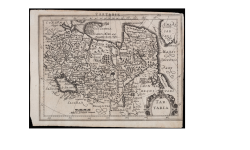
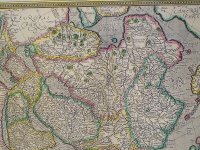
Terra de Iesso; the Bering Strait and Anian Strait are not the same. Do old maps show a missing landmass we assumed was Alaska?

Gold

Core Member
Active Member
Joined
Sep 14, 2020
Messages
186
Reaction score
345
I propose that the Bering Strait and the Anian Strait are not the same, and old maps that many of us thought show Alaska (myself included) actually show an entirely different chunk of land bridging the two lands of modern day mainland North America and Siberia. It's also possible that Northeast Siberia was either a part of this land or America itself. The latter is I had previously concluded after trying to reconcile how Japan was apparently in the Bering Strait, but I didn't know about the possibility of another territory that reached Japan from America, because maps such as Ortelius labeled it as America. Some label it as The Land of Jesus (or Ainu?). For a while I erroneously thought St. Lawrence Island was Japan and they had somehow moved, but Japan's apparent location in the Bering Strait never sat right with me, and many maps seemingly displayed this.

Many old maps such as the classic Ortelius maps that we've looked at many times have fascinated us when researching Prester John, Quinsay and Arsareth. I've mulled over this for months. I used to think that Japan on these maps was not Japan now, but had to be one of the destroyed islands between Siberia and Alaska, then somehow modern day Japan was named as such after the destruction of the original one. I don't think that anymore, because old maps show some consistency we can refer to today.

Let's look at some of these.

Ortelius Map of Tartary, 1570-1572

Tartary by Ortelius 1570-1572.png


Louis de Hennepin, Map of a Three-Story Country between the New Mexico and the Glacial Sea, 1698

1698_Louis_Hennepin_Map_of_North_America_-_Geographicus_-_NorthAmerica-hennepin-1698.jpg


Alleged Nazi map based off the moon plasma map projections (looking to the moon for a reflection of true earth)

moon plasma map.jpg


I cannot post Urbano Monte's map because it's too massive for my internet to handle uploading, but I encourage you to look at it yourself and compare it to the above Nazi map.
Lastly,

1693 Cantelli da Vignola Map of the Tartar Empire

(note that this one has Tazata island, an island in Scythian myth as well as more very important information I'll let a friend I invited dive into when the time is right.)

1693 Cantelli da Vignola Map of the Tartar Empire.jpg


Ages ago, KD speculated that the mythical city of Quinsay was in Russia and not China based off the assumption that the Bering and Anian straits were the same, I thought so too but now I disagree. It's an excellent thread that was key to me realizing some things here.
Another thread that's required reading is Bizarre transformation of the North American Continent: 16th through 19th centuries where we can actually see other maps depicting Anian/Iesso as part of mainland America.

Quinsay cannot possibly have been in modern northeast Siberia because historical maps place it near what seems to be the tail end of the "Great Wall of China".
This is relevant because we're going to be using Japan and the approximate location of Quinsay as important landmarks.
Let's look at a modern map of the path of the great wall and compare it to the Urbano Monte map KD used,
korea.jpg

korea corai.jpg

Of course, things move, sink, rise, get destroyed or altered.
We're dealing with a lot of unknowns as usual, but Quinsay is consistently near Japan. That narrows things enough for some rough landmarking.

Some correlations: proximity of a similar lake Quinsay would've sat in to Japan, nearness to the tail end of the Great Wall
A large caveat: Korea is either not seen on Urbano Monte or it's "Corai", a microscopic island.

This approximation is good enough for what we're using it for. Clearly, the lands have changed since the time these maps were made. And I believe we're being lied to, and this land of Iesso (Land of Jesus or Land of Ainu?) may still exist, or may not, but something doesn't add up with the Bering Strait. We'll get to that soon.

Using Japan and the approximate estimation of Quinsay we can roughly estimate some borders. Maybe I'll make myself look like a fool because I don't know how to read map distortions for new or old maps but roll with me for a minute.

The land identified as Amerique or America in some maps such as Ortelius, and Terra de Iesso in others, can't possibly be Alaska as we know it today because of how much lower Alaska would have to be to be near Japan. This necessitates either a third landmass or an extension of America, whether separated by a narrow body of water or not, that is either underwater or hidden today.
 

Attachments
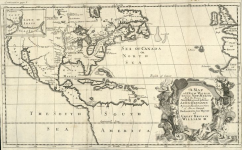
  • Louis de Hennepin, Map of a Three-Story Country between the New Mexico and the Glacial Sea, 16...png
    Louis de Hennepin, Map of a Three-Story Country between the New Mexico and the Glacial Sea, 16...png
    691.2 KB · Views: 717
Last edited:
If you pull up something like Google Earth you'll see an entire face of the globe is nothing but water.
gap.jpg


There is a massive gap of ocean between California and Japan/Siberia, but also a LOT of sunken land under comparatively shallow waters if you take these projections to be accurate.
If you cross reference these maps you'll notice this huge chunk of ocean could seemingly fit the massive continent south of Japan on Urbano Monte's map identified as Brasilae (not Brazil) or Lemuria on the Nazi map.
Interestingly, on the Nazi map there is indeed a large gap of water there now. So there's nothing there in the modern day maybe?
I could be wrong, but I don't think Lemuria could be the Terra de Iesso or Amerique identified above. It's too far from California.
Let's assume modern California may not be the one on these maps, but that it's namesake was carried over to the nearest part of the continental mainland when it seemingly sunk at some point. If you put a big chunk of land there off the coast of modern California to represent "Old California" and slotted in a chunk of rectangular land to bridge North America and Japan you would recreate this Strait of Anian.

Note that such a land would conveniently fit on the Nazi map and roughly fill that gap between North America and Asia/Japan, and note that the gap on Google Earth seems far larger than the Moon Map projection depicts it as.
But these maps tell us more; I also think the confusion I and others here have
that led us to assume these maps were depicting the Bering Strait and Alaska comes from the assumption that those maps were depicting the modern day borders of Siberia and Alaska.

Now I know I've been doing a lot of assuming too but humor me. Let's assume these maps weren't just bullshitting us outright. At least, less than we're bullshitted now.
- Japan is a decent landmark
We've established some consistency in the location of Japan, even if not it's exact shape, but the lake Quinsay sat in and the Great Wall being near Quinsay.
- We can be quite certain these maps aren't depicting Alaska and modern Northeast Siberia. I think modern maps distort the east edge of Asia and the sea to be more bloated.
distance.jpg

Refer back to the 1693 Vignola map. Take note of Nova Zemla. This land still exists. Well, it's glassed but still there.
Both the Vignola map and the Hennepin map depict a progression of Japan from Ortelius and Urbano Monte to connecting to mainland Sibera by a bridge. We can observe that on modern maps. Tazata may or may not remain at all in the modern day, but if it did I would put it as being more near October Revolution Island than the Anzhu Islands.

If we assume that these maps were accurate, or accurate enough whether you think there were some errors, or over the next few decades massive changes happened to the lands, they would have to be depicting a bisected Siberia, or Northeast Siberia is not as bloated as it's depicted on the globe. Either Siberia was bisected, or the modern globe maps distort and bloat Northeast Siberia to make the gap between it and North America look far larger. Refer back to those and think about it yourself. Consider the below image as well when pondering whether or not Alaska and Siberia are REALLY that close together...

russia alaska time difference.png


I've mulled over whether the Sea of Okhotsk was dry or not but I don't think it really matters. It certainly does for ascertaining the locations of Arsareth but my main assertion here is this:

The Anian Strait cannot be the Bering Strait because it's too close to Japan. Map distortion on old and new maps really fucks with us a lot, but I believe Siberia to be mostly unchanged from then and now. The Scythian Sea in Ortelius seems to be the Okhotsk Sea. Vignola flattens the border of Siberia out more and adds some Islands not seen in Ortelius, and Monte depicts Nova Zemla right next to Greenland which is the opposite of how the Nazi map depicts these areas. Perhaps distortion and sea level changes can account for these changes, perhaps not, but with the consistent placing of Japan.. the Anian Strait CANNOT be the Bering Strait. It has to be a missing chunk of land, Terra de Iesso, which seems to be Terra Incognito and maybe even included Anian pr., and if it was, it would've been part of America connected to California, which would explain California being depicted so close to Japan on old maps and explain why this area was called America. It was part of America, but it's impossible for it to have been Alaska. All of this land north of California Island could've been labeled Terra de Iesso as a whole. California seems to be connected to Iesso but considered a separate kingdom, at least by some.

california.png

Finally, I would look to point out some interesting coincidences.
Iesso has been connected to the Ainu. Anian and Ainu sound similar. Ainu have a presence in Japan, Alaska and Siberia.
The island near Japan and Amerique or Iesso in the Anian Strait is called Campaignie Island.
California on old maps is an island. This is consistent across them.
So is it's close proximity to Japan.
San Francisco on old maps is NOT on the island of California. It's on the mainland where it is now. A massive missing chunk of land called California would explain why California is so close to Japan but so far away now.
Is it just error or coincidence that Japan, San Francisco and Quinsay are consistently landmarked? That these details are accurate hundreds of years later but they just fucked up and drew a massive island that didn't exist?

This long video goes in depth on the topic of Iesso and the two straits.

Here are two screenshots of a map from the video. Shows some interesting things.

iesso2.png

iesso island.png


In conclusion, I think it's impossible for maps depicting an Anian Strait to be the Bering Strait. There are too many discrepancies for it to be one in the same and the America or Iesso depicted to be Alaska, it's a mistake I made that led me into circles and one that many of us make. It's also possible that a lot of Northeast Siberia that lay directly north of Japan was once part of Terra di Iesso, perhaps Alaska too. Before learning about the possibility of Iesso I had concluded that the northeast chunk of Siberia had to once be connected to America and the Anian Strait was simply west of where it is now. Some old maps such as the Vignola map seem to indicate that Siberia didn't encroach east as much as it does now. While the tip of Yvpi looks very similar to the Bering Strait, it's impossible for them to be the same because of the proximity to Japan and Korea. The Florida-esque panhandle northeast of Japan didn't exist on any of these maps.


Anyways, that's all I got. I totally expect to mull over this more in the future and probably find more areas I was wrong in, but I'm quite certain there's something to Iesso, the missing island of California and deception regarding the distance between Asia and North America.

Big thanks to a friend I invited, elgiborest for sending me bookloads of interesting information including a lot of the material I mentioned here and all of the Iesso maps. I've only scratched the surface here and didn't do justice to all the things he's sent me. Forgive my shitty formatting, I'm still getting better at it but I know my posts aren't as pretty as KD or other OG members but I felt like I needed to make this thread while it was in my head.
 
Last edited:
Other things I wanted to get into but will either do later or leave to someone else are the obvious implications between Anian and Ainu. I think I've left enough here to build on later when it comes to the Ainu and their relation to Terra de Iesso and Anian.
 
Just found this too, a Mercator 1595-1630 map showing Quinsay west of Korea. Interesting that Korea just pops up out of nowhere, many maps of this period don't show it at all, some do like Urbano Monte, then it pops up out of nowhere. Quinsay is west of Korea. Right in the little body of water west of Korea, near Beijing.
Absent in this second Mercator map. Again, I'm not the best at reading through distortion on any maps, but the first Mercator map has not just Quinsay but Sibir, the mythical capital of Siberia. Looking at this as a normal person you'd think this is all basically Siberia with how they present the continent but we know Korea and Japan are most likely in the same place now as when these were drawn thanks to landmarking.

I simply can't accept that the Anian Strait is the Bering Strait, even though I made this mistake many times and was certain they had to be the same, like many others. We can all be forgiven for it, it makes sense at first, and the way a normal person reads maps with a strait in the northeast part of what looks like SIberia would naturally lead you to conclude it was the Bering and Alaska. But I think there's enough to cast doubt on it now. Hell on these maps it looks like it's exactly where Alaska would go, in the northeast tip of Siberia. But even with the distortion issue, Alaska is nowhere near enough Japan to jot down on a map of neighboring territories. I dunno, man.

Of course, nobody knows anything, and it could all be made up or they could've been schizophrenic like we're told. But Terra di Iesso or not, I think we can safely conclude they were NOT the same strait. Even the mainstream narrative says they weren't the same, they just say they made it up until they accidentally found the Bering Strait. Nonetheless, I think it's interesting to point out another possible phantom land right under our noses. Very cleverly hidden, honestly. And of course, they could have just been wrong. But I'll still trust schizophrenics from 500(thousand) years ago over modern day experts. Even if we know they lied too, simply because modern day experts lie about lies that schizophrenic cartographers (may have) told.
 

Attachments

  • Mercator map of tartary.png
    Mercator map of tartary.png
    3 MB · Views: 255
  • CEM-15-Asia-Mercator-1595-Tartaria-2532.jpg
    CEM-15-Asia-Mercator-1595-Tartaria-2532.jpg
    2.1 MB · Views: 256
Last edited:
Other things I wanted to get into but will either do later or leave to someone else are the obvious implications between Anian and Ainu. I think I've left enough here to build on later when it comes to the Ainu and their relation to Terra de Iesso and Anian.
Cascadia 1700....land of Jesus right in the path of 9.5. Japan got hit with orphan tsunami cause there weren't any quakes around Japan they didn't know at time were it came from. Island of California swept away and left 1000 ships stranded at SF Yerba Buena. Burnt 1851 all the ships rotted unsalvageable clogged bay from 1700 tsunami Cascadia. Try tell me 1000 captains abandoned their life's work and deserted THEIR own ships to look for gold STOOOOPID
 
Tips
Tips
Please respect our Posting Rules.
Back
Top