Here Be Dragons

dlux

Member
Patron
Joined
May 21, 2022
Messages
7
Reaction score
16
Location
USA
Here Be Dragons.png
Photo from Atlas Obscura

The phrase "Here be Dragons" or hic sunt dracones in Latin was purportedly first found on the Hunt-Lenox globe c.1503. That phrase was etched into this tiny 5" diameter copper globe on the lower east coast of Asia, in the vicinity of modern day China / Thailand / Vietnam. While I feel that globe's authenticity is somewhat dubious, if its indeed authentic then it nonetheless provides another data point for me in my quest to truly comprehend dragon origins and lore, and the possibility that there may have been terrestrial "dragon" creatures at some point in recent human history.

Further recognized history of this phrase shows it printed as a label on a sea monster in the North Atlantic ocean, near Iceland/Greenland as depicted on the Carta Marina c.1539, a wall map by a Swedish cartographer.

It seems that subsequent cartographers from 1500-1800 widely depicted sea serpents and monsters on their maps, labeling them serpentes or dracones. Presumably, a cartographer during that era of early seafaring must have been highly incentivized to create the most accurate possible maps, as their employers were generally crown elite and wealthy merchants who required precise knowledge of land, waters and liabilities in order to navigate. Why would a cartographer engage in flight-of-fancy or buffoonery such as adding fictitious features, creatures or hyperbole to their maps? Accuracy in their body of work was surely paramount to any other motives.

Nevertheless, of course officialdom's historical record immediately and automatically assumes dragons to be entirely mythological, and mocks any notion to the contrary. Truly respectable science indeed, automatically dismissing multiple instances of documented evidence by respected seafaring cartographers, to be mocked as myths.

To Be Continued - Please Contribute

Vortigern-Dragons.jpg
Photo from IRIS28, "A History of Dragon in Visual Art"
 
Last edited:
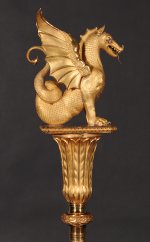
During the brazilian empire, we had the Serpe as the animal of the empire and the imperial family. Several items from the period depict the Serpe, this one is the staff used by the emperor Pedro II on ceremonial ocasions

Deemed, as usual, a mythological creature, but to me there’s more to it durante to it's relevance

Cetro4.jpg
 
Presumably, a cartographer during that era of early seafaring must have been highly incentivized to create the most accurate possible maps, as their employers were generally crown elite and wealthy merchants who required precise knowledge of land, waters and liabilities in order to navigate.
None of these maps are sea charts. Those rarely come to us through time likely because they were used and wore out. Equally likely they were updated 'on the fly' and copied when back in port with the older ones being destroyed as being out of date.
This could have been a time when secrecy of route was the difference between fortune and failure for commercial endeavours.
Most of the named cartographers never went to sea.
 
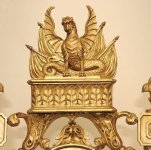
A close up of the Serpe in the main imperial throne, gorgeous if you ask me.

images - 2026-02-13T233752.695.jpeg

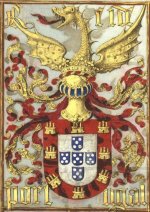
I did my research to try and find the origins of this particular dragon, it was made the official symbol of the house of Bragança in 1640, alledgedly. But it's origins go to the supposed origins of Portugal as a nation in "medieval times"

It's interesting to note that even when the royal family established the capital of the kingdom in Brazil after the napoleon event, the serpe symbol was never used in any royalty related object, only used as a coat of arms.

The only period in which it was used on objects of royalty was during the brazilian empire

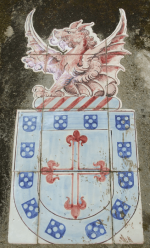
Here are some images of it in the portuguese coat of arms

6986e1_edc34b45515a4045a36b857ee42fa322~mv2.jpg brasc3a3o-com-dragc3a3o.png
1_hM7rrySEJfrZbaSzKtorrw.jpg
 
Last edited:
Tips
Tips
Please respect our Posting Rules.
Back
Top