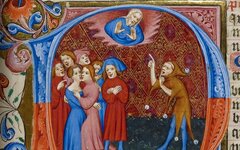
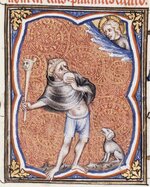
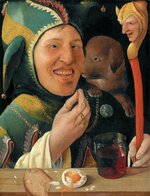
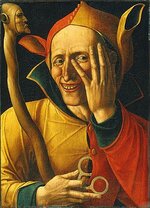
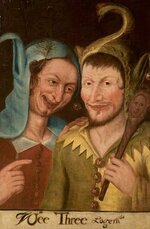
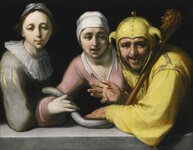
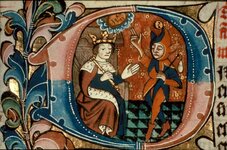
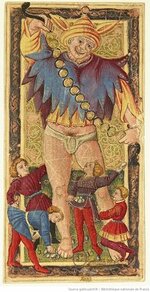
Apparently the Quinametzin (Giants) in the legends of Mexico have that clown-like appearance or no doubt lost their skin.
Wikipedia lists about 10 of them, among them Xelhua who supposedly built the pyramid of Cholula after his brothers were saved from the flood.
Xelhua - Wikipedia
The flood was sent by the god Tlaloc:
.. At the time of the flood, giants dwelt on the earth, many perished submerged in the waters, some were converted into fish and only seven brothers were saved in the caves of the mountain Tlaloc.... Xelhua the giant went to the site that was later called Cholollan and with large adobe bricks made in Tlalmanalco, a very distant site, and led from hand to hand by a line of men stretched between the two points began to build the pyramid in memory of the mountain where he was saved. Irritated Tonacatecutli father of all the Gods that the work threatened to reach the clouds launched the celestial fire and with a large stone in the form of toad killed many of the builders dispersing the rest, and did not go ahead the construction ...
Something similar is said in the legend of the Toltec flood:
It had rained a lot that year, and it continued to rain from morning till night, without a ray of sunshine or moonlight to illuminate the fields. The beautiful stars had hidden perhaps forever, and the birds hid in their nests and chirped sadly, covering the baby birds with their soaked wings; thus, the mothers took care of their little children shivering with cold.
The mothers wept and the children were terrified because they saw torrents of water falling from the sky in the form of great snakes that lashed the fields, destroyed the crops, flooded the cities, the hurricane lashed the trees and their branches broke off, like huge wounded giants, and the Toltec home was in danger.
Thus was that country of our ancestors in the days of the deluge.
Why was heaven so severe upon men?
Ah, because they had failed in their duty, they were not industrious, nor did they worship their gods, nor were they respectful of other men, their brothers.
Then the men thought of doing something to save the family: they built a great pyramid as a mountain of brick and special cement, which they called Tolan Chololan, high, up to the sky, to escape the flood. There they raised an altar to Tlaloc, the god of the rains, and to Quetzalcoatl, the god of the wind; and they took their families up the great stone stairs until they reached the summit... the god of the waters, pitying the men when he saw their activity and union in their work, made the flood cease, and the affliction of the people ended.
The Toltec legend does not mention anything referring to giants like the legend of the Pyramid of Cholula, Puebla. And it is perceived as a deluge more like a Flood of Mud or Hurricane or Sunami.
According to the legend of the birth of Huitzilopochtli, he killed the Titans and chased them to all corners of the earth, which by the way is a biblical allusion as well, like the Tower of Babel (Cholula), like the flood.
According to what the old natives said and knew of the birth and beginning of the devil who is called Uitzilopuchtli, to whom the Mexicans gave much honor and respect, there is a mountain range called Coatépec, near the town of Tula, and there lived a woman named Coatlicue, who was the mother of some Indians who were called centzonuitznáoa, who had a sister named Coyolxauhqui. And the said Coatlicue did penance by sweeping every day in the mountains of Coatépec; and one day it happened that while she was sweeping, a little ball of feather, like a ball of yarn, came down to her, and she took it and put it in her bosom next to her belly under her naguas; and after having swept she wanted to take it and did not find it, and they say she became impregnated.
Bernardino de Sahagún, Historia General de las cosas de Nueva España, Vol III Cap.I.
The Centzon Huitznáhuac in Mexica mythology are the gods of the southern or southern stars, the sons of Coatlicue, goddess of fertility, patroness of life and death, brothers of the lunar goddess Coyolxauhqui who ruled them.
- I find it very striking the way in which many legends seem to relate biblical texts.
The Popol Vuh or also known as "book of the council" is a historical document of great value and therefore the most important book of the Quiché language. It is part of the culture of the indigenous people of the Mayan Highlands, present-day Guatemala. It was transcribed and translated into Spanish by Fray Francisco Ximénez from the "original" in the K'iche' language between 1701 and 1702. The resemblance between the Christian Bible, the "Maya Bible" and the Hebrew traditions has attracted the attention of linguists and scholars of Maya literature. The story of the flood is mentioned through four brothers who cross the sea with their family from the east and settle in a promised land. In Maya mythology Huracán (Maya: hunracán 'one [single] leg''hun, one; racan, leg') was the god of fire, wind and storms. He is also called the heart of the sky.
He is represented as a being with a serpentine tail and also of reptiloid appearance, carrying a smoking object (possibly a torch) and a large crown. With his one leg, he traveled enormous distances in a short time. He is also described walking upside down, with his hands. From his name comes the word hurricane, which designates the meteorological phenomenon.
According to mythology, he was one of the gods who participated in the creation of man from corn. Hurricane had sent The Great Mayan Flood, a universal deluge, sent to destroy the wooden men who had enraged the gods. He had lived in the clouds above the flooded Earth while he repelled it by pushing the water to the original shores. The gods create the world,
The gods create the animals, but since they do not praise them they condemn them to eat each other.
The gods create the clay beings, which are fragile and unstable and fail to praise them.
The gods create the first human beings of wood, these are imperfect and lacking in feelings.
The first human beings are destroyed and become monkeys. The origin of man, who after several failed attempts is made of corn (fundamental food of the Quiché).
- The heartless Palo men mentioned in the legend, I think, may resemble these little men from New Mexico.
Even the Inca flood seems to be full of biblical passages:
Legend of the Ayar brothers.
The legend tells that after an immense flood, four young men appeared, the Ayar brothers together with their wives: Ayar Manco and Mama Ocllo, Ayar Cachi and Mama Cora, Ayar Uchu and Mama Rahua, Ayar Auca and Mama Huaco. According to Inca legend, the group was in search of fertile lands.
It was Ayar Cachi, the brother with more strength and cunning, who after having a dispute with his brothers, was ordered to return to the caves of Pacarina. However, they sealed his exit with a rock and he was never able to leave again.
The other brothers continued on their way to Mount Huanacauri and found a stone idol to which they showed respect; except for Ayar Uchu who jumped on the back of the statue and was petrified. The same happened to Ayar Auca, who after continuing the journey was also turned to stone.
Ayar Manco, was the only brother who reached Cusco and found good lands. After sinking his golden staff, he founded Cusco, capital of the Inca Empire.
Inca legend of the creation of the world.
One of the most popular Inca myths tells that the Andean god Viracocha gave origin to a universe without light inhabited by giants who disobeyed him. This motivated Viracocha to turn them into stone to later create torrential rains until the earth was submerged in water.
Viracocha decided to create beings similar to him this time. The Flood was to purify the world and start again, and that is how human beings were born. Then he brought light - through the creation of the moon, the sun and the stars. To teach men, Viracocha sent Viracochan, a man who would be an example of a life in harmony, following a behavior of peace and dedicated to the harvest and a government full of wisdom.
With the passage of time and despite Viracocha's generosity, many men began to mock their god, being transformed into stones by a rain of fire. The men learned that although Viracocha could be kind, he also had the power to punish them if they did not act in a good way.
- Therefore, it could be said that the Quinametzin were the Nephilim, there was also cannibalism, throughout northern Mexico legends abound of giants who live in caves and like to eat children, according to Yaqui legend in the beginning these giants helped with the crops but when they drank they lost control.
There are very grotesque gods like Xipec Totec (The Disembodied).
Xipe Totec - Wikipedia
- The famous gardens and zoos in Tenochtitlán, which Hernán Cortés and Bernal Díaz del Castillo witnessed and were very impressed with.
They tell us that in those gardens there was a very peculiar one where blind people, Siamese twins, dwarfs and people with malformations lived, whom the Spaniards called "monsters", since in Europe that was the worldview of people who were born with a similar condition.
Tenochtitlan, Texcoco, Tepetzingo, Chapultepec, Iztapalapa, Coyoacan, Xochimilco and Oaxtepec, housed beautiful gardens that were owned by the nobility and were dedicated to the care of the aforementioned people.
In his book "Monarquía Indiana", Fray Juan de Torquemada, describes an exclusive place for the disabled:
"...He had in this house a room in which he had men and women and children white from birth in face and body and hair and eyebrows and eyelashes. He had another house where he had many men and women monsters, in which there were dwarfs, corcovados and contracted, and others with other deformities...".
Those born with such anomalies were considered children of the sun and deserved total respect. They were also associated with the gods of pleasure and physical excess.
On the other hand, hunchbacked people and dwarfs were considered sacred and for that reason "were incorporated into the group of jesters of the court of the Tlatoani in turn, and others were housed in a special house, where they could be seen by the public".
- Apparently, the children with very white skin, the dwarves, the disabled, were sacred because in that way they were very similar to the gods, that reminded me of these Nephilim.