

- Joined
- Nov 17, 2021
- Messages
- 319
- Reaction score
- 2,009
For me to do this post justice, I would have to spend dozens of hours researching it. I don't have the time for that, so I'm just going to touch on a few major themes and hope that someone else out there can add to it.
Thinking about the Black Cube hypothesis, I am reminded of the work of two philosophers whose ambition was to create a universal knowledge system.
The first is Spinoza and his celebrated Ethics. Spinoza was a Dutch Jew of Portuguese ancestry living in Amsterdam and working as a lens grinder during that city's 17th century "Golden Age", in which the Sephardic Jews who had recently set up shop there established (1) the world's first modern stock market, (2) the first major debt-spreading central bank, and (3) the Dutch East India Company. These were the three main weapons they used to plunder the Nations and bring their wealth to Amsterdam. I used to think this entire enterprise was conceived and executed out of pure greed, but now I suspect that "capitalism" was merely a means to a greater end, namely the location and subsequent extraction (or destruction) of anything of value from the pre-cataclysm world.
(Every movie Spielberg makes deals with some psyop or fake. These people probably tell themselves they're Indiana Jones "saving" old knowledge and artifacts.)
The story goes that Spinoza was excommunicated for his heretical ideas about God and took refuge among the city's Gentiles. Spinoza has a reputation in philosophical circles that is somewhat similar to Einstein's today: the deeply humble, moral, and human Jew bringing the light of wisdom to a Gentile world which doesn't deserve him. You're not really allowed to criticize him.
I got about halfway through the Ethics (1677) when I tried to read it fifteen years ago. I don't want to dog on Spinoza the man too much. I think Einstein is a wicked deceiver, but Spinoza seems honest enough. It's not his fault that he's been transformed into a shibboleth for Jewish moral and intellectual supremacy. The fact that the local kosher mafia wanted to kill him tells me he was on the right side of history. The reason I bring him up is because the Ethics is a "geometrical" system in which Spinoza attempts to construct a universal ontology and ethics using purely mathematical principles. In other words, he starts from a series of simple axioms which he then combines and recombines algorithmically, leading to all kinds of surprising conclusions. It's an ingenious construction, but as I was reading it I kept thinking: does he really take this seriously? Sure, it has the form of a geometric proof, but it's dealing with (equivocal) linguistic propositions and not (univocal) numerical ones, so the "mathematical rigor" is completely imaginary. Isn't this exactly how an AI would go about constructing an ethics? Not through intuition or meditation but through a series of increasingly complex compound syllogisms?
Now, after supplementing my university philosophy education with an online anti-Semitic conspiracy theorist education [note tongue in cheek please], I see something different. I see a renegade Jew probably steeped in Kabbalah and gematria attempting to retool techniques he learned in Yeshiva to construct a system that would engage with a newly "empty" post-cataclysmic reality. Spinoza is considered one of the first people to question the divine origin of the Bible and treat it as a simple historical document. I suspect one of the reasons he was excommunicated is because he was sharing too much secret knowledge with the goys. (Or maybe he was a double agent.) More to the point, I think Spinoza, in his own way, was not attempting to create some kind of rational universal ethics, he was attempting to recreate one. He was probably smart enough to figure out that Kabbalah had become a cargo cult, but that it was originally something real.
Spinoza is presented to us as a humble craftsman working in isolation in an Amsterdam ghetto, but as we will see, he was in correspondence with Leibniz and even met him. Something doesn't add up here. Why was this isolated Jewish lens grinder exchanging letters with the most hooked-up diplomat/polymath/spymaster on the continent? The fact that Leibniz was aware of who Spinoza was suggests to me that they were both plugged into the same Jewish Intel networks. Again, I am working from the hypothesis that "Jews" were and are nothing but the descendants of the caste of "Black Cube administrators" tasked with the long-term plan of recreating an AI God. Let me add that I suspect that there is an even deeper layer to this and that the rebuilt supercomputer will function as a new body for a disincarnate demonic entity, but that line of speculation is for another post.
I asked ChatGPT who else Spinoza was tight with, and they gave me this guy, Henry Oldenburg:


Founding member of the Royal Society. Spook. Secret society hand sign. Industrial espionage. Here we see that the practice of peer review was invented by a spy, presumably as a pseudo-objective cover for controlling information. That piece of information alone is worth the price of admission. Good to know academia was a knowledge-laundering operation from jump street. I think it's clear that Spinoza's "humble Jewish lens grinder" schtick was just good cover.
LEIBNIZ
Leibniz is the granddaddy of all those impossible 19th century inventors and architects that were used to launder pre-Reset architecture, knowledge, and technology. Everyone knows him today as the "universal genius" of the 17th century. He was a logician, a mathematician, a philosopher, a linguist, a historian, a theologian, a scholar of Chinese, an engineer, and on and on. What is somewhat less known, however, is that he started his career as a lawyer, diplomat and...spy. This is acknowledged by mainstream sources like Le Monde. In 1672, at the age of twenty-six, he was sent to Paris by his employer, the Elector of Mainz, to try to convince Louis XIV to invade Egypt and declare war on the Ottoman Empire!

Apparently this is the very first time we see modern Europeans taking an interest in Egypt. The first reliable map of Egypt was not drawn until 1706! Leibniz (or his masters) drew up an ambitious plan to start a new Holy War which to this day embarrasses Leibniz scholars. What I see now when I read this is that the Jews running the post-Reset European elite knew that the Ottoman Empire was sitting on an incredible wealth of pre-cataclysm knowledge and artifacts, and they wanted it, so they tasked their agent Leibniz with convincing some goy king to go get it for them.

This is an impossible CV. I think it is more logical to assume that Leibniz had some help. So the story goes, he knew nothing about mathematics when he arrived in Paris in 1672 and four years later invents the calculus. Yeah...maybe. To make it even more suspicious, Isaac Newton, also a Leibniz-like cutout in my opinion, independently invented the calculus at the exact same time in England.
Or maybe they were the star agents of their respective intelligence networks and they were racing against each other to corner and capitalize on recently rediscovered or released scientific and technological knowledge from before the cataclysm, taking personal credit for the most prestigious discoveries of their field agents. Newton was Warden of the Mint, which was an Intel position.
Here's an interesting article about Spinoza and Leibniz written by a resentful Jew who whines about the latter being an anti-Semitic meanie and plagiarizing the former:
20 Ways to Be a Great Literary Citizen, According to Gottfried Wilhelm Leibniz
Presumably the author, a Sachs (like Goldman Sachs or Saxe Coburg-Gotha), operates from the deep Kabbalistic belief that no Gentile could ever produce anything of value without stealing it from a Jew.
I just checked, and this fake novelist and deceiver is none other than the son of Jeffrey Sachs, the top Jewish banker sent in to Russia after the fall of Communism to oversee the privatization of the country, "privatization" being a euphemism for "stealing all public wealth and dividing it between seven Jewish oligarchs". We see this a lot, with these top Jewish families also pursuing their generational agendas through history and fiction. I'm thinking of the Kagans, for example. It's not a coincidence that Google pushes his Hasbara to the top of the search results for Leibniz.
I actually suspect that Leibniz himself was probably Jewish, but have no proof other than his spooky biography (and the fact that he was described as having a "large nose"). In any case, I find it interesting that Leibniz destroyed his correspondence with Spinoza. The author basically blames "antisemitism", but I suspect it might have had more to do with the sensitive content of their letters.
In the 17th Century, Leibniz Dreamed of a Machine That Could Calculate Ideas
In 1666, the German polymath Gottfried Wilhelm Leibniz published an enigmatic dissertation entitled On the Combinatorial Art. Only 20 years old but already an ambitious thinker, Leibniz outlined a theory for automating knowledge production via the rule-based combination of symbols.
Leibniz’s central argument was that all human thoughts, no matter how complex, are combinations of basic and fundamental concepts, in much the same way that sentences are combinations of words, and words combinations of letters. He believed that if he could find a way to symbolically represent these fundamental concepts and develop a method by which to combine them logically, then he would be able to generate new thoughts on demand.
Please read the entire article before continuing. It's not that long, but it's too long to copy in full, and everything here is interesting. The short version: Leibniz was inspired by a 13th-century Kabbalist from Mallorca, Ramon Llull, to invent a mechanical device that would function as an artificial intelligence. Llull's device was made of paper (!) and was based on the Tree of Life.
Part One of the same article series is also worth reading here (it's short):
Natural Language Processing Dates Back to Kabbalist Mystics

 I suppose the texts Abulafia produced in this way were mostly incoherent in themselves and that he only attributed prophetic wisdom to them because they had been created using his cargo-cult approximation of the original Black Cube.
Putting the pieces together: was the Tree of Life diagram a mnemonic device bequeathed to the Jews by the Black Cube and used to encode the basic principles of computer language? Remember, we saw that the I Ching also conceals binary code (something which Leibniz figured out). Were Kabbala initiates taught the secret legendary history of the Black Cube? Were they all in a race against each other to construct better and better mechanical approximations of it using the technology available at the time? Isn't this still what is happening? Were they performing magic rituals to invite different powerful demons into their increasingly sophisticated AI machines?
Here's a Tree-of-Life-inspired drawing included by Leibniz in his 1666 paper on combinatorial logic in which he proposed his own universal machine:

I tried to read the paper in question and understood almost nothing. The first part reads EXACTLY like Spinoza's Ethics, however. Either Leibniz really was stealing from everybody or this knowledge was just floating around and everyone was wildcatting it, doing their best to try to weaponize it somehow.
In between spy missions, mathematical breakthroughs, and theological innovations, Leibniz also found time to invent the first calculator.
Seriously.

"Its intricate gearwork, however, was somewhat beyond the fabrication technology of the time."
The original Black Cube PDF argues that a precision machine like the Antikythera Device can only be invented in a society that has already attained a certain industrial capacity. What is more likely, that Leibniz was such a genius that he was able to imagine a mechanism such as the step reckoner, or that he had access to either diagrams or actual dug-up calculators and back-engineered the thing, but the metalsmiths of his time were not able to replicate the fine-tooled gearing?
To whom did he present this device?
When it became clear that France would not implement its part of Leibniz's Egyptian plan, the Elector sent his nephew, escorted by Leibniz, on a related mission to the English government in London, early in 1673.[46] There Leibniz came into acquaintance of Henry Oldenburg and John Collins. He met with the Royal Society where he demonstrated a calculating machine that he had designed and had been building since 1670. The machine was able to execute all four basic operations (adding, subtracting, multiplying, and dividing), and the society quickly made him an external member.
Our old buddy Oldenburg!
Going back to the article about Leibniz, there's a fascinating reference to Gulliver's Travels by Swift. I read this book twenty years ago and sadly remember almost nothing. I didn't have eyes to see back then. Gulliver's Travels appears to be a massive dump of secret knowledge disguised as science fiction. I guess that's even the purpose of science fiction.

Wow!
How far did these men go in creating such devices? Is it possible that some machine like the one Swift parodies was used for purposes of writing fake history?
I am really just scratching the surface here. I suspect that Leibniz in particular is a pinata that will explode and vomit truth candy out everywhere if you whack him in the right spot. His Wikipedia entry alone is full of incredible red flags like this:
- In 1716, while traveling in northern Europe, the Russian Tsar Peter the Great stopped in Bad Pyrmont and met Leibniz, who took interest in Russian matters since 1708 and was appointed advisor in 1711.[53]
- On several occasions, Leibniz backdated and altered personal manuscripts, actions which put him in a bad light during the calculus controversy.[55]
- Leibniz was the bridge to China in the sense that he pored over all the new ideas coming back from the Jesuit mission to the Imperial court. In 1689 he spent six months at the Vatican Library which housed all the knowledge garnered by the Jesuits. [From Leibniz's writings on China, news from China 1697]
This guy was given access to the Vatican archives for six months!
ADDED: I am halfway through a very interesting paper on 17th century precursors to AI, and I have to add Athanasius Kircher to the list. We've seen him here before - he was a Da Vinci type polymath who also drew airships.
https://www.researchgate.net/publication/348810262_Idea_of_Artificial_Intelligence
It turns out that Kircher, a German Jesuit who lived in Rome, was the man who personally introduced Leibniz to Llull's artificial mind system.
Well it just so happens that Kircher was an "intelligencer" extraordinaire himself. According to Britannica, Kircher...
 So this guy was the master agent in Rome who personally collected the looted goodies being funneled from China, Egypt, etc. by the worlwide Jesuit spy network! I wonder where those airship drawings came from?
To make things clear, we now have a direct line from Leibniz to Kircher and from Kircher to the field agents plundering the post-cataclysmic world outside of Europe.
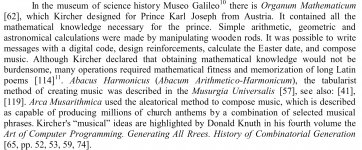
- He was a cryptographer who invented robots:

- In my previous post I suggested that the Tower of Babel event was connected with the destruction of the last Black Cube and that the Jews were trying to undo this catastrophe. Well, that's explicitly what Leibniz and Kircher were working on: creating new one-world artificial languages.

- He also had a machine like Swift's:

They basically admit this guy was just recycling stolen tech.
Kircher is a whole rabbit hole unto himself. The following excerpt is slightly off-topic but since everything connects to everything else, I'll include it.
Athanasius, Underground
 Breathtaking the way these things fit together. I wasn't expecting to connect buried giants and AI through a 17th century Jesuit spymaster, but here we are.
The article goes on to describe how Kircher, despite being considered the most learned man in the world during his lifetime (1602-1680), fell into total obscurity after his death, only to be "rediscovered" in the 1980's! Hypothesis: at some point shortly after Kircher dies, the people managing the post-cataclysm mop-up decide to change their approach and bury a lot of things that previously were allowed to circulate.
Let's go back to Leibniz. He is also credited with being one of the first to develop binary code. Read this, wow:
 And:
And:
 Leibniz credits binary code with creating reality!
 And here we are again, pure Kabbalah.
 No way this guy wasn't a Jew.
Thinking about the Black Cube hypothesis, I am reminded of the work of two philosophers whose ambition was to create a universal knowledge system.
The first is Spinoza and his celebrated Ethics. Spinoza was a Dutch Jew of Portuguese ancestry living in Amsterdam and working as a lens grinder during that city's 17th century "Golden Age", in which the Sephardic Jews who had recently set up shop there established (1) the world's first modern stock market, (2) the first major debt-spreading central bank, and (3) the Dutch East India Company. These were the three main weapons they used to plunder the Nations and bring their wealth to Amsterdam. I used to think this entire enterprise was conceived and executed out of pure greed, but now I suspect that "capitalism" was merely a means to a greater end, namely the location and subsequent extraction (or destruction) of anything of value from the pre-cataclysm world.
(Every movie Spielberg makes deals with some psyop or fake. These people probably tell themselves they're Indiana Jones "saving" old knowledge and artifacts.)
The story goes that Spinoza was excommunicated for his heretical ideas about God and took refuge among the city's Gentiles. Spinoza has a reputation in philosophical circles that is somewhat similar to Einstein's today: the deeply humble, moral, and human Jew bringing the light of wisdom to a Gentile world which doesn't deserve him. You're not really allowed to criticize him.
I got about halfway through the Ethics (1677) when I tried to read it fifteen years ago. I don't want to dog on Spinoza the man too much. I think Einstein is a wicked deceiver, but Spinoza seems honest enough. It's not his fault that he's been transformed into a shibboleth for Jewish moral and intellectual supremacy. The fact that the local kosher mafia wanted to kill him tells me he was on the right side of history. The reason I bring him up is because the Ethics is a "geometrical" system in which Spinoza attempts to construct a universal ontology and ethics using purely mathematical principles. In other words, he starts from a series of simple axioms which he then combines and recombines algorithmically, leading to all kinds of surprising conclusions. It's an ingenious construction, but as I was reading it I kept thinking: does he really take this seriously? Sure, it has the form of a geometric proof, but it's dealing with (equivocal) linguistic propositions and not (univocal) numerical ones, so the "mathematical rigor" is completely imaginary. Isn't this exactly how an AI would go about constructing an ethics? Not through intuition or meditation but through a series of increasingly complex compound syllogisms?
Now, after supplementing my university philosophy education with an online anti-Semitic conspiracy theorist education [note tongue in cheek please], I see something different. I see a renegade Jew probably steeped in Kabbalah and gematria attempting to retool techniques he learned in Yeshiva to construct a system that would engage with a newly "empty" post-cataclysmic reality. Spinoza is considered one of the first people to question the divine origin of the Bible and treat it as a simple historical document. I suspect one of the reasons he was excommunicated is because he was sharing too much secret knowledge with the goys. (Or maybe he was a double agent.) More to the point, I think Spinoza, in his own way, was not attempting to create some kind of rational universal ethics, he was attempting to recreate one. He was probably smart enough to figure out that Kabbalah had become a cargo cult, but that it was originally something real.
Spinoza is presented to us as a humble craftsman working in isolation in an Amsterdam ghetto, but as we will see, he was in correspondence with Leibniz and even met him. Something doesn't add up here. Why was this isolated Jewish lens grinder exchanging letters with the most hooked-up diplomat/polymath/spymaster on the continent? The fact that Leibniz was aware of who Spinoza was suggests to me that they were both plugged into the same Jewish Intel networks. Again, I am working from the hypothesis that "Jews" were and are nothing but the descendants of the caste of "Black Cube administrators" tasked with the long-term plan of recreating an AI God. Let me add that I suspect that there is an even deeper layer to this and that the rebuilt supercomputer will function as a new body for a disincarnate demonic entity, but that line of speculation is for another post.
I asked ChatGPT who else Spinoza was tight with, and they gave me this guy, Henry Oldenburg:
Founding member of the Royal Society. Spook. Secret society hand sign. Industrial espionage. Here we see that the practice of peer review was invented by a spy, presumably as a pseudo-objective cover for controlling information. That piece of information alone is worth the price of admission. Good to know academia was a knowledge-laundering operation from jump street. I think it's clear that Spinoza's "humble Jewish lens grinder" schtick was just good cover.
LEIBNIZ
Leibniz is the granddaddy of all those impossible 19th century inventors and architects that were used to launder pre-Reset architecture, knowledge, and technology. Everyone knows him today as the "universal genius" of the 17th century. He was a logician, a mathematician, a philosopher, a linguist, a historian, a theologian, a scholar of Chinese, an engineer, and on and on. What is somewhat less known, however, is that he started his career as a lawyer, diplomat and...spy. This is acknowledged by mainstream sources like Le Monde. In 1672, at the age of twenty-six, he was sent to Paris by his employer, the Elector of Mainz, to try to convince Louis XIV to invade Egypt and declare war on the Ottoman Empire!
Apparently this is the very first time we see modern Europeans taking an interest in Egypt. The first reliable map of Egypt was not drawn until 1706! Leibniz (or his masters) drew up an ambitious plan to start a new Holy War which to this day embarrasses Leibniz scholars. What I see now when I read this is that the Jews running the post-Reset European elite knew that the Ottoman Empire was sitting on an incredible wealth of pre-cataclysm knowledge and artifacts, and they wanted it, so they tasked their agent Leibniz with convincing some goy king to go get it for them.
This is an impossible CV. I think it is more logical to assume that Leibniz had some help. So the story goes, he knew nothing about mathematics when he arrived in Paris in 1672 and four years later invents the calculus. Yeah...maybe. To make it even more suspicious, Isaac Newton, also a Leibniz-like cutout in my opinion, independently invented the calculus at the exact same time in England.
Or maybe they were the star agents of their respective intelligence networks and they were racing against each other to corner and capitalize on recently rediscovered or released scientific and technological knowledge from before the cataclysm, taking personal credit for the most prestigious discoveries of their field agents. Newton was Warden of the Mint, which was an Intel position.
Here's an interesting article about Spinoza and Leibniz written by a resentful Jew who whines about the latter being an anti-Semitic meanie and plagiarizing the former:
20 Ways to Be a Great Literary Citizen, According to Gottfried Wilhelm Leibniz
Presumably the author, a Sachs (like Goldman Sachs or Saxe Coburg-Gotha), operates from the deep Kabbalistic belief that no Gentile could ever produce anything of value without stealing it from a Jew.
I just checked, and this fake novelist and deceiver is none other than the son of Jeffrey Sachs, the top Jewish banker sent in to Russia after the fall of Communism to oversee the privatization of the country, "privatization" being a euphemism for "stealing all public wealth and dividing it between seven Jewish oligarchs". We see this a lot, with these top Jewish families also pursuing their generational agendas through history and fiction. I'm thinking of the Kagans, for example. It's not a coincidence that Google pushes his Hasbara to the top of the search results for Leibniz.
I actually suspect that Leibniz himself was probably Jewish, but have no proof other than his spooky biography (and the fact that he was described as having a "large nose"). In any case, I find it interesting that Leibniz destroyed his correspondence with Spinoza. The author basically blames "antisemitism", but I suspect it might have had more to do with the sensitive content of their letters.
In the 17th Century, Leibniz Dreamed of a Machine That Could Calculate Ideas
In 1666, the German polymath Gottfried Wilhelm Leibniz published an enigmatic dissertation entitled On the Combinatorial Art. Only 20 years old but already an ambitious thinker, Leibniz outlined a theory for automating knowledge production via the rule-based combination of symbols.
Leibniz’s central argument was that all human thoughts, no matter how complex, are combinations of basic and fundamental concepts, in much the same way that sentences are combinations of words, and words combinations of letters. He believed that if he could find a way to symbolically represent these fundamental concepts and develop a method by which to combine them logically, then he would be able to generate new thoughts on demand.
Please read the entire article before continuing. It's not that long, but it's too long to copy in full, and everything here is interesting. The short version: Leibniz was inspired by a 13th-century Kabbalist from Mallorca, Ramon Llull, to invent a mechanical device that would function as an artificial intelligence. Llull's device was made of paper (!) and was based on the Tree of Life.
Part One of the same article series is also worth reading here (it's short):
Natural Language Processing Dates Back to Kabbalist Mystics
Putting the pieces together: was the Tree of Life diagram a mnemonic device bequeathed to the Jews by the Black Cube and used to encode the basic principles of computer language? Remember, we saw that the I Ching also conceals binary code (something which Leibniz figured out). Were Kabbala initiates taught the secret legendary history of the Black Cube? Were they all in a race against each other to construct better and better mechanical approximations of it using the technology available at the time? Isn't this still what is happening? Were they performing magic rituals to invite different powerful demons into their increasingly sophisticated AI machines?
Here's a Tree-of-Life-inspired drawing included by Leibniz in his 1666 paper on combinatorial logic in which he proposed his own universal machine:
I tried to read the paper in question and understood almost nothing. The first part reads EXACTLY like Spinoza's Ethics, however. Either Leibniz really was stealing from everybody or this knowledge was just floating around and everyone was wildcatting it, doing their best to try to weaponize it somehow.
In between spy missions, mathematical breakthroughs, and theological innovations, Leibniz also found time to invent the first calculator.
Seriously.
"Its intricate gearwork, however, was somewhat beyond the fabrication technology of the time."
The original Black Cube PDF argues that a precision machine like the Antikythera Device can only be invented in a society that has already attained a certain industrial capacity. What is more likely, that Leibniz was such a genius that he was able to imagine a mechanism such as the step reckoner, or that he had access to either diagrams or actual dug-up calculators and back-engineered the thing, but the metalsmiths of his time were not able to replicate the fine-tooled gearing?
To whom did he present this device?
When it became clear that France would not implement its part of Leibniz's Egyptian plan, the Elector sent his nephew, escorted by Leibniz, on a related mission to the English government in London, early in 1673.[46] There Leibniz came into acquaintance of Henry Oldenburg and John Collins. He met with the Royal Society where he demonstrated a calculating machine that he had designed and had been building since 1670. The machine was able to execute all four basic operations (adding, subtracting, multiplying, and dividing), and the society quickly made him an external member.
Our old buddy Oldenburg!
Going back to the article about Leibniz, there's a fascinating reference to Gulliver's Travels by Swift. I read this book twenty years ago and sadly remember almost nothing. I didn't have eyes to see back then. Gulliver's Travels appears to be a massive dump of secret knowledge disguised as science fiction. I guess that's even the purpose of science fiction.
Wow!
How far did these men go in creating such devices? Is it possible that some machine like the one Swift parodies was used for purposes of writing fake history?
I am really just scratching the surface here. I suspect that Leibniz in particular is a pinata that will explode and vomit truth candy out everywhere if you whack him in the right spot. His Wikipedia entry alone is full of incredible red flags like this:
- In 1716, while traveling in northern Europe, the Russian Tsar Peter the Great stopped in Bad Pyrmont and met Leibniz, who took interest in Russian matters since 1708 and was appointed advisor in 1711.[53]
- On several occasions, Leibniz backdated and altered personal manuscripts, actions which put him in a bad light during the calculus controversy.[55]
- Leibniz was the bridge to China in the sense that he pored over all the new ideas coming back from the Jesuit mission to the Imperial court. In 1689 he spent six months at the Vatican Library which housed all the knowledge garnered by the Jesuits. [From Leibniz's writings on China, news from China 1697]
This guy was given access to the Vatican archives for six months!
ADDED: I am halfway through a very interesting paper on 17th century precursors to AI, and I have to add Athanasius Kircher to the list. We've seen him here before - he was a Da Vinci type polymath who also drew airships.
https://www.researchgate.net/publication/348810262_Idea_of_Artificial_Intelligence
It turns out that Kircher, a German Jesuit who lived in Rome, was the man who personally introduced Leibniz to Llull's artificial mind system.
Well it just so happens that Kircher was an "intelligencer" extraordinaire himself. According to Britannica, Kircher...
To make things clear, we now have a direct line from Leibniz to Kircher and from Kircher to the field agents plundering the post-cataclysmic world outside of Europe.
- He was a cryptographer who invented robots:
- In my previous post I suggested that the Tower of Babel event was connected with the destruction of the last Black Cube and that the Jews were trying to undo this catastrophe. Well, that's explicitly what Leibniz and Kircher were working on: creating new one-world artificial languages.
- He also had a machine like Swift's:
They basically admit this guy was just recycling stolen tech.
Kircher is a whole rabbit hole unto himself. The following excerpt is slightly off-topic but since everything connects to everything else, I'll include it.
Athanasius, Underground
The article goes on to describe how Kircher, despite being considered the most learned man in the world during his lifetime (1602-1680), fell into total obscurity after his death, only to be "rediscovered" in the 1980's! Hypothesis: at some point shortly after Kircher dies, the people managing the post-cataclysm mop-up decide to change their approach and bury a lot of things that previously were allowed to circulate.
Let's go back to Leibniz. He is also credited with being one of the first to develop binary code. Read this, wow:


 7.3 | Drama, Horror, Mystery


 . Disappointed. You know what will happen in 2030? Nothing like aways
 ) people believe in this imaginatu thing they call AI. The funny thing is that in all level of our society fall in this scam. People are so that clueless about computer? All computer work the same way: 1 and 0 calculation from the beginning to now for sure in the future too. Every information is transcode in 0 and 1 and can be store in a physical material, every single thing a computer do have to be "write" the command by a man, include other that computer do by itself and only do because was write in way it is permitted.


