SH Archive Translation: Mercator 1569 world map

SH.org OP Username
KorbenDallas
SH.org OP Date
2018-08-19 03:22:25
SH.org Reaction Score
10
SH.org Reply Count
10

KD Archive

Not actually KorbenDallas
Active Member
Joined
Sep 22, 2020
Messages
4,691
Reaction score
1,500
Note: This post was recovered from the Sh.org archive.
Username: whitewave
Date: 2018-08-19 12:44:32
Reaction Score: 1
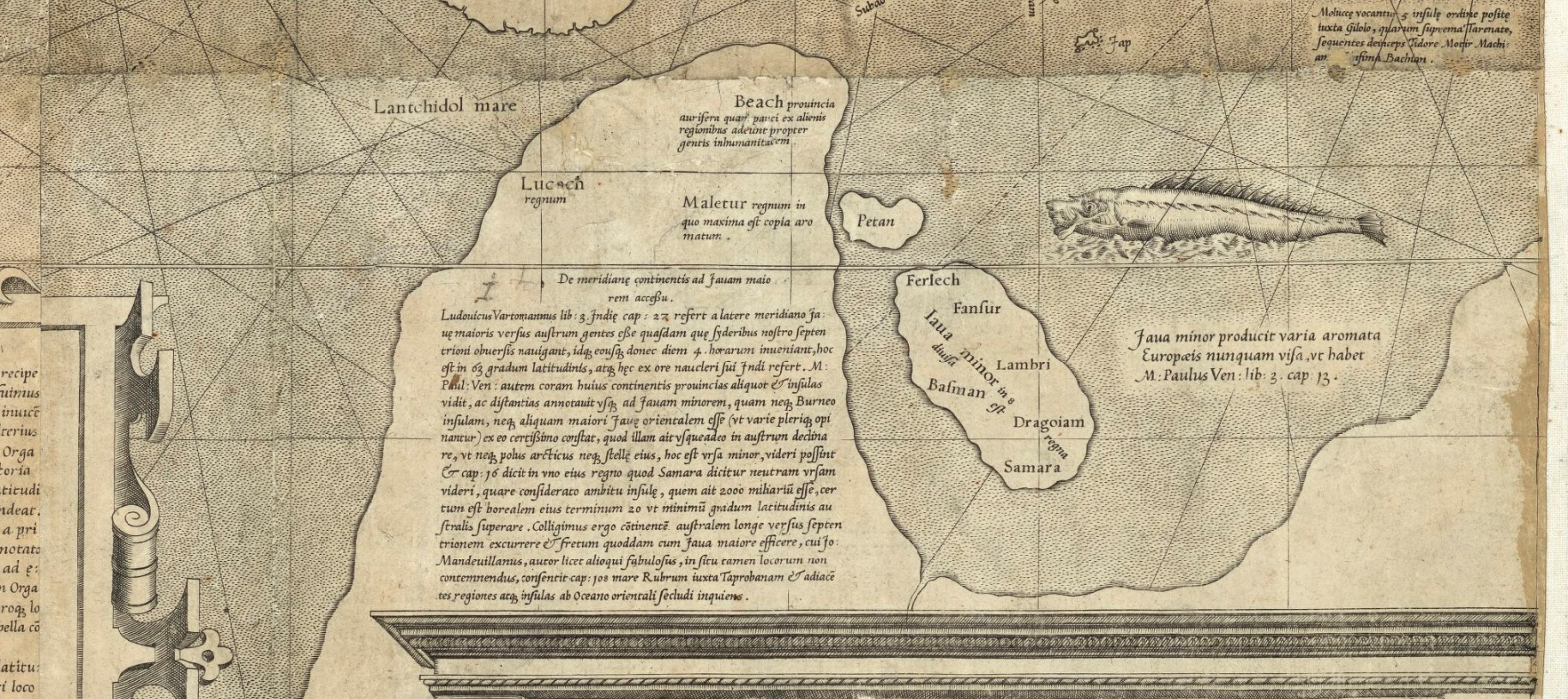
"Ludovicus vartomannus" was some roman name. "Indie cap" maybe refers to Tibet in the south. "Rasert a laterre" I believe refers to a resort on the earth (terre). "Meridiano" is meridian. Then, I think the "maoiris versus austrum" may be some astronomical reference (maoiris referring to Canis Major? and austrum meaning stars or maybe south wind).

I see "latitudinus" (latitude), "continentalis" (continent), "collignus" (learn), "ergo" (therefore), "australem" (possibly the Negev desert in Israel?), "longe versus septum" (far toward the narrow part), "trionem excurrerre" (former digress), "& sretum quoddam" (and follow), "cum saua" (as saddle), "maiore" (great/major-interestingly, can also mean ancestors), "efficere" (make happen/bring to pass), "cui so:" (to whom or in which), "Mandeuillanus" (possibly the name of a deity), "autor" (author?), "licet" (license-allowed to speak),"alioqui" (incomparable", "fabulosus", (fabulous), "in situ" (on site, locally), "tamen" (however, yet), "locorum" (place), "non contemnendus" (not to be despised), "consentit-cap" (consent-head: 'chief's consent?), "mare Rubrum" (red sea/ruby sea), "iuxta" (next to or close), "Taprobanan" (think that's the name Greeks gave to an island in the Indian Ocean), "& adiace" (and bordering), "regiones" (regions or provinces), "atq" (lined up/queued), "insulas" (island), "ab oceano" (away from ocean), "orientale" (east), "secludi" (secluded), "inquiens" (saying).

So, my crappy translation of the last sentence, fwiw, is: Learn therefore the desert, far toward the narrow part, digress and follow the great saddle which will bring you to Mandeuillanus in which the author has much to say. Incomparable, fabulous site, however not to be despised is the chief's consent to the red sea close to the island and bordering regions or islands in a line on the east side of the secluded ocean.

Obviously, I don't speak, read, or write Latin but I picked up a few words learning medical terms (none of which I see in the text). :) Maybe these links will do a better job of translating. Or this.

Can't wait til someone who knows Latin comes on here and pisses themselves laughing at my translation. I'll pay a nickel to see it. :)
 
Note: This post was recovered from the Sh.org archive.
Username: parta
Date: 2018-08-19 13:53:26
Reaction Score: 1
refers to information in a particular section of the book Itinerario de Ludouico de Varthema Bolognese

Lodovico de Varthema, de Varthema also spelled di Barthema, Latin Vartomanus, or Vertomannus, (born c. 1465–70, Bologna [Italy]—died June 1517, Rome, Papal States), intrepid Italian traveler and adventurer whose account of his Middle Eastern and Asiatic wanderings was widely circulated throughout Europe and earned him high fame in his own lifetime. He made significant discoveries (especially in Arabia) and made many valuable observations of the peoples he visited; his ready wit enabled him to handle difficult situations.

He sailed from Venice near the end of 1502, visited Alexandria and Cairo, proceeded up the Syrian coast, and went inland to Damascus. Then, either adopting Islam or pretending to, he became the first Christian known to have made the holy pilgrimage to Mecca, a journey of gravest danger for a non-Muslim. He completed the trip between April and June 1503 and remained in Mecca about three weeks. In his writings he provides an accurate description of both the town and the religious rituals practiced there. Deserting his Syrian caravan, he then joined a group of Indian pilgrims on their way to India. He was, however, arrested as a Christian spy at Aden and imprisoned for two months. Sent to the palace of the sultan, he gained the intercession of one of the sultan’s wives. By this means, and by feigning madness, he was set free. He then made a walking tour of about 600 miles (965 km) through the mountainous southwestern corner of the Arabian peninsula, visiting Sanaa, Yemen.

He next sailed for northwestern India by way of Somaliland but then returned to Arabia. Touching at Ẓupār and Muscat, he went on to Hormuz in the Persian Gulf and spent much of 1504 in southern Persia. At Shīrāz, Persia, he entered into partnership with a merchant whom he knew from his Mecca pilgrimage and who accompanied him on the rest of his Asian travels. Following an unsuccessful attempt to reach Samarkand, the two men returned to Hormuz and embarked for India. Sailing the length of the western coast, they touched at Cambay and at Goa, from where Varthema visited the inland capital of Bijāpur; at Cannanore he detoured to visit Vijayanagar, a great city enjoying its final days of splendour; at Calicut (now Kozhikode) Varthema observed Hindu customs as well as trade and city government. He visited Ceylon and southeastern India and then made his way to the magnificent Myanmar (Burmese) capital at Pegu. From Malacca, on the southern Malay peninsula, he returned to India in the summer of 1505 and, upon reaching Calicut, posed as a Muslim holy man. Eager to return to Europe, Varthema joined the Portuguese garrison at Cannanore, fought for Portugal, and was knighted for his services. In 1507 he sailed for Europe by way of the Cape of Good Hope.

Varthema’s account, Itinerario de Ludouico de Varthema Bolognese… (1510), first appeared in English translation in Richard Eden’s History of Travayle(1576–77). The Hakluyt Society of London published an English translation, Travels of Ludovico di Varthema, in 1863.
 
Note: This post was recovered from the Sh.org archive.
Username: KorbenDallas
Date: 2018-08-19 20:29:19
Reaction Score: 0
Thank you very much. Now we just need to figure out why it was placed on the map where it was.
 
Note: This post was recovered from the Sh.org archive.
Username: parta
Date: 2018-08-19 21:07:48
Reaction Score: 0
is that not australia the text is on? seems mercator needed alot of space for blurbs. vartomanus wrote about that general area [ex borneo] if i could find my glasses i would read book 3 ch 27 and maybe the answer would be there.
 
Note: This post was recovered from the Sh.org archive.
Username: KorbenDallas
Date: 2018-08-19 21:15:55
Reaction Score: 0
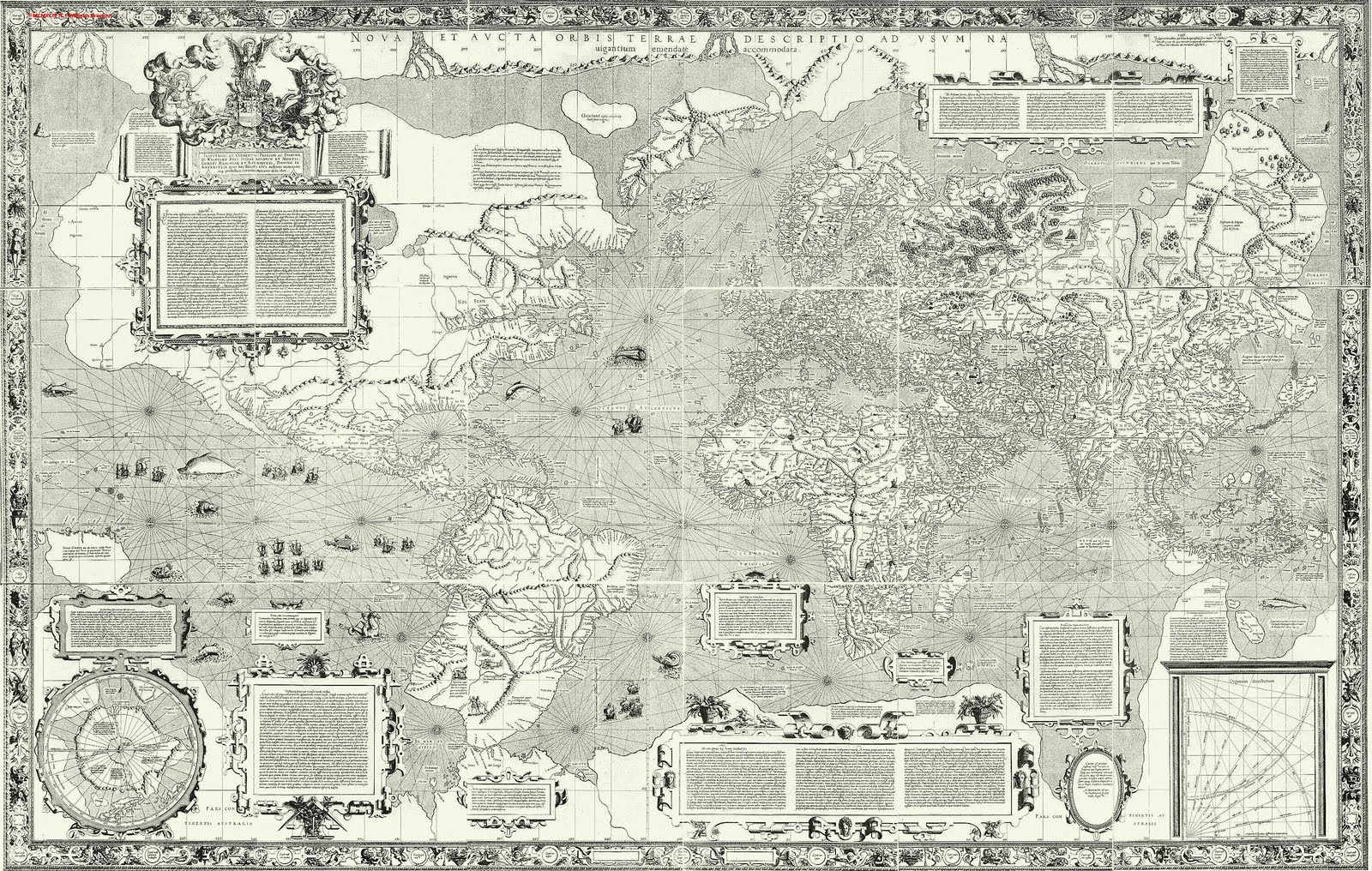
The entire map is different from today's. There could be no continent of Australia at the time. Sometimes I think they slapped those textblocks and images just to cover something upon the older maps they used to make these.
 
Note: This post was recovered from the Sh.org archive.
Username: parta
Date: 2018-08-19 21:25:04
Reaction Score: 1
if you go here and search for australia it seems there is some discussion of the author mentioning australia but i could be wrong.
 
Note: This post was recovered from the Sh.org archive.
Username: KorbenDallas
Date: 2018-08-19 21:33:22
Reaction Score: 0
Thank you. Interesting names those people had.

Rear-admiral C. R. DRINKWATER BETHUNE, C.B.
 
Note: This post was recovered from the Sh.org archive.
Username: humanoidlord
Date: 2018-08-23 00:41:54
Reaction Score: 1
why is europe the only continent wich has identical shape nowdays?
 
Note: This post was recovered from the Sh.org archive.
Username: JWW427
Date: 2019-09-10 22:32:15
Reaction Score: 0
Mercator must have had access to Spanish or Vatican archives to make this map.
I believe that like most maps of that era, this one was compiled from a host of older maps.
It shows Frisland, Hy Brasil, and an island chain off the SE of India ---all do not exist today.
Ill do a post.
JWW
 
Tips
Tips
Please respect our Posting Rules.
Back
Top