'Vanilla' skies

SH.org OP Username
Mifletz
SH.org OP Date
2020-08-10 10:11:38
SH.org Reaction Score
77
SH.org Reply Count
19
the “airship theory” is fascinating!

I was digging for a bit more info, and came across the following photograph; photo artifact? Or actual electricity
The forgotten era of the Airships in rare photographs, 1900s-1940s - Rare Historical Photos
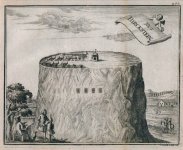
Can't speak for the alleged electrical discharges. However, the dangling lines may help interpret some features in this image of Sloup Castle in the Czech Republic:

Nejstarsi.jpg
1712 depiction of Sloup Castle (Bürgstein), Czech Republic. Source

Sloup Castle (Google Maps), (Google Streetview), (OpenStreetMap), (Flickr images)

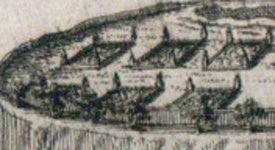
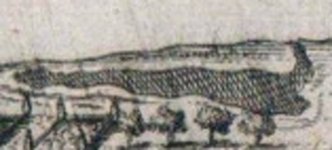
If Sloup Castle was an airship/dirigible handling facility, what was the role of the six rectangular arrangements visible on the upper left of the rock?

1980_tower_cornered_rectangles_nejstarsi.jpg
Detail from above Sloup Castle image.

The image of the Norge airship in the post above suggests some airships flew with dangling handling lines. A guess is that the six rectangular affairs with low corner towers on the top of Sloup Castle were 'stables' in an earlier sense of the word. It's possible that horizontal lines were strung at roughly head height between each stable's corner towers. When an airship came in, the airship's dangling handling lines were grabbed and then clipped (or tied) to the horizontal lines between the towers.

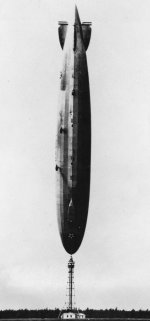
It's a simple arrangement that would keep the tethered airship stable. More stable than the USS Los Angeles tethered to a single mooring post:

uss_los_angeles_vertical_airships_in_pictures_15.jpg
USS Los Angeles achieves lift off - with the help of the wind. Source

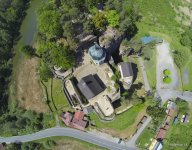
There is plenty of evidence that Sloup Castle handled airships. You can see just some of the evidence in this image:
03-dron.jpg
Aerial view of Sloup Castle today. Source
We're looking at airship handling facilities. Gas production facilities can also be found among the other images in Sloup Castle's image galleries. Especially images of its Royston Cave-like 'famine pit' and images of the vaulted 'church' roof with a hole into the lighthouse.

Equally, if less excitingly, Sloup Castle's six rectangular affairs my have been vegetable gardens. In which case the corner towers may have been supports for the net apparently laid out nearby:
1980_net_nejstarsi.jpg

A disappointing alternative interpretation, for sure. But it doesn't detract from the evidence that Sloup Castle's below ground facilities were bio-gas digesters.
 
Last edited:
Why are the skies in old photos "vanilla skies" i.e. whited out: is this deliberate to hide something in the sky, such as pre-1900 aerial vehicles as the clip claims, or an artifact of their old film process?


Are there any pre-1900 photos of clouds, sprites, tornadoes, the moon, the sun etc?


Sometimes verification, or possible verification, can be found in other ways. While we may not have photos of airships or other aircraft going back very far, way back in the late 1400s Leonardo da Vinci "invented" the parachute, or so we are told. There's a drawing said to be from 1485 of the da Vinci parachute, in his Codex Atlanticus.

Where would a parachute be tested from? The narrative doesn't say, and leads people just to conclude that it was only a concept sketched up by da Vinci, as part of another narrative about his acclaimed super genius. It could be, if editing of the past took place as many of us contend, that while keeping the narrative about da Vinci for whatever reason, the Editors thus may have overlooked this parachute.

Interestingly, in 2000, according to an Encyclopedia Brittanica a British balloonist constructed a parachute based on da Vinci's drawing, and bailed out of a balloon 10,000 feet up, and the da Vinci parachute, of course, worked.

Britannica article on da Vinci's parachute

While this invention is not at all direct evidence of airships back in the 1400s (regardless, for the moment, of whether da Vinci himself actually existed, or if the 1400s existed as we're told), it does suggest a certain consistency with the possible existence of airships, and thus of a later need for erasing out anything artificial in the skies in photos taken much later on.

2-da-vinci-parachute-1485-science-source.jpg
 
Aeawar and Wooden Nickels respond to Mind Unveiled's claims of 19th century photographic hocus and vanilla skies


View: https://www.youtube.com/watch?v=BFT6QLMTk4E

Watched the video, a shame that the creators turned the comments section off (seems they don’t do this for every video, so I guess there’s some kind of backlash already)

Personally, I agree more with ”Mind Unveiled”’s stance than theirs, i.e. “all photographs are fake(manipulated)” and therefore photographs ALONE cannot be relied on to make arguments.

I disagree that throwing out the photographic evidence leaves “nothing” - for example, we know in the official history of the Chicago World Fair, two buildings are built to be permanent(Palace of a Fine Arts/Museum of a Science and Industry, and the Art Institute of Chicago), and were completed in a timeframe of 2 years. AND the photographs of the Palace of Fine Arts DO look like the building that still exists today. So the photographic evidence now combined with the actual building we have now, and the official narrative all together raises the question of how believable the narrative is. The counter-argument that “there are construction photos” now becomes invalid because it relies on photographic evidence ALONE.

The point here is: “if the photographs are inadmissible”, then is the narrative believable/trustworthy by itself?

I do agree with their point that “empty street photographs” should not be taken to be evidence (I’m not sure whether they are actually arguing this point or being hyperbolic?); since 1. the photo could have been manipulated 2. The photo could have been taken at dawn so no one is out in the streets yet 3. The photographer could have waited for the exact time when no one is in the streets etc. So, indeed, photographs should not be taken as the definitive evidence of anything

***
edit:

the fact that ”photographic evidence”(including videos) alone should not be taken as evidence of an event is not only applicable to “historical narratives”, but modern events - things you see on the news, today, tomorrow - as well.
Indeed, very little people are open to the possibility that news media or clips on YouTube are not guaranteed to be real. In fact, in my experience, they are more likely to be fake than real!
 
Last edited:
I do agree with their point that “empty street photographs” should not be taken to be evidence (I’m not sure whether they are actually arguing this point or being hyperbolic?); since 1. the photo could have been manipulated 2. The photo could have been taken at dawn so no one is out in the streets yet 3. The photographer could have waited for the exact time when no one is in the streets etc. So, indeed, photographs should not be taken as the definitive evidence of anything

If the exposure time was extremely high it is also possible no one appeared in the photos because they weren't standing still long enough. Typically this will leave some artifacts like ghostly figures, but sometimes it doesn't.

However, long exposure times do not explain the vanilla skies in old photos. There was a discussion buried somewhere on this site where researchers were able to find a few old photos with clouds intact, but it is the exception and not the rule.

Photographs are a tricky subject in this line of research - because I can see both sides of it. Photographs of old structures are often the only way we know these buildings existed, since many are gone now. That said - using photos as the only line of evidence in a post or a YT video to make a claim isn't very strong. The more you dive into the history of photography the more you realize that photo manipulation has been there from the start ( @Timeshifter can attest to this). It is a fallacy to assume that photo doctoring has only really been an issue since computers were able to digitally edit photos, however a majority of 19th and 20th century photos were physically edited and doctored in the time they were created, not after the fact.

On a related note - it is unsurprisingly difficult to research old photography techniques because internet search result are completely inundated with modern photoshop and other software tricks to achieve similar effects.

Matte (filmmaking) - Wikipedia
How Digital Matte Painters Work

Film matte painting grew directly out of this special effects tradition. In 1905, a man named Norman Dawn was working as a still photographer in Los Angeles. He was disappointed when one of his shots came back partially blocked by a telephone pole. A colleague told Dawn to go take the picture again, but this time to bring along a piece of glass with an image of a tree painted on it. Hold the piece of glass between the camera and the building and use the fake tree to cover the pole. It was a simple old photographer's trick, but proved a convincing illusion [source: Cotta Vaz].

An aspiring filmmaker, Dawn soon developed a system for applying glass matte painting to the exciting new world of motion pictures. The Dawn Process or in-the-camera matte shot works like this:

  1. A large sheet of glass is mounted in a box attached to the front of the camera.
  2. Using black paint, a matte artist blocks out all parts of the scene that will later be replaced with a matte painting. What remains are the actors in front of some small constructed sets.
  3. The live action is shot through the glass matte, creating a partially-exposed negative. Since light was not allowed to pass through the blackened portions of the camera lens, the corresponding parts of the negative are considered unexposed.
  4. The movie director shoots several minutes of extra footage with the glass matte in place. This extra footage will be developed and used as test strips.
  5. In post-production, the matte artist uses a frame of the test strip as a reference to create a new glass matte where the live action area of the scene is blocked out with black paint.
  6. The artist then paints all around the black area, carefully maintaining the perspective and composition of the shot. He continually checks his work against the test strip.
  7. When the matte artist and director are satisfied with the way the matte painting blends with the test strip, they mount the glass painting on the front of the camera.
  8. Finally, they run the partially exposed negative back through the camera and film the scene with the glass matte painting in place. Since the live action portion of the scene is blacked out on the matte painting, the first exposure isn't double-exposed. The result is a realistic composite image of the live action and the matte painting.

This trick can be used for live action photography (videography) or still photography. The point being that if a photographer wanted to conceal the sky in the photo, they could even do it inside the camera before the image is developed.

The million dollar question is "Why matte the skies in old photos?" There are a few explanations I can speculate on:

  • For a cleaner, less busy image
  • It was a popular photography trend at the time (photography is, at the end of the day, a commercial business. Trends in photography have come and gone as often as cameras have been around)
  • There are things in the sky they did not want people to see in the images
Regarding that last one - which is potentially the most "conspiratorial" - theories have ranged anywhere from attempting to obscure the ubiquity of airship travel to atmospheric energy tech. Of course this is the most difficult theory to "prove", and in order to do so one would have to find images with these things intact. We definitely have photos of airships, though finding "proof" of atmospheric energy harvesting has proved a much more difficult task. Of course - speculation as to how the atmospheric energy grid operates has been theorized in great detail here on this site (The Lost Key: Part 1) but all we have is the structures themselves, without explicit proof of this tech in action. However, in my opinion the argument for an old world atmospheric energy grid is much stronger on its own without needing photographic evidence of it in action (though of course it would be useful).

Of course I do not entirely discredit the idea that these photos were doctored digitally after the fact in certain circumstances - however this is a risky move because those who know what to look for can easily determine digital chicanery (JPEG compression, artifacting, various pieces of software that analyze images). I also don't discount the idea that the original printing of these photos were destroyed, and the negatives were re-developed with the masking of the skies. The reason this is difficult to accept is twofold:

  • Basically every still life photographer who took photos of buildings in the 19th and 20th century were "on the take" to ensure their photos had the sky masked out (assuming it wasn't done due to a particular popular trend)
  • Alternatively - there was a concerted effort to destroy any remnant of the original photos, get access to all the negatives, and redevelop with the sky masked out.

There is supplemental evidence to support a more concerted effort to obscure the reality of the world that may have been present in photos - primarily that many older photos often have people or other items in the background physically drawn in. Again this is a technique that is still employed today digitally, and you can find it on many older photos too.

All of that to say I agree that it is impossible to make any concrete arguments that solely rely on images to prove, regardless of when the photos are taken.
 
An experienced photographer on this forum said that the exposure difference between normal outdoor daylight subject matter and the sky is four stops. Film a hundred years ago had limited dynamic range so the sky was automatically whited out by the limitations of the medium. I experienced this with my first digital DSLR camera back in 2009 - there wasn't enough dynamic range to capture everything in the shot. Depending on how you set the exposure, you could get detail in the highlights but shadows were completely blacked out; or you could get detail in the shadow but the highlights were completely whited out.

Having said that, I've seen plenty of old photos where you can easily see that erasure has taken place above the line of the buildings. I've also seen a lot of photos from the 1800s, before radio was supposedly invented, in which there are elaborate antennae systems on the roofs of many buildings.

Here are some of the best photos of the atmospheric energy lights in daylight so you can see the relative brightness between the sky and the lights. I've no idea if these were taken during normal daylight or around dusk, I think these are from late 1800s or possibly early 1900s.

I think this is probably dusk.

Screenshot 2021-11-10 at 10.54.09.png


I think this is San Franciso world's fair site. My opinion - at dusk.

Screenshot 2021-11-21 at 19.50.00.png


This is from coolguitargear YT channel. These glowing orbs look like nothing I've ever seen in my life. A lot of the old photos of cities have these kind of glowing orbs on the apexes of buildings.

Screenshot 2021-11-17 at 13.48.10.png


The things on these towers look an awful lot like lightbulbs. However the devices on the tops of the towers look like an unknown technology. I guess this is at dusk.

Screenshot 2021-12-08 at 20.13.19.png
 
The things on these towers look an awful lot like lightbulbs. However the devices on the tops of the towers look like an unknown technology. I guess this is at dusk.

I think the standard explanation for this type of tech (which I don't necessarily disagree with per-se) is that these are Mercury Arc/Vapor lamps.

The Mercury Vapor Lamp - How it works & history

The mercury vapor lamp is a high intensity discharge lamp. It uses an arc through vaporized mercury in a high pressure tube to create very bright light directly from it's own arc. This is different from fluorescents which use the mercury vapor arc to create a weaker light that mainly creates UV light to excite the phosphors. The "Merc" as it is known has been a workhorse for society; lighting streets, factories and large areas for over 100 years.

Advantages:
- Good efficiency (lamps after 1980s have a high lumen per watt rating)
- Color rendering is better than that of high pressure sodium street lights
- Some lamps last far longer than the 24000 hour mark, sometimes 40 years

Disadvantages:
- Like many lamps it contains traces of mercury which must be disposed of properly
- HPS streetlights have a better lumen per watt rating
- Human skin looks green under the light, it is poor for color film/photography
-Warm up time required to start the lamp​
 
Thank you for boosting this post back up

regardless of whatever the reason for the sky manipulation,
the “airship theory” is fascinating!

I was digging for a bit more info, and came across the following photograph; photo artifact? Or actual electricity
The forgotten era of the Airships in rare photographs, 1900s-1940s - Rare Historical Photos
Negative decay not electricity.
Probably celluloid. Find similar 'stretch marks' on old family photos and negatives.
 
Last edited:
Do the paintings of Constable (d1837) and Turner (d1851) belie the Vanilla Sky narrative, or were photos deliberately nobbled to hide something, or is it an artifact of the development process, or was there really a change in world atmospheric illumination from 1850-1910?

1685265814827.png

1685265911161.png
 
Tips
Tips
Please respect our Posting Rules.
Back
Top