I do agree with their point that “empty street photographs” should not be taken to be evidence (I’m not sure whether they are actually arguing this point or being hyperbolic?); since 1. the photo could have been manipulated 2. The photo could have been taken at dawn so no one is out in the streets yet 3. The photographer could have waited for the exact time when no one is in the streets etc. So, indeed, photographs should not be taken as the definitive evidence of anything
If the exposure time was extremely high it is also possible no one appeared in the photos because they weren't standing still long enough. Typically this will leave some artifacts like ghostly figures, but sometimes it doesn't.
However, long exposure times do not explain the vanilla skies in old photos. There was a discussion buried somewhere on this site where researchers were able to find a few old photos with clouds intact, but it is the exception and not the rule.
Photographs are a tricky subject in this line of research - because I can see both sides of it. Photographs of old structures are often the only way we know these buildings existed, since many are gone now. That said - using photos as the only line of evidence in a post or a YT video to make a claim isn't very strong. The more you dive into the history of photography the more you realize that photo manipulation has been there from the start (
@Timeshifter can attest to this). It is a fallacy to assume that photo doctoring has only really been an issue since computers were able to digitally edit photos, however a majority of 19th and 20th century photos were physically edited and doctored in the time they were created, not after the fact.
On a related note - it is unsurprisingly difficult to research old photography techniques because internet search result are completely inundated with modern photoshop and other software tricks to achieve similar effects.
Matte (filmmaking) - Wikipedia
How Digital Matte Painters Work
Film matte painting grew directly out of this special effects tradition. In 1905, a man named Norman Dawn was working as a still photographer in
Los Angeles. He was disappointed when one of his shots came back partially blocked by a telephone pole. A colleague told Dawn to go take the picture again, but this time to bring along a piece of glass with an image of a tree painted on it.
Hold the piece of glass between the camera and the building and use the fake tree to cover the pole. It was a simple old photographer's trick, but proved a convincing illusion [source:
Cotta Vaz].
An aspiring filmmaker, Dawn soon developed a system for applying glass matte painting to the exciting new world of motion pictures. The
Dawn Process or
in-the-camera matte shot works like this:
- A large sheet of glass is mounted in a box attached to the front of the camera.
- Using black paint, a matte artist blocks out all parts of the scene that will later be replaced with a matte painting. What remains are the actors in front of some small constructed sets.
- The live action is shot through the glass matte, creating a partially-exposed negative. Since light was not allowed to pass through the blackened portions of the camera lens, the corresponding parts of the negative are considered unexposed.
- The movie director shoots several minutes of extra footage with the glass matte in place. This extra footage will be developed and used as test strips.
- In post-production, the matte artist uses a frame of the test strip as a reference to create a new glass matte where the live action area of the scene is blocked out with black paint.
- The artist then paints all around the black area, carefully maintaining the perspective and composition of the shot. He continually checks his work against the test strip.
- When the matte artist and director are satisfied with the way the matte painting blends with the test strip, they mount the glass painting on the front of the camera.
- Finally, they run the partially exposed negative back through the camera and film the scene with the glass matte painting in place. Since the live action portion of the scene is blacked out on the matte painting, the first exposure isn't double-exposed. The result is a realistic composite image of the live action and the matte painting.
This trick can be used for live action photography (videography) or still photography. The point being that if a photographer wanted to conceal the sky in the photo, they could even do it inside the camera before the image is developed.
The million dollar question is "Why matte the skies in old photos?" There are a few explanations I can speculate on:
- For a cleaner, less busy image
- It was a popular photography trend at the time (photography is, at the end of the day, a commercial business. Trends in photography have come and gone as often as cameras have been around)
- There are things in the sky they did not want people to see in the images
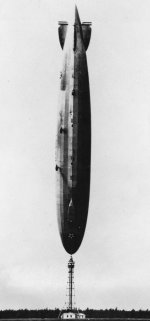
Regarding that last one - which is potentially the most "conspiratorial" - theories have ranged anywhere from attempting to obscure the ubiquity of airship travel to atmospheric energy tech. Of course this is the most difficult theory to "prove", and in order to do so one would have to find images with these things intact. We definitely have photos of airships, though finding "proof" of atmospheric energy harvesting has proved a much more difficult task. Of course - speculation as to how the atmospheric energy grid operates has been theorized in great detail here on this site (
The Lost Key: Part 1) but all we have is the structures themselves, without explicit proof of this tech in action. However, in my opinion the argument for an old world atmospheric energy grid is much stronger on its own without needing photographic evidence of it in action (though of course it would be useful).
Of course I do not entirely discredit the idea that these photos were doctored digitally after the fact in certain circumstances - however this is a risky move because those who know what to look for can easily determine digital chicanery (JPEG compression, artifacting, various pieces of software that analyze images). I also don't discount the idea that the original printing of these photos were destroyed, and the negatives were re-developed with the masking of the skies. The reason this is difficult to accept is twofold:
- Basically every still life photographer who took photos of buildings in the 19th and 20th century were "on the take" to ensure their photos had the sky masked out (assuming it wasn't done due to a particular popular trend)
- Alternatively - there was a concerted effort to destroy any remnant of the original photos, get access to all the negatives, and redevelop with the sky masked out.
There is supplemental evidence to support a more concerted effort to obscure the reality of the world that may have been present in photos - primarily that many older photos often have people or other items in the background physically drawn in. Again this is a technique that is still employed today digitally, and you can find it on many older photos too.
All of that to say I agree that it is impossible to make any concrete arguments that solely rely on images to prove, regardless of when the photos are taken.