SH Archive 1671 Aqueduct of Santa Fe in Nova Mexico

SH.org OP Username
KorbenDallas
SH.org OP Date
2020-03-04 18:39:00
SH.org Reaction Score
5
SH.org Reply Count
11

KD Archive

Not actually KorbenDallas
Active Member
Joined
Sep 22, 2020
Messages
4,691
Reaction score
1,499
avenida-chapultepec-aqueduct-6.jpg


Good luck trying to figure out when Tenochtitlan became Mexico City, for it was allegedly founded as Mexico Tenochtitlan in 1324. Some things are just too funny:
  • The date 13 March 1325, was chosen in 1925 to celebrate the 600th anniversary of the city.
  • LOL. On what date did they celebrate 500, 400, etc?
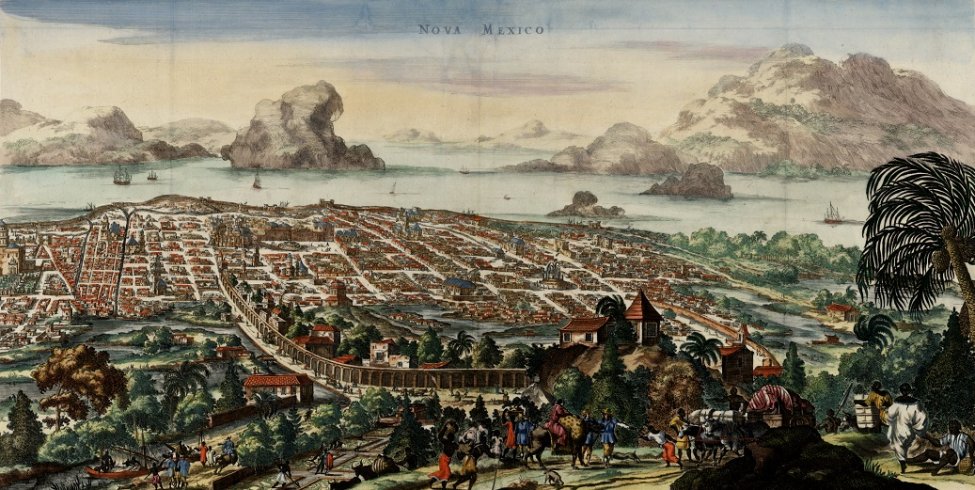
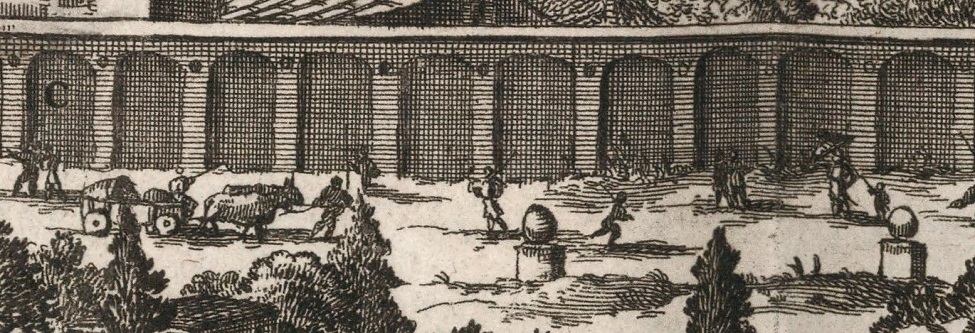
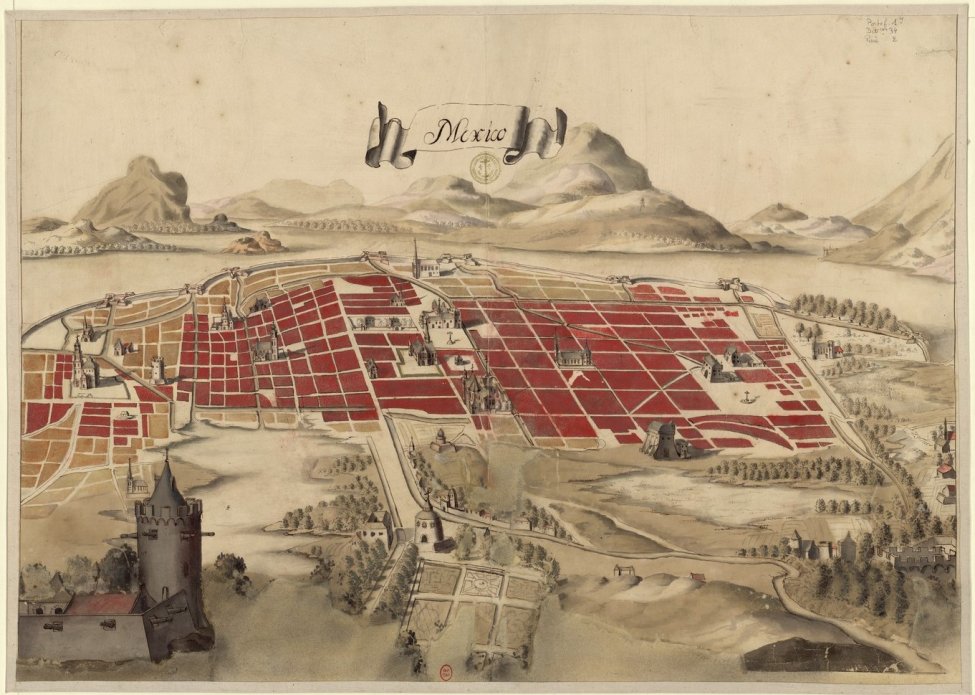
Anyways, below is a detailed view of Mexico City from the 1671 edition of John Ogilby's America. It is one of the most influential works of the 17th Century. Here are image sources:
aqueduct-tenochtitlan-1.jpg

New Mexico
Ok, before I get to the aqueduct I wanted to rant about this Nova Mexico BS, which I'm pretty sure was somehow explained by the narrative. It was probably done in a manner similar to this New Granada one. Why do they call it New Mexico? Where was old Mexico, if this one was a new one? Where is logic? We have:
  • New York ≠ York
    • New Amsterdam (NYC) ≠ Amsterdam
  • New Holland (Australia) ≠ Holland
  • New Zealand ≠ Zealand
In all of the above cases New X ≠ X, but with Mexico it's an exception.
  • New Mexico = Mexico
    • I'm obviously talking about the above image, and not the US State.
If you have an explanation for this inconsistency, please share what you know. Thank you.

The Aqueduct
aqueduct-santa-fe-image.jpg
aqueduct-santa-fe.jpg
I'm trying to figure out when this aqueduct was built. As you can see in 1671, or probably a bit prior to the pub, this aqueduct was called something like Aqueduct of Santa Fe. This is where it gets confusing. According to the English Wiki article, there were only 3 versions of the aqueduct.

#1 Chapultepec Aqueduct
The water level under Tenochtitlan was only 4–5 feet below the city, however, it was not a viable source of freshwater as the water retrieved was brackish. Shallow wells were constructed, and the water retrieved was used for household work. Construction of an aqueduct that brought fresh water, suitable for cooking and drinking, from Chapultepec springs to Tenochtitlan began in 1418. Building relied on mud and plant material to create the foundation, which rested on artificial islands that were spread 3 to 4 meters apart. Mounds consisting of mud were constructed on these islands and driven through with a wooden stake for support. The top of each mound had a hollowed out trough lined with compacted clay, and hollowed out logs were placed in the bottom of the flow path to bridge gaps between the islands. A wooden plank walkway flanked the aqueduct, making it easily accessible and a method of transportation from the city to the outlying areas. Once the water reached the city, it was delivered to small reservoirs and select households through a network of canals that extended in the four cardinal directions and branched off to individual streets.
  • Despite its relative longevity, the composition of the aqueduct could not withstand the forces of nature. Erosion weathered away the compacted clay, and in 1449, heavy rains triggered a flood that destroyed the aqueduct and effectively shut down Tenochtitlan for weeks.
#2 Chapultepec Aqueduct
After the destruction of the original aqueduct, the king of Texcoco, Nezahualcoyotl, ordered the construction of another water system using sturdier materials following the same route as the original. This aqueduct consisted of two mortar lined troughs made of stone masonry. The addition of the second trough allowed for water to be diverted to the second pipe when maintenance had to be performed on the other. This allowed for a continuous supply of fresh water to be delivered to the city.
  • Like the original aqueduct, the second rested on a chain of artificial islands.
  • The pipes were secured to the islands by wood pilings attached to a foundation of sand, lime, and rock.
  • The aqueduct was constructed using wood, carved stone, and compacted soil, with portions made of hollowed logs, allowing canoes to travel underneath.
#3 Colonial Aqueduct
After his arrival in the Aztec empire, Hernan Cortes discovered the economic and political importance of the Chapultepec aqueduct. He took advantage of the city's dependence on the aqueduct and blocked the fresh water supply, eventually destroying it. Shortly after the Spanish conquest, he set about dividing the land among the conquistadors. He wanted to take the forest of Chapultepec for himself, but Charles V, King of Spain, denied his request and decreed that the springs were needed to provide the people with potable water and were thereby the property of the city of Tenochtitlan.
  • Construction of a new aqueduct started under the reigning Viceroy Fernando de Alencastre, 1st Duke of Linares (1711-1716).
  • The structure became known under another name as the Aqueduct of Belen, named after an old Belen convent it passed by.
  • Built along the same path as the Aztec engineered aqueducts, it was constructed using Roman architecture, reflected in its 904 arches.
  • In completion, it reached a total length of 4663 varas, roughly 4 kilometers. In conquest times, the aqueduct supplied the city with the majority of its freshwater, however, waterborne illness was a concern.
  • In an effort to reduce the possibility of external contamination, iron and lead pipes were installed to replace the open troughs during the 19th Century.
  • These shielded the water from air and outside contaminants but did not decrease the number of pathogen related illnesses and death.
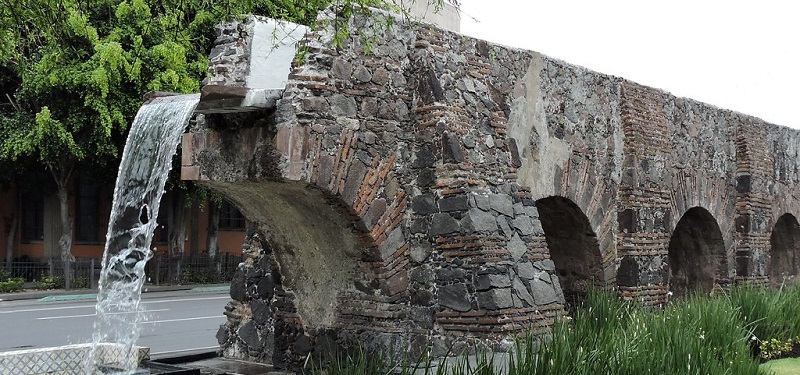
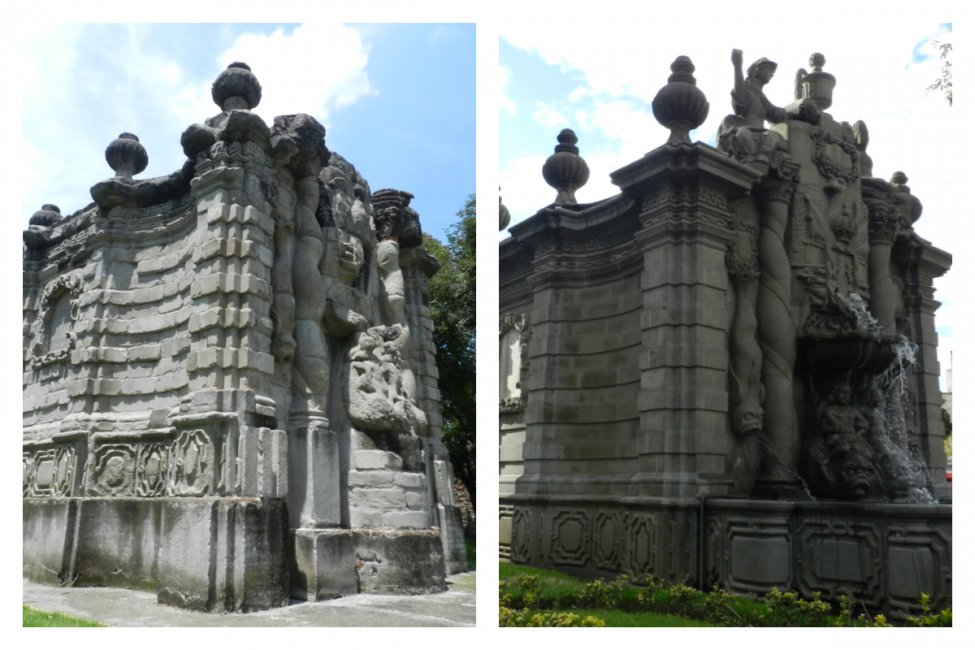
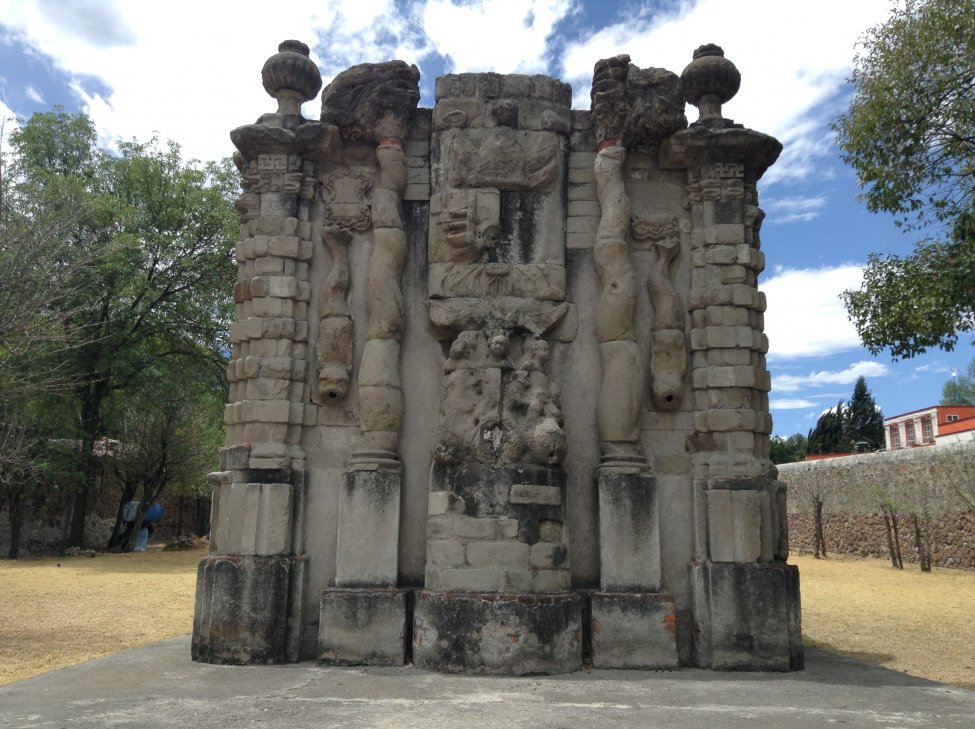
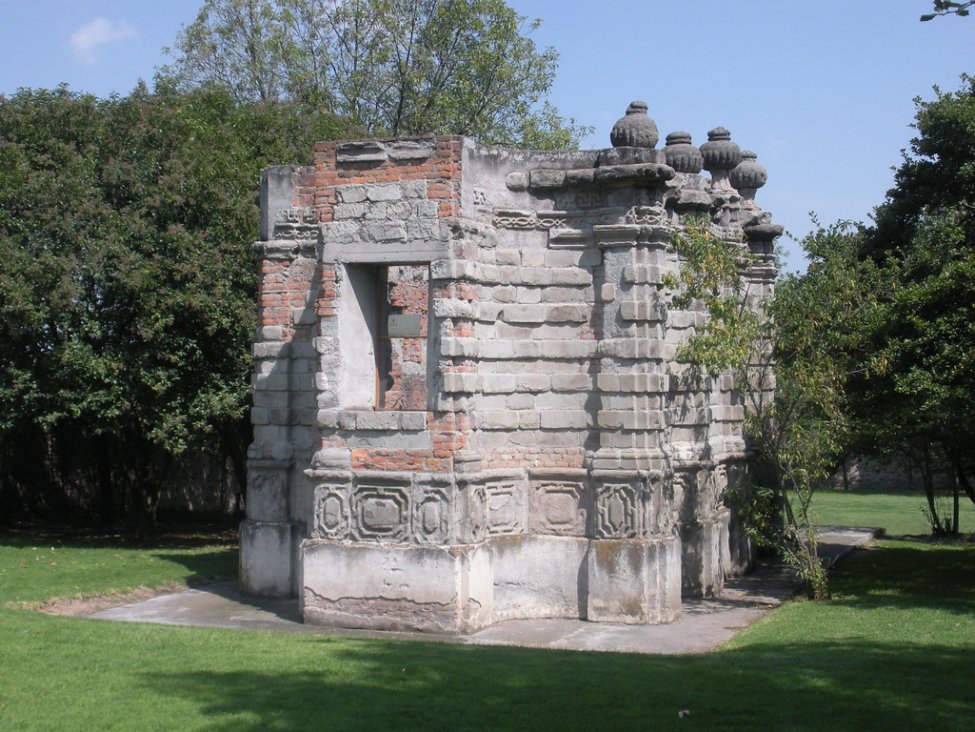
  • Located on Chapultepec Avenue near Metro Sevilla, a small section, about twenty-two arches long, still survives today.
  • Also standing today are two fountains associated with the aqueduct.
So, which one do we have in the above 1671 image. According to the above info, it would have to be #2, because they did not start building #3 until at least 1711.


Aqueduct of Santa Fe
But then we get to the Spanish language (google translated) Wiki article: Aqueduct of Santa Fe (Mexico City). After a lot of interesting blah-blah-blah we get to this:
  • On December 4, 1571, after discussing the project, work began, under the command of the alarife and carpenter Miguel Martínez.
  • This first work had such problems, that the alarming Miguel Martínez was dismissed from his position.
    • Processed for mismanagement, he had to pay a large fine and return the sums of money that had been given to him for the work.
    • As part of his sentence he was banished to Zacatecas where he died at the hands of indigenous Chichimecas .
  • In 1607 work restarted under the command of the governor Maldonado del Corral, who demolished the old indigenous aqueduct and the one done by Miguel Martínez.
  • With the rubble of these he made an aqueduct that was formed by a stone base and pillars of the same material, on which canoes or square ducts made with wooden planks and joined by nails were assembled through which the water ran.
And then it goes like this:
  • This aqueduct had to go into operation but in 1617 a contest was made to replace it with a completely masonry aqueduct, the work was apparently granted to Pérez de Castañeda and Gordivar who made parts of the works, but the lack of materials such as brick, made it necessary to increase the costs of the work.
  • By that time the water service had been transferred to a private party by the Viceroy Marquess of Salinas , so the city had no control over the work, but after a decade the work had a medium range and the viceroy ordered delivery to the city of the work, which was carried out by Baltasar de los Ríos who finished it on an undetermined date, although the amount of the debt acquired by the City of Mexico with Del Río, of 130,000.00 pesos of gold was not paid until 1853.
Note: In 1611 Marquess of Salinas departed New Spain to take up this position in the mother country. He served as president of the Council from December 1, 1610 until retiring old and infirm on August 7, 1617. He died one month later in Seville.
  • How exactly did Marquess of Salinas oversee the works in 1617. He left Mexico in 1611, and died in 1617.
The Plaque
We also have this plaque mounted on the aqueduct itself. It translates to "Remains of the aqueduct begun in 1620 finished in 1790 containing 904 arches."
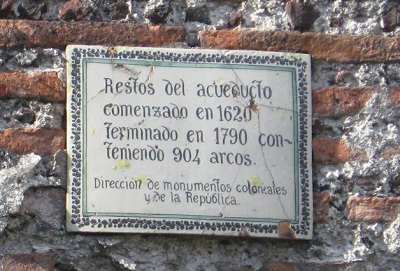
ChapultepecAqueductPlaque.jpg

Year 1466
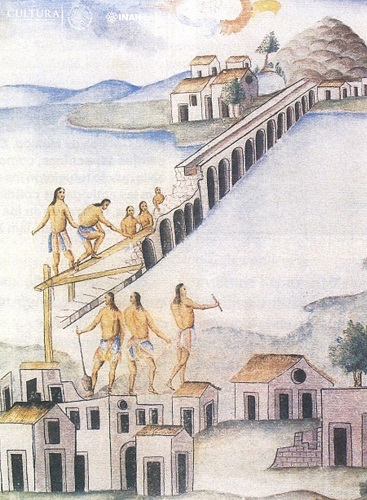
And this here "Acueducto de Chapultepec, construido por Nezahualcóyotl en 1466, en Códice Panes y Abellán, vol. IV. lám 148" translates to "Aqueduct of Chapultepec, built by Nezahualcóyotl in 1466, in Codex Panes y Abellán, vol. IV. sheet 148."
  • With a narrative compliant addition:​
    • Esta es una representación colonial de la construcción del acueducto de Chapultepec. Una de las obras hidráulicas del México antiguo más conocidas, cuya obra fue dirigida por el emperador Nezahualcóyotl.
    • This is a colonial representation of the construction of the Chapultepec aqueduct. One of the best known hydraulic works in ancient Mexico, whose work was directed by Emperor Nezahualcóyotl.
acueducto-de-neza.jpg

19th Century
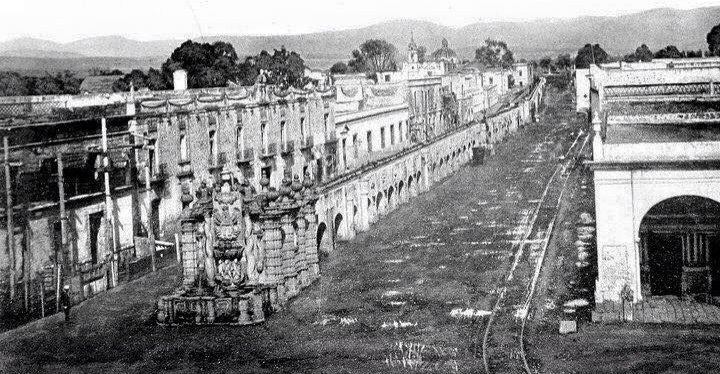
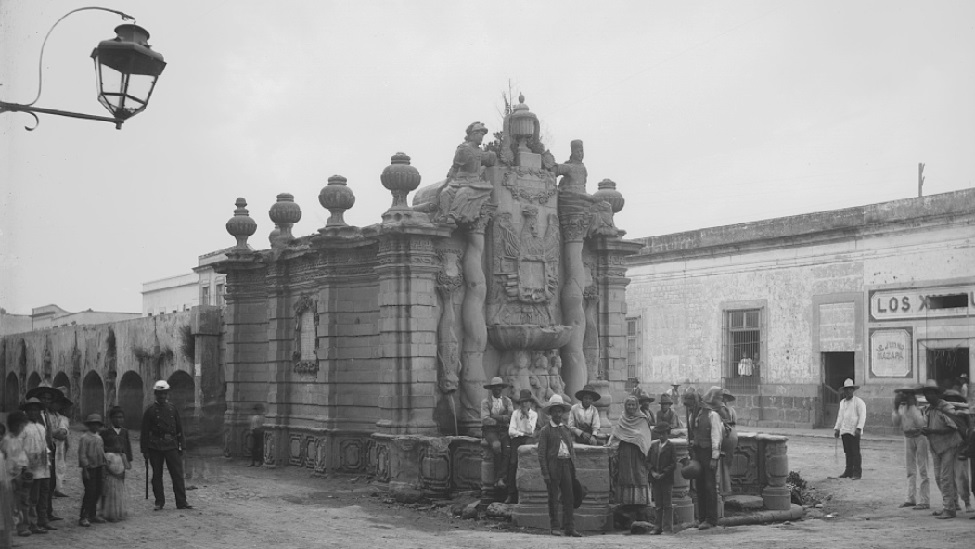
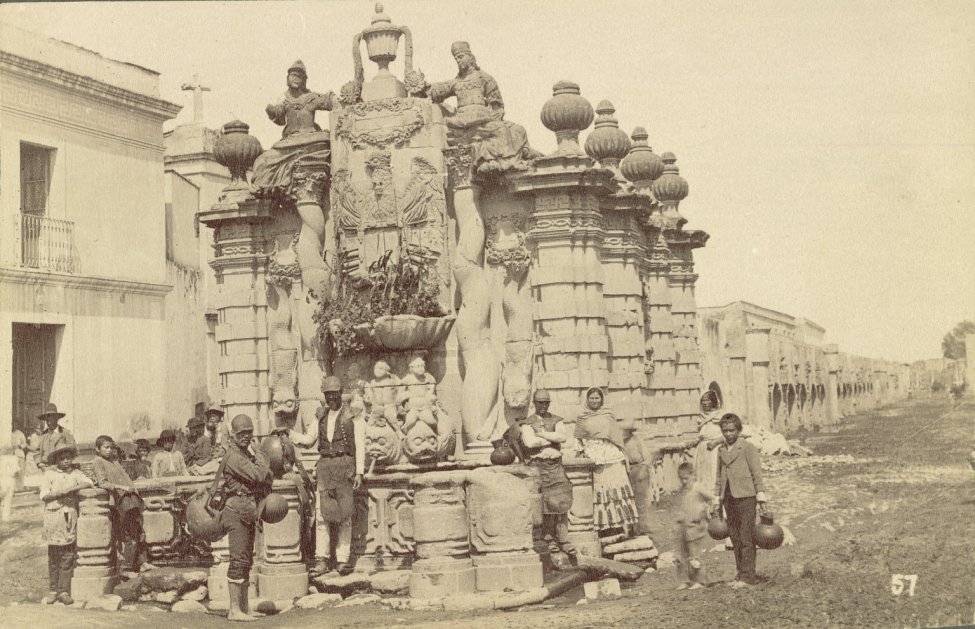
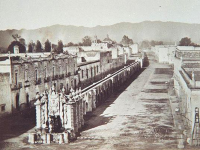
And this is what this aqueduct looked like some time in the 19th century. One too many places describe it as this "The Chapultepec aqueduct built by the Aztecs during the Tenochtitlan era, located in Mexico City near Metro Sevilla."

chapultepec-3.jpg
aqued.jpg


KD: What do you think? When was the depicted 1671 aqueduct built, and who built it?
Note: This OP was recovered from the Sh.org archive.
Note: Archived Sh.org replies to this OP are included in this thread.
 
Note: This post was recovered from the Sh.org archive.
Username: Galenturul
Date: 2020-03-05 04:00:25
Reaction Score: 0
In the first photo, I'm assuming the wall in the foreground is pat of the aqueduct? The end of it, on the left certainly resembles the large fountain in the last photo. Also when was the last photo taken? The stones that make up the cherubs holding the bowl are weathered and worn more that fountains in Italy that were built 700 years ago
 
Note: This post was recovered from the Sh.org archive.
Username: KorbenDallas
Date: 2020-03-05 06:25:08
Reaction Score: 2
Check out this view dated on Gallica with literally 17..-18.. - With some additional details here. From everything that we know in 1520 future Mexico city looked like that:
Tenochtitlan was never supposed to look like in the image below. Well, at least not after Cortes got there. And how about them star shaped little tiny fortresses at the end of each road. What kind of mechanism was this? And of course we have the main star fortress in the left bottom corner.
  • ... where is the aqueduct. In some way, shape or form it is supposed to be there.
 
Note: This post was recovered from the Sh.org archive.
Username: Felixnoille
Date: 2020-03-05 10:17:26
Reaction Score: 1
It seems there's a great deal of dispute and uncertainty regarding the origin of the name 'Mexico'. What is clear though is that it doesn't come from a Spanish surname, province or city. The Spanish word 'mexica' means Aztec, which is probably the biggest clue.

What's also interesting is the word 'gringo'. Apart from the modern connotation referring to someone from the United States - it has other meanings:
In Uruguay an Englishman or a Russian.
In Bolivia, Honduras, Nicaragua and Peru, a blonde person with fair skin.

Pure supposition, but maybe the Aztecs joined forces with the invading Spanish and became the hunters instead of the hunted, creating New Mexico (New Aztecland) until the Spanish turned on them later and wiped them out, but kept the name?
 
Note: This post was recovered from the Sh.org archive.
Username: Cemen
Date: 2020-03-05 22:33:59
Reaction Score: 0
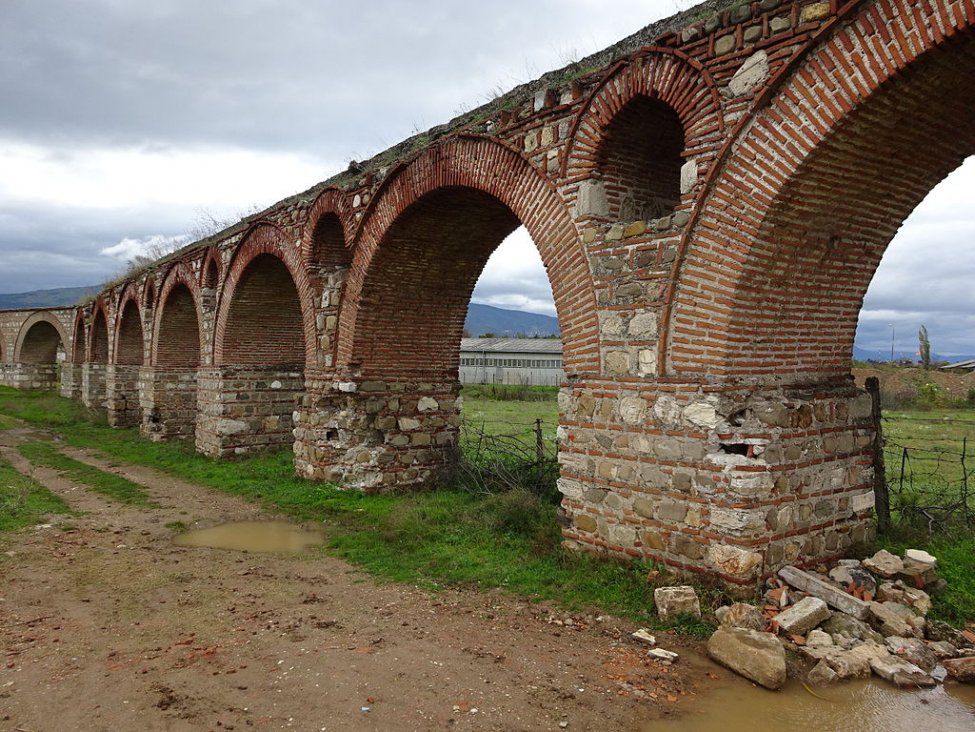
And again, roman brick.

In general, a very strange building, a brick with stones. The Romans also built aqueducts from mixed materials, but not so ugly and chaotic. Akvadukt_(18).JPG
 
  • I think I have good data on the Santa Fe aqueduct.
  • Ancient Mexico seems to have no aqueduct or perhaps it was subway, and this is based on the two engravings of John Ogilby.

vetus mexico, 1671.png
Vetus Mexico.

nuevo mexico 1671.png
Nova Mexico.
  • Although perhaps it could be at the top and coming from that central mountain, which could be Chapultepec. More or less as depicted by Hernan Cortes in his Map of Temix Titan. This time, the part in front guarded by Starfort. As already shown by KD in the map above. SH Archive - 1671 Aqueduct of Santa Fe in Nova Mexico
1-Tenochtitlan_1520_1 - copia.png

  • I dare to say that there may even be another even more ancient Mexico where the pyramids appear, this considering all the findings that have been made.
ZONAS-ARQUEOLOGICAS-CDMX-VIAJA-BONITO-8.jpg
Águila real ubicada en Templo Mayor.jpg
1024px-Zona_Arqueológica_de_Tlatelolco_TlatelolcoTV_7.jpg
mexico-tenochtitlan-revive-sus-ruinas-recorriendo-la-cdmx-portada.jpg
INAH_museo_templo mayor_3.jpg
VISITAR EL Templo Mayor.jpg


  • Once the previous aqueduct was destroyed, in 1531 they built the Chapultepec causeway and then the aqueduct in 1575.​
The Santa Fe Aqueduct in Mexico City, Mexico, is an aqueduct that still carries water from springs in the Desierto de los Leones National Park in Cuajimalpa to the city and was built at the end of the 16th century. It owes its name to the fact that until the middle of the 17th century it only carried water from the springs belonging to the town of Santa Fe located in what is now Military Zone 1-F in the Federal District.
Since 1381, in order to supply drinking water to the city of Mexico-Tenochtitlan, the Huey Tlatoani Tenochca Chimalpopoca asked his grandfather the Huey Tlatoani of Azcapotzalco Tezozomoc to allow him to take advantage of the waters of the springs of Chapultepec, which after several difficulties managed to be carried by the Chapultepec Aqueduct.
This first work was carried out in 1466, apparently under the guidance of the Huey Tlatoani Nezahualcoyotl of Texcoco, -apparently the Texcocans had a high esteem as engineers-. He and his engineers created the "aochpango" or aqueduct (Nahuatl word: 'atl, water; ochpantli, road and co, place, which would be Place of the water road), which as said was partly destroyed during the Conquest of Mexico.
This aqueduct, contrary to popular belief, was not mostly overhung on structures, but was subway on the mainland side and in the middle of a mound of earth on the lake side, it ran through a ditch, which had its walls reinforced with stone. Inside ran two tubes made of ceramic, considered to be fired, each about 50 cm in diameter. The idea of two pipes was to allow the maintenance of one while continuing to use the other. Such use was described by Hernán Cortés to the King of Spain in his Letters of Relation.
Around 1532, in the novo-Hispanic era, there is news of the construction of the Chapultepec Causeway (today Chapultepec Avenue) on which a group of neighbors of San Juan Tenochtitlan requested in 1575 that they be allowed to build a pipe along this causeway to supply water to their neighborhoods, which was done by the indigenous people but with the support of the City Council of Mexico regarding the lime needed for the work, this aqueduct was a subway work on the basis of ceramic pipes.
In 1575 the governor of the partiality of San Juan Tenochtitlan, Antonio Valeriano (tecpaneca ally of Cortés) and the mayors Francisco de la Cruz and Martín Hernández, request to the Viceroy Martín Enríquez de Almansa his permission to construct a derivation of the aqueduct of Chapultepec, so that it ran by the road of San Juan, to which it agrees and supports with the lime for its construction, while the rest (materials and workmanship) would be contributed by the natives. This work began in 1577 and was finished about seven years later, although the construction of branches, repairs and fountains allows us to give a much later date of 1650.

This aqueduct should have been in operation, but in 1617 a contest was held to replace it with a completely masonry aqueduct, the work was apparently awarded to Pérez de Castañeda y Gordivar, who carried out parts of the works, but the lack of materials such as bricks made it necessary to increase the costs of the work. By that time the water service had been ceded to a private party by the Viceroy Marqués de Salinas, so the city had no control over the work, but after a decade the work had a medium scope and the viceroy ordered the delivery of the work to the city, which was carried out by Baltasar de los Ríos who finished it at an undetermined date, although the amount of the debt acquired by the City Council of Mexico.
In the middle of the XVIII century the open channels were substituted by fired ceramic pipes, which improved the hygiene, these channels had lumbreras to regular spaces which served to carry out the maintenance of the aqueduct.

1810
During Mexico's War of Independence it was closely guarded by both the city guard and the royalist army. By that time, the replacement of ceramic pipes with cast iron pipes sealed with natural fibers and soldered with melted iron or lead had begun. As they could withstand a higher pressure than the ceramic ones, the old systems were replaced, even eliminating the luminaries. Thus, in 1866, work began on the demolition of the old quarry aqueduct, which for many marked the end of the aqueduct. Only the water distribution fountains survived, although not for long. Of its arches, only a few arches are known to survive inside the Official Residence of Los Pinos. As for its fountains and water boxes, many of them were demolished, being the Tlaxpana the last to be demolished in 1899.

273922807_2043227922513668_1268505546026452987_n.jpg

  • This Tlaxpana fountain is not only interesting for its Bicephalous Eagle, but it is also a copy of an Italian fountain dedicated to Neptune.
Villa_d'Este_din_Tivoli_-_Fontana_dell'organo.jpg
1024px-Villa_d'Este_01.jpg
1280px-Tivoli,_Villa_d'Este,_Fontana_dell'organo_(2).jpg
maxresdefault.jpg
Villa-dEste.Tivoli.Italia.Plano_.tivoli-iloveyou-e1495569589898.jpg

Villa d'Este is a villa located in Tivoli, near Rome.
Pirro Ligorio, responsible for the iconographic programs developed in the frescoes of the villa, was also in charge of designing the gardens of the villa, with the assistance of Thomaso Chiruchi of Bologna, considered one of the best hydraulic engineers of the 16th century; Chiruchi had worked on the fountains of the Villa Lante. At the Villa d'Este he was assisted in the technical designs of the fountains by a Frenchman, Claude Venard, who was an expert creator of water organs.

Returning to the Tlaxpana Fountain:

Fuente de la Tlaxpana, An Italian fountain in the Mexican style.
This fountain was demolished in 1899, so we only have engravings to know how it looked like. It is supposed to have been created based on the model of the Tivoli Fountain.
Throughout the capital there were hundreds of fountains that were necessary water intakes for the inhabitants of the city: "unlike now, the fountains served for people to approach and bring water to their homes. However, their utilitarian function was not at odds with their aesthetic value and there were fountains whose beauty stood out, such as the Chapultepec, La Mariscala and of course the Tlaxpana."
Tlaxpana: means "the place where one sweeps". In colonial times this area was considered "the outskirts of the city" and through its "rumbos" ran an aqueduct that provided water to the center of the capital: the Veronica or Santa Fe Aqueduct, which ran through what today are the Circuito Interior and the Ribera de San Cosme.
Its existence preceded the Colony and already in colonial times it is estimated that it had a length of more than a thousand meters and had hundreds of arches. According to Raquel Pineda Mendoza, in her book "Origen, vida y muerte del Acueducto de Santa Fe", this aqueduct was of pre-Hispanic origin; it was restored in the XVI century and continued to function until the XIX century, when "it was clumsily demolished, together with part of its Santa Fe arcade, with which it constituted, since 1628, the beautiful aqueduct of two levels, unique in its kind, which introduced water from Chapultepec in its lower conduit and water from Santa Fe in the upper one".

6e1d78b715bcec03c670c9ed291b90da.jpg
La Fuente de la Tlaxpana = The Tlaxpana Fountain = Fontaine de la Tlaxpana.
  • "There were fountains whose beauty stood out, such as Chapultepec, La Mariscala and of course Tlaxpana."

    I have already shown you the Tlaxpana fountain, now I show you the Chapultepec fountain:

FUENTE CHAPULTEPEC.jpg
10801569_866374683384553_1209337365048536845_n.jpg
FUENTE DE BELEN CHAPULTEPEC.png
FUENTE DE BELEN CHAPULTEPEC2.png
  • As you can see there are two aqueducts from Chapultepec to the city and that is why we have two similar views of the Salto de Agua fountain.​
FUENTE SALTO DE AGUA CENTRO 5.png
La Ciudad de Mexico = The City of Mexico = La Ville de Mexico.

FUENTE SALTO DE AGUA CENTRO 3.png
MONUMENTO A CARLOS IV.jpg
FUENTE SALTO DE AGUA NORTE.png


FUENTE SALTO DE AGUA CENTRO 6.png
ACUEDUCTO-DE-CHAPULTEPEC.jpg
FUENTE SALTO DE AGUA CENTRO.png
FUENTE SALTO DE AGUA.jpg

FUENTES SALTO DE AGUA.png
  • Its existence preceded the Colony and already in colonial times it is estimated that it had a length of more than a thousand meters and had hundreds of arches. According to Raquel Pineda Mendoza, in her book "Origen, vida y muerte del Acueducto de Santa Fe", this aqueduct was of pre-Hispanic origin; it was restored in the XVI century and continued functioning until the XIX century.
    Restored only eh!
  • Tlaloc seems to have parallels with Poseidon or Neptune. Then comes Quetzalcoatl, Serpent, Dragon, then comes Huitzilopochtli (God of war) with the Aztecs or Mexicas.
 

Attachments

  • 1651662878173.png
    1651662878173.png
    597.5 KB · Views: 194
  • 1651662999251.png
    1651662999251.png
    487.6 KB · Views: 192
Last edited:
Tips
Tips
Please respect our Posting Rules.
Back
Top