SH Archive 1860s: Advanced Civil War weapons

SH.org OP Username
KorbenDallas
SH.org OP Date
2018-10-02 19:48:37
SH.org Reaction Score
27
SH.org Reply Count
19
Note: This post was recovered from the Sh.org archive.
Username: BrokenAgate
Date: 2018-12-13 20:59:55
Reaction Score: 2
Are they cardboard cutouts? There a black line around them, like it was badly photographed against a green screen.
 
Note: This post was recovered from the Sh.org archive.
Username: KorbenDallas
Date: 2018-12-13 21:30:07
Reaction Score: 1
The image was clearly doctored, but it belongs to a different thread and has nothing to do with the OP, which is the advanced civil war weapons. I know that it was posted earlier in this very same thread, but with a different context.

Please avoid derailing threads, we do have a Civil War photography thread discussing staged and doctored images. Just trying to keep things relevant, and in order, which is not easy :geek:
 
Note: This post was recovered from the Sh.org archive.
Username: ISeenItFirst
Date: 2018-12-13 23:45:00
Reaction Score: 1
I totally get what you are saying, but to me it is all window dressing. That civil war cannon is not very different than a modern howitzer and it's not that different from a supposed Crimean war cannon. It goes boom and throws a rock in essentially the same manner since its inception.

That third gun looks cool, but that's about it. They could have put a shroud around any of them, but that is more a function of tactics.

The cannon is just a tube, what would you have them change? All of the improvements have come in 3 to 5 areas depending how you break it down. Materials. Better steel tubes, better powder, higher pressures, more durability. Ammo. Explosive projectiles, rifled projectiles, consistency of charges and sizes. Mechanics. How to load and unload the thing.

I could make a functional shotgun at home depot for less than 10 bucks, just need ammo.

The precursor tech to these weapons is simply gunpowder and a metal tube. Although, I'm sure wooden cannons have been used as well, they just wouldn't be good for very many shots.

I don't believe the official story, but I still don't see anything anachronistic about these gun designs. These designs could easily have been in the mind of hundreds of historical armorers, just waiting on the materials to try it.

Kind of like the SR-71 plane. Designed long before it could be realized. The material science had to catch up to the design. Of course that story could be false as well, so who knows.

I think some of these guns show the opposite, actually. They show some ingenious and sometimes silly actions for firing and reloading, when ready made cartridges are already starting to be produced. These guns ARE the missing link between a wooden cannon and a modern howitzer.

Looks like a fairly natural progression to me that coincides with the material science of the times.

Now if we find out some of those barrels had some high tech materials(Some do look rather impressive, materially, but that can be decieving) then, sure, we have anachronistic weapons. Just judging by the huge diameters we see on the larger guns at the chamber end, we are not dealing with high grade steel here, no matter how smooth and shiny it looks. They were worried about blowing up the gun, and that's not even with modern propellants.
 
Note: This post was recovered from the Sh.org archive.
Username: KorbenDallas
Date: 2019-10-23 01:08:26
Reaction Score: 1
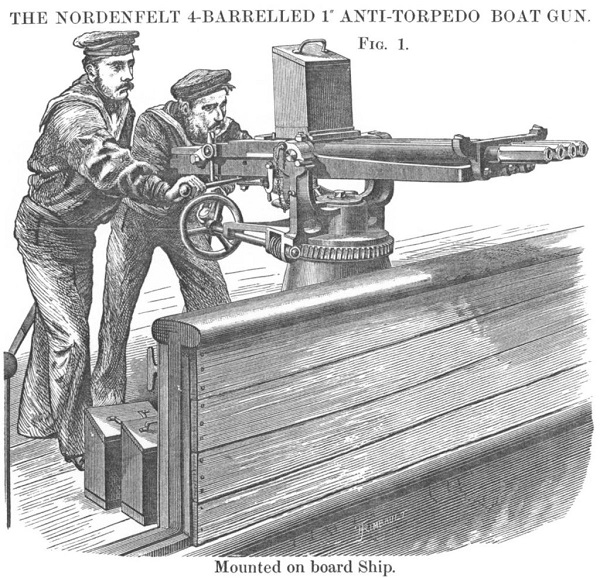
One of the guns mentioned in the op that is.

InchNordenfelt4BarrelGunNavalActionDrawing.jpg
 
Note: This post was recovered from the Sh.org archive.
Username: Ravinoff
Date: 2020-02-08 07:10:53
Reaction Score: 2
Not totally sure what the etiquette on posting in months-old threads here is, but this is an area I can kinda get into and shed some light on. The two big innovations that you've more or less identified in the opening post are the breechloading gun and very early forms of cartridge ammunition.

To start on either, we've gotta dive into the history of firearms. The first guns (both small arms and artillery, it takes a while for the two to diverge) were basically a cast-iron barrel packed with blackpowder and a round ball projectile, with a hole at the back and fitted to either a carriage or a primitive stick-handle. They were fired by touching a slow match (a burning piece of cord, basically) to spark the blackpowder via the touch-hole at the end of the barrel. That's a matchlock, and while the slow match was replaced with other ways to make a spark - think of a flick lighter for wheelocks, and everyone's familiar with the flintlock. The main thing connecting all of these is that they were loaded from the muzzle (with the exception of some experiments that didn't catch on with armies of the day) using loose powder and bullets.

The two things that change in the 1840s to 1860s are industrial advancements allowing for a barrel that opens at the rear and closes securely, and the percussion primer. The latter is easier to explain and still found on modern ammunition. Percussion primers replaced the unreliable sparking mechanisms of former eras with a copper cap filled with impact-sensitive explosive (lead or mercury fulminate, back then). People had been using primitive cartridges of pre-measured powder and a bullet for decades, but the invention of the percussion primer removed the need to deal with loose powder entirely. Guns were still loaded from the muzzle, but with powder and bullet wrapped together in waxed paper or canvas (or several other materials), striking the cap generated a jet of flame hot enough to ignite that through the wrapping. Looks a bit like a cigar:
lf.jpg
Shortly after that, experiments started with putting the percussion cap into the paper cartridge leading to things like the Dreyse needle gun (paper cartridge with a cap inside, struck by a long spring-driven needle-like firing pin) or the Lefaucheux pinfire (cartridge with a cap inside and a rod protruding out that's struck by an external hammer), and a myriad of other designs that eventually turned into the modern centerfire cartridge by the 1870s or so. Variants of that concept are what the Claxton and Agar guns in OP would've used, fed by a crank or lever driving the gun breech, same with the later Nordenfelt, all of which fall under the category of manual machine guns - most famous being the hand-cranked Gatling gun.

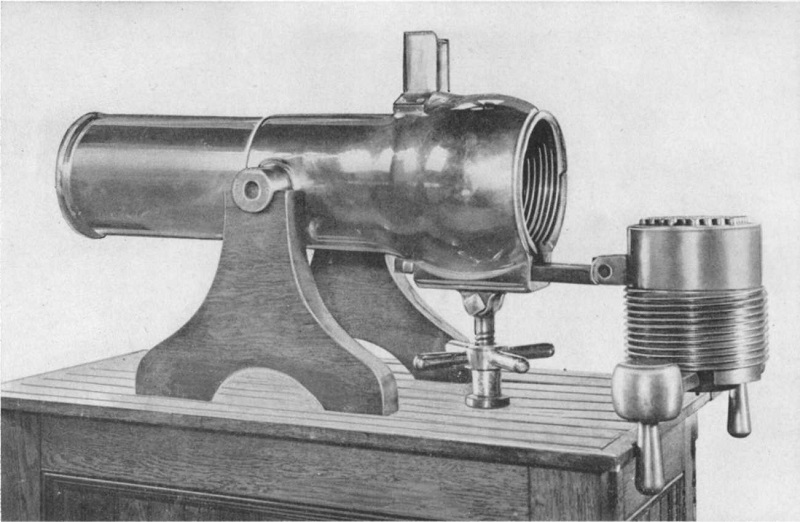
Breech mechanisms are a bit more complicated, but basically it's like this: you need something to seal up the rear of the barrel reliably so you can load your cannon from the rear (breech), because that lets you shoot faster since the propellant and ball don't need to be rammed down the barrel. For artillery purposes, that boiled down to either a screwed-in breech block, or a sliding block locked with a wedge (small arms gets complicated around here so we'll stick to artillery). Both of those are still around today and can look pretty impressive. That Vandenberg volley gun and the mitrailleuses used versions of these systems. The Vandenberg is simplest to explain at a glance:
Vandenberg Volley Gun_2.jpg
See the screw and all the separate barrels/tubes in the breechblock? Each of those would be loaded individually not unlike a multi-barreled modern gun, then the whole block is tilted up and screwed shut before firing. Later designs would use a faster interrupted-screw breech, which really culminated in the main armament of the last battleships. Each Iowa-class mounted nine 16"/50-Caliber Mark 7 guns (caliber in artillery refers to barrel length divided by bore diameter, so a 16-inch 50-caliber has a barrel 66 feet 8 inches long), capped off with this absolutely massive Welin interrupted stepped thread breechblock:
new jersey breech.jpg
 
Note: This post was recovered from the Sh.org archive.
Username: RedFox
Date: 2020-04-22 12:58:20
Reaction Score: 0
I find odd that they didn't have smokeless powder but have all this.
Edit:typo
 
Note: This post was recovered from the Sh.org archive.
Username: Ravinoff
Date: 2020-04-25 18:25:49
Reaction Score: 1
The biggest advancement brought by smokeless powder was velocity and reduced fouling, and of course less clouds of smoke. Not to say it wasn't a massive jump for ballistics and firearms design, but blackpowder is quite functional if you know the limitations. Blackpowder Cartridge Rifle Silhouette is a major competition thing using replicas of 1860s-1870s rifles.

Edit: to expand a bit, you'll notice that these volley and early "machine" guns had a couple things in common: they were all manually-operated and often had multiple barrels. That's because no suitable self-loading mechanism had been developed yet and blackpowder fouling in a single barrel would make accurate rapid fire nearly impossible.
 
That Vandenberg volley gun and the mitrailleuses used versions of these systems. The Vandenberg is simplest to explain at a glance:<br/>
<img alt="Vandenberg Volley Gun_2.jpg" class="bbImage" data-url="" data-zoom-target="1" src="https://s3.stolenhistory.net/stolen...attachments/40223/vandenberg-volley-gun_2.jpg" title="Vandenberg Volley Gun_2.jpg"/><br/>
See the screw and all the separate barrels/tubes in the breechblock? Each of those would be loaded individually not unlike a multi-barreled modern gun, then the whole block is tilted up and screwed shut before firing.
The images of that gun are thought-provoking. Presumably it was secured to a recoil-friendly mount. A mount that would help rapid action loading-firing-reloading better than the museum stand shown in the photo. Presumably its barrel also cooled quickly enough that it could be handled during enemy action.

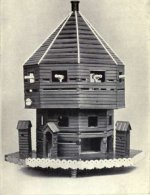
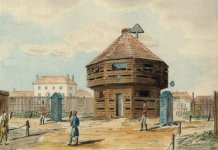
I wondered about this because similar-sized guns (or so they look to me) were installed in the central blockhouse of Norman Cross prisoner-of-war camp near Peterborough, England:
Norman_Cross_block_house_model.jpg
Prisoner-made blockhouse model. Source

durant-scanb-e1524684445284.jpg
John Durant blockhouse painting. Source

That means the guns were installed some time in the 20 years the camp operated after it was built in 1796.

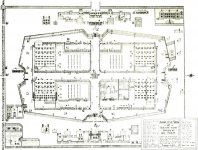
The wooden blockhouse and its stock of ammunition were built in the centre of the camp:
norman-cross-birds-eye-view-e1524673858116.jpg
1813 plan. Source

Or, as it looks today:
norman-cross-google-earth-2002-annotated-e1524672584683.jpg
Blockhouse was in the centre between the two trees. Source

Norman Cross (Google Maps), (Google Streetview), (OpenStreetMap)

Hardly seems big enough for 5,500 people. Perhaps many of them were thin - like the tall, thin people in John Durant's painting.

Looking at the gun mounts on the french prisoner's model, I wondered what recoil and heat issues were expected from those devices if the prisoners became unruly or if they rushed the blockhouse. The impression we're given is that the Norman Cross guns were expected to be used only for suppression of an already subdued and disarmed crowd.

Though they were a very ingenious subdued and disarmed crowd, as you can see from the source links above. Or if Peterborough Museum ever puts online its huge collection of models made by Norman Cross prisoners (as part of their escape plans, I suspect).

'Norman Cross' is an interesting name for the world's first prisoner of war camp. Peterborough Museum helpfully created an educational timeline that ensures its name doesn't get conflated with the Normans. Or with the Romans. And to ensure English schoolkids don't even think of the Holy Roman Empire.

Whose end coincided with the creation of Norman Cross prisoner-of-war camp.
 
Last edited:
Tips
Tips
Please respect our Posting Rules.
Back
Top