Note: This post was recovered from the Sh.org archive.Username: jd755Date: 2019-02-04 11:43:41Reaction Score: 1
From here
1894 Description of Flagler's St. Augustine Hotels by the Tatler Magazine
And here
19th century St. Augustine, Florida architecture
Tatler
– December 1894: St. Augustine as a Winter Resort - Her Hotels
St. Augustine enjoys a prestige unrivaled among the resorts of the country; not alone as the oldest town in the United States, but also as the oldest winter resort. For many years before winter resorts had been thought of, scores of people came here for the benefit of the salubrious climate, many remaining,, and they and their children have become thoroughly identified with the city. As the custom of leaving home for a period of immunity from the severity of Northern winters became more general St. Augustine grew in popularity, additional hotels were required to accommodate the visitors who came down the St. John’s to Picolata and across the country (the scene of contests between the red men and the soldiers) to the city; late the Tocoi road, primitive enough, was constructed, and visitors considered themselves exceedingly fortunate, crude as were its accommodations. A few years later the road between Jacksonville and St. Augustine was constructed and the progress of the Ancient City was assured.
Among the first hotels built in answer to the growing demand was the St. Augustine since destroyed by fire; the Florida House and the Magnolia. In 1883 General Crufts, who was then building the Magnolia Springs hotel on the St. Johns, visited St. Augustine accompanied by Mr. O. D. Seavey, and on his representation purchased the site of the San Marco hotel and made a contract with the builders of the Magnolia Springs to build the present perfectly arranged hotel. Two years later it was opened for the reception of guests, and from the first was a success and indeed struck the key note of St. Augustine’s fame as a winter resort.
Mr. Henry M. Flagler, with Mrs. Flagler, was a guest of the San Marco during its first season, and believing that the American people were as a recent writer expressed it, “learning to enjoy themselves,” and that a hotel, combining the luxuries and elegancies of the palace homes of persons of wealth, with proper means of amusement the delightful climate and the prestige St. Augustine would attract this class of visitors here, making it a winter resort, projected the Ponce de Leon, whose grandeur of conception, beauty of architectural design, perfection of detail, perfect arrangements for heating, lighting, its decorations, arrangement of public and private rooms, superior sanitary arrangements, together with its superior management securing an unexcelled cuisine, perfect service and the amusement of the guests, making it a charming winter home, the delight of the wealthy and cultured classes of the country.
In addition to the magnificent hotel, with its superb appointments, magnificent frescoes, carvings and tessalated floors; its dining room and parlors of almost regal magnificence; its handsome reading, writing and smoking rooms; its loggias, court and fountains another building, almost rivaling it in architectural beauty, was erected opposite as an annex to the Ponce de Leon. Around its beautiful court pretty shops would supply the guests with gowns, hats, jewels and bric-a-brac. The rooms above, spacious and handsomely furnished, are to be occupied by guests of the Ponce de Leon. Beyond were located the magnificent marble baths, both Turkish and Russian; and in connection with them the immense bathing pool and casino, the former at the time of its construction the largest in the country, and the casino, an immense room, unique and beautiful in design and finish. In the grounds surrounding the Alcazar were located the tennis courts, with bowling alleys located near by. Two years was occupied in constructing this magnificent hotel, the Ponce de Leon; another in completing the Alcazar and baths.
In January, 1888, the Ponce de Leon opened its doors for the reception of guests, without ceremony dinner was served, meanwhile the fine band of twenty-four pieces, secured for the entertainment of the guests during the season, was stationed in the east wing rendering an excellent program. A few invited guests, friends of the owner, Mr. Flagler, the architects and painters, their friends, a number of the citizens and the guests already assembled, gathered about enjoying the music, marveling over the wondrous beauty of the room, the elegance of silver, china and napery spread before them.
The season was a phenomenal one; until the 1st of May there was a constant stream of visitors. The great hotel drew guests to the other hotels as well, and the long line of cars that arrived many times daily brought wondering, delighted guests to the Ancient City. A season of prosperity marked this era, leaving an impress upon the city that time will not efface.
In addition to the Ponce de Leon and Alcazar miles of concrete pavement were laid, new streets opened, a Methodist church built, cottages and a fine, commodious depot sprung into existence as if by magic, changing the entire aspect of the city.
Marsh land was transformed into beautiful gardens and fields, and throngs of visitors have been coming and going each season since. The Hotel Ponce de Leon has accommodations for five hundred and fifty guests. Many of the rooms are in suite, with corridors shutting them off from other rooms; at least fifty rooms have private baths, and every appointment of both parlors, bed-rooms and dressing-rooms, handsome and as perfect as modern appliances can secure. Almost all the parlors attached to bed-rooms have pretty artistic fireplaces, others are heated by steam, some by both, although it is only occasionally that either is necessary.
The plumbing and all sanitary arrangements are of the highest order, the water coming from an artesian well fourteen hundred feet deep. The house and grounds are lit by electricity, the plant being in the basement of the kitchen, during the summer of 1893 entirely new wires were placed all through the house incased in brass tubing and running to a series of switch boards located in convenient places that any repairs may be made without the workmen entering the rooms. These boards are of marble designed by the house electrician making the entire system perfectly fire proof.
Some idea of the cost of maintaining such a hotel may be gathered from the amount of linen and napery required; tablecloths of the heaviest and finest damask, manufactured expressly for this hotel, with monogram, are purchased by the hundred, similar napkins by the thousand, and replenished every season. Blankets of the finest texture are purchased by hundreds of pairs; linen pillow slips are used entirely, the material purchased by the fifty pieces; both linen and cotton sheeting is used, and similar purchases made. Towels, woven expressly for the Ponce de Leon, come by the hundreds of pieces. The purchase of crash for use in dining, serving-room and kitchen would support some families for some time, as in one season twenty pieces of one kind, thirty of another, twelve of two or three kinds are made up for a beginning. Eider down comforts are purchased by the score; spreads by the hundreds, all of superior make.
Then the breakage is enormous; yearly hundreds of dollars are spent in replacing china, glass and silver that has a habit of disappearing most mysteriously.
The Ponce de Leon, in fact, maintains a second hotel within itself the entertaining of the nurses, maids and help employed in the hotel. A handsome dining-room in the portion of the building in rear of the dining-room is for the use of the officers, a second for the second officers, who are served from the main kitchen; while another kitchen, with a fine range and all modern conveniences, has been provided for preparing food for the help. Above stairs is a dining-room for the band, and down stairs one for colored officers, one for colored men, another for colored women, and two for white help. A number of persons are employed in preparing meals for them, and in serving them, as everything is a systematically arranged as for the guests in the larger house. Help is also required to care for these rooms—about one hundred and fifty. One hundred and fifty rooms are in the building, called the barracks, for the accommodation of male help, and about sixty more over the immense laundry.
This season Mr. Clarence B. Knott, formerly the cashier of the Ponce de Leon and last season manager of the Cordova, assumes the management of the great hotel, opening it on January 16th, 1895. A number of the staff formerly employed will remain with Mr. Knott including Mr. Romer Gillis who will again preside over the register assisted by Mr. Streeter who was room clerk the past summer at Passaconaway Inn, Mr. W. S. Crichlow, bookkeeper, Mr. William Greaves will again fill the important position of cashier and assisted by Mr. George Gibbs, Mr. Clarence M. Murphy formerly passenger agent of the Richmond and Danville at Asheville will have charge of front mail and keys. Miss Anne McKay, who has so satisfactorily filled the position of housekeeper to both manager and guest heretofore, will again have charge of that department. Mr. Robert Murray, formerly steward of the Cordova, will fill that important position at the Ponce de Leon this year with Frank Thompson at the head of the dining-room force, and Wm. Lowry head bellman.
Hotel Alcazar. Although the first intention in constructing this building was as an annex of the Ponce de Leon; before its completion, this idea seemed impracticable, and a restaurant was built in addition to it, and the house first opened on the European plan, a year later on both the European and American plans. But this was not entirely satisfactory, and it was then managed on the American plan alone, growing constantly in popularity, and each season additions were made to it, in order to meet the demands made upon it.
Three years ago forty rooms were added, with a larger parlor and ladies’ waiting-room on the first floor, occupying the space of four shops, and an annex to the dining-room. The season following was one of unparalleled success. Last year, owing to the depression in financial circles, the house was opened for rooms only.
Arrangements have been completed to open the Alcazar for this season in January on the American plan, with rates fixed at $3.50 per day, under the management of Mr. Knott. As the Alcazar is directly connected with the Casino, and the Imperial Gypsy Band will give daily and evening concerts there, commencing in January; a regular orchestra will not be employed.
The Alcazar is built around four sides of a square, or court, the lower, or office floor, entirely surrounded by a beautiful arched loggia. The rooms are arranged to either look into the court or streets surrounding the house. They are large and beautifully furnished, the parlors attractive and with handsome appointments. ‘A superior cuisine and service will be maintained, with an excellent staff and corps of help.
Hotel Cordova became the property of Mr. Henry M. Flagler in 1889 by purchase. Immediately many changes in its interior arrangements were made and the hotel under the management of Mr. E. N. Wilson. Last year Mr. Flagler appointed Mr. Clarence B. Knott, who had been cashier of the Ponce de Leon, manager, making the rate three and four dollars per day.
This year the house was opened on the 5th of November again under the management of Mr. Knott and has been remarkably well patronized. On Sunday last one hundred guests were dined.
The Cordova occupies the southeast corner of the Alameda, is a handsome house of pure Cordovese architecture, its main entrance on Cordova street facing the beautiful grounds of the Alcazar. The office and writing-room are extended into a sun-parlor where tropical plants add to the attractiveness of the entire apartment; here the daily and evening concerts are given and enjoyed both by guests and cottagers who are welcomed most cordially by “mine host,” making it one of the favorite gathering places in the city. Weekly dances are given every Wednesday that are greatly enjoyed by hundreds of visitors to the city. The large handsomely furnished parlor adjoins the sun-parlor and opens upon a broad veranda facing King street with the beautiful Government park opposite; a ladies’ entrance and hall separates this from the library or reading-room that occupies the the corner of the building, and commands a magnificent view of the Ponce de Leon. All are furnished most harmoniously.
A private entrance south of the office leads directly to the dining room, one of the finest in the State’ high studded ceiling, with finely draped windows looking into a pretty court. The table furnishings are particularly pleasing. Fine damask, sparkling silver on it, glass and dainty china add to the excellent menu served.
From here
Flagler's St. Augustine Hotel Competition
Flagler's
St. Augustine
Hotel Competition
Did Henry Flagler have competition in St.Augustine?
The short answer to this question is no.There was no competition to Henry Flagler. The closest thing to competition to Flagler was the San Marco Hotel. He took the builders, the manager, sometimes the orchestras, and the train station. Later the hotel was burned by arsonists. After that there was no quality competition. Even the San Marco suffered from its age. It was built in the time of gas as opposed to the time of electricity. (See what 2 years will do.) Even Flagler was on the cusp of change as private bathrooms were added year by year to the Ponce de Leon Hotel.
The Major St. Augustine Competition
Most of the hotels opened only for the winter season, which could extend from November through May. Late openings or early closings meant that guests would simply move to other hotels. The hotel proprietors usually managed a hotel in a northern state in the summer; like their wealthy guests, they wintered in the south and spent summers in the north. The hotel maids, waiters, etc. did the same thing in many instances. Henry Flagler broke the pattern by not offering a northern hotel. However, his managers were allowed to advertise their summer hotels (including adding the name of the other hotel on the Flagler hotel stationery). If the manager was good at his job, guests would "follow" the manager from hotel to hotel.
NOTE:
What's the difference between a boarding house and a hotel?
For the purpose of these pages -how they advertised. If you look at the pictures you may notice that some hotels are smaller than boarding houses, some boarding houses look like they should be hotels. (See Boarding Houses)
The Competition
Florida House
George L. Atkins and Sons were the proprietors of the Florida House Hotel in the 1880s. Their summer hotel was the Ocean Hotel in Asbury Park, New Jersey, open from June 15th to September 15th.
The Florida House was originally built in 1833. It opened in 1834. Mr. J. H. Rehmer of Ansonia,Connecticut erected the main building in 1875.
In 1883, George Atkins petitioned the town council for permission to build a pedestrian bridge over Treasury Street, connecting the Florida House with the Planters Hotel, and enlarging the hotel.
In the 1884 Chapins Hand Book of St. Augustine by Elias Nason, the Florida House was advertised as a winter hotel open from December to April. Chapins reported that improvements had been made to the hotel, and that its 131 rooms were large, elegantly furnished, well ventilated, and lighted throughout with gas. A steam passenger elevator carries guests to the New improvements were made for the year.
The rooms were advertised as large, elegantly furnished, well ventilated, and lighted throughout with gas. A steam passenger elevator carries fourth floor. The introduction of steam into the building insures a warm and comfortable house. Electric bells in each room connect with the office.
Terms are $4.00 a day. A liberal reduction given to parties desiring to engage rooms for the season.
Special rates for January. George L. Atkins and Sons ran the hotel.
In the early 1890s Charles F. Beck was the proprietor followed by I. T. Skiles was the proprietor.
The ads are based on the location between the City Gates and the Plaza, sanitary arrangements, best service, special care in the selection of experienced and first-class cooks and assistants. Terms were $3.00 to $4.00 a day with reduction for patrons who would take rooms for the season. It also had special rates for January.
The Hotel was located on 131 St. George street near the Plaza.
The sister hotel to the Florida House was Pierce Villa in Cottage City, Massachusetts. The rates at Pierce Villa were $3 to $4 per day in 1890.
The Florida in the 1900s was open all year. Rates were $2.00, $2.50 and $3.00 per day with special weekly and monthly rates.
In 1904 F. C.. Hayden was the proprietor. From 1907 to 1912 the proprietor was John B. O'Connor.
In 1912 the managers were listed as O'Connor & Mahon. The capacity was 250.
The hotel was destroyed by fire in 1914.
Magnolia Hotel
Mr. B. E. Carr, a St. Augustine merchant, built the Magnolia Hotel in 1847. The hotel opened with seventeen rooms and could accommodate about 40 people. In 1853 it had 45 rooms. W. W. Palmer from New York City became the proprietor in 1872. The 200-room hotel was located on St. George Street and
boasted great fireplaces in the reading-room and parlor. A specialty of house was the hand painted menus. The hotel was located at 104 St. George Street.
In 1859 a guest could stay at the Magnolia for $1.25 per day. However, the rate for second floor accommodations was $6.50 per month, and guests staying in the attic paid only $4.00 a month.
By 1886 the Magnolia had 250 rooms that rented for $4.00 a day.
In 1892, it advertised filtered rainwater for drinking, and by 1894, porcelain bathtubs on each floor were advertised. The public and private rooms have gas.
1867 Arrivals
MAGNOLIA HOUSE B JOHN C. BUFFINGTON
D. G. Jones, Nashville Ten.
B. K. Guilt A
J. (?) Bingham
Mrs. E. Shoemaker & Daughter, N. Y.
F. Grossman, U. S. Army
B. R. Amos A
R. B. Patterson A
H. W. Wensells A
Buckinham [sic] Smith, St. Augustine
Mrs. Ameron, New York
Miss Ameron
D. Livingston, Canada
K. Kelly
F. A. Molloy
C. Bohn, Fla.
Mrs. Palmer arranged card parties and entertainments. They were usually opened by Thanksgiving. In 1892 Mr. J. N. and G. H. Mance were the office with William Bosworth as Stewart and Mr. Armstrong as chef. In 1899 20 new bathrooms were opened.
The partners had hotels in New Jersey for the summer months. Palmer originally had Hotel Brighton at Long Branch, New Jersey, with space for 250 guests and rates of $17.50 to $25 per week. Later, Palmer and MacDowell owned
Hotel Breslin on Lake Hopatcong, N. J. It was forty-three miles from New York, had electricity and could care for 500 guests.
In 1904 J. N. Mance was the cashier of the hotel. In 1912 Palmer & MacDowell with the hotel capacity was 300.
St. George Hotel
The St. George Hotel (211 St. George Street) started with the house of Dr. Oliver Bronson. It was originally a small hotel (see Boarding houses) provided over by Col. Tyler but in 1887 Charles Tyler, his son, enlarged it. The hotel was located next to the Trinity Episcopal Church on St. George Street and King. By 1888 the property was owned by L. K. Tyler of Newark, New Jersey. It had a parlor, sitting rooms, broad verandas, reading and reception rooms.
In 1892 George S. Fell was chief clerk; Mr. H. D. Wilde, Night clerk; Mr. F. E. Fenton, Steward; Mr. E. V. Lucas, chef; Isaiah Spencer, Baker and Ben Briant, Porter.
1912 M. B. Montgomery was the manager. The hotel held 200. In 1916 Mrs. A. R. Spencer was the manager. The rooms were $2.50 a day.
The hotel was razed in 1941 after being purchased by Trinity Episcopal Church. .
San Marco Hotel
The San Marco Hotel, opened in 1885, was the main competition to Henry Flagler's hotels. Henry Flagler and his second wife, Ida Alice Shrouds, spent their honeymoon in this hotel. In part, this beautiful new hotel convinced Flagler that St. Augustine had possibilities. The hotel was unique for St.Augustine in that it sat on twenty acres of land and created its own environment.
Mr. Isaac Smith Crufts of Boston built the San Marco. Originally a ship builder, Mr. Crufts was an established hotel owner when he built the San Marco. His first hotel was the Maplewood in the White Mountains of New York, and in March 1882, he built the Magnolia Hotel on the St. Johns River near Green Cove Springs. It could be said that Crufts was the "first" person to transform St. Augustine from a backwater town.
Four stories high, the San Marco was built on the highest ground in St. Augustine, next to the Castillo de San Marcos. It had a view of the bay, ocean, and surrounding country. The hotel was four stories tall and the towers could be seen 15 miles out in the ocean. There were roughly 275 rooms in 1885 and the hotel could hold about 600 guests. The cost was $2.50 to $6 per day. Corridors extended the entire length of the hotel, with guest rooms on both sides. Guests could use the large elevator, or the stairs to access the upper floors.
The office, parlors, reading and writing-rooms occupied most of the first floor. The dining-hall was west of the main hotel and was a large, lofty room with windows on three sides. A theatre was attached to hotel where dances and entertainments were held. The hotel also offered a newsstand, barbershop, billiard room, private docks, and a café in addition to tennis and croquet courts.
For a guest at this hotel the week would start with a sacred concert on Sunday evening and end with a card party on Saturday night. One unique opportunity in the hotel was that the guests were able to pick their own vegetables from the hotel garden for their meals.
As the competitor to Flagler's hotels, the San Marco advertisements used "built on natural ground", high and dry," and "large and airy" to capitalize on the Flagler Hotels being built on a former tidal area.
Isaac Crufts dies December 27, 1889 . The Hotel does not open for the 1890 season but reopens for the 1891 season.
The San Marco Hotel burned to the ground on November 7, 1897 and was not rebuilt.
Henry Flagler not only got the vision of St. Augustine's potential from the San Marco Hotel, but also took McGuire and MacDonald, the builders, and Osborn Seavey, Crufts hotel manager, away from the Hotel.
The Hotel Buckingham
The Hotel was built from the remodeled building that Dr Oliver Bronson commissioned for the Buckingham Smith Association. Later it was used as an Industrial school for African-Americans.
It opened in 1895 for the first time. It was located on 16 Granada Street the renamed Bronson Street across the street from the Alcazar Hotel. It was listed as a family hotel. Meals were served from bills of fare.
It's advertisement listed electric bells, baths, and open fireplaces. The rates were $2.50 per Day and up with special weekly and monthly rates. The opening manager was George C. Howe. By 1899 Howe had expanded to Daytona with the Holly Inn and the Hybiscus at Palm Beach. He had also acquired the Clarendon at Green Cove Springs.
In the early 1900s G. L. Bryant was the proprietor. It was open from January 1 to April 15th accommodating 75. The rates were $2.50 to $4.00 per day or $17.00 to $25.00 per week. It was located in a large garden of roses and date palms facing the Alameda opposite Hotel Alcazar.
In 1903 the proprietor was Everett I. Mathewson who had a summer hotel of Mathewson House in Narragansett Pier, R. I. A frequent guest was writer James Branch Cabell. In 1916 Wachenhousen & Maust were managing. The hotel still accommodated 75.
The hotel closed in 1964.
The Casa Monica
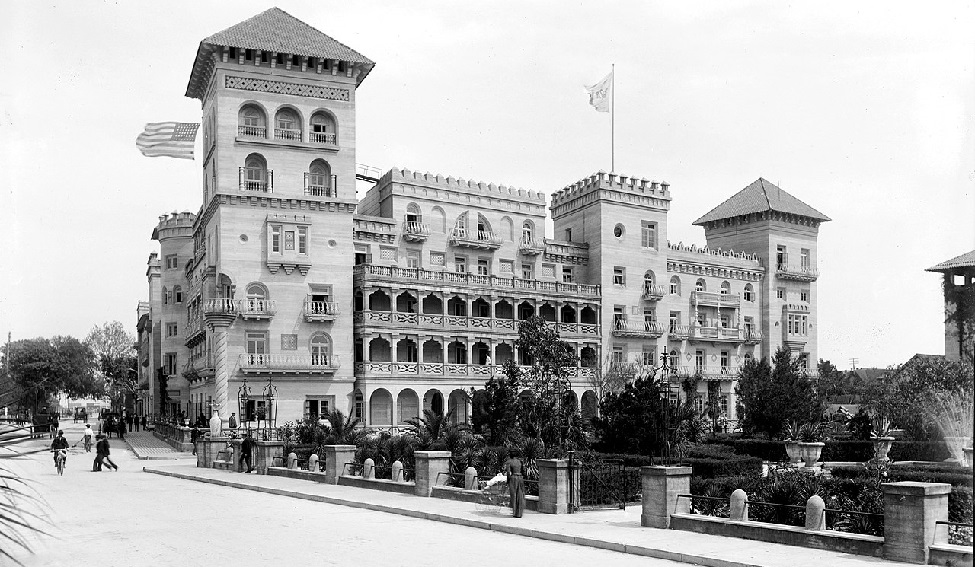
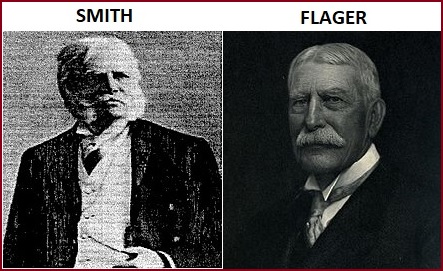
Flagler had some unexpected competition from his associate, Franklin Smith. In arranging the land acquisition, Flagler gave Smith land and the Sunnyside Hotel, which was moved across the street to the site of the Casa Monica Hotel. Flagler encouraged Smith to fix up the Sunnyside, but Smith had much bigger plans he moved the Sunnyside Hotel and built a 250-room hotel on its site.
The beautiful new building was concrete, with less coquina than the Ponce de Leon or the Alcazar.
Deep river sand was used, which made the color of the building more dense and uniform than the Ponce de Leon or Alcazar. Advertising for the new hotel focused on its Spanish-Moorish structure, Artesian sulfur baths, French cuisine, and Table d'hote.
All of the suites in the Casa Monica were equipped with closets, gaslights, gas heat, and electric bells to call for service. Baths were located on each floor. With its cottages, the hotel could accommodate four hundred guests.
Smith had trouble completing the hotel; a plumbers' strike in January of 1888 sent all the plumbers back to New York (The Florida error! Bookmark not defined. Times Union, January 7, 1888), and a fire at the Nelson, Matter & Co. factory in Michigan delayed a shipment of furniture. The building opened on January 17, 1888, a week after the Ponce de Leon. The opening was not a success. Smith was plagued by low occupancy and was unable to compete with the Ponce de Leon.
The hotel officially opened on January 30, and by March 28 Smith was cutting back expenses by closing off two floors and laying off two or three dozen people. The hotel was sold in April to Henry Flagler for $250,000 On July 16 the name of the hotel was changed to the Hotel Cordova. In the coming years Flagler will keep the manager of the Hotel - E.N. Wilson. However, in the summer of 1889 with the assistance of O. D. Seavey the interior of the hotel is renovated especially the kitchen area.
Even though the Casa Monica would be sold to Flagler to become the Cordova it would still have interesting guests like Frank Woolworth, Mrs. Tom thumb and Archibald Clavering Gunter.
Valencia
The Valencia was a smaller family hotel with bell service. The house was located on south St. George Street near the St. Francis' barracks with a view of the ocean. It was run in the 1890 through the early 1900s by Mrs. Mary Fraser who had been managing hotels in St. Augustine since the early 1880s.
It had electric bells and gas and a great menu.
The water was aerated artesian well water. The hotel was built by McGuire and McDonald. The room rate was $2.50 to 3.00 per day or $15.00 to $20.00 per week.
It had private baths, steam heat and modern conveniences. It stated that special attention was paid to table. The hotel was located at 276 St. George Street on what is today the parking lot of the St. Francis Inn (which as one time was known as the Valencia annex.) Two of the more famous guests were Sinclair Lewis and William Dean Howells in 1916. In 1912 Miss E. Fraser was the manager.
The hotel held 75 and still charged $2.50 to $3.00 per day.
The name of this hotel was later changed to the Alencia Hotel.
The Barcelona
In 1874 Henry Ball constructed a residence that was located on 20 Valencia and Sevilla Streets. In 1885 Henry Flagler purchased and moved the house.
The Barcelona was located near the Union Depot, Memorial Presbyterian (two blocks from the station) and Grace Methodist Episcopal, North Churches on the corner of Carrera and Seville Streets.
It was the Ball mansion moved, enlarged and remodeled. Miss R. E. Hasseltine was the manager in the 1890s.
It had baths, gas, hot and cold water on each floor. In 1904 Miss A. N. Blair was the proprietor.
In 1904 R. E. Hasseltine was still in charge. The hotel accommodated 70 with rates from $2.00 to $2.50 per day or $10.00 to $18.00 per week. It was open from November to May. Located two blocks from the station it had all modern improvements with a good family table.
In 1909 A. N. Blair was the proprietor. The rates were from $2.50 to $4.00 per day. It advertised a good family table and home comforts and was open November to May. In 1916 Miss A. N. Blair was the manager. The capacity was 70.
The hotel was razed in 1962. It's now the site of the Ancient City Baptist Church Parking lot.
The Carleton
This hotel was located on St. George Street and Treasury not far from the Plaza. Mr. Rolleston was the owner and manager. This family hotel was located on the corner of St. George and Treasury Streets, It advertised itself as the best location, best table and best hotel. The rate was $2.00 per day with special rates to permanent guests.
The La Borde
The La Borde was located near the bay on 38 Marine Street bordering on Bridge.
- In 1885 this was considered a private boarding house when Miss S. P. C. La Borde was the proprietor. Large rooms with water views. Mr. and Mrs. Abbott were the owners in the 1890s. In 1904 S. W. Cole was the proprietor.
- In 1895 the Tatler reported: The La Borde has a charming location near the bay with an open space intervening. The rooms are large, with delightful water views, and prettily furnished. An excellent table is maintained. The entire house, with its different departments, homelike and comfortable. Mr. and Mrs. Abbott , the proprietors, are indefatigable in securing the comfort of their guests. Excellent sanitary arrangements.
- In 1909 Mrs. Jack Cowan was the proprietor. It accommodated forty people. The rates were $1.50 and $2.00 per day.
- In 1910 it was sold to Margaret Morgan and renamed The Kenwood. By 1912 it was the LaBorde again with Mrs. E. Cowan as manager
La Posada Hotel
La Posada Hotel was located on 52 Carrera Street. In the early 1900s Mrs. H. A. Rumley was proprietor. It was open all year with rates from $1.50 to $2.00 per day or $5.00 to $9.00 per week. It was a family hotel two blocks from Ponce de Leon and convenient to all points of interest. In 1904 the proprietor was T. L. Clark.(This hotel is still existent today as a much renovated private residence.)
In 1909 Mrs. R. C. Gould was the proprietor and still kept it open year round. The rates were $1.00 to $1.50 per day with special rates to families or parties. It was billed as a pleasant family hotel in a most desirable part of the city two blocks from the station and convenient to all points of interest. It was surrounded by broad verandas and spacious lawns, making it a most comfortable and home-like place.
In 1912 Mrs. John Center was the manager. The hotel held 50 persons.
Abbey Hotel
The house was located on 21 St. George street and Fort Marion Lane near the city gates and Fort Marion. It was run by W. B. Pine and W. A. Wood. Originally it was owned by Mrs. A. B. Abbe from Martha's Vineyard, Mass. The northern hotel that matched the Abbey was the Pierce Villa in Cottage City Mass. The rates were $2.00 and $2.50 per day or $10.00 to $14.00 per week
In 1892 the Tatler stated: "This comfortable family hotel is pleasantly located on St. George Street near the city gates and with many of its rooms overlooking the bay. Its exterior is attractive and once one enters its home like comfortable appearance soon decided one to remain. The manager, Mrs. A. B. Abbe, who manages Pierce Villa, at Martha's vineyard, has a host of patrons who escape the winter's cold and summer's heat, by becoming her guests at either one of her hotels."
In 1895 the Tatler reported: "This comfortable family hotel has been leased by Mr. W. B. Pine, who,with W. A. Wood, have made an enviable reputation at the Goodwood, Archer, Fla. The house has been put in perfect order and new furniture added. Mr. Pine has determined to maintain a first-class table with good service. The house is located on St. George street, a short distance from the city gates and grounds of Fort Marion, one of the best locations in the city. A broad plaza across the front of the house affords a delightful lounging place."
In the early 1900s it would be run as a select family hotel under the management of Summerfield Hotel in Ocean Grove, N. J. with F. S. Haynes as the proprietor. In 1904 Mrs. N. F. Garcia was the proprietor.
In 1909 Mrs. J. C. Cook was the proprietor. The rates were $1.50 and $2.00 per day.
It later became the Northern Hotel. It became the Arlington by (1910). In 1916 the hotel was run by Mrs. Emma McKeen. The hotel held 60. The rates were now $2.50 and up per day.
The hotel burned in the 1920s.
Columbia Hotel (House)
The Columbia hotel was $2.00 per day or $10.00 per week.
It advertised gas, sanitary sewerage and electric bells. Located at 60 St. George Street, it was owned by A. S. Washburne. Washburne was from the Saratoga and the Saratoga at Palatka. It had fifty rooms. The northern hotel was the
Washburne Hotel in Saratoga Springs, N. Y.
The Tatler reported in 1891: "Mr. A. S. Washburne, who has made such a success of "The Washburne," at Saratoga, and "The Saratoga," at Palatka, has taken this pleasantly located house for a period of three years, and has made it first-class in every respect,
putting gas all through the house with electric bells in all the sleeping rooms. These have been newly papered and painted throughout, and with the new furniture, is as attractive as possible. The office has been refurnished, the parlor enlarged and refitted, making it a delightful room.
The house has baths and the best possible sanitary arrangements. Nor has the dining room and kitchen been neglected. Everything possible to insure cleanliness and good cooking has been secured in the kitchen, and the dinning room is well supplied with dainty linen, pretty china and new silver. Mr. Washburne brings his Saratoga staff with him and gives promise of making this as good a $2-a-day house as there is in the country, and will no doubt have his fifty rooms filled all through the season.
Ocean View
On 132 Bay Street
it had gas in the office, parlors, dining room and halls. In charge of the house was Mr.W.S.M. (William Slade Macy) Pinkham (who would later be the St. Johns County School Board Superintendent.) The dinning-room sat 100. This was the only hotel directly on the bay in the 1890s by 1910 it was next door to the Hotel Marion. In 1898 the manager was Frank C. Hayden. In the 1900s the Ocean View came under new management. A. Madole and Company took over matching it with the Lebanon Cottage in Chautauqua, N. Y. The Ocean View featured in its advertising fine fishing and northern cooking.
In 1909 it was listed as accommodating seventy-five people. Rates were $1.50 up per day with special rates by the week and to parties. It was listed as delightfully located, fronting bay and ocean. It was located 60 feet from the sea wall. The hotel was surrounded by broad and sunny verandas with only a few minute's walk from all points of interest.
It had sanitary plumbing, free hot and cold baths with Northern help and cooking.
In 1911, the hotel was sold to Henry E. Hernandez. In 1912 H. E. Hernandez was still the proprietor.
In the 1960s it was torn down and replaced by the Marion Hotel. The site is now the location of the Bayfront Inn.
(See Hernandez)
Monson House
The second Monson House was located on 26 Bay Street next to Bravo Lane.
(The first one burned in the 1895 fire.) A. V. Monson, Proprietor. Open all year the rates were $1.50 to $2.00 per day with $7.00 to 12.00 per week. Forty feet from the seawall. Two minute walk to the fort. Guests have free use of row boats with fishing grounds in a distance of fifty yards to two miles.
It had hot and cold baths.
It was enlarged in 1901.
In 1909 with A. V. Monson as the proprietor the hotel was open year round. The rates were $1.50 to $2.50 per day with special rates by the week. It was located overlooking the bay and ocean and forty feet from the sea wall. It was two minutes from old Spanish fort and Ponce de Leon Hotel. Guests had free use of rowboats. Fishing grounds within a distance of fifty yards to two miles.
Hot and cold baths were free with perfect sanitary arrangements. It featured northern cooking and street cars passed the door. In 1912 A. V. Monson was still the proprietor with the capacity of 75.
It was then destroyed in the April 2, 1914 fire and replaced by a masonry structure in 1915. In 1960 it was destroyed and replaced by the Monson Motor Lodge.
Hotel Chautauqua
In the beginning this hotel located at 11 King Street was called the Algonquin Hotel. In 1899 it was operated by C. F. Cox. This hotel was located opposite the public market and plaza overlooking the bay and ocean. It featured "Northern" cooking with rates from $2.00 and up. Mrs. M. Crittenden was the proprietor.
Lynns Hotel
Lynns Hotel was located on 7 King Street. In 1904 the owner was Truman J. Lynn.
Lynn's Arcade Hotel
It was open year round and accommodated 75 guests. Its food was on either the American or European plan. The European plan was .50 to $1.00 per day. A café was located on the lower floor.
The hotel was located on St. George Street opposite the Florida House.
Plaza Hotel
Plaza Hotel was located at 17 King Street.
Hotel Aragon
In 1910 extensive improvements were made on the exterior of the Hotel Aragon on St. George street, New Porches are being added and many alterations which will greatly improve the hotel and make it better fitted than ever for the business.
Granada Hotel
(1899) Is located directly opposite the main entrance to the Ponce de Leon and overlooking the handsome grounds of the Alcazar. It is artistically furnished, has a handsome foyer and parlor on the main floor.
Many of the guests' chambers are arranged in suites, including a parlor bedroom and bath, are light and with entrancing views. The proprietor, Mr. Harry w. Wachenhusen, is well known to travelers and tourists. This is his second year at the Granada and many of last year's guests are again enjoying his hospitality this season, while others have secured rooms for the near future.
In 1904 H. W. Wachenhusen was the manager of the Granada Hotel. It was open from December to May 15th and accommodated 150 guests. Rates were $2.50 and upwards per day. Special weekly and monthly rates were available. It was located at the corner of King and Granada Streets facing the "Alameda." Rooms were light, airy, and cheerful daintily furnished in white and gold arranged single or en suite with or without private bath.
The Arcade, the lower front section included shops. In 1912 the manager was S. Thomas Penna. In 1913, new owner Abraham S. Mussalem renamed the building the Alhambra Hotel.
A fire destroyed the 73-room hotel in 1954.
Spear Mansion
The Spear Mansion was built by Capt. Thomas F. House who also built the Sunnyside Hotel. Mrs. A. R. Spencer was the proprietor and in the early 1900s J. O. Lumsden was the manager. The mansion was open all year with rates from $2.00 to $3.00 per day or $10.00 and up per week. It was one block from the Ponce de Leon and post office opposite the Casino a ten minute walk to the golf links. Home cooking was a specialty. It was directly across the street from St. Joseph Academy and Convent at 240 St. George.
1909 - Mrs. A. R. Spencer was the proprietor. The hotel was open year round with rates from $2.00 and up per day with special rates by the week and to parties. The hotel was centrally located on St.George street one block from the Ponce de Leon. It had large grounds, beautiful with shrubbery and flowers.
Rooms en suite, with or without private bath; wide verandas, electric bells, sanitary plumbing.
Home cooking was a specialty.
Filtered water for drinking. Sulphur well in yard. 1912 Mrs. A. R. Spencer was still the proprietor. The hotel held 75 people charging $250 to $3.00 per day with $15.00 to $20.00 per week.
In 1938 the Sisters of St. Joseph purchased the property and demolished the mansion.
Columbia Hotel
The Columbia Hotel was located at the corner of Cuna and St. George. In the 1890s the Columbia Hotel had rates of $2.00 per day. The owner was A. S. Washburne. Washburne also ran the Washburne Hotel in Saratoga Springs New York.
The 1891 Tatler reported: "Mr. A. S. Washburne, who has made such a success of "The Washington" at Saratoga, and "The Saratoga," at Palatka has taken this pleasantly located house for a period of three years
and has made it first-class in every respect, putting gas all through the house with electric bells in all the sleeping rooms. These have been newly papered and painted throughout, and with the new furniture, is as attractive as possible. The office has been refurnished, the parlor enlarged and refitted, making it a delightful room.
The house has baths and the best possible sanitary arrangements. Nor has the dining room and kitchen been neglected. Everything possible to insure cleanliness and good cooking has been secured in the kitchen, and the dining room is well supplied with dainty linen, pretty china and new silver. Mr. Washburne brings his Saratoga staff with him and gives promise of making this as good a $2-a-day house as there is in the country, and will no doubt have his fifty rooms filled all through the season.
Keystone Hotel
Keystone Hotel - This hotel was started in either 1905-06 in the former home of C. G. Gleason, the Superintendent of the Canal Company. One block west from front entrance of Hotel Ponce de Leon. It has large airy rooms and excellent cuisine. Mrs. L. J. Boyes is the owner. She had formerly worked in millinery.
The hotel was located at 112 King street. In 1909 Mrs. L. J. Boyes was still the proprietor. It was one block from the front entrance to the Hotels Ponce de Leon and the Alcazar and convenient to the post office and railway. In 1909 it still featured large, airy, well-furnished rooms, all outside.
Hot and cold baths and heat in bedrooms free of extra charge. Soft water was supplied in bedrooms. Perfect sanitation. No consumptives taken. Northern home cooking a specialty with fresh vegetables from own farm. Jellies, preserves, etc., home made. Rates, $2.00 per day. Special rates by the week or month.
In 1912 L. J. Boyes was the manager. The hotel held 60 people.
Hotel Marion
The Hotel Marion was a new hotel in 1905-06. It was located on the Bay front at Bravo and Marine.
Henry Muller was the proprietor. There was an earlier version of the Marion Hotel on Charlotte street next to the St. Augustine Hotel in 1884.
In 1909 H. Muller was still the proprietor. The hotel was open year round and accommodated sixty people. It featured both European and American plans. The rates were $2.50 and up per day; special by the week. It was situated fronting the bay and ocean. All modern improvements with Cuisine Francoise.
It had steam heat and electric lights throughout. In 1912 it was listed simply as The Marion with H. Muller still the proprietor. By 1912 it could accommodate 75 people.
Hotel Colonial
Hotel Colonial was located near the City Gates
Lyon Building
The Lynn Building was built at the same time as the Casa Monica Hotel and completes the block. Very low rent at $3.00 per week O. B. Smith was the manager.
In 1909 with O. B. Smith as the manager, the building held 150. It was open from November to May with furnished rooms only. Prices ranged from $3.00 to $20.00 per week. It was a central location opposite the post office.
The building was listed as strictly fireproof and sanitary arrangements perfect. The rooms were large and first class.
There were gas heaters and "hot plates" when desired with restaurants and stores close at hand. In 1912 O. B. Smith was still the manager.
Bennett House
The Bennett House was located at 10 Bay Street. S. F. Bennett was the manager. In 1909 it was listed as a new house. The rates were $1.50 to $2.00 per day. It accommodated sixty.
The hotel was demolished in 1961 by the National Park Service in its reroute of Fort Marion Circle.
Central Hotel
It was located at 84 Charlotte Street (near Treasury.) This hotel was owned by Henry E. Hernandez until 1910. It accommodated forty people
and featured hot and cold baths. The rates in 1909 were $1.50 to $2.00 per day and $8.00 to $12.00 per week. In 1912 C. W. Johnson was the manager with a capacity of 50 people
It was burned in the 1914 fire.
Abbott Mansion
1885 Opposite San Marco Hotel Mrs. Leo R. Vogel, Proprietor
Rolleston House
1885 St. George Street
Hotel Clairmont
Next to the Opera House on St. George Street (1910). In 1904 this was the Aroyle Hotel. 1912 manager was Mrs. A. Boutelle. The hotel held 75. Rates per day $2.00, per week special.
Palmetto Hotel
Corner of Tolomato and Spanish (1899) (1904) (1910) (1912) held 50. The daily rates were $1.50 to $2.00 per week, $7.00 to $10.00
San Marco - 1912 version held 100 people rates per day, 41.00, rooms only.
Competition Lost
Two sources of competition were lost before the doors of the Ponce de Leon and the Alcazar opened.
Hotel St. Augustine was built in 1869 by a partnership of Captain E. E. Vaill, F. H. Palmer, and Dr.Andrew Anderson. T. P House was the architect and builder.
The hotel had gaslights, was 200 feet long, three stories high, and contained 80 rooms (140 rooms were added in 1875).
In 1884 in Chapin's Hand Book of St. Augustine by Elias Nason included the following description of the hotel: southerly front of 200 feet upon the Plaza and 160 feet on the Bay with wide plazas and hanging balconies from each story overlooking the City, Bay, and Atlantic Ocean. The Dining-Room, Parlors, Billiard-Room, and many of the Sleeping Rooms are elegantly frescoed.
It is lighted with gas and provided with water conveniences, electric bells. The dining hall is capable of seating over 300 guests, and the table will be furnished with all the luxuries of the Northern Market By 1885 the St. Augustine Hotel had 300 rooms that rented for $4 per day.
Captain Vaill (a sea captain from Milton, Conn.) was the sole owner of the Hotel St. Augustine in 1887 when the fire that also destroyed the Cathedral destroyed it. Unfortunately, Captain Vaill had canceled the insurance on the hotel because he thought the rates were too high.
Sunnyside Hotel - Thomas F. House built the Sunnyside Hotel in 1876 on property that had been part of Dr. Anderson's estate. Originally on the site of the Ponce de Leon, Flagler moved the hotel across the street (to the present site of the Casa Monica) and
gave it to Franklin Smith, encouraging him to run the Sunnyside rather than build the Casa Monica. The hotel had a capacity of 40 guests and rented for $2.50 per day. It was renamed "Villula" by 1884 (Sanborn map) and "Villa del Sol" by Franklin Smith when it was annexed on December 15, 1886. It's location was directly on the site of the future Casa Monica.
It had a bath house which had an artesian well with enough force to pump water to the third floor of the hotel.