SH Archive 1896: Brighton and Rottingdean Seashore Electric Railway

SH.org OP Username
KorbenDallas
SH.org OP Date
2019-12-15 00:44:56
SH.org Reaction Score
16
SH.org Reply Count
33

KD Archive

Not actually KorbenDallas
Active Member
Joined
Sep 22, 2020
Messages
4,691
Reaction score
1,500
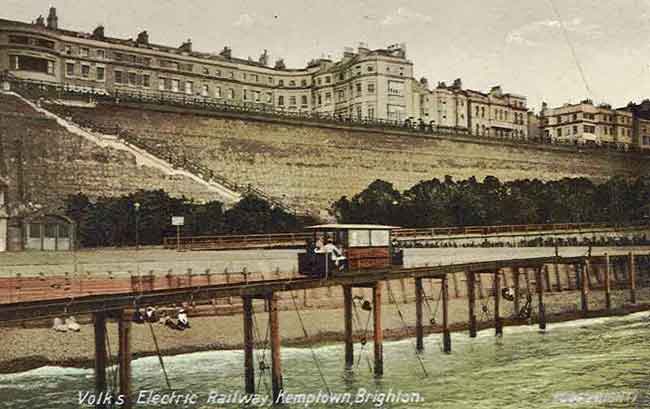
I doubt too many people know about this electric train. The Brighton and Rottingdean Seashore Electric Railway was a unique coastline railway in Brighton, England that ran through the shallow coastal waters of the English Channel between 1896 and 1901.
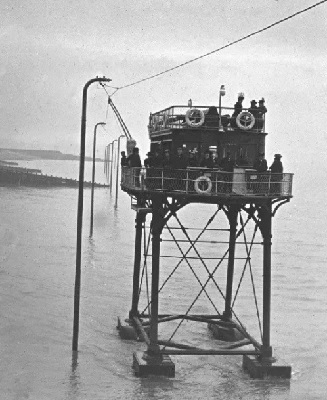
train-water.jpg

The aim of the railway was to extend the reach of the existing Volk's Electric Railway eastward. Since the eastern section of coast ran out of seafront, and quickly ended up with cliffs that were directly against the sea, Volk was confronted with the intimidating and costly prospect of an expensive project to build the railway extension onto the cliff-face.
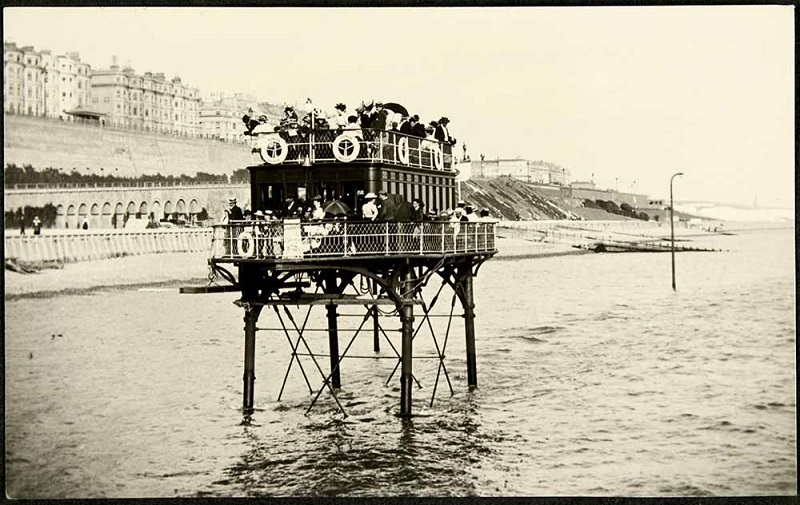
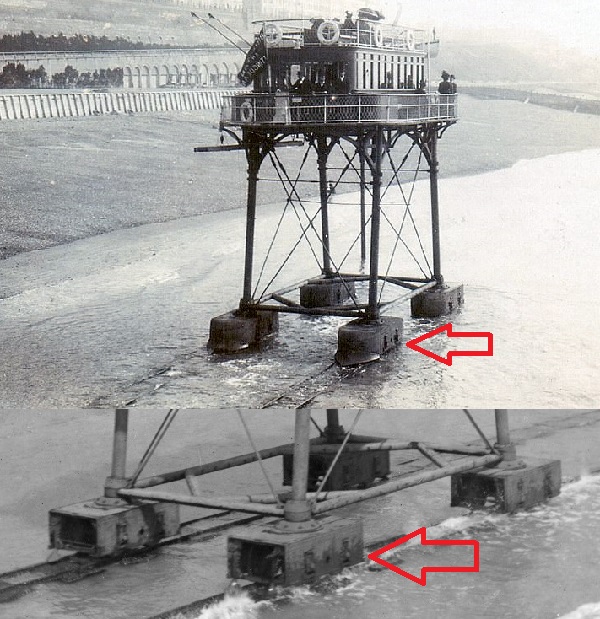
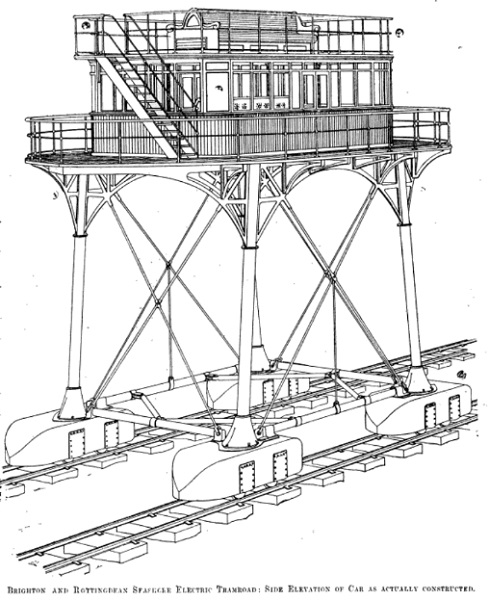
  • Volk's solution was instead to build the railway out at sea, with the electrically-powered car built on four cross-braced stilted legs that kept the passenger section well above sea-level, and to also build a special alighting-platform at Rottingdean.
Rottingdean-Extension-car-on-stilts-Volks-Electric-Railway-Brighton-1910.jpg
The railway itself consisted of two parallel 2 ft 8 1⁄2 in (825 mm) gauge tracks, billed as 18 ft (5.5 m) gauge, the measurement between the outermost rails. The tracks were laid on concrete sleepers mortised into the bedrock. The single car used on the railway was a 45 by 22 ft (13.7 by 6.7 m) pier-like building which stood on four 23 ft (7.0 m)-long legs. The car weighed 45 long tons. Propulsion was by electric motor. It was officially named Pioneer, but many called it Daddy Long-Legs. Due to regulations then in place, a qualified sea captain was on board at all times, and the car was provided with lifeboats and other safety measures.
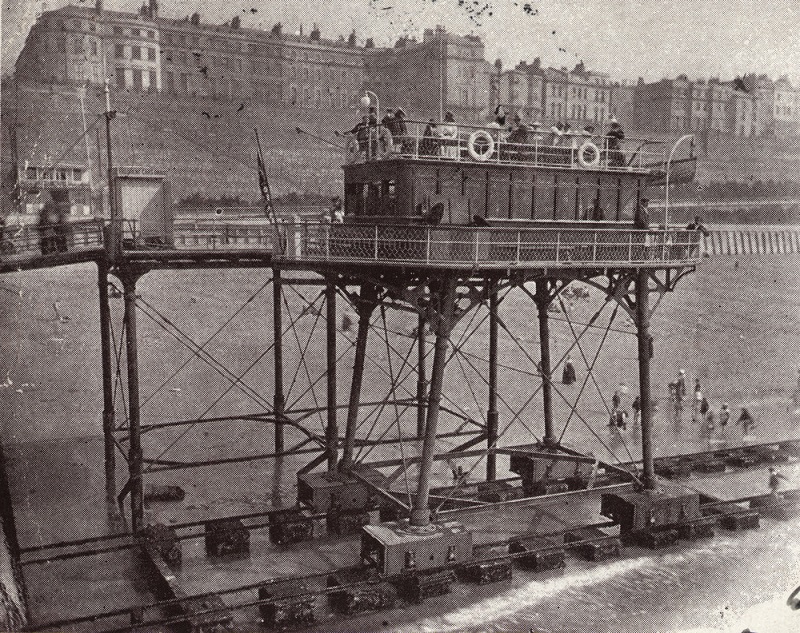
Rottingdean-Extension-car-on-stilts-Volks-Electric-Railway-Brighton-3.jpg
Construction took two years from 1894 to 1896. The railway officially opened 28 November 1896, but was nearly destroyed by a storm the night of 4 December. Volk immediately set to rebuilding the railway including the Pioneer, which had been knocked on its side, and it reopened in July 1897.
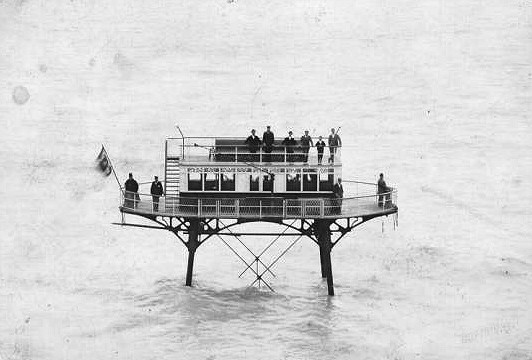
Rottingdean-Extension-car-on-stilts-Volks-Electric-Railway-Brighton-2.jpg
The railway was popular, but faced difficulties. The car was slowed considerably at high tide, but Volk could never afford to improve the motors. In 1900, groynes built near the railway were found to have led to underwater scouring under the sleepers and the railway was closed for two months while this was repaired. Immediately afterward, the council decided to build a beach protection barrier, which unfortunately required Volk to divert his line around the barrier. Without funds to do so, Volk closed the railway.
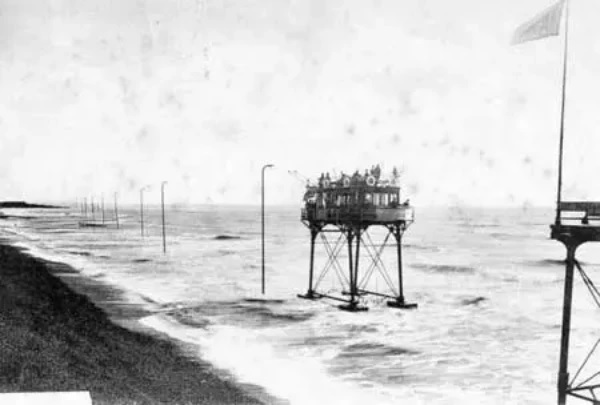
Rottingdean-Extension-car-on-stilts-Volks-Electric-Railway-Brighton-4.jpg
As you can see above, the train traveled along the coast line, and the amount of water depended on high/low tides. Was this solution really superior to extending the landline over the cliffs?

Below we have an 1893 plan of the proposed ‘Brighton and Rottingdean car on stilts’.
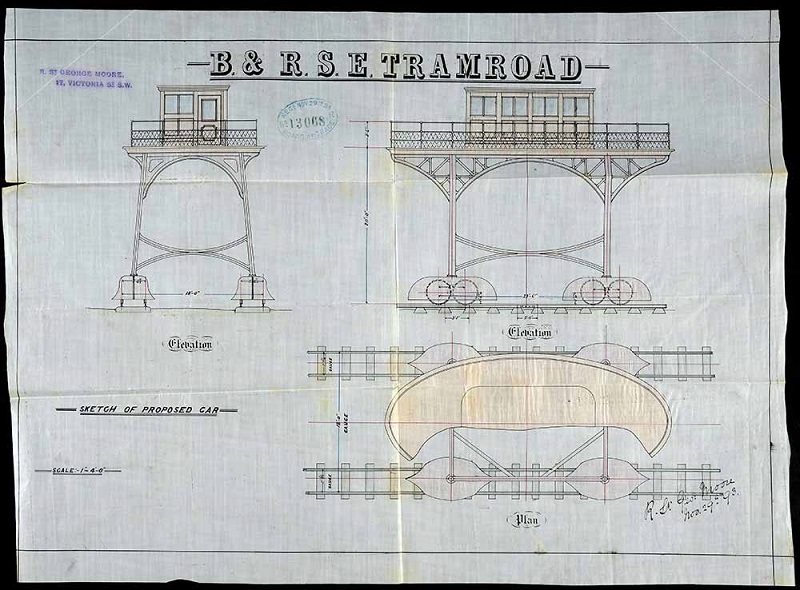
  • Where is the engine?
MT6-1109-2-Plan-of-proposed-Rottingdean-Extension-car-on-stilts-Volks-Electric-Railway-Brighto...jpg

Apparently the water train was advertised, and the fare was 6d. each way. I am not sure what "d's" they were talking about. If you know, please share.
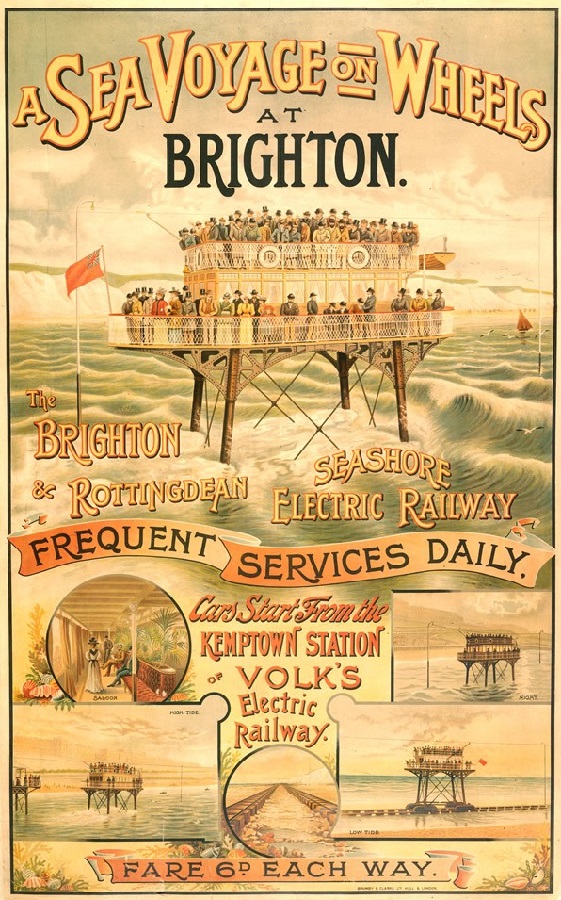
the-sea-voyage-on-wheels-at-brighton.jpg
In 1901 the right-of-way was broken up for construction of the barrier. One further attempt was made to raise money for a conventional over-water viaduct along roughly the same route. The track, car and other structures were sold for scrap, but some of the concrete sleepers can still be viewed at low tide. Eventually Volk's Electric Railway was extended onshore, covering a portion of the same distance; it remains in operation.
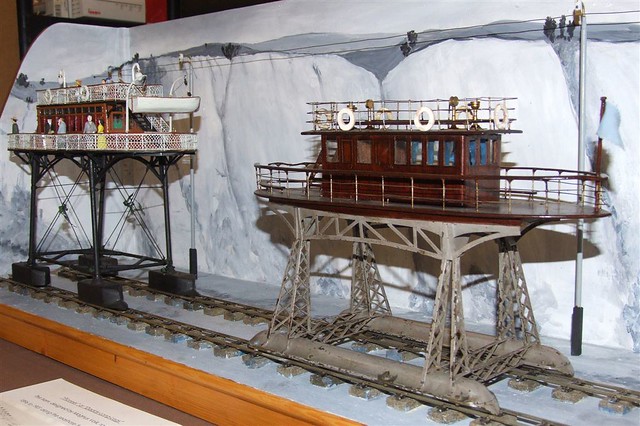
museum.jpg

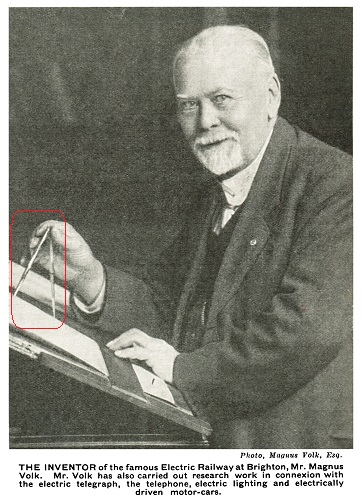
Magnus Volk
Magnus_Volk_at_his_drawing-board_(RWW_1935).jpg
1851–1937
Magnus Volk was a Brighton-born inventor and electrical engineer who achieved a number of early successes and world firsts in the field of electrical engineering, including the world's first electric railway (still running!), early electrical public lighting and telephony, and early examples of electric cars.
Volk was born in a house on Western Road in 1851. During his early life he had some success producing parlour telegraph sets which were little more than toys for rich men to impress their friends with. He first became properly well-known in 1879 when he installed the first telephone line in Brighton from his house in Preston Road to another nearby in Springfield Road.
  • The following year he cemented his fame by being the first person in the town to light his home by electricity. This success led to him being awarded a contract for installing electric lighting throughout the Brighton Pavilion gardens and within the Brighton Museum and Corn Exchange complex.
  • In 1883 he launched his most famous and long lasting project. The Volk's Electric Railway which still runs along the seafront today, making it the oldest electric railway in the world that is still running. A model of one of the V.E.R Carriages is on display in the museum.
  • In 1896 he launched his Brighton to Rottingdean Seashore Electric Railway which has become better known as the Daddy Long-Legs. It ran on a three mile track between Banjo (Paston Place) Groyne and Rottingdean powered by overhead cables like a tram. Despite its popularity, the novel railway was forced to halt operations in 1901 when extra sea defences built by Brighton Town Council intersected the trackway. A model of the Pioneer car is also on display in the museum in Arch One.
  • Volk continued to be involved in various projects in and around Brighton until his death in 1937.
Videos

?


Sources and Links:
kd_separator.jpg
KD: Some things just make you wonder. This train is one of those for me, for I find the official explanation hard to believe. Is it plausible enough to meet the plausibility threshold? I don't know.
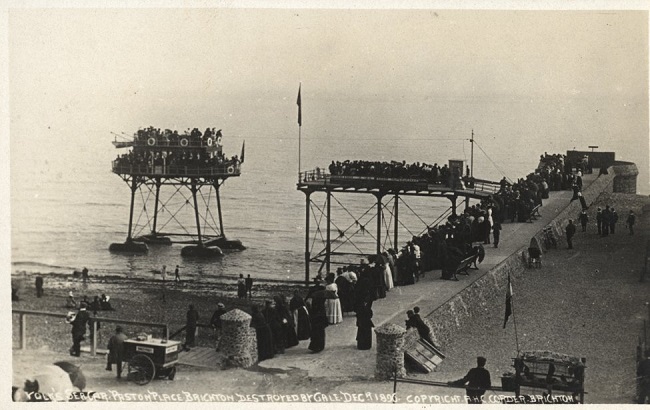
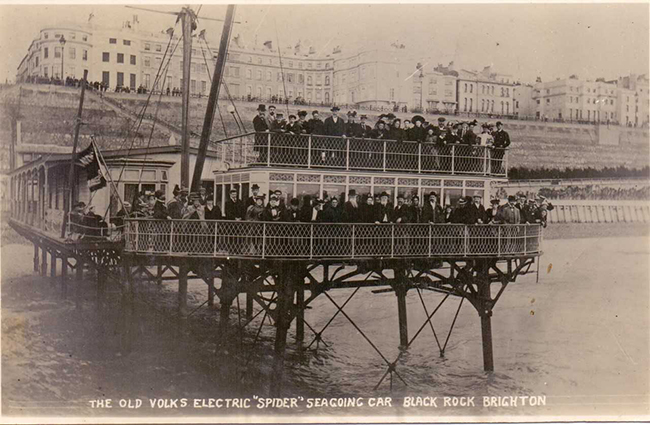
Daddy-Longlegs-and-Volks-railway-1896.jpg
seashore-railway.jpg

What do you think?
Note: This OP was recovered from the Sh.org archive.
Note: Archived Sh.org replies to this OP are included in this thread.
 
Note: This post was recovered from the Sh.org archive.
Username: EUAFU
Date: 2019-12-15 02:42:36
Reaction Score: 1
I would like to be a passenger in this completely crazy vehicle. That said, I redo the question "Where are the engines?" I really wasn't expecting this. Crazier than that, only an 18th century electric submarine railway is discovered.
 
Note: This post was recovered from the Sh.org archive.
Username: KorbenDallas
Date: 2019-12-15 06:46:40
Reaction Score: 7
The only place them electric engines could be located at, I would imagine. They had to develop some under water running electric engines for this purpose alone.

tram-water-electric.jpg
kd_separator.jpg
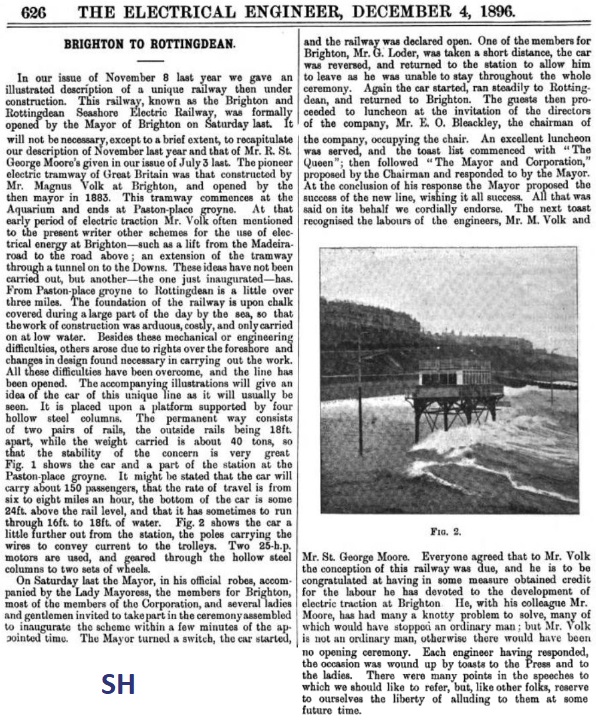
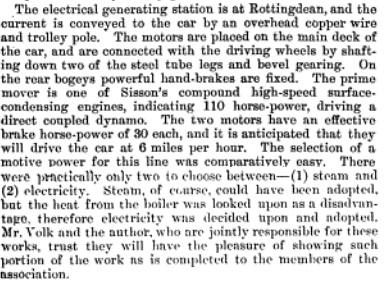
There is nothing about engines in the below 1896 pub, but it has some interesting details.

11.jpg
kd_separator.jpg

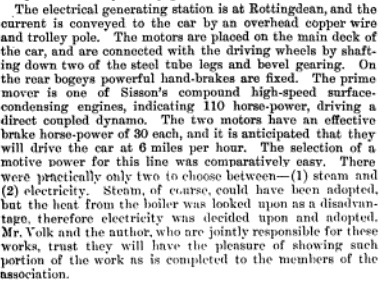
The Engines
I guess I was wrong above...
22.jpg
Though I'm still not sure where on the main deck these engines were located.

 
Note: This post was recovered from the Sh.org archive.
Username: whitewave
Date: 2019-12-15 15:06:40
Reaction Score: 1
Kind of reminds me of that tank that supposedly ran over water mentioned in another thread. Could this one have been based on that earlier tech?
 
Note: This post was recovered from the Sh.org archive.
Username: jd755
Date: 2019-12-15 15:13:20
Reaction Score: 5
It's what was called an Esplanade basically a fancy word for a seafrot terrace of buldings, hotels, homes, guest houses etc.

Here's another incarnation of the Volks railway.


From here; Volk's Electric Railway Association, Brighton
bottom of each leg was a bogie housing four 33″ wheels. One bogie on each side was driven by a shaft and worm gear arrangement from 2 General Electric 25hp electric motors. The other 2 legs carried the brake rodding to the other two bogies.
 
Note: This post was recovered from the Sh.org archive.
Username: EUAFU
Date: 2019-12-15 15:36:41
Reaction Score: 0
I can't see how these engines attach to the wheels, but I really could never be an engineer.
 
Note: This post was recovered from the Sh.org archive.
Username: TS135
Date: 2019-12-15 18:34:52
Reaction Score: 0
I tried to find any photographs of the engines but I could not. A close up of the wheel hubs is also non-existent.
 
Note: This post was recovered from the Sh.org archive.
Username: jd755
Date: 2019-12-15 18:42:36
Reaction Score: 0
There weren't any engines. The power came from the wire seen in the pictures which came from the shore.
bottom of each leg was a bogie housing four 33″ wheels. One bogie on each side was driven by a shaft and worm gear arrangement from 2 General Electric 25hp electric motors. The other 2 legs carried the brake rodding to the other two bogies.
 
Note: This post was recovered from the Sh.org archive.
Username: TS135
Date: 2019-12-15 18:45:28
Reaction Score: 1
From this post. They were on the deck, but where?

22.jpg
 
Note: This post was recovered from the Sh.org archive.
Username: Timeshifter
Date: 2019-12-15 18:54:46
Reaction Score: 2
Re the 6d @KorbenDallas ... 'old money' my parents remember this, it was shortly before my time, pre decimal.

The symbols 's' for shilling and 'd' for pence derive from the Latin solidus and denarius used in the Middle Ages. Old money

As for the contraption. I fail to believe there was not a simpler way of traversing the same journey, boat perhaps? This looks like another ridiculous retro fit to me.
 
Note: This post was recovered from the Sh.org archive.
Username: jd755
Date: 2019-12-15 18:57:08
Reaction Score: 2
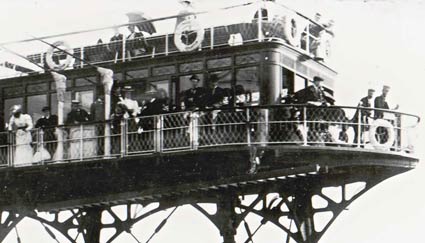
Inside the car above the water would be the best place to lessen the chances of seawter getting into them. Keeps the internal wiring lengths short to lessening their exposure to salty water. All electric boats have their motors located internallyy for the same reasons. Until we can find an image of the interior this to me is the descroption that makes most sense.

Here's some background on Volks from here; Magnus Volk - Graces Guide
Magnus Volk (1851–1937) was a British electrical engineer who built Volk's Electric Railway and the Brighton and Rottingdean Seashore Electric Railway.

1851 October 19th. Born at Brighton the son of a German clockmaker and lived at 38 Dyke Road in Brighton.

1887 he constructed a prototype electric car, which led to an order from H.M. Sultan Abdul Hamid of Turkey. The car was built by Pack and Sons, local carriage builders. The motors were supplied by Moritz Immisch of London

But Volk was in severe financial difficulties. He agreed to install and manage the charging stations for an electric launch service Immisch was planning on the River Thames.

1887-1895 Built a few electric carriages with motors by Acme and Immisch

1888 He filed for bankruptcy in January

1891 discharged from bankruptcy in August

1891 October. Announcement. 'Mr. Magnus Volk has entered upon possession of the Electric Railway at Brighton.'[1]

1892 He was able to devote more time to the railway and another new venture - the Brighton and Rottingdean Seashore Electric Tramroad.

Magnus Volk had a son named Conrad who wrote a biography of his father.

1937 May 20th. Died in Brighton. Volk is buried at St Wulfran's churchyard in Ovingdean near Brighton

Here is gracesguide description of the pioneer aka dady longlegs

Brighton and Rottingdean Seashore Electric Tramroad - Graces Guide
1894 Work started on a 3-mile extension to Rottingdean; the necessary viaduct was seen to be too expensive so the line was built partly through the sea (up to 100 yards from the shore). The Gloucester Railway Carriage and Wagon Co was contracted to build a vehicle, called "Pioneer", consisting of a gantry car built on a framework of 4 stilts 23 feet tall, which would run on a pair of tracks on the seabed; electric motors supplied with electricity delivered via overhead electric cable delivered power to the wheels down 2 of the legs.

After much discussion the vehicle was designated as a sea-going vessel which meant it had to be staffed by a sea captain in addition to the driver, as well as carry a lifeboat and lifebelts.
Follow the twin pole power pickups (on the left hand side in this photo) down to the deck to see the motors most likely location. Under the deck but inside the hull.
daddy-long-legs-06.jpg
 
Note: This post was recovered from the Sh.org archive.
Username: wild heretic
Date: 2019-12-17 15:12:22
Reaction Score: 2
Was thinking just the same. Why?

Wouldn't it be easier to put tram lines on the promenade above and people can walk down to each beach segment via the steps?
 
Note: This post was recovered from the Sh.org archive.
Username: jd755
Date: 2019-12-17 15:58:24
Reaction Score: 1
The answer is in one of the linked pages. Cannot remember which sorry but basically the bit of the Volks railway that predated the op portion was just above sea level.
Check the topography of the day in these old postacrds. Old Postcards of Rottingdean
And this one Volks Electric Railway
 
Note: This post was recovered from the Sh.org archive.
Username: Moriarty
Date: 2019-12-17 23:27:49
Reaction Score: 2
Pennies were d's back in the day. So that would have been sixpence in old English pre decimal currency

Also I live very near Brighton and had never heard of this. I am there next week and will see if there any trace of this remaining
 
Note: This post was recovered from the Sh.org archive.
Username: Verity
Date: 2019-12-28 01:36:37
Reaction Score: 1
I don't pretend to know why this specific idea but it seems back then they were just coming off gas and steam for everything and going hell-for-leather on electricity, seeing what they could come up with. Practicality didn't appear to sit at the top of their list of priorities, it was novelty ($$) and trying to push the machine/invention bar higher.
I got hold of some of my grandmothers old private school things once and there was a pamphlet, dated around 1915 suggesting ways young ladies could make the best use of their newfound leisure time, which suggested to me that prior to this general period no such thing existed.
As ways to power technology advanced, its uses went from the sublime to the ridiculous.

Sublime (washing machine);

1915a.jpg1915 1926.jpg1926 1935.jpg1935 1940s.jpg1940


Ridiculous but quite funny;

madeinholland8.jpg Wooden bathing suits.

madeinholland15.jpg Piano for the bed-ridden

madeinholland25.jpg Snowstorm masks


10-insane-inventions-that-were-actually-used-in-the-past-1.jpg Two-person baby-holder
 
Note: This post was recovered from the Sh.org archive.
Username: Pathfinder
Date: 2020-05-21 10:18:28
Reaction Score: 0
Somethime I Think this is all fake...someone put These Impossible Things upon u s ...what about Storms and the very soft underground.
 
Tips
Tips
Please respect our Posting Rules.
Back
Top