1901: Pan Am Buffalo and why these Pan Ams were as insane as they look

SH.org OP Username
anotherlayer
SH.org OP Date
2018-07-07 04:52:15
SH.org Reaction Score
124
SH.org Reply Count
39
Note: This post was recovered from the Sh.org archive.
Username: KorbenDallas
Date: 2018-07-08 20:53:40
Reaction Score: 7
What we are lacking is any proof of construction. We can speculate saying that this picture looks more like construction vs. demolition. In all of the possible "construction" pictures we have, everything looks very old.
  • no site preparation photos
  • no pictures of the site at 1/4, 1/2, 3/4 stage of completion
  • no construction tools visible (unless you count those wheelbarrows)
  • no transportation present
There allegedly was only one building built to last. It was the New York State building. The building that houses the Buffalo History Museum was constructed in 1901 as the New York State pavilion for that year's Pan American Exposition, and is the sole surviving permanent structure from the exposition.

Where is any evidence of construction? What equipment was used to bring those granite looking pillars to the site?

What cranes were used to elevate those statues? Where are the scaffolding images?


Then we have this Temple of Music building with a pretty large open space inside. Allegedly constructed of wood.

The Temple's auditorium was capable of seating 2,200 people, and contained one of the largest pipe organs ever built in the United States.


And these musical organs are designed, and built to a specific building they are going to be in. You can not just stick one into a building and expect it to work.

Here is an unrelated pipe organ story: Pipe organ at Village Presbyterian Church is finding its voice.
And this 1901 Buffalo Pan-Am pipe organ could be problematic to explain, for hardly any of us have an idea, what it takes to build a pipe organ: The 101 of organ building. 1901 expo had one of the biggest one ever built in the US.

* * * * *

Too many things do not add up. And every other expo has similar problems.

Every single Exposition, or Exhibition to ever take place before like 1920 was demolished.
 
Note: This post was recovered from the Sh.org archive.
Username: ISeenItFirst
Date: 2018-07-08 21:55:49
Reaction Score: 2
Haha. Right. Of course it had an organ. One of the largest in the states at the time to boot. I'm sure it had a laser light show and a space elevator too. Why not, it's only temporary. Haha, what a laugh.

I'm sure they hung all those pipes on flaky staff walls too. They really jumped the shark with that one. Lol.
 
Note: This post was recovered from the Sh.org archive.
Username: The Wack
Date: 2018-07-08 22:05:16
Reaction Score: 2
I know a bit about timber and trees, if the post next the Missouri sign is a solid post(think 4x4 but feet)


Whoa mama, that was a big tree... and sawmill and then transport and lift?
 
Note: This post was recovered from the Sh.org archive.
Username: ISeenItFirst
Date: 2018-07-08 22:22:11
Reaction Score: 1
No way that's a solid post. The way the joining members are constructed definitely lends itself to a piece by piece constructed post. Those cross member supporys would be nearly worthless if they didnt pass straight through the column. Not to say they weren't mortised in, but that takes time and craftsmen and money, not the work of day laborers. Much easier to build it in pieces.


On closer examination, the nuts in this pic look like square nuts which makes sense, but they have an integral flange, which doesn't jive with the methods of producing square nuts at the time. Not sure, I would love to see the construction drawing for any of these buildings.

Every single thing is specialty and custom and built in the blink of an eye. It paints a pretty picture but it just doesn't hold well against scrutiny. I'm really good with drawings, and have even worked with some from not long after this time period.

Take a look at the "removing the first tree" picture. There is one other tree in the pic and neither are very big. Nothing else visible out to damn near the horizon. And what the heck are they doing. They've got wooden rails and rollers in the pit they've dug around the tree. Looks like they are going to move it vertically and pull the whole root ball out of the ground on that wooden ramp. Why would they do this.

Maybe there is a simple reason, but I can't think of one.
 
Note: This post was recovered from the Sh.org archive.
Username: KorbenDallas
Date: 2018-07-08 22:41:49
Reaction Score: 3
Organ Acoustics
Planning a room with good acoustical properties is important, not only for the pipe organ but for all music (instrumental or choral) and the spoken word. To insure the desired results, it is often wise to retain the services of an acoustical engineer. Look for one who understands the requirements of successful musical acoustics as well as clear speech intelligibility. Seek out one who has demonstrated that understanding in church buildings you can visit.

It is important to plan for a room that has pleasant, responsive, resonant acoustical properties. An even reverberation time of 2 - 3 seconds with the building half occupied is a practical goal. While it is possible to build a successful instrument in conditions less favorable than this, it is not the most desirable situation. One general rule to achieve this is to allow a minimum of 250 cubic feet of volume for every person. A room should be equally responsive in all frequency ranges.

The acoustic response of the room is determined initially not only by its cubic volume, but also by its shape and its materials. A rectangular plan with high flat ceiling is best. Sidewalls which are too low not only reduce cubic volume but force undesirably low positioning of the organ pipes.

Hard reflective surfaces (floor, walls, and ceiling) will promote better sound reflection. Choose all finish material carefully. Sound absorbing material (pew cushions, carpet, etc.) should be avoided. Floor surfaces of hardwood, concrete, tile or marble are most desirable. Walls of stone or smooth brick are ideal. Generally, the more solid the material, the better the results. Ceilings should also be hard surfaced. Porous materials should be avoided. If such material is desirable for visual reasons, it should be sealed with a polyurethane sealer. It is especially important to provide rigid materials near the choir and organ areas. This will contribute greatly to the total effect of the room. Sound diffusion, the desirable, even distribution of sound throughout a room, is in part created by architectural details such as pilasters, beams, moldings and reveals. Irregular wall and ceiling surfaces also promote sound diffusion and should be incorporated into the design of a room if possible.

Remember the following points in planning a good room: Plan for responsive acoustics with a natural reverberation. Surfaces (floor, walls, ceiling) should be constructed of solid, hard, acoustically reflective materials with sound diffusing elements. Avoid sound absorbing materials. Minimum cubic volume = 250 cu. ft. per person.

Source: Planning Space for Pipe Organs
 
Note: This post was recovered from the Sh.org archive.
Username: anotherlayer
Date: 2018-07-08 23:59:57
Reaction Score: 0
lol, i can guarantee you those floors are pine ;) and, maybe not oak, maybe some sweet, sweet (no longer available) chestnut! i dunno, i was just razzing throwing around examples of any non-marble/stone/tiled floor, like that of any other building we call pre-Buffalonian.
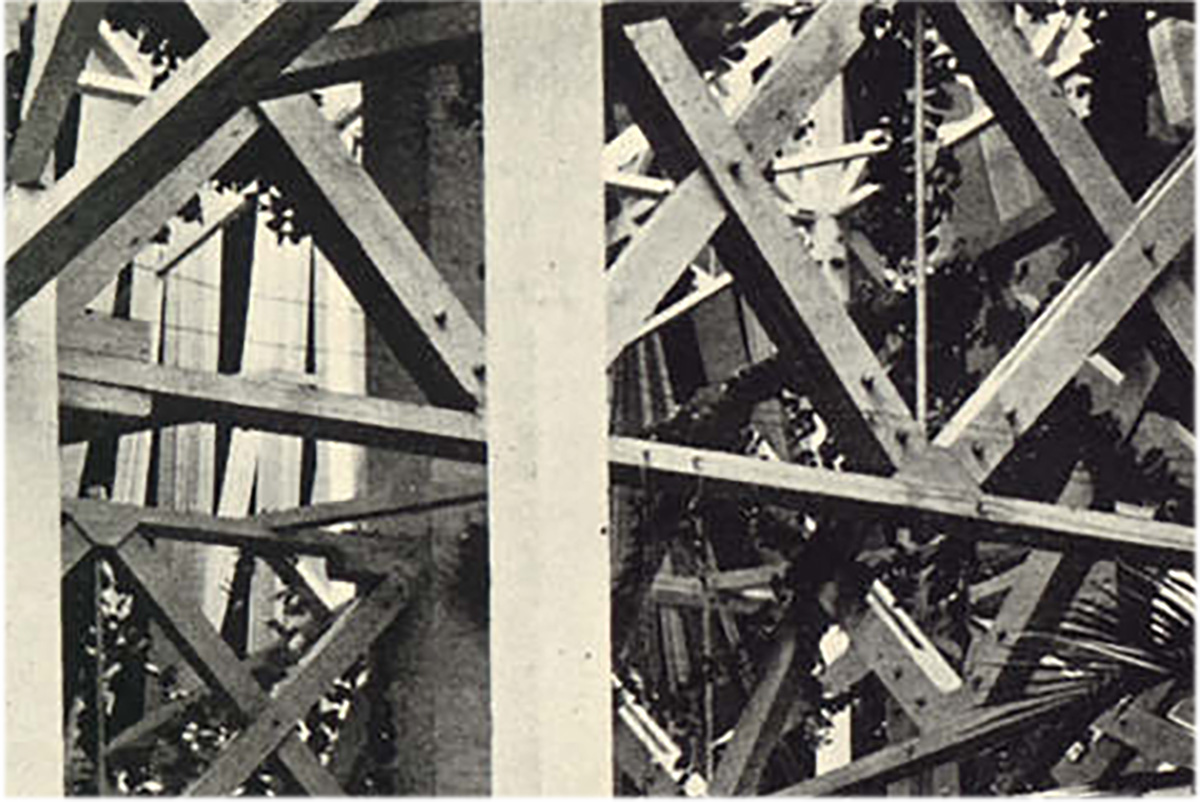
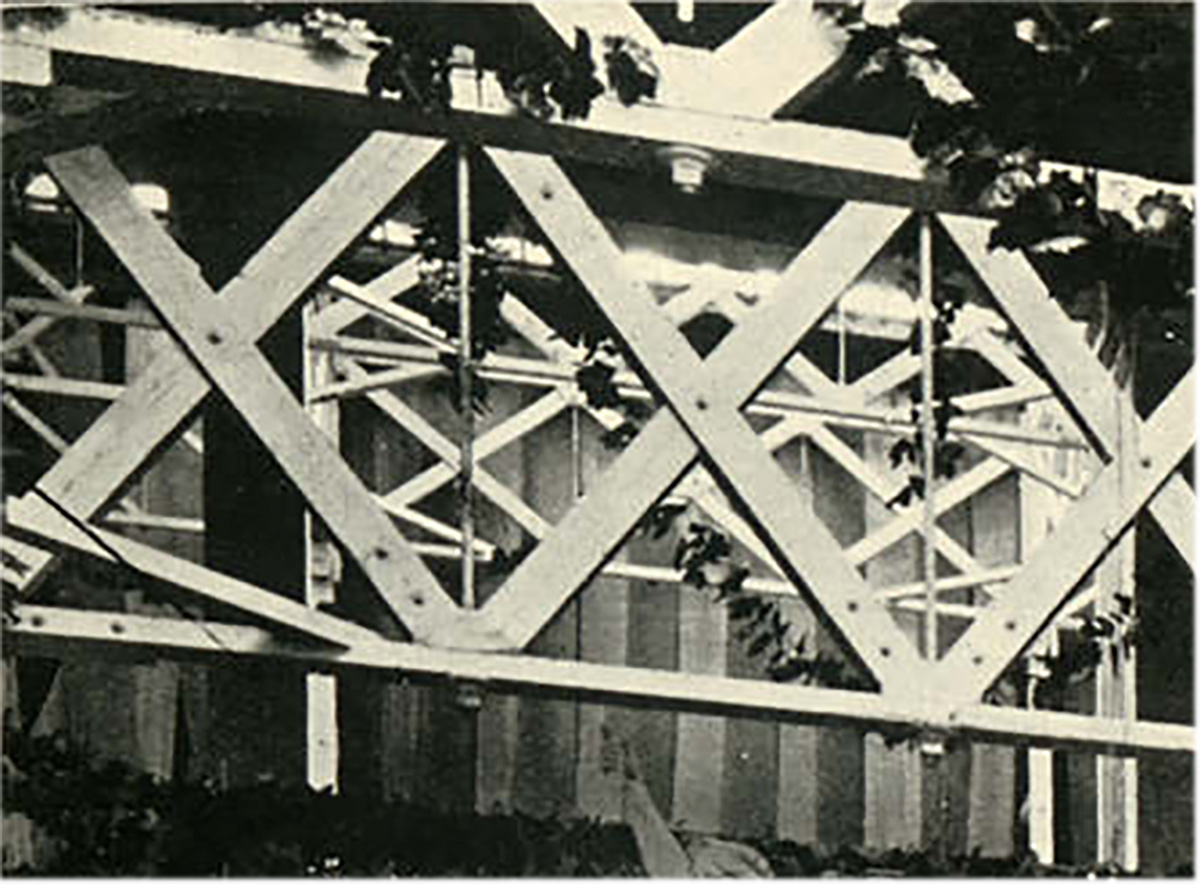
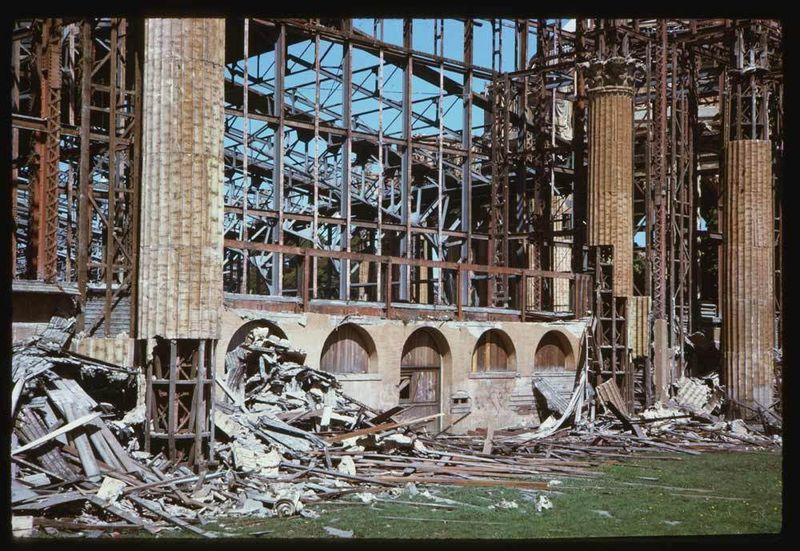
the second picture tho, are you saying these beams are steel? because, i dunno, looks like wood. and some awesome 1900-era lag bolts.

pan-wooden01.jpg
pan-wooden02.jpg

that's 2018 talk. we didnt have OSHA in 1900.
 
Note: This post was recovered from the Sh.org archive.
Username: ISeenItFirst
Date: 2018-07-09 00:19:06
Reaction Score: 0
No those look wood to me. Except the braces and nuts, those are metal.
Was just razzing about the wood, I would bet money they are pine floors as well, I still see some every now and then, and those look the part. Yeah beams would be oak or chestnut, or maybe even fir, about impossible to tell from the pics.

These on the other hand show copious amount of steel.

42254226

And don't get me started on OSHA, I couldn't care less about them. It's my reputation that matters to me. I don't build things that fall down.
 
Note: This post was recovered from the Sh.org archive.
Username: anotherlayer
Date: 2018-07-09 00:28:37
Reaction Score: 1
i don't think anyone would assume that is one tree trunk. guys, it's just wood covered in plaster. yes, a pipe organ is miraculous. that's what people did for a living. they built pipe organs in every church in every major city. are we now saying that pipe organs that still exist were built by pre-Buffalonians? guys...
Post automatically merged:

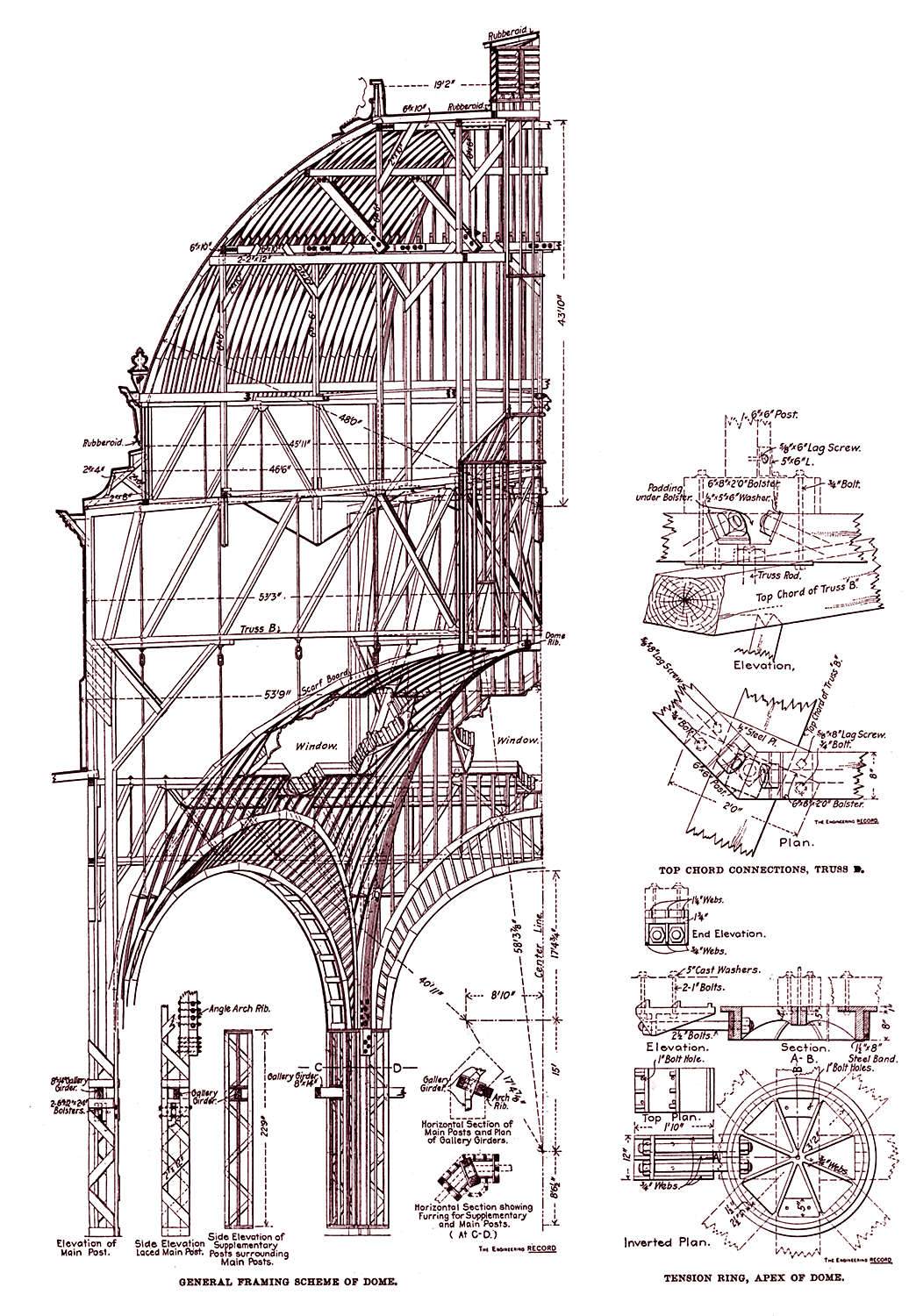
here is the Temple of Music blueprint...

pan_temple.jpg
 
Note: This post was recovered from the Sh.org archive.
Username: ISeenItFirst
Date: 2018-07-09 00:49:29
Reaction Score: 1
Where these drawing come from. I want more.

Those guys who went round making organs for a living, how many do you think they made in a year. And of that 1 that they partially finished in a year, how many of that one were the largest in the country, and how many were affixed to staff walls.

It's not that organs exist, it's the size and complexity and time frame. It often takes years to design and build any large organ, and that's assuming an already existing building, not a construction site. Also, who would build such a monstrosity if it was meant to be temporary. Show me a large organ that wasn't meant to be in place for 50 years minimum or more. It's not practical nor probable. Possible, maybe, but I'm not convinced. There are much better ways to piss away millions.

I do want those drawings though. This is a small part of what would be necessary to build it. I'd have further comments, but if love to see the plans first.
 
Note: This post was recovered from the Sh.org archive.
Username: anotherlayer
Date: 2018-07-09 01:03:53
Reaction Score: 1
this is a good start: Browse Items · Digital Collections - University at Buffalo Libraries

seriously, this stuff is mind-blowing, but all explainable.
nice little quote that explains a little: The history of the organ installed in the Temple of Music is less than clear. It has been reported that the organ was originally ordered from builder Emmons Howard by the St. Louis Church on Main Street, but how it came to be used at the Exposition is not clear. The original cost of the organ was $18,000.

After the Exposition the organ was installed in the Elmwood Music Hall, where it was in use until 1938 when the old hall was replaced by Kleinhans Music Hall. The organ was put into storage in the barns on Cassy Street where it deteriorated beyond repair. An article in the May 19, 1942 issue of the Buffalo News reported that the remains of the organ had been sold for $165.

Descriptions of the 4-manual organ exist in the Exposition's booklet, Music at the Pan-American Exposition, Organists, Orchestras, Bands, Buffalo 1901, (p. 4-5) and in Emmons Howard's own pamphlet, The Great Organ in the Temple of Music, Buffalo, N.Y. : built by Emmons Howard & Son, Westfield, Mass., and Buffalo, N.Y. The specifications state that the organ contained a total of 3228 organ pipes, a moderately large organ for its time. Howard utilized the latest in contemporary technology in building the organ, including sforzando and crescendo pedals, an enclosed Choir division, adjustable combination action, and tubular pneumatic action. He was awarded a gold medal at the Exposition for his design.


We built this. All of it. There is absolutely zero evidence at this point that these buildings existed prior to the 1901 Pan Am. And on top of that, the amount of daily press about the comings and goings from 1898 until well after it was all destroyed just seems to match that the news we hear of 1901 happened in 1901.
 
Note: This post was recovered from the Sh.org archive.
Username: KorbenDallas
Date: 2018-07-09 01:29:13
Reaction Score: 5
I don't see any issues with this complex being built. We all know that ancient Egyptians built their pyramids with copper chisels, and moved moved stones using sleds. There are images proving it. We also have partial blueprints, and a test model.

My point is that this is not weather the buildings could be built. They obviously stood at some point. Yet, we can have all the drawings in the world meaning just that those drawings exist.

We are being told that just about any 19th, and early 20th century expo took 18 months to build. Operated for 180 days, lost money, broke even, or virtually made no profits, and got dismantled. Then it moved to the town next door to continue the vicious cycle.

But somehow we do not have any evidence of the vigorous construction processes. We have no idea how many people were involved. Were there 5 people involved, or 50,000? No equipment, no nothing. We simply end up with buildings ready to use. And it happens every time with those expos.

We have hundreds of expositions, repeating each other's fate.

We could talk all day long about 4x4's and types of bolts. If there is a professional out there, I would like to know how much time, people and resources would be required to build all this in 18-30 months.

I think there is a reason we do not see those construction photographs. With as many expos as there were, there should be thousands of crystal clear construction photos out there. What do we have in reality?


What's in those images we are not supposed to see?
 
Note: This post was recovered from the Sh.org archive.
Username: ISeenItFirst
Date: 2018-07-09 02:13:18
Reaction Score: 0
In case you haven't gathered, I am somewhat of a construction expert. That's why I am so keen on the plans. With a full set of plans, I could do all that and more. I've managed the building of everything from home additions to large data centers. No one can know it all, and there is something to learn on each job. I've worked most of the trades, the management positions, and even spent time working on drawings with architects, and doing calculations with engineers.

The sketch we see looks more like a partial as-built drawing. If be happy with one dimensioned site plan. I am just trying to see if the methods match the tech of the time.
 
Note: This post was recovered from the Sh.org archive.
Username: humanoidlord
Date: 2018-07-09 18:27:45
Reaction Score: 0
nice try but no cigar, once again we have a bunch of people posing for the picture and a mr random doing something in the foreground, it looks very staged
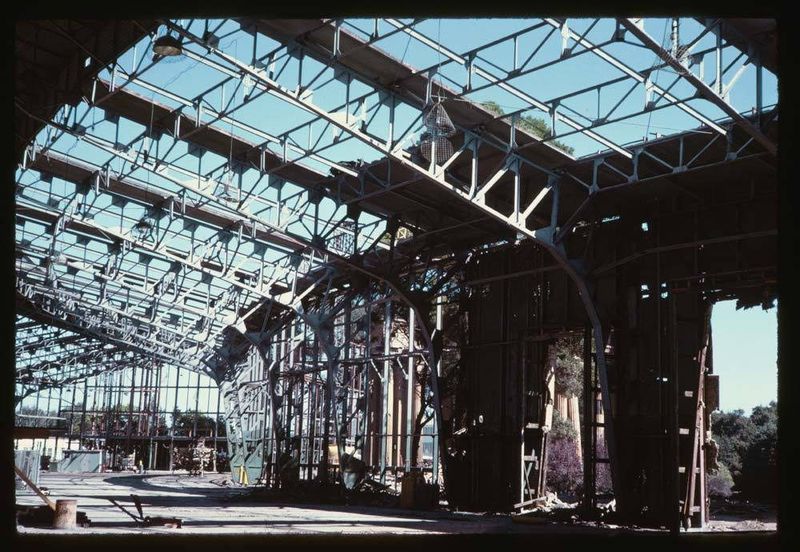
now this is convincing proof, some bizzare constrasct here, pristine "plaster" outside and a inside that looks like a abandoned warehouse?

this is headache inducing, why perfection in some pictures and no decoration in others?
pumpkins?
 
Note: This post was recovered from the Sh.org archive.
Username: anotherlayer
Date: 2018-07-12 00:43:04
Reaction Score: 6
I stopped down to the Historical Society today and grabbed some copies of construction photos. There are 50+ photographs and time ran out, closed at 8. I'll go back and gather some more. All of it is there. Every bit of construction, every bit of the workers, the horses, building canals, the shanty shacks, the onsite makeshift factories, all the 2x4s, all the plaster and staff. So, let's have a look at some terrible photocopies.

The site of the still standing (and only one built to remain post-Pan Am) NY State Building (now the Buffalo Historical Society). Bottom photo is some canal dredging.


Canal retaining walls??? Bottom photo is the Machinery Building


More land/Plaster section


Some workers, Agriculture Building


Killer panorama of the panamera! This is incredible in person, I will get a better shot next time


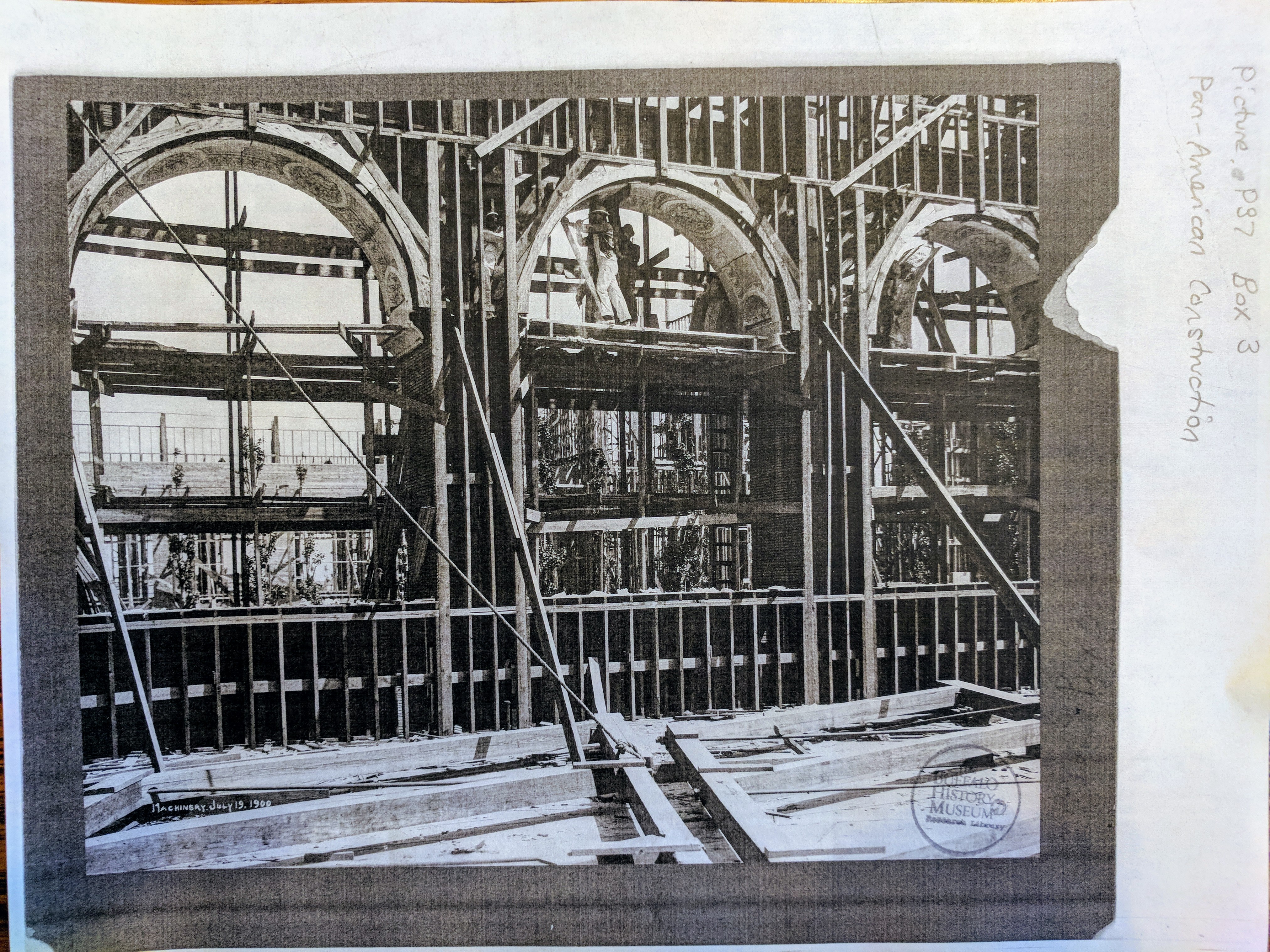
Machinery Building plaster arches


We built it all. This was the power of Buffalo NY. I'm pretty sure if you went to the St. Louis Historical Library or the Chicago Library, you will find these Expo construction photos. I haven't even gotten to the demolition photos, but they exist. So for each YouTube'r that insists that every building demolished does not have any construction photos, you haven't done enough research to be sure. We can't assume that things don't exist simply because it cannot be found on the internet.

The Buffalo Historical Society has over 100 boxes(!) of non-digitized photographs that basically no one has ever bothered to look at. How many other Societies have the same lack of interest but are full of the goods? I can't imagine some of the truths we'd uncover if we saw the photos no one else has in 100 years.
 
Note: This post was recovered from the Sh.org archive.
Username: ISeenItFirst
Date: 2018-07-12 01:36:57
Reaction Score: 1
Well, something I can sink my teefs inta. Excellent work, Thank you. I'd love to see some that weren't taken on a 1998 Idaho potato, please. Beyond that, those are most decidedly not the impressive front arches of the temple of music.
 
Note: This post was recovered from the Sh.org archive.
Username: anotherlayer
Date: 2018-07-12 01:46:18
Reaction Score: 1
Thanks! Sorry, I was running late and I'm a massive chatty-Cathy. I'm friends with the Society, so it turns into a "hey how's life" event. I am going to get the actual photos, I promise. I was so shocked by what I was looking at. It was 5 minutes to 8 and it was time to close up. Trust me when I tell you, it's all there. Pictures of hundreds of people and horses and piles of wood and you name it. And, these are in that weird ultra-HD photo-era. I know my images are garbage, they are photocopies and then I took a picture of them with my phone. I know, it's bush league :)

And yeah, I corrected that listing as the Temple of Music, it was actually the Machinery Building. My bad, my bad.

Here is the backside no one sees:


The detail... it ain't Hyperborean fancy:


The 9 generic dudes that are entirely unimpressive:

 
Note: This post was recovered from the Sh.org archive.
Username: ISeenItFirst
Date: 2018-07-12 02:26:48
Reaction Score: 0
I'm more than open to it. I see a few anomalies there but need better quality. 50+ photos is, I can assure you, not all of it, and not even close. I could show you 500 photos from a job and you still could have no clue what's actually happening on the jobsite, where or why. On a single building jobsite that many pics can be taken in a day just for quality control and communication.

It's the quality of the evidence, not just the quantity.
 
Note: This post was recovered from the Sh.org archive.
Username: anotherlayer
Date: 2018-07-12 02:41:01
Reaction Score: 1
so, after seeing even this one photo (below), you still think what, exactly? what are you holding on to?
IMG_20180711_201410.jpg

What is great about that one is you can easily see the actual lathe. they would not put lathe up to help demolish it. This is construction and I'm telling you guys, this is a real photograph. I held it in my hand. This is 3 dudes bustin' balls. Arches. Twobyfers.
 
Note: This post was recovered from the Sh.org archive.
Username: ISeenItFirst
Date: 2018-07-12 02:41:58
Reaction Score: 0
When was this built, did it take 18 months for starters

I'm not the why guy, I just call it like I see it, I don't have any of my self worth or identity tied up in these theories, I'm not holding onto anything. You make a great case for buffalo. I'm about convinced. If Buffalo unravels the rest of them, oh well. Korben has made a great case for the anomalies of the expos so far, so we see where it leads.

Haha. I don't need to be told what construction is. If this is what you think it looks like you are dead wrong. This is either a couple guys finishing something up after everyone went to lunch or a photo op. It does look something like a movie set come to think of it, but I won't go there for now. If this is a typical picture it was not an 18 mo job, not even close.

Why don't you tell me where you think you see lathe in this picture, because there is not much visible. Also just what it is you think those guys are doing.
 
Tips
Tips
Please respect our Posting Rules.
Back
Top