- Joined
- Mar 19, 2021
- Messages
- 131
- Reaction score
- 310
Alexander invents a mirror
Telescope described in Ayneye Iskandari
Abstract: Amir Khosrow Dehlavi's book Ayneye Iskandari (1300 AD) contains a short story about the invention of a mirror by Alexander. He makes a round mirror from polished iron. It has the features of an optical device capable of producing enlarged images of ships and pirates. It is also rotatable and shows the images of universe. Therefore, the text can be about a telescope. It is possible that the book Ayneye Iskandari was actually written in the 18th century based on the timeline of development of reflecting telescopes.Telescope described in Ayneye Iskandari
Keywords: Alexander Mirror, Ayneye Iskandari, Camera, Telescope, Lighthouse
It is interesting to read Alexander's life story from different sources. This time, I'll write about a passage from a relatively unknown book that narrates the story of invention of a mirror by Alexander. I'll argue that this story is actually about the development and use of telescopes in Europe during the 17th and 18th century.
Ayneye Iskandari, which translates as "Alexander's mirror, or Alexandrian mirror" is a biography of Alexander in an oriental style. It is written by Amir Khosrow Dehlavi (1253-1325 AD), a Persian-writing poet from India. His books, as far as I know, have not been translated into English, but I have found a good summary and have included the interesting sections here. I have added line-by-line translations for most important parts in between {}.
Iskandar wishes for a memorial of himself, and philosophers like Aristotle create the astrolabe.Under Iskandar, the development of skills is praised, and invention is always a topic of conversation. Artificers arrive from the farthest China. Iskandar summons them to his palace to learn what they know. The Chinese claim that they can create wall paintings that move and look exactly like their subjects; {The Chinese claim their paintings, not created by using the brush, can move and are exactly similar to the subject. Once the subject turns around, it will also turn around. When you get closer, the image moves towards you. It is impossible to expect a lifeless image to have these characteristics.} They claim that no such paintings or painters can be found in Rum (Rome).
" Iskandar calls the painters for a competition: Chinese and Roman painters will each decorate an ayvan (portico, room) in the palace. Each group sets about its work in secret. Iskandar goes to the Romans first and sees a magnificent image of a beautiful woman, which he admires tremendously.[ii] He then goes to the Chinese ayvan and notices that the entire wall is polished iron, reflecting the observers and their motions. {All the walls are covered with bright polished iron, and in that light, images of faces are reflected on the walls. If one looks forward or backward, he can see himself anywhere. One person associated with the king has his image everywhere, and if someone moves quickly, his image moves quickly as well.} Iskandar is astonished.
Iskandar plans to put the mirror into new use. One day, some merchants who had been robbed appeared in court. They tell of a band of pirates based on the island of Qubrus (Cyprus). {A group of Farangs are located on the Cyprus Island who invade and rob ships in the Mediterranean Sea.} They attacked merchant ships traveling from Sham (Syria and Lebanon) to Armenia with goods from the Maghrib. The merchants are appealing to Iskandar for justice. Iskandar has long considered an instrument with which to scan the land and sea, and he spends some nights with the philosophers discussing the issue. Iron from China is ordered, and a monumental mirror is created. {They made a circular mirror, ten by ten, and put magic inside it to see far away clearly and brightly. The mirror becomes bright like the sun. On that bright surface that rotates like a pair of compasses, many pictures of the world emerge. They place it on a tower in the Mediterranean Sea River. This is similar to an astrolabe that can view the light from the skies.} A tall tower is built on Rum's shore, with the mirror atop. The mirror reflects events that occur sixty farsangs (leagues) away. } A mirror image of the figure is displayed when someone is moving on the island of Cyprus. {A hundred of Iskandar's ships are prepared for the appearance of the pirate ships in the mirror, and the pirates are apprehended. The mirror-tower survives Iskandar's reign, but it is demolished in later evil times. "
Alexander's Mirror is a popular topic in the Persian literature. I will skip over the other sources because the one mentioned above provides a more detailed description. Nezami (1141-1209) has a brief chapter on it, stating that they used various materials such as gold and silver to create the first mirror, but the experiments failed. Finally, polished iron could reflect objects accurately. Different shapes are discussed too, including elongated or wide, square, and hexagonal, none of which had a perfect reflection. Finally, the text says, a circular (spherical or paraboloidal) iron mirror could provide an ideal reflection.[iii]
Figure 1: Experiments with different materials and shapes to create a mirror with the ideal reflection: a spherical iron mirror. Both paintings are related to the same scene; according to Nizami (right: painted in 1595, left: painted in 1490 AD).
Prior to discussing the mirror, the piracy event is discussed. In general, the Persian literature offers no solid geographical or political data. The piracy event, described here, is an exception. The commercial ships, which had traveled from the Maghreb, got assaulted approximately between Sham (the Levant) and Armenia (small Armenia on the southeast coast of Anatolia). The pirates were Frangs, based in Cyprus. In Persian literature, Farngs refers to Christian westerners, particularly the French, following the events of the third Crusade. According to history books, the Franks ruled over Cyprus, for three centuries (1192-1489). Pirates were active in Cyprus and the Eastern Mediterranean during the 15th and 16th centuries. Historical records of their piracy are available.[iv]
Figure 2: Alexander (Iskandar) invents a mirror that, when mounted on a tower, shows everything within a radius of 60 farsangs and thus enables Alexander's men to attack raiding pirates. (Ayneye Iskandari painting, dated to 1609 AD)
Figure 3: Alexander the Great ordered the construction of a tall tower surmounted by a revolving mirror in order to battle the pirates menacing the Mediterranean Sea. Note the usage of guns and cannons. (Ayneye Iskandari, painting dated to 1598 AD) [v]
What kind of mirror did Alexander invent? The mirror is curved, not planar, as the texts say that only circular, meaning spherical, mirrors can reflect the images perfectly. Other Persian authors say that the mirror resembles a cup. So, this is a concave mirror. Several sources emphasize that the material used is iron.
When the text discusses the usage of the mirror, it becomes unclear, confusing, and complex. In initial phrases, the text seems to refer to the camera obscura as an aid to painting in competition between painters or as a means of displaying live performances. In a comparable way, it could be the description of a magical lantern.
However, the main focus of the text is unrelated to camera obscura. I think that the text is more about telescopes.
Here's a brief overview of the different types of telescopes, as well as the official history and timeline of their invention and development. There are two types of telescopes. A refracting telescope uses lenses to enlarge distant objects, while a reflecting telescope uses reflection from mirrors to magnify. Initially, scientists used lenses, followed by mirrors.
While the camera obscura is an antique device, telescopes were developed during the seventeenth century. Most historians make the Netherlands the country of the telescope’s origin and 1608 the year of its birth. Many writers give this merit to Hans Lippershey. At the time, the Netherlands was fighting for the independence. In fact, initially, telescopes were developed as valuable addition to military strategy. A committee tested the first telescope, a monocular, from a tower to find it was "likely to be of utility to the State." Several years later, Galileo constructed his own telescope. Interestingly, he wrote, “Many noblemen and senators climbed to the highest church towers in Venice to observe distant sails and shipping, using my spyglass that made objects appear large and near. After several decades, due to the optical problems of lenses, curved mirrors were used to build reflecting telescopes.
Evidence suggests that Leonard Digges (1515 - 1559) invented a simple instrument with lenses and a concave mirror, relatively similar to a modern reflecting telescope. However, in the 16th century, it would have been very hard to construct lenses with the required optical precision, and, importantly for our discussion, even more difficult to construct a satisfactory mirror. For the first time, Leonard Digges described how he saw distant objects magnified.[vi]
Isaac Newton built the first reflecting telescope in 1668. Other scientists built different mirror-based telescopes over the next centuries. In this type of telescope, the mirrors are made of speculum metal. (Figures 6 and 7) It is an alloy of copper and tin that has a highly reflective surface when polished. Interestingly, speculum metal mirrors were called "steel mirrors" even though they contained no steel. Speculum metal was used between the mid-17th and mid-19th centuries, before the invention of glass silvering.
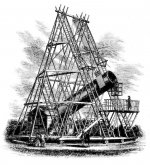
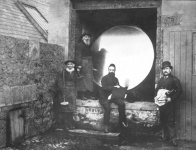
Large reflective telescopes were constructed in the 18th century and later. I don't intend to write a comprehensive history of telescopes. However, two large-scale reflecting telescopes are notable. In 1761, Nicolas Noël created the Eight-Foot Telescope in Paris. (Figure 4) Between 1785 and 1789, Herschel's 40-foot telescope was built in England. It was equipped with two 120-cm concave metal mirrors, a 12-meter tube, and a rotatable mount. (Figures 5 and 6)
Figure 4: Eight-Foot Telescope created by Nicolas Noel. It had a rotatable mount. 1761

Figure 5: Great Forty-Foot telescope. A large-scale device with 12-meter tube, on a rotatable mount.1789

Figure 6:The Forty-Foot telescope 's first mirror made of speculum metal. 1789
 Figure 7: Six-foot speculum metal mirror for the Leviathan of Parsonstown telescope. Around 1850 [vii]
Figure 5: Great Forty-Foot telescope. A large-scale device with 12-meter tube, on a rotatable mount.1789
Figure 6:The Forty-Foot telescope 's first mirror made of speculum metal. 1789
Back to Ayneye Iskandari, let us examine the story. It should be noted that this book was written in 1300 AD based on official history. The poet discusses futuristic topics such as experimenting with different shapes and materials to find an ideal reflector, concave mirrors on a tower that can magnify images, military applications of a new optical device, and a rotating instrument depicting image of the universe. These are oddly similar to future optical technology.
To begin with, the text describes some sort of curved and round mirrors on the walls of a room, reflecting images. Likewise, the reflecting telescope is an optical device that uses curved mirrors inside a tube. Both the mirrors and the tube can be quite large like a room or a chamber. (Figures 5 and 6)
The poet underlines iron as the preferred material for making mirrors. It is polished and has a very reflective surface. As previously mentioned, early reflective telescopes used metal mirrors. Mirrors made of speculum metal were known as "steel mirrors." Testing various materials in Persian sources is about developing a proper metal alloy, not selecting iron among others. Similarly, speculum metal production has been difficult, with lots of experimentation. A scientist tested 150 different alloys for speculum metal. The production process is described as laborious and lengthy. Nizami talks about the same process of extensive testing. (Figure 1) and selecting “steel mirror”
The writer states that the Alexandrian mirror is utilized for military purposes by magnifying the view of the enemy ships and pirate activities on Cyprus Island. (Figures 2 and 3) As already mentioned, in 17th century Europe, telescopes were initially used for military purposes as well, mainly to observe and scan ships.
The poet claims that the mirror is placed on a tall tower. As it was said, the first telescopes in Europe were tested by men over the top of a towers on the shores. The tall minaret in the text can be an observation tower located in an unspecified location on the Mediterranean coast. [viii]
Then it loosely states that the shining surface rotates like a pair of compasses and displays images of the world.[ix] If the Alexandrian mirror is considered a telescope on a rotatable mount, this challenging and well-known verse can be understood (Figure 4). The theme of a mythological cup used to see the entire world is popular in Persian literature. [x]
In the final phrases, once again, the text becomes confusing as it says the mirror has some sort of magic inside that makes it shine like the sun. [xi]It appears that here the poet has mixed up the telescope and the lighthouse. The magic inside the mirror can be oil that burns and gives light. This is why some academics believe the Alexandrian mirror is the lighthouse of Alexandria.[xii] However, others reject the idea because a lighthouse does not enlarge the image of ships. The Alexandrian lighthouse is the subject of many historical writings. Rather than the mirror, the primary focus, however, is on the tower and its collapse. Nizami and Amir Khosrow provide a unique overview of shape, material, and the reflective properties of the mirror.
Putting aside distractions and confusion, the rotating chamber with round polished iron walls capable of magnifying objects is a large-scale reflective telescope. The tower is an observatory or an observation tower.
Some say that these are all the fantasies of poets. In fact, some Iranian scholars hold the same viewpoint. They believe: "It was impossible to use the shining mirror on top of the tower of Alexandria." They continue, "It is practically impossible to use the mirror above a tower to watch ships from a long distance. As a result, the specifications attributed to this mirror appear to be fake. Also, it appears that the story of a mirror on top of a tower was created by dreamers, which gave rise to legends and beautiful poems.” There is even the opinion of a number of physicists. Their mistake is considering the presence of only one concave mirror and not the combination of several reflectors inside a chamber. [xiii]
Descriptions of the Alexandrian mirror are similar to real optical devices of the 17th and 18th centuries (which did not exist in the 13th century). I mentioned that according to official history, even in the 16th century it was not possible to make a suitable lens or mirror for a telescope. Even if we do not accept that Amir Khosrow mentions the construction of a telescope in his book, we must accept that he clearly says that the Alexandrian mirror has the ability to magnify the images of ships and people. Remember that the subject of optical magnification of objects was first discussed in the 16th century.
Amir Khosrow lived, in my opinion, within the late 17th and early 18th centuries, far from the center of technological developments of that time. He had a vague knowledge of telescopes, cameras, and lighthouses. Yet he integrated these vague imaginations into his stories and poems, also giving them a mystical touch. An example of such partial information is the claim that iron was used to create metal mirrors based only on the name "steel mirrors." Another theory is that Amir Khosrow received edited data from multiple sources to write his book. Therefore, he talks about the development of optical devices and their use in a confusing manner. While he has detailed information about the piracy events in Cyprus in the 15th and 16th centuries, he does not have data on location of the tower. Therefore, he vaguely places it on a river in the Mediterranean Sea.[xiv] Since mysterious and mythological cups and mirrors hold an important place in eastern sophism, additional studies are required, especially considering the possible presence of chronological errors.
i made some modifications.
[ii] Isn’t she the Virgin Mary?
[iii] For ease of discussion, I have added Nizami's story to Amir's, as it has some more details about the mirror.
[iv] Based on the piracy event, Alexander the Great is a Mamluk or Ottoman sultan.
[v] Firearms and especially battleships appear futuristic, even for the alleged date.
[vi] As Henry C. King claims in his book.
[vii] Compare it to Figure 1, the highly reflective surface is the burning mirror.
[viii] The large tube also resembles a tower. Alternatively, the tower and the mirror could be some sort of aerial telescope from second half of the 17th century.
[ix] Interestingly, the word گیتی means the universe or the cosmos, not the earth.
[x] For example, in Hafez’s poems.
[xi] Some people could say that the Alexandrian Mirror is an ancient energy device or antenna but I have no information about these kinds of topics.
[xii] There are similarities between this magical mirror and the Archimedes' heat ray.
[xiii] Some Greek academics insist that the Pharos of Alexandria was a real structure equipped with advanced optical equipment. It's interesting how they agree with me that this tower has specifications or descriptions of a lighthouse, telescope, as well as camera obscura, similar to the Alexandrian mirror in the Persian texts. The reader can judge whether my or their theory is correct. The link of full text is provided.
[xiv] The European version of history of telescope is also unclear. Another possibility is that, according to the piracy event, such technology was developed somewhere in modern-day Turkey or Syria, east of the Mediterranean Sea. It was during the Great Mongolian Empire in the 15th century based on the new chronology. By the way, I could find no evidence in Persian sources that supports Fomenko's theory that the Alexandrian lighthouse is actually Ivan the Great bell tower in Moscow.
Sources
Different pages of Wikipedia.
Amir Khusrau - WikipediaAyina-i Iskandari (Amir Khusrau) - Wikipedia
Farang - Wikipedia
Kingdom of Cyprus - Wikipedia
Armenian Kingdom of Cilicia - Wikipedia
Curved mirror - Wikipedia
Speculum metal - Wikipedia
Reflecting telescope - Wikipedia
40-foot telescope - Wikipedia
https://en.wikipedia.org/wiki/Father_Noël
List of largest optical telescopes historically - Wikipedia
کتاب خمسه امیر خسرو دهلوی صفحات 489 تا496
آیینه ساختن اسکندر در شرفنامه نظامی Here
Piracy in Cyprus and the Eastern Mediterranean during the Later Lusignan and Venetian Periods (15th-16th Centuries) Here
The history of the telescope by Henry C. King Chapters 2 to 7 Here
Ancient Greek Optical Instruments and the Pharos of Alexandria Here
How did the lighthouse at Pharos work? Here
Perspectives on Persian Painting Illustrations to Amir Khusrau's Khamsah Page: 20
Images of Persian books : Here Here Here Here
Persian papers : Here Here Here