SH Archive Apollo 11: The greatest single broadcast in television history

SH.org OP Username
KorbenDallas
SH.org OP Date
2019-09-23 19:35:11
SH.org Reaction Score
12
SH.org Reply Count
25

KD Archive

Not actually KorbenDallas
Active Member
Joined
Sep 22, 2020
Messages
4,691
Reaction score
1,500
It's probably more suitable for the tech subforum, but it pertains to the Moon Landing. Anyways, the question is:
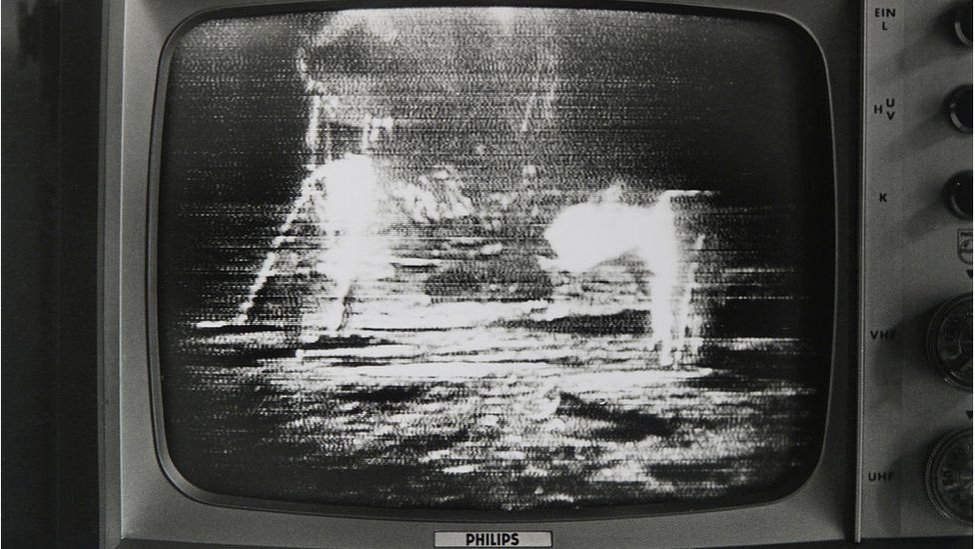
Was it technologically possible to pull this off in 1969?
When the Eagle spacecraft touched down on the Moon's surface on 20 July 1969, a television camera mounted on its side captured the first tentative steps and words of astronaut Neil Armstrong and sent them across hundreds of thousands of miles to hundreds of millions of pairs of eyes glued to television sets.
  • The mesmerising television coverage of the Apollo 11 Moon landing 50 years ago brought previously unthinkable images and ideas into the homes of millions, leaving a profound impact on pop culture and the American psyche.
apollo_11_landing_2.jpg
I am not sure if the video below is the actual live transmission of the landing (it looks that way), but NASA says the following:

  • Original Mission Video as aired in July 1969 depicting the Apollo 11 astronauts conducting several tasks during extravehicular activity (EVA) operations on the surface of the moon. The EVA lasted approximately 2.5 hours with all scientific activities being completed satisfactorily. The Apollo 11 (EVA) began at 10:39:33 p.m. EDT on July 20, 1969 when Astronaut Neil Armstrong emerged from the spacecraft first. While descending, he released the Modularized Equipment Stowage Assembly on the Lunar Module's descent stage. A camera on this module provided live television coverage of man's first step on the Moon. On this, their one and only EVA, the astronauts had a great deal to do in a short time. During this first visit to the Moon, the astronauts remained within about 100 meters of the lunar module, collected about 47 pounds of samples, and deployed four experiments. After spending approximately 2 hours and 31 minutes on the surface, the astronauts ended the EVA at 1:11:13 a.m. EDT on July 21.

kd_separator.jpg

KD: So, was our level of technology (as far as abilities/capabilities of sending this video from the Moon to the Earth goes) on par with the claimed achievement of broadcasting from the Moon?
  • At perigee - its closest approach - the moon comes as close as 225,623 miles (363,104 kilometers).
  • At apogee - the farthest away it gets - the moon is 252,088 miles (405,696 km) from Earth.
  • On average, the distance from Earth to the moon is about 238,855 miles (384,400 km).
Note: This OP was recovered from the Sh.org archive.
Note: Archived Sh.org replies to this OP are included in this thread.
 
Note: This post was recovered from the Sh.org archive.
Username: Timeshifter
Date: 2019-09-23 20:02:28
Reaction Score: 7
From a photography point of view. I always wondered why the lens had not at least fogged up, let alone become frozen ( I know, lack of moisture) except that on/ inside the camera from being in the atmosphere of the lander... Anyway, Nasa's anwser...

'In order to stop the camera from overheating or freezing, it was coloured silver to help regulate temperature. The two film magazines were also given the silver finish to help protect the final images' Source

Wow, its that simple! Now I know that Ill paint my camera silver for thd next time Iam out in the cold.

From a photographer, this is an utter crock of s**t.

As for broadcast tech, signal, tech. My educated guess would also have to be no. Why? Here in the UK, pre digital, if you traversed a hill you would lose signal, hell it was a nighmare to tune anything analogue without an aerial on a 30 foot mast or rooftop.

1969, uhf/ vhf/ whatever, 384k? I don't buy it.

Just my opinion of course ?
 
Note: This post was recovered from the Sh.org archive.
Username: trismegistus
Date: 2019-09-23 21:09:23
Reaction Score: 3
I addressed some of their methods in this post

This info seems to be straight from the source, so to speak. Not saying it is what happened, as of course I have my doubts.
 
Note: This post was recovered from the Sh.org archive.
Username: Kansas
Date: 2019-09-24 01:35:40
Reaction Score: 1
I’m firmly convinced all the moon-landing stuff is a hoax. But I don’t doubt the power of rockets or that they could carry someone as far as the moon... and I think radio signals would carry better outside the atmosphere with mo resistance. The Van Allen belt idea doesn’t scare me either... but I think it was made up to try to do so. I don’t think TPTB want us looking around on the moon. Hell, they want to destroy history here on earth... what evidence may or may not be on the moon probably terrifies them.
 
Note: This post was recovered from the Sh.org archive.
Username: EmmanuelZorg
Date: 2019-09-24 13:31:31
Reaction Score: 2
Even in recent times, when a news footage takes place where a reporter is some distance away from the main studio, there is an apparent delay in the audio at times, and my general understanding is this is due to the time required for the signal to transmit from the remote location to the main studio. And that is often measurable only in hundreds or thousands of miles, not hundreds of thousands of miles!

Maybe TV transmission waves (and audio ?) travel differently in the vacuum of space, but that is the sort of experiment that is only available to a very small selection of the population. It's difficult to test and verify.
 
Note: This post was recovered from the Sh.org archive.
Username: Kansas
Date: 2019-09-24 14:27:02
Reaction Score: 1
Not to argue... because I think we share an overall view on this, but just to play devil’s advocate, analog signals of the past were significantly stronger than today’s digital broadcasts. That may play a part in the delays we see today. (It would seem to me that the digitalization of the signals a decade back was about controlling the infrastructure and thereby the content available via broadcast... limiting the potential number of broadcasters to those with significant capital or backing - it forced a ridiculous degree of consolidation among radio and tv outlets... broadcast quality-level be damned!)
 
Note: This post was recovered from the Sh.org archive.
Username: EmmanuelZorg
Date: 2019-09-24 14:43:11
Reaction Score: 1
And I didn't consider the modern method of relaying the communication is to send the signal to a satellite in orbit, then back to the surface. But that is still a considerably shorter distance out-and-back to a satellite than to the moon and back.

And analog definitely had some strengths that were brushed aside when things were swept over to digital.
 
Note: This post was recovered from the Sh.org archive.
Username: Tazx55
Date: 2019-09-24 20:09:21
Reaction Score: 0
Nah the whole thing was done local. Too many oddities and as a photographer said above, a crock os!
 
Note: This post was recovered from the Sh.org archive.
Username: PrincepAugus
Date: 2019-10-03 20:11:57
Reaction Score: 1
For those wondering about Soviet reactions:

 
Note: This post was recovered from the Sh.org archive.
Username: usselo
Date: 2019-10-24 16:19:30
Reaction Score: 1
For anyone wanting a long-form read on the Soviet elite's attitude to the Apollo missions, there's interesting material at:
Apollo Investigation, Illusory Apollo: the Ultimate Mega Show by Aerodynamicist Alexander Onoprienko. AULIS Online – Different Thinking
and among the text at:
Apollo Investigation, The Odyssey of the Lost Apollo CM. A detailed analysis of the April 1970 event. AULIS Online – Different Thinking
and
Apollo Investigation, The April Odyssey and the November Boat by Andrei Bulatov and Alexander Boyko. AULIS Online – Different Thinking

A few Russian rocket engineers' analyses of the technology are among the PDFs at:
PDF Downloads. Apollo Investigation, Aulis Online
as well as:
Apollo Investigation, Did this Saturn V Rocket Get to the Moon. Alexander Popov PhD and Andrei Bulatov. AULIS Online – Different Thinking
and
Apollo Investigation, Evaluation of Saturn V F-1 Engine Characteristics by Gennady Ivchenkov, PhD. A Scientific Evaluation. AULIS Online – Different Thinking

I've gone heavy on the links because I find it difficult to remember where articles are in Aulis' navigation. Generally, I use their article list at:
AULIS Online – Different Thinking

I appreciate people can become frustrated at claims parts of the program were faked so, if it helps, note the site has articles claiming parts of the Soviet program were also faked:
Apollo Investigation. Developments at the turn of the 21st Century. Chinks in the Armour. AULIS Online – Different Thinking
Apollo-Soyuz: The Joint Hoax? - AULIS Online – Different Thinking
Spaceflight. When Russia Won the Space Race. A Cold War History, in Pictures by Mark Wolverton. Aulis Online and Aulis Publishers

The site's stance is that some of the people involved deliberately made subtle mistakes that would only alert the observant:
Apollo Investigation. Stanley Kubrick and Apollo, Links to the films of Stanley Kubrick. AULIS Online – Different Thinking (the mildewed experiment box is a great notion. Can't say if it is true but...)
Apollo Investigation, Further Findings. Research into the Apollo imagery continues – 2007 update. AULIS Online – Different Thinking
Apollo Investigation, Examples of Anomalies and Inconsistencies in the Apollo Photography. Deliberate mistakes and intentional continuity errors. AULIS Online – Different Thinking
 
Note: This post was recovered from the Sh.org archive.
Username: Starmonkey
Date: 2019-10-24 17:26:09
Reaction Score: 1
No wonder that the great Jack Parsons was an occultist as well as a rocket scientist?...
 
Tips
Tips
Please respect our Posting Rules.
Back
Top