SH Archive Ask Pro | - All you ever wanted to know about dinosaurs but never dared to ask

SH.org OP Username
Randolph C
SH.org OP Date
2020-07-12 22:59:41
SH.org Reaction Score
100
SH.org Reply Count
100
Note: This post was recovered from the Sh.org archive.
Username: Divine Wind
Date: 2020-07-19 17:52:28
Reaction Score: 5
Interesting you mention dragons. The bible appears to mention 2 dino's, one does sound like a Brontosaurus/ Apatosaurus, and the other sounds like a sea dragon. The descriptions are quite vivid.

Job 40:15-24 - Behemoth

15 "Look at Behemoth, which I made along with you and which feeds on grass like an ox. 16 What strength it has in its loins, what power in the muscles of its belly! 17 Its tail sways like a cedar; the sinews of its thighs are close-knit. 18 Its bones are tubes of bronze, its limbs like rods of iron. 19 It ranks first among the works of God, yet its Maker can approach it with his sword. 20 The hills bring it their produce, and all the wild animals play nearby. 21 Under the lotus plants it lies, hidden among the reeds in the marsh. 22 The lotuses conceal it in their shadow; the poplars by the stream surround it. 23 A raging river does not alarm it; it is secure, though the Jordan should surge against its mouth. 24 Can anyone capture it by the eyes, or trap it and pierce its nose?


Job 41:18-19 - Leviathan (compare to Rahab in Isaiah?)

1 "Can you pull in Leviathan with a fishhook or tie down its tongue with a rope? 2 Can you put a cord through its nose or pierce its jaw with a hook? 3 Will it keep begging you for mercy? Will it speak to you with gentle words? 4 Will it make an agreement with you for you to take it as your slave for life? 5 Can you make a pet of it like a bird or put it on a leash for the young women in your house? 6 Will traders barter for it? Will they divide it up among the merchants? 7 Can you fill its hide with harpoons or its head with fishing spears? 8 If you lay a hand on it, you will remember the struggle and never do it again! 9 Any hope of subduing it is false; the mere sight of it is overpowering. 10 No one is fierce enough to rouse it. Who then is able to stand against me?

11 Who has a claim against me that I must pay? Everything under heaven belongs to me. 12 "I will not fail to speak of Leviathan's limbs, its strength and its graceful form. 13 Who can strip off its outer coat? Who can penetrate its double coat of armor[1] ? 14 Who dares open the doors of its mouth, ringed about with fearsome teeth? 15 Its back has[2] rows of shields tightly sealed together; 16 each is so close to the next that no air can pass between. 17 They are joined fast to one another; they cling together and cannot be parted. 18 Its snorting throws out flashes of light; its eyes are like the rays of dawn. 19 Flames stream from its mouth; sparks of fire shoot out. 20 Smoke pours from its nostrils as from a boiling pot over burning reeds. 21 Its breath sets coals ablaze, and flames dart from its mouth. 22 Strength resides in its neck; dismay goes before it. 23 The folds of its flesh are tightly joined; they are firm and immovable. 24 Its chest is hard as rock, hard as a lower millstone. 25 When it rises up, the mighty are terrified; they retreat before its thrashing. 26 The sword that reaches it has no effect, nor does the spear or the dart or the javelin. 27 Iron it treats like straw and bronze like rotten wood. 28 Arrows do not make it flee; slingstones are like chaff to it. 29 A club seems to it but a piece of straw; it laughs at the rattling of the lance. 30 Its undersides are jagged potsherds, leaving a trail in the mud like a threshing sledge. 31 It makes the depths churn like a boiling caldron and stirs up the sea like a pot of ointment. 32 It leaves a glistening wake behind it; one would think the deep had white hair. 33 Nothing on earth is its equal- a creature without fear. 34 It looks down on all that are haughty; it is king over all that are proud."


Psalm 104 : 26 more on Leviathan
25Here is the sea, vast and wide, teeming with creatures beyond number, living things both great and small. 26There the ships pass, and Leviathan, which You formed to frolic there.

This creature is clearly not a crocodile, and no mention is made for wings ie no dragon. It is evidently a sea creature, and my first guess would have been Mosasaurus at 60 feet long. The size and teeth are fine, the neck looks great, the fire breathing stuff is the difficult bit.
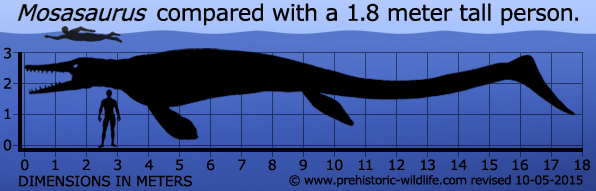
Mosasaurus.jpg


Was Leviathan a Parasaurolophus? - creation.com some think Leviathan is Parasaurolophus

This is an interesting commentary on lots of other verses and comparisons with other sources
The strange and curious pantheon of biblical gods and monsters (part 3) — Steemit


Other sources for the Sea Dragon
Lots of giant sea serpents have been mentioned in ancient mythologies around the world, plus there have been numerous sightings as well

The largest sea beast known in Norse mythology was known as Jormungandr
The Sea Serpent – An UNSOLVED Mystery

The Sea Monster Literary Canon | The Gothic Library Homer, Jules Verne
Sea Monster Sightings and the ‘Plesiosaur Effect’ — Tetrapod Zoology 9 types of sea monster etc
Dragon Lore: Origins of the Fire-Breathing Beast Asian Sea Dragons

Fire breathing beasts?
Nature shows how dragons might breathe fire technical analysis, yes
Were there really fire breathing dragons? yes
Mythological Creatures of Fire | Mythical Fire Beasts various legends, and some myths
Fire-Breathing Dinosaurs? Physics, Fossils, and Functional Morphology vs. Pseudoscience | Skeptical Inquirer This chap says 'no'

An 18th-century description of a sea serpent was given by the national saint of Greenland, Hans Egede. According to him, the crew abroad the ship that was passing the coast of Greenland on July 6, 1734, saw a terrible creature that they have never seen before. The monster was longer than their vessel and had giant fins and small head.

Drawing based on description from Hans Egede and the crew for Sea Monster near Greenland (date 1734 ) - fire breathing?
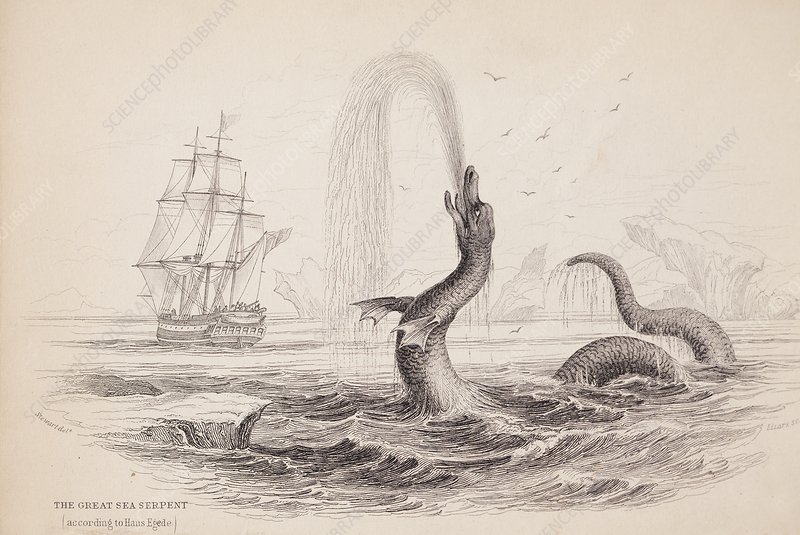
sea monster 1734.jpg

Same monster - different drawing - but more obvious signs of a fire breather?
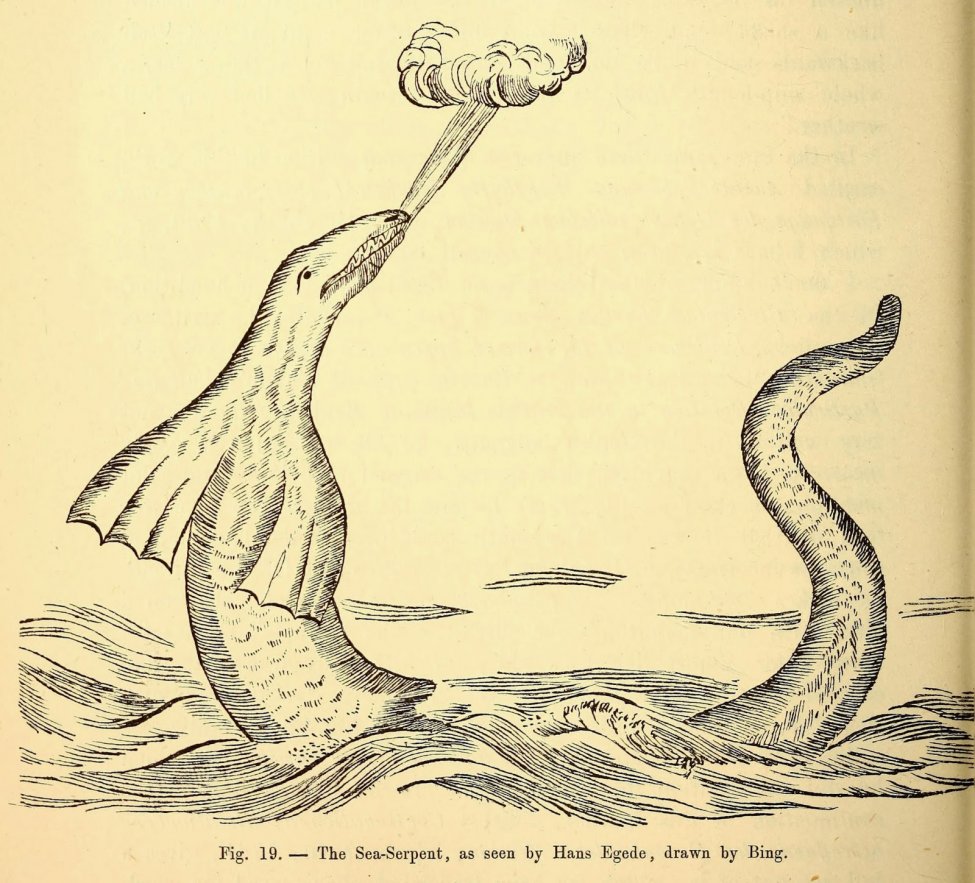
sea monster same artist.jpg
 
Note: This post was recovered from the Sh.org archive.
Username: Randolph C
Date: 2020-07-19 21:16:20
Reaction Score: 1

Thanks for the question. There have been studies conducted on that question, but I think they are not very trustworthy.

So I can just give my personal opinion. These animals were around for a long time. How long exactly we do not know. They were living on all continents and in all climate zones. They ranged from bird-size to the most massive creatures that ever roamed the Earth (as far as currently known), so they basically had the same role in the ecosystems as mammals have today (disregarding the really tiny ones).

So look how diverse mammals still are today despite the great (and probably largely human-caused) mass extinctions that have recently taken place among them. So it can be assumed that there was several thousand of legit dinosaur species. How many in terms of individuals is very hard to tell, but I think that the plant eaters, particularly the rather unspectacular medium-sized ones, would have been much more common as comparable plant-eating animals are in Africa today (I say more common because the African ecosystems are not the original ones anymore, they have been largely ravaged, devestated and decimated). So there may have been species the count of individuals of which may have been in the millions. The carnivores, as with today's ecosystems, must have been much rarer.
Good questions. So here is the drill.

1. You have to look in the right rocks. Anything magmatic or metamorphic will not (or only very rarely) contain any kind of recognizable fossils, so skip all granites, gneiss, volcanites and the like in the first place. You have to look in sedimentary rocks, sandstone, siltstone, claystone, marls, limestone and so on.

2. The stuff must be of the right age. Dinosaurs are animals that - currently - are known from the Upper Triassic to the end of the Cretaceous. there are a few finds that have been published which are younger, but they are highly controversial. Grab your geological map, we are not starting from scratch here, there are geological maps of the entire world. Including Antarctica. And they tell you (as far as it is known) how old the rocks are supposed to be. Sometimes they are faulty (I had several such cases), but usually, particularly in Europe and North America, they are of good quality and work astoundingly well.

3. Your best bet are terrestrial sediments. Dinosaurs were landlubbers mostly. So you won't be lucky digging around in some marine sediments full of mussels, snails, ammonites and the like. There are cases of dinosaurs in marine sediments, probably carcasses washed out to sea during flooding events etc. But these are rare. Look for stuff that was deposited in rivers, lakes, desert sandstones and the like. With a good background knowledge in geology, particularly sedimentology you should be able to spot them.

This usually significantly narrows your options down already.

4. Look for places where there is a lot of outcrops. You can't expect to find a dinosaur in any little quarry or at a small construction site, even if all the above criteria apply. Such things happen, but rarely and usually out of sheer chance. These beasts are rare. So if you want to go prospecting with any chance of finding something decent, your best bet will be areas that are deserts or semi-deserts, where there is little vegetation and the rocks are just exposed to crumble. There is a reason why so much stuff has been found in places like the US badlands, the Gobi desert, the desert areas of China and so on. You have much higher chances to find something if you can just walk along giant outcrops for miles and miles.

5. This is an obvious one: Look for places where something has been found before. If some dude has found a dinosaur bone 50 years ago in a particular area, chances are high that there is more of the stuff. Fossils do not occur randomly. There are huge formations (like the Nubian sandstones which cover a large part of north-eastern Africa) that are almost completely devoid of fossils. In other places they are common, because conditions were favourable. maybe a lot of critters died during some catastrophic event, like it is assumed for many of the Chinese dinosaurs from Liaoning, where there was tons of volcanic eruptions over a long time period close by. They were probably just suffocated by the gasses of grilled medium rare by the ash, and also covered very fast by mud and ash and debris.

Concerning a new dino species every week: that is nothing new. It was almost the same during the Cope-Marsh bone wars in the 19th century. They would have described even more back then, if they had access to modern means of publication. Publication of scientific works at that time cost a lot of money (particularly if you had to produce illustrations) and it was time-consuming, so it slowed them down a bit.

Dinosaurs are one of the very few areas of palaeontology (which is actually a fringe science with limited practical use, apart from the relative dating of strata part) where you can become "famous", so a lot of people are into that, and this has increased exponentially since goddamn "Jurassic Park" and its sequels. And the best way to earn your 15 minutes of fame is to discover a new species of dinosaur. A lot of dinosaur species produced in the 19hundred's were crap, and a lot of them produced today are equally crap. They are just listed as "valid species" on Wikipedia and elsewhere because nobody has yet undertaken a thorough re-study so far and shown how crappy they are.

Another factor that plays in is that palaeontology was almost exclusively a North American and European thing in the 19th century and much of the 20th century. With some South American and Asian guys stepping in late in the 19th century. Nowadays you have those buggers everywhere, from Argentina to Zimbabwe. It has become international, a lot more people working in practically every country in the world, while for a long time it was basically England, France, Germany and, from around 1860/70, also the United States who did 90% of the research.

Generally I think the number of named dinosaur species is massively overblown for at least about 20-30%. Particularly the stuff coming out of China is suspicious for various reasons. One of them is Chinese palaeontologists earning an extra bonus to their salary if they describe a new species, and a double bonus if they do so in an international peer-reviewed journal. This explains why the majority of new species for 20 years now has come out of China. You can probably just sink 50% of them into already existing ones.

Your last question: yes, they are rare, except for a few select localities in the world, where you get mass accumulations of bones, obviously mostly linked to unusual and probably often catastrophic events. These only include a single or very few species normally. Think of a herd of dinosaurs being killed in a huge flood. I could tell you more on the case of that particular palaeontologist if I had more details. If he discovered a dozen new fossil species, well, that is nothing unusual, I did so myself, but over more than two decades and in many places of the world. If he did discover a dozen new dinosaurs at a single locality, it is highly suspect. Such things do not normally happen.

Concerning dragons: As many of the depictions of dragons are probably based on actual fossil finds, representing an earlier way of attempting to reconstruct these animals, there should be many species of them. Early 19th century restorations of dinosaurs and other fossil reptiles don't look much different from many medieval or renaissance depictions of dragons. In this special case, however, we are dealing with a very specific dragon, and there seems to be no consensus on its anatomy.

If Breughel meant these things to be camels, he was a lousy painter. I always tought he was one of the greatest geniusses :cool:

Jokes aside: these critters look highly suspicious. And they are not that large, just like I would imagine sauropods if they survived the K/T catastrophe. I would not expect a Brachiosaurus-sized critter. The pic gives me a nice Dinotopia feeling. The guy who wrote Dinotopia was a genius by the way, solving one of the geratest riddles in dinosaurology before any academic had a clue (and they also onyl found out because suddenly they had a rather complete skeleton of the critter in question). I won't tell which one, but it occurred to me recently when I was reading the book to my daughter and I was really amazed ;)
 
Note: This post was recovered from the Sh.org archive.
Username: Divine Wind
Date: 2020-07-19 22:25:41
Reaction Score: 7
I think you will really like this, some dino's spotted in the sea

More dino sightings in Papua New Guinea - creation.com
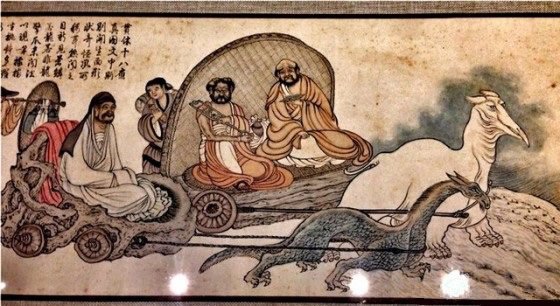
That painting of 1562 is fascinating. Here is a slightly later painting carried out by Wu Bin who became a secretary of a Ming Emporer, who was also a landscape painter. It's interesting that different types of dragon are shown. Painting is circa 1600.


The Chinese Connection
"It is well known that the Chinese have historical records of men interacting with dragons. The book Zuozhuan tells the narrative of how the “ancients raised dragons and how the state used the services of two clans known as the Dragon Rearers and the Dragon Tamers” (Sterckx 2012). As early as 1611 BC the Emperor of China appointed the post of Royal Dragon Feeder, an official whose primary responsibility was to deliver food into the sacred dragon ponds. Historical records tell of a Song Dynasty (AD 960–1279) Emperor who raised dragons within his palace compound (Niermann 1994). The Song overlapped the construction timeframe of Angkor Wat. The Italian merchant and traveler Marco Polo visited China in the late 13th century and brought back credible dragon reports (Niermann 1994; Polo 1961). Ming Dynasty Chinese landscape painter Wu Bin (1573–1620) served for a time as the Emperor’s secretary. Among his paintings is a piece entitled “Eighteen arhats” (Fig. 15), an ink and color handscroll showing Chinese dragons pulling carts. But the mythical quality to Wu Bin’s work suggests that dragons had become extinct by his time (hundreds of years after the Ta Prohm construction)."

Huang Di, the mythic Yellow Emperor, was said to make sacrifices at the summit of Tai Shan, after driving there in a chariot harnessed to six dragons” (Roberts 2004). In his book on dinosaurs, Paul Taylor references the ancient Chinese classics when he described dragons pulling the Emperor’s chariot (Taylor 1989). Perhaps the stegosaur was one of the dragons used for this purpose. If so, one would expect that there would be a harness of some kind to attach the dragons to the cart (as Wu Bin illustrated) and a muzzle and bridle for their heads. Moreover, the spikes would almost certainly need to be removed so that they did not destroy the chariot!

It is a matter of historical record that the Chinese sent numerous delegations to visit the Angkor Kingdom. One envoy at the time of the Chinese Emperor Timur Khan, Zhou Dauan, is particularly noteworthy. He came to Cambodia as part of a mission of Chinese nobles in 1296–1297 and stayed there to chronicle life in the Khmer capital. His records are the only written report of the Angkor Kingdom. As a Buddhist, Dauan took some interest in writing about the temples at Angkor (Daguan 2007). It would be expected that with this level of interaction (and religious synergy) some dragon stories and perhaps even drawings would have been brought to Angkor from China".

Marco Polo lived in China for 17 yrs. around 1271 A.D. and reported that the emperor raised dragons to pull his chariots in parades. In 1611 the emperor appointed the post of a “Royal Dragon Feeder.” Books even tell of Chinese families raising dragons to use their blood for medicines and highly prizing their eggs.
 
Note: This post was recovered from the Sh.org archive.
Username: IndridCold
Date: 2020-07-20 09:37:59
Reaction Score: 2
Hello Randolph, reading the posts with much interest!

First of all, under our current model of the world and physics, it seems very anomalous to me that animals were at one time absolutely gigantic and now they are small. Not just dinosaurs, but everything. All animals were much larger, there is a skeleton of a giant prehistoric sloth in my local museum that is absolutely massive.

It seems to me that a lot of the mysteries about these giant animals (and humans!) of the past would be solved if gravity was not a constant, and does in fact alter over the course of time. I've read old religious texts about our distant past, stating that the earth's gravity was weaker and that during this time there was in fact a water vapor "canopy" suspended above the entire earth. The humidity of the earth in general was greater during that time, more tropical just like the environment we typically associate w the dinosaurs.

Then, due to some sort of catastrophe, the earth's gravity altered radically and the water canopy came crashing down in what is known throughout different cultures as the great flood.

According to what I understand, Brachiosaurus had nostrils on the top of its head. When I read about this dinosaur as a child it was said that it had raised nostrils for the same reason that crocodiles and such animals have raised nostrils: because they spent most of their time submerged under water.

But then as I understand it, experts began to realize that these animals would've had difficulty moving their massive muscles and bones above water, so it would've been impossible moving while submerged under a gigantic amount of water pressure. So it was then decided that they didn't spend any time under water, even though that was the common-sense inference from the nostrils on top of the head. This seems to me another example of a mystery that would be solved if gravity had been different at some point in the distant past.

To what degree is this idea of a variable gravitational force on earth something you seriously consider with regard to our past? Would this help to solve some of the enigmas that still exist with regard to that time period?
 
Note: This post was recovered from the Sh.org archive.
Username: msw141
Date: 2020-07-21 02:26:07
Reaction Score: 1
Hi there. a few questions:

1) do you think that most paleontologists believe that dinosaurs become the "fossil fuels" that we refine into gas for our vehicles?

2) do you think that if it were proven that a cataclysmic event occurred 10,000-20,000 BC, that it would open debate for the possibility that dinosaurs could have lived up to that time instead of tens of millions of years ago? I'm not a fan of explaining things away by "billions of years" when it comes to astonomy, or "tens of millions of years" for geology based on gradualism or whatever it's called. We know that fossils don't get formed because a dinosaur croaks and lays on the ground while silt layers up over him for millions of years. Flooding causes these fossil fields we're finding.

3) Are there fossils of animals that are only tens of thousands of years old? assuming the conditions to create fossils still exists, and is not only a feature of some era millions of years ago. What would the difference between them look like? I've seen that near complete dinosaur that they pulled out of that quarry a few years ago. I'm not convinced you require 10s of millions of years to do that. and anything in the dirt for a million years was at some point a thing in the dirt for 50,000 years. I'm also reminded of something I read that said they think 95% of all species that ever lived were made extinct in two ELE's in our past, not that they dwindled out over eons. I'm curious what an extra tens of millions of years really adds to the fossilization process, other than it supports our notions of geologic time.
 
Note: This post was recovered from the Sh.org archive.
Username: Randolph C
Date: 2020-07-22 09:43:28
Reaction Score: 1

Hi there, thanks for your input and sorry for the late reply, I was actually busy finishing some scientific papers :cool:

Yes, we can speculate about such things of course. As I said previously, one of the major caveats of natural sciences is the principle of uniformitarianism, which assumes that things have always been the way they are, which is just an axiomatic assumption that is unproven. The giant size of some of these ancient critters points to certain parameters possibly being quite different from today. They were probably also again different before the giant dinosaurs came along, because we do not have such absolutely gigantic land living animals in earlier times. Well, we have, but not in the shape of repties but in the shape of anomalously huge insects and other arthropods which were thriving in what is known as the Carboniferous period.

So I consider it a possibility that should be seriously investigated.

Thanks for your questions

ad1: nope, dinosaurs certainly did not become "fossil fuels", that is just a ridiculous idea. Ancient plants become coal over time, there is no question about this. You can literally look at the different types of coal and see how they turn from still recognizable plant matter to jet black anthracite, meaning we do have all the intermediates. I am not that convinced about crude oil, though. All predictions about crude oil have so far been far off the mark. It seems like it is not, or not only, formed by organic matter (speaking rather of marine microorganism than dinosaurs), but that there are other processes involved as well which we do not yet fully understand. It is a question rarely addressed by mainstream geology. The abiogenic hypothesis for crude oil and gas has some merits, though, and there are indeed mainstream scientists who seriously propose it

Abiogenic petroleum origin - Wikipedia

I incline to support this hypothesis as the main factor for the formation of oil and gas deposits, actual organic matter only playing a subsidiary role.

2. Anything is possible. However, this leaves us with the big problem how we can explain the total lack of dinosaur fossils between the end of the Cretaceous and today. Incidentally, there is also absolutely NO fossil record of coelacanths since the Creteaceous, and the Tuatara of New Zealand (basically the last living typically mesozoic reptile) also belongs to a group that has no fossil record at all after the Cretaceoous. It is thus possible that some dinosaurs survived in remote areas of the world. I particularly think about those which were inhabiting thepolar circles in the Cretaceous. They should probably have a better chance than those living in the tropical or moderate climates, because they were already adapted at dealing with very harsh conditions.

If there should be fossils of dinosaurs younger than the Cretaceous anywherein the world, I would unironically first look for them in Antarctica.

There are artifacts and artistic depictions showing very dinosaur-like creatures from all over the world. these can either represent attempts at reconstructing these animals from actual fossil finds (I do not think that the people who built the pyramids, the Roman temples and aqaueducts or the medieval cathedrals were too dumb to come up with a halfway realistic idea about an animal of which they found a skeleton somewehere) or based on encounters with actual surviving dinosaurs. I highly doubt that any have survived today but a couple of 1000s of years ago? Who knows?

3. Yep there are, like for example fossils of cave bears, lions, hyaenas and the like that we find all over the place just in the area where I live. The main difference is, that their bones are very rarely "petrified", i.e. they just are much more like the bones of living animals, with very little if any mineralization. They are much lighter usually. A soon as a bone is completely fossilized, there is no fundamental difference if it is one million years old or 100 million years old (I'm using the official time frame here, which, as I pointed out above, may not be correct due to fundamental difficulties with radiometric dating).
 
Note: This post was recovered from the Sh.org archive.
Username: luddite
Date: 2020-07-25 22:20:33
Reaction Score: 1
Hello Randolph, great thread and answers!

Statement: When I bury animal bones or egg shells they degrade to dust within a observable time frame. I've seen bones concreted before and they don't stand the test of time much better than if they were in dirt. Dinosaurs fossils are empty cavities that become filled with some other substance which becomes a mold of the original form. Nothing would be left after 100years let alone 1000years.

Question: Why can dinosaur bones last 65million years after tectonic shifts, cataclysmic events, weather changes and maybe the odd water damage over that time period?
 
Note: This post was recovered from the Sh.org archive.
Username: Randolph C
Date: 2020-07-25 22:25:51
Reaction Score: 1
Hi there

If you bury animal bones or eggshells, you bury them in soil. Soil is full of humidic acids. Nothing will remain after a short time period, because humidic acids dissolve the calcium phosphate slowly. Best example are the bog bodies. They are almost perfectly preserved (due to anoxic conditions), but their bones are usually entirely dissolved. Humidic acids. To preserve a fossil it has to be covered rapidly in real sediment, sand, mud, lime, whatever, or in volcanic ash or something. No acids - chances higher that something is preserved. Usually nothing is preserved, though, otherwise the world would be literally full of dinosaur skeletons and they would not be so rare. Fossil preservation is always the result of ANOMALOUS conditions (think of catastrophes like tsunamis, volcanic eruptions, yeah even literal mudfloods, poor critters getting stuck in tar pits or quicksand), because under normal conditions nature recycles everything, includings bones and teeth.
 
Note: This post was recovered from the Sh.org archive.
Username: luddite
Date: 2020-07-25 23:11:16
Reaction Score: 1
Thanks for the reply. Even if those substances could last 65m years they are all porous. If we estimate ten times 1 inches of rainfall per year and that only 10 percent of these seep then we have 65 million inches of water through the ground. Water caries lots of things and pH varies as it does. Limestone can't filter over that time frame. The premise that anything remains preserved on the basis of acid absence is ludicrous in the extreme. We are talking more than one human lifetime here. If a average lifespan of 50 years then that is 1.3million lifetimes. (not a billion as I first guessed). The timeline is incredible.


14,334,000,000 inches to the lowest moon orbit distance. So roughly 5 times the distance from earth to the moon in water.

Edited: added some basic math.
 
Note: This post was recovered from the Sh.org archive.
Username: whitewave
Date: 2020-07-26 00:00:27
Reaction Score: 2
@Randolph C, "anomalously huge insects and other arthropods which were thriving in what is known as the Carboniferous period."

A little different type of question for you.

Human beings are almost all irrationally fearful of crawling, creeping, and/or flying insects. This has always seemed like unusual and anomalous behavior considering our greater size, strength and intelligence.

Do you think it possible that humanity shares a genetic memory of the creatures roaming during the Carboniferous age? And wouldn't such a memory be due to sharing that time period with them?

I realize such questions don't play into your academic wheelhouse so I'm not looking for a scholarly response (I can look on wiki for that); I'm more interested in your personal opinion based on your learned experience.

Based on what you've learned and seen, do you think it possible that humans (in one form or another) lived in the same time frame as giant creepy crawlies?

Thanks for letting me color outside the lines.
 
Note: This post was recovered from the Sh.org archive.
Username: Randolph C
Date: 2020-07-26 13:41:40
Reaction Score: 1
Rocks remain that long. Fossils, when fossilized, are basically rocks. why should they behave any different?
Well, our ancestors (in the shape of early mammal-like reptiles) certainly lived in the same environments with these critters, which must have seemed to them like literal bug monsters from "Starship Troopers", and they did so for a long, long time. They were hunted by them. They were eaten by them. They were their most dangerous enemies. As I am an avid supporter of the idea of hereditary memory, this could be a more conventional explanation.
 
Note: This post was recovered from the Sh.org archive.
Username: luddite
Date: 2020-07-26 13:50:58
Reaction Score: 1
65 million isn't some abstract number. It's a bloody long time. Entire continents have come and gone in that time. Water 65million inches of water(more probable that it was 650million inches) would erode the rock. That's what water does. Look at canyons and beaches. It's simply not feasible.
 
Note: This post was recovered from the Sh.org archive.
Username: Randolph C
Date: 2020-07-26 13:58:06
Reaction Score: 0
Yeah it erodes the rock where erosion takes place. It does not erode the rock where sedimentation takes place. There only more and more sediment is added on top, think of a river delta for example. Granted the 65 million are just a number. I mistrust radiometric dating. Radiocarbon dating has been shown many times to give absoluetly unreliable results, practically since Libby invented the method. There are so many sources of error, that it is just ridiculous. I have little doubt that other methods are prone to even larger margins of error when we try to date even older specimens/rocks. We can be off by a huge margin. withthe offical geological timescale. But that does not matter, we talk about the principles of fossil formation/preservation here.

Fossils do not form where erosion takes place. fossils do not form where atmospheric water dissolves rock. They form in sedimentary basins/environments where sedimentation, not erosion, takes place. They can be completely dissolved of course by water, and this has happened many times, when the rocks are again exposed to erosion/subsurface erosion by groundwaters. In that case they either completely dissolve, as you correctly say, or an impression is preserved, granted that the surrounding rock was solidified enough when that took place and the fossils were more prone to dissolution than the surrounding sediment. This depends on the chemical/mineralogical composition of the fossil and the surrounding rock (which can be very different, think of a pyrite fossil in a claystone), the pH of the water involved, the chemicals in the water and a lot of other parameters.
 
Note: This post was recovered from the Sh.org archive.
Username: ritch
Date: 2020-07-26 21:37:52
Reaction Score: 1
Hi Randolph interesting thread. I've been wondering about the soft tissue issue, would it be possible to tell in any way whether a fossil had been flash frozen or even 'cooked' before it was fossilised? Also the vast chinese loess deposits do they cover or contain any dinosaur or other fossilised remains?
 
Note: This post was recovered from the Sh.org archive.
Username: Huaqero
Date: 2020-07-28 12:22:28
Reaction Score: 1
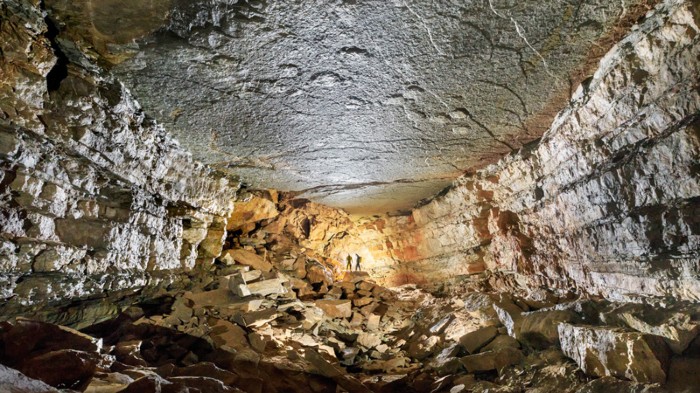
Gigantic dinosaur footprints are found on the roof of a cave

"The site was then at the planet’s surface, but geological processes have buried and tilted the sediments,
and the prints are now on the cave’s roof, 500 metres underground."

d41586-020-00972-y_17851312.jpg

The earth literally turned upside down, yet the footprints remained intact :confused: :unsure: :ROFLMAO:
 
Note: This post was recovered from the Sh.org archive.
Username: whitewave
Date: 2020-07-28 14:06:09
Reaction Score: 0
That line of reasoning, while sound, presupposes that for 65 million years+ no changes to the environment occurred in areas where dinosaur remains are found. No earthquakes, no mudslides, no volcanic eruptions, no human development, no animal predation, no floods washing away all that preservative sedimentation, etc. All those bones just sat undisturbed slowly building up cultural layer upon layer for millions of years? A few hundred years, maybe but millions and millions and millions (say it at least 65 times)? Seems unlikely to say the least.
 
Note: This post was recovered from the Sh.org archive.
Username: Worsaae
Date: 2020-07-28 15:53:48
Reaction Score: 0
What riddle was this?
 
Note: This post was recovered from the Sh.org archive.
Username: Randolph C
Date: 2020-07-29 20:04:02
Reaction Score: 1
Sorry, I have been busy for a few days, so I could not reply immediately. The whole madness of the current events doesn't spare anyone. me and family included.

Yeah, the soft-tissue issue is something that bothers me. Fossilized "soft-tissues" aren't a great deal, we are aware of them since the 19th century, but what we usually call "fossilzied soft-tissue" is actually petrified/mineralized/carbonized soft tissue, i.e. stuff that has been turned into anything from phosphate to carbon to pyrite, whatever.

The dinosaur soft-tissue, which is still transparent and flexible is a hard pill to swallow and I can't provide a straight answer for that. There are several possibilities, i alluded to some of them already:

- The Schweizer lab are scientific fraudsters and all that stuff is paleo-bedtime-stories.
- We know jack shit about how fossils really form (at least in some extreme cases) (here your idea comes into play, we also had the possibility of "electric fossilization" which sounds crazy at first, but becomes much more reasonable as soon as one digs a bit deeper into the issue)
- The timeline is severely off and dinosurs are not nearly as old as we believe.

Concerning the huge Chinese Loess deposits: they are very young (ice-age/post ice-age stuff), and yes, they contian fossils, but it is mostly land snails and mammal bones. No dinosurshave ever been discovered (or at least officially discovered) therein.
Well, it always depends on where you are on planet Earth. there are areas, like the Russian platform in pre-Ural Russia/the Baltics, where literally nothing happened since the Cambrian. Cambrian rocks containing trilobites are soft as chocolate (literally), Ordovician sands and "limestones" are so soft, that you can prepare the fossils with a tooth-brush. No major volcanic activity, no major orogenetic processes, no cataclysms of any kind, just a huge sedimentary basin slowly subsiding. In other parts of the world, like large parts of the big mountain belts (think of the Alps in Europe or the Rockies in North America), things have been wild and there are large areas where you don't find fossils at all. Everything has been destroyed due to numerous events, some of them certainly cataclysmic on a scale we can hardly imagine. So there is no "rule-of-thumb" that can account for everything. The Earth is a "living" planet, and whereas some areas have been affected in a major way by previous cataclysms, some others have been spared almost completely. The latter are usually those where we find most of the fossils.
As they are undeniably there, I have no reason to doubt it. But look at the footprints, what do you see? They are convex. Do animals leave convex footprints? Of course not. So what has happened is that the underlying sedimentary layer (which was probably softer or more easily dissolved by running water or whatever) has collapsed/been dissolved, so that you are now looking at the UNDERSIDE of the next sedimentary layer, which preserves the CONVEX relief of the footprints.
The riddle of Deinocheirus, a huge predatory dinosaur found by the Polish-Mongolian expeditions in the 1960s in the Gobi desert. Only a pair of arms and the shoulder girdle were found with the most immense claws that any dinosaur ever possessed. No academic paleontologist ever had a really good idea what the complete beast might have looked like, and they came up with alot of fanciful "reconstructions". Dinotopia portrays Deinocheirus as a basically harmless onivore with no teeth, closely related to the well-known but much smaller Gallimimus of Jurassic Park-fame.

Some years ago a complete skeleton was discovered. It ended up (illegally) on the international fossil market and how it was relocated, re-assembled and finally returned to Mongolia is like a real-life detective story. It turned out that Deinocheirus was exactly as predicted in Dinotopia, a giant ornithomimosaur (as we call these), and not a terrifying predator. I found that very amusing and very much indicative that Dinotopia was not written by an ignoramus, but by someone who not only loves dinosaurs, but also knows a damn lot about them.
 
Note: This post was recovered from the Sh.org archive.
Username: EUAFU
Date: 2020-08-01 05:59:48
Reaction Score: 0
Well well well. Don't you know that nobody was plowing the fields or building anything anywhere in the world? How could they find such "fossils" if none of these activities were carried out and only started to occur in the 19th century?
 
Note: This post was recovered from the Sh.org archive.
Username: Felix
Date: 2020-08-01 18:08:18
Reaction Score: 1
hi Randolph
thanks for doing this!

first question, have you heard of this hypothesis (presented for public consumption in a ted talk)


and if yes, is it generally accepted in paleontology?

second question, are there any examples of findings from your field having important practical implications or leading to scientific advancements that are helpful in other fields? (i.e. not just an increase in knowledge about dinosaurs for its own sake)
 
Tips
Tips
Please respect our Posting Rules.
Back
Top