Atmospheric energy - A Retrospective

Here's something that might have relevance to this discussion .

Back in the early 70's at tech college we were working on electrical motor systems - mainly three phase AC motors .

However we did a bit of playing with an old DC series wound motor. The instructor told us the usual bumph - including the fact that DC motors are better and other forgettable stuff.

However he did tell us not to mess around too much with it and to never run under load free conditions .The motor would just accelerate uncontrollably .So myself and another apprentice decided to do that, red flag to bull springs to mind .

Disconnected the motor from the machinery attached to it but before we could try it out the instructor caught and said some swear words and asked us what we were playing at. "Trying to build a time machine sir - thought if we reached the speed light ,you know HG Wells anall that"

Turns out that motor would accelerate until self destruction since the heat generated would destroy the bearings and the housings. Forgot all
about that incident but having read through this thread a bit a light bulb went off in my head.

"So where would the energy come from? I now ask myself"

This fellow here says never run this type of motor because there is no bearing at the load end , is that a convenient way to hide the constant acceleration thing?


View: https://www.youtube.com/watch?v=EAxWAtvrVto


I could be wrong but removing the drive end bearing maybe just a convenient way of hushing up that phenomenon. He doesn't mention the fact that DC motor must only be run under load.

Alternating current flows in one direction and reverses 180 degrees 50 times a second, if we are still on 50Hz . Back and forth. So a motor accelerates in one direction and a fraction of a second later it current should provide a force of rotation in the opposite direction. How did this system ever catch on . The motor must receive it's impetus from the initial burst of current. The constant switch in direction back and forth must limit the power of the motor - wasting electrical power and pouring money into the electric company coffers.

Direct current provides a rotational force in one one direction and the amount of current would be limited by the load attached to the rotor. Must be far more efficient.

Correct me if I'm wrong - was involved in industrial electrical engineering most of my working life . Never thought to question the damn thing.

I will watch the Pete and Pete vid when I get the chance . I will have a chuckle if I've wasted all those years.

I know we used to
 
wow thats real interesting about dc motors, never knew that, hmmm, it just keeps speeding up as in some kind of flywheel effect, the energy keeps getting added to hmmm....
 
Thinking about it further - AC energy is not natural , it's a greedy man invention forcing us to pay for what is essentially produced naturally in our environment and freely available for use .

A metal lightning conductor will channel atmospheric electrical charge to earth - that's it's job. Put a break in that conductor then it will no longer do that. In that break in the conductor put an open switch connecting to some form of heating and lighting ,these being earthed .

Nothing will happen until the switch is closed . Then atmospheric electrical energy ,Direct Current , will flow through each device . The limiting factor of that DC flow will be governed by the resistance of the lightning conductor and the resistance of cables to devices and any associated loads.

That seems to be what the series wound DC motor when run without a load tells me. I don't mind if anyone can tell me different . We are told that atmospheric voltage is high , that's good - it isn't the voltage that kills , it's the current.

I am supposing all this was known pre-reset as evidenced in all those old building photos and designs. I am wondering what was used for heat and lighting?

Maybe those power stations we see are just there to convert free atmospheric energy to chargeable AC

Also no need for lightning to provide the electricity. It's there in the air
 
Last edited:
Back in the early 70's at tech college we were working on electrical motor systems - mainly three phase AC motors .

However we did a bit of playing with an old DC series wound motor. The instructor told us the usual bumph - including the fact that DC motors are better and other forgettable stuff.

However he did tell us not to mess around too much with it and to never run under load free conditions .The motor would just accelerate uncontrollably .So myself and another apprentice decided to do that, red flag to bull springs to mind .


This is interesting. When I did an Electrical Engineering degree in the 80s, I was told that a DC motor has an automatic self-speed limiter built in, because the back EMF generated by the spinning generator (all electric motors are also generators) gets more and more as the speed increases. So you have to put in exponentially more voltage to get exponentially smaller increases in RPM. I've no idea how th current (Amps) curve would look in those cases.

However that's probably wired differently. I don't know how.

With the fixed coil and the moving coil wired in series, the generator feeds back into the motor. This is a new concept to me. So you get a different set of design issues. Obviously, and most importantly, it burns itself out.

Question is, if it had a load applied, would the load restrict the speed? Or if you drew useful work off the motor, like moving ball bearings up hill into a hopper.

And then what would happen? Disclaimer I don't know...

Disconnected the motor from the machinery attached to it but before we could try it out the instructor caught and said some swear words and asked us what we were playing at. "Trying to build a time machine sir - thought if we reached the speed light ,you know HG Wells anall that"

Turns out that motor would accelerate until self destruction since the heat generated would destroy the bearings and the housings. Forgot all
about that incident but having read through this thread a bit a light bulb went off in my head.
 
This is interesting. When I did an Electrical Engineering degree in the 80s, I was told that a DC motor has an automatic self-speed limiter built in, because the back EMF generated by the spinning generator (all electric motors are also generators) gets more and more as the speed increases. So you have to put in exponentially more voltage to get exponentially smaller increases in RPM. I've no idea how th current (Amps) curve would look in those cases.

However that's probably wired differently. I don't know how.

With the fixed coil and the moving coil wired in series, the generator feeds back into the motor. This is a new concept to me. So you get a different set of design issues. Obviously, and most importantly, it burns itself out.

Question is, if it had a load applied, would the load restrict the speed? Or if you drew useful work off the motor, like moving ball bearings up hill into a hopper.

And then what would happen? Disclaimer I don't know...
I am going back to the early 70's here . The only DC system we looked had that series wound motor and the instructor did state that the motor would accelerate to destruction if run load free. I have had a little look around but have not come across another mention of this effect. I do remember the back EMF from the AC motor things, all many years ago though.

Interesting that DC motors have an auto self speed limiter - would that be because back EMF is negligible? excuse my ignorance

I believe there must be other than the Series wound motor but these were never covered . Most of the work was on 3 phase AC stuff - heavy industrial.

I'm thinking along the lines of voltage induced in tall metal unearthed structures by earth's rotating magnetic field. All substances conduct to some degree and there must be a degree of electric current flow in all things. Free energy if we could harness it. Maybe we have at some point in the past.
 
Board should look at the 40" & 60" "not" telescopes at Mount Wilson and Yerkes Observatories circa 1900s. Drawings show a multi-ton mercury filled articulating armature base of the 5 story tall "scope"? I'd link it and post pics but it's not allowing me to. MW also had a sunbeam light that cast up to 160miles out to sea from side of Observatory. There's some old photos of that as well, it's so hard edged and white you think it's 2 separate photos on a background board until you realize it's a white laser beam shooting over the Pasadena.
 
Board should look at the 40" & 60" "not" telescopes at Mount Wilson and Yerkes Observatories circa 1900s. Drawings show a multi-ton mercury filled articulating armature base of the 5 story tall "scope"? I'd link it and post pics but it's not allowing me to. MW also had a sunbeam light that cast up to 160miles out to sea from side of Observatory. There's some old photos of that as well, it's so hard edged and white you think it's 2 separate photos on a background board until you realize it's a white laser beam shooting over the Pasadena.
Wonderful .That's the Alexandrine mirror / Plato burning mirror I have read in " old" Persian / Arabic literature.
 
I can say now with confidence that there are at least three devices which can be powered directly with atmospheric electricity.
  • Motors (Coronamotors)
  • Lights (Gas Discharge Lamps)
  • Bells (Franklin's Bells)
It is suspected that so-called fireplaces also used atmospheric electricity to create heat but until I have a better understanding of how they worked I don't want to say for sure.
 
I was very fascinated by this post. The idea that in the past the etheric forces of the Earth were harnessed to produce energy is an area that should be explored in depth as well as the idea that the function of various buildings have probably been hidden and concealed from us by history books. I have translated the text into Italian and if anyone would like I can provide it for free as an epub version. I show you two old prints of the city of Turin, Italy, that show how it was full of towers and tall buildings that no longer exist.


Attachments

  • Turin 1.jpg
    Turin 1.jpg
    498.7 KB · Views: 115
  • Turin 2.jpg
    Turin 2.jpg
    32.8 KB · Views: 98
Last edited:
In these two photos of the same building taken during daylight, you can see the solid orb which apparently glows brightly at night.
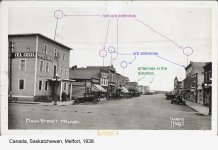
I noticed this same setup was widely used in old photos of Canadian buildings in the early 1900s. Lots of buildings and houses had antennas attached to their roofs, and usually at the tip of the antenna there was an orb. Sometimes there wasn't, but regardless it happened so frequently enough that I couldn't ignore it.

I'll attach some photos.
 

Attachments

  • orb-48799.jpg
    orb-48799.jpg
    683.5 KB · Views: 35
  • orb-48800.jpg
    orb-48800.jpg
    1.3 MB · Views: 35
  • orb-48801.jpg
    orb-48801.jpg
    1.4 MB · Views: 34
I noticed this same setup was widely used in old photos of Canadian buildings in the early 1900s. Lots of buildings and houses had antennas attached to their roofs, and usually at the tip of the antenna there was an orb. Sometimes there wasn't, but regardless it happened so frequently enough that I couldn't ignore it.

I'll attach some photos.

I noticed something else in the distance on that second photo.

1779416550545.png

1779416622718.png
 
Tips
Tips
Please respect our Posting Rules.
Back
Top