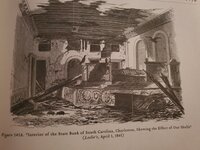
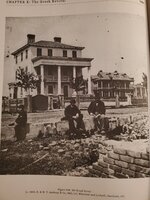
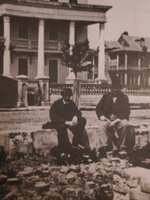
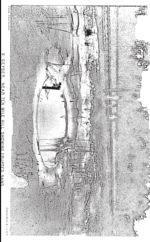
After reading the thread, "Single Photo:1865 - Nine Story Building in Charleston" I wanted to share what I found pertaining to Charleston and it's peculiar run of "bad luck". Charleston may be like many cities during the period - another unluckiest city in America.
Were the ruins of 1865 after 2 Years of Union Bombardment? or, A Great Fire earlier, in December 11, 1861?
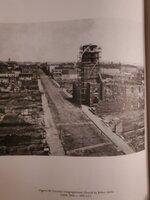
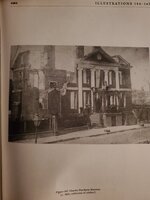
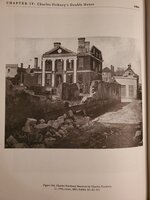
The photos may be off by 4 years. Pertaining to the photos everyone circulates that shows Charleston destroyed by the Civil War. As mentioned by many, fires cannot reduce the rubble to nothing, as seen in just about every city. At any rate, several sources claim that the photos that are circulated of the presumed 1865 destruction are the result of the Great Fire of 1861. Screenshot below of the first source:

The fire destroyed 1/3 of the city - from start to finish in just under 24 hours.

This is corroborated by many newspapers. I mention one because I want to discuss this destroyed church that "allegedly wasn't too old."

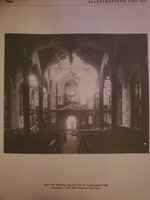
This is the "circular church", built in 1806, but it wasn't actually built in 1806, despite what this dingy clipping says:

(Above: Charleston daily courier- May 23, 1806)
The Church was actually preceded by an older church, at least from 1681, a "Meeting House" built in the exact same address (As an aside, Wikipedia references the church photo of the ruins seen above with reference to the 1865 destruction.) The records of the early 17th century church were conveniently lost in the worst "typhoon" in coastal history...
The Great Earthquake of September, 1 1886
This was either the biggest earthquake in Atlantic Coastal History, or just at the time. In all of the calamities, the city is either "mostly destroyed", "destroyed", or "devastated". In every single event. When do they have time to rebuilt? When they are being assaulted daily by cannon fire for two years from 1883-1885?

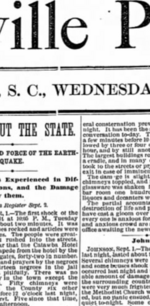
In the Abbeville Press on 9-8-1886, this Earthquake is made out to be the greatest disaster to date.

Volcano in Charleston

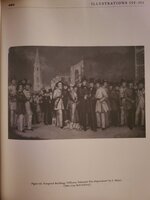
(source: SC state museum- 1886 painting- "people running the night of the Earthquake")
What are they uniformly running from, and trampling people in the process, a dust cloud? People appear to be looking over their backs at whatever that is.

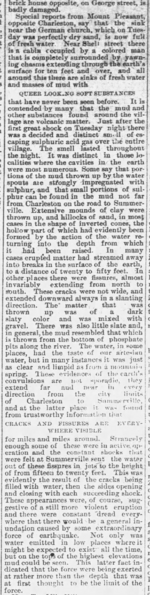
I wanted to mention the brimstone reference above, because sulfur dioxide gas is very poisonous. This reminded me of alternative theories about why epidemics are thought to be observed around earthquakes, volcanic activity, and other cataclysms (eg. Daniel Defoe, Diary of a Plague Year and Comet descriptions). Bubonic plague allegedly killed 1/3-2/3 of Europe (huge mortality spread, very scientific). At any rate, I wonder if many people killed by a huge release of sulfur dioxide.
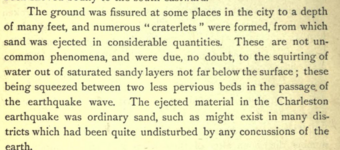
Here is another article describing the extent to which the ground opened up.

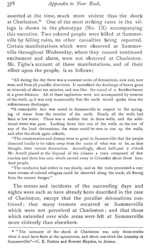
"... there was the distinct smell of escaping sulphuric acid gas over the entire village." Very toxic gas (eg. Taal volcano 2020, 15 deaths.)
This was mentioned in St. Paul Globe (9-5-1886) as a volcano.

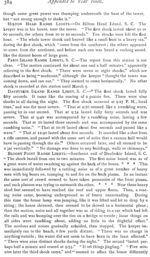
More evidence of volcanic eruption (Chattanooga Daily Times, 9-3-1886):

It seems that a possible volcano was sighted off the coast by a lighthouse (source: Parsons Daily Sun September 10, 1886).

And this series of disasters doesn't include the diseases that were reported in the area related to either being without running water, or sulfur dioxide etc...
August 25, 1885 Great Cyclone Devastates Charleston (Elsewhere referred to as Cat 3 Hurricane, that "damaged 90% of buildings")

Recent Appraisals of 1886
These do not mention anything from the newspaper clips above. Ultimately, what left the city of Charleston in ruins?
1861 - Great Fire?
1863-1865 - Union Siege
1885 - Great Typhoon?
1886 - Great Earthquake?
To me, the finding of evidence of volcanic activity is the most fascinating part. While the Earthquakes are not suppressed, there is so little information in the present that admits to volcanic activity. The USGS has a very good report on the 1886 Earthquake here. How could they compile these maps (he used newspaper clippings to compile them (see p.6))?
 While there are some photos showing a few small buildings collapsed from the 1886 earthquake, they are not as impressive as the total devastation "1865 photos" purportedly from the Civil War. What appears to be ignored is the convincing observations of volcanic activity, which is believable considering this was a 7.3 R earthquake and the admission that there are inactive volcanoes in SC.
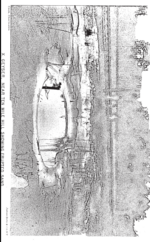
In Summary, the photographic and newspaper record is vague and with little agreement among sources. Eyewitness accounts as reported in newspapers suggest volcanic activity in Charleston, which is not discussed in the present. The destruction of the cities with limited debris is obviously from a higher energy source and not something that can be readily explained. Volcanic mud formation and flooding could certain explain the settling of buildings , as seen below.


Were the ruins of 1865 after 2 Years of Union Bombardment? or, A Great Fire earlier, in December 11, 1861?
The photos may be off by 4 years. Pertaining to the photos everyone circulates that shows Charleston destroyed by the Civil War. As mentioned by many, fires cannot reduce the rubble to nothing, as seen in just about every city. At any rate, several sources claim that the photos that are circulated of the presumed 1865 destruction are the result of the Great Fire of 1861. Screenshot below of the first source:
The fire destroyed 1/3 of the city - from start to finish in just under 24 hours.
This is corroborated by many newspapers. I mention one because I want to discuss this destroyed church that "allegedly wasn't too old."
This is the "circular church", built in 1806, but it wasn't actually built in 1806, despite what this dingy clipping says:
(Above: Charleston daily courier- May 23, 1806)
The Great Earthquake of September, 1 1886
Volcano in Charleston
(source: SC state museum- 1886 painting- "people running the night of the Earthquake")
What are they uniformly running from, and trampling people in the process, a dust cloud? People appear to be looking over their backs at whatever that is.
I wanted to mention the brimstone reference above, because sulfur dioxide gas is very poisonous. This reminded me of alternative theories about why epidemics are thought to be observed around earthquakes, volcanic activity, and other cataclysms (eg. Daniel Defoe, Diary of a Plague Year and Comet descriptions). Bubonic plague allegedly killed 1/3-2/3 of Europe (huge mortality spread, very scientific). At any rate, I wonder if many people killed by a huge release of sulfur dioxide.
Here is another article describing the extent to which the ground opened up.
"... there was the distinct smell of escaping sulphuric acid gas over the entire village." Very toxic gas (eg. Taal volcano 2020, 15 deaths.)
This was mentioned in St. Paul Globe (9-5-1886) as a volcano.
More evidence of volcanic eruption (Chattanooga Daily Times, 9-3-1886):
It seems that a possible volcano was sighted off the coast by a lighthouse (source: Parsons Daily Sun September 10, 1886).
And this series of disasters doesn't include the diseases that were reported in the area related to either being without running water, or sulfur dioxide etc...
August 25, 1885 Great Cyclone Devastates Charleston (Elsewhere referred to as Cat 3 Hurricane, that "damaged 90% of buildings")
These do not mention anything from the newspaper clips above. Ultimately, what left the city of Charleston in ruins?
1861 - Great Fire?
1863-1865 - Union Siege
1885 - Great Typhoon?
1886 - Great Earthquake?
To me, the finding of evidence of volcanic activity is the most fascinating part. While the Earthquakes are not suppressed, there is so little information in the present that admits to volcanic activity. The USGS has a very good report on the 1886 Earthquake here. How could they compile these maps (he used newspaper clippings to compile them (see p.6))?