De Virga World Map - Garden of Eden in South Africa?

dreamtime

Administrator
Staff member
Joined
Aug 25, 2020
Messages
2,005
Reaction score
8,103
1652888480831.png
photo_2022-05-18_17-45-11.jpg

De Virga World Map

The world map by Albertinus de Virga from 1411 or 1415 is of Venetian origin and consists of two parts:
  1. a calendar with representations of the signs of the zodiac and a table for calculating the positions of the moon.
  2. the actual circular map of the world.
It is a synthesis of a typical world map of the Middle Ages and a portolan. It has highly accurate representations of the supposedly then unexplored regions of Asia, Africa and Northern Europe. Even southern Africa - a few years before historians say that the Portuguese circumnavigated it - shows outlines that correspond to reality.

The map was rediscovered in 1912 by an art collector in an antiquarian bookshop in Croatia, Albert Figdor. Its authenticity was later confirmed by the University of Innsbruck.

The map’s first known owner, the wealthy Viennese collector Albert Figdor, bought it in 1912 from a Dalmatian source after having it authenticated by Franz Ritter von Wieser, a well-known Austrian cartographical scholar. Source

The place of storage indicated by Paolo Revelli in 1937, the French National Library in Paris, could not be confirmed. Its whereabouts after a failed auction in 1932 are considered uncertain in scholarly circles. Possibly it was stolen. According to "The world map, 1300-1492. The persistence of tradition and transformation", the map disappeared with its Jewish owners in 1932. This at a time when the biblical history of Israel probably wasn't as established as today - before the founding of modern Israel in 1948, which is based upon the Biblical narratives.

1652889114602.png

Only Wieser, Gilhofer and Ranschburg based their work on the original map and not on copies. Unfortunately, the files of Gilhofer and Ranschburg were destroyed during the Second World War in Vienna. Just like the "Holy Land map" by Lucas Cranach (probably this one) reappeared in recent years, it may be possible that this map emerges again at one point. Although the question is if the "rediscovered" maps are still the same as the originals.

On this map, a place that appears to be the Garden of Eden is located at the southernmost point of Africa, from which the four rivers mentioned in Genesis flow inwards into the land.
1652898732990.png
Atlantis.jpg
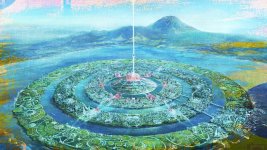
The place on the map resembles some visions of Atlantis - a round city with different layers. The diameter of the structure would be around 150 miles, if it correspondends to reality.

The way this supposed Biblical Garden of Eden is shown, is pretty interesting - what could it be? The structure is almost the size of South Africa - enough space to seed a new human race, if that's what happened in the Garden of Eden.

HerefordEden-1024x769.jpg
1652899996608.png

Compare with the depiction of Eden from another Mappa Mundi - Hereford Map (left), Ebstorf Map (right). On both maps the location of Eden correspondends to the modern location of Japan, and like Japan it's shown as an Island on the Hereford map.

The description of the Ebstorf map says: "Asia is called after a queen of the same name. Its first region from the east is Paradise, a lovely and all-around pleasant place, uninhabitable by humans and surrounded by a sky-high wall of fire. In it is the wood of life, i.e. a tree; whoever eats of its fruit does not grow old and never dies."
What else do we have on the Virga map? A place that looks like Gog and Magog behind the walls of Alexander.

1652900748853.png

It should be noted that there are some hints that the original Bible stories actually took place in South Africa - it seems modern day Jerusalem doesn't fit to the Biblical descriptions for Jordan River, and other areas, most importantly the area is too small.

1280px-20100923_mer_morte13.jpeg
flat,1000x1000,075,f.jpg

Jordan River (left)- if you can't jump across it without getting wet, ask God to part the waters. The Orange River to the right seems to fit better with the Biblical description.

The Jordan River in the Middle East is not large enough to justify a parting of the waters by "God", for example - the Israelites could have simply walked through it. There are no archeological signs that the river bed of Jordan River was way larger in history.

Some speculate the true Jordan River is actually the Orange River in Africa.

Just like the Queen of Sheba is moved by Jewish scholars from Ethiopia to present-day Yemen (even though there no written source in ancient history mentioning Sheba in the context of Yemen), probably for political reasons, the potential relevance of Africa for Biblical history seems to be neglected in this case as well.

Israel Finkelstein and Neil Asher Silberman suggest that the kingdom was located in southern Arabia. Source

"Suggest" is something of an understatement. They just brush off every other possibility:

1652903711752.png

At the same time we have the Black Hebrew Israelites who push a highly distorted self-centric view of Bliblical history. The de Virga map seems to be used by nationalist Africans to support their claims. In this case they may be right, though. For what it's worth - maybe it doesn't matter to find the one and only location of the Bible - it seems almost all places everywhere in the world have some form of connection to the Bible stories.


A couple places in South Africa with a Biblical background:
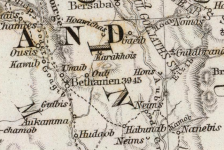
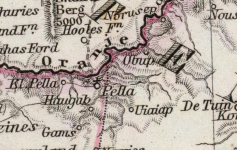
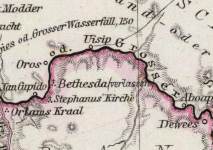
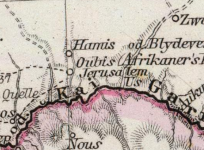
bethanien.png pella.png bethesda.png jerusalem.png
Bersaba, Bethanien - Pella - Bethesda - Jerusalem
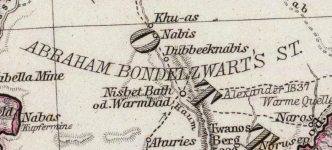
abraham.png
Something with Abraham

Of course, this could be explained conventionally with the Missionaries naming these places after the Bible.


Some interesting places:

Le MIRAGE Squiver_08D6361 1_adj.jpg
le-mirage-desert-lodge.jpg

This is a Resort in Namibia (Le Mirage) in the middle of nowhere - was it really built anew, or only renovated to hide the ancient history and Biblical connection?


Schloss_Duwisib (1).JPG

Duwisib Castle - really built in 1909, or older?
Wikipedia says the Duwisib Castle a grand pseudo-medieval looking fortress in the hills of the semi-arid Southern Namib region of Namibia, 72 km southwest of Maltahöhe, Hardap Region. It was built in 1909 to serve as the residence of Hans Heinrich von Wolf, a German military officer. Since 1979 the castle has been owned by the government.

There doesn't seem to be any place in the world that doesn't claim a biblical history - from Japan, over Germany, California to France.

The location doesn't matter to me - the Bible is too censored to use it as a historical document, and due to the worldwide spread of Christianity, we see references to the Bible everywhere. In this case what I find most interesting is that we have a map that disappeared under mysterious circumstances, which showed a place for Biblical paradise/Garden Eden that contradicts the other maps that usually place it near the Middle East or India.

It seems the Jewish family that owned the map was the niece from the guy who originally discovered the map in 1912 and her husband. They had intended to sell the map in 1932:

When Figdor died on 22 January 1927, his magnificent collections became the property of his niece Margarete Becker-Walz, the wife of a prominent Heidelberg lawyer. (...) If Becker-Walz withdrew the map from the auction on Fischer’s advice — and withdraw it she did — neither of them would have had much opportunity to proceed further. Early in 1933 Hitler and the National Socialists came to power in Germany. Father Fischer was still at the Jesuit college of Stella Matutina in Feldkirch and would soon have felt both the worsening relations between Germany and Austria and the anti-Catholicism of the Nazis. By April of 1934 Stella Matutina’s large contingent of German students had to transfer to Saint Blaise in Switzerland because the Austrian Jesuit school could no longer grant them valid diplomas.

No published author has been more fervently convinced of a cartographical record of Norse transatlantic sailings than the German Ptolemaic scholar Father Josef Fischer, S.J. (1858–1944), whose probable ties to the Vinland Map and demonstrable ties to the auction house of Gilhofer & Ranschburg in 1932 merit further scrutiny in connection with the disappearance of the de Virga world map. Source

Was this a Zionist attempt at rewriting history before founding modern day Israel? Or did the Jewish family disappear in the National Socialist concentration camps?

What we have at least is a connection with a Jesuit Father.

One possibility is that this map showed an earlier attempt by the Church history forgers to place the mythological Eden in a different place, but later they went with India/Asia, and that's why the map had to disappear (until it somehow appeared again in 1912) - maybe the place where humans got "created" was neither South Africa or Asia, but both were actually attempts to rewrite history. Although the de Virga map doesn't show any overt Christian Church symbolism like the other mappa mundis (with the exception of paradise and Gog and Magog) - which is why I consider the Virga map a bit more credible than the others. The Hereford and Ebstorf maps are full of blatant Church propaganda. The existence of paradise and the Alexander wall on this map suggests it's either church propaganda as well, or both were real and only later adopted as Christian mythology.
 
On this map, a place that appears to be the Garden of Eden is located at the southernmost point of Africa, from which the four rivers mentioned in Genesis flow inwards into the land.

There is no indication on the map that it is a representation of the Garden of Eden is there? If not then this is purely supposition. If four rivers flow into the land, where does all that water go, down into the earth?

The diameter of the structure would be around 150 miles, if it correspondends to reality.

The way this supposed Biblical Garden of Eden is shown, is pretty interesting - what could it be? The structure is almost the size of South Africa - enough space to seed a new human race, if that's what happened in the Garden of Eden.

Who exactly is doing the supposing that this is the Garden of Eden? From the poor quality image it looks as if you are claiming that the size of South Africa constitutes a circular structure of 150 miles in diameter surrounded by a larger circular area of maybe 300 miles in diameter as it's depicted on the map. If this is 'supposedly' the Garden of Eden shouldn't there be better quality images around?

What else do we have on the Virga map? A place that looks like Gog and Magog behind the walls of Alexander.

Once again, does the map indicate that this has anything to do with Gog and Magog? Do you mean the mythical giants or locations? It looks more like a dry dock for shipbuilding to me.

At the same time we have the Black Hebrew Israelites who push a highly distorted self-centric view of Bliblical history. The de Virga map seems to be used by nationalist Africans to support their claims. In this case they may be right, though.

This "highly distorted self-centric view of Bliblical history" isn't exclusive to the Black Hebrew Israelites. You propose that "they may be right" based upon pure speculation - that the maps are genuine, that the feature is actually the Garden of Eden and that the dry dock structure has something to do with Gog and Magog, etc.

There doesn't seem to be any place in the world that doesn't claim a biblical history - from Japan, over Germany, California to France.

Isn't that a coincidence? Especially when you think that there doesn't seem to be any place in the world that doesn't claim to have been originally populated by the Lost Tribes of Israel.

Or did the Jewish family disappear in the National Socialist concentration camps?

Why would you propose this rather than say that they emigrated, or died of disease, or got run over by a tram? Why bring up the holocaust specifically?

This post contains a great deal of speculation, all with a very Hebrew/Jewish flavour.

PS: Your title is missing an "of".
 
Yes, it's all speculation.

Maybe the structure wasn't intended to show the Garden of Eden. I wonder what else it could be? At least we have 4 rivers, so this is a pattern.

Regarding Gog and Magog and the wall, this is speculation as well, but the location on the map is similar to the depiction of this on other mappa mundis. Could it be something different? Of course. Both the depiction of paradise as well as the walls of Alexander is a reocurring theme on several mappa mundis. So it's not far-fetched.

I mean this: Gog and Magog behind Alexander the Great's wall in China – purple motes

During the Middle Ages, the Gates of Alexander story was included in travel literature such as the Travels of Marco Polo and the Travels of Sir John Mandeville. The identities of the nations trapped behind the wall are not always consistent, however; Mandeville claims Gog and Magog are really the Ten Lost Tribes of Israel, who will emerge from their prison during the End Times and unite with their fellow Jews to attack the Christians. Polo speaks of Alexander's Iron Gates, but says the Comanians are the ones trapped behind it. He does mention Gog and Magog, however, locating them north of Cathay. Some scholars have taken this as an oblique and confused reference to the Great Wall of China, which he does not mention otherwise.​

The authors discussing the fate of the map owners discussed the whereabouts and implied they disappeared with the National Socialist persecution of Jews, so it's possible they were politically persecuted in that time and sent to such a camp as many Jews were, whatever happened to them there. I didn't speculate further.

A big part of our history is shaped by judeo-christian culture. The references to Christianity are everywhere, including on old maps. Whatever that means. For example, whether "paradise" or the walls of Alexander really existed - people took it seriously at one point, so I guess it's interesting to analyze this stuff and look where it came frome.
 
Well tbh this seems to be more of an accurate location for Garden Of Eden, 4 rivers flowing from the center as well.

I prefer that one as well. The map also doesn't have the usual christian symbolism, which makes me think the De Virga map is part of the church rewriting of history, just like the other Mappa Mundis we have from that time, including the work by Marco Polo and John Mandeville, which is often referenced on those maps as sources for the claims of these christian beliefs.

This location at the north pole also makes more sense to explain what this place originally was. If there was an entrance into "another world" (some call it inner earth), then it would explain why humans originated from there.

Also note the discrepancy of the mappa mundis - on one hand they show that people had a good general idea of borders, cities, etc., which is only possible when you have a good scientific understanding of things. On the other hand they contain ridiculous references, and are generally painted in a childish manner.

This discrepancy is the smoking gun of the history forgers who tried to paint the middle ages in a certain light. In contrast to this, the Mercator map is of consistent scientific quality in every way.
 
This is one of my favorite topics. I’m of the opinion that there were multiple “Edens” and this well-written OP showcases much evidence for one of these “Gardens” being located in South Africa. As someone who believes in the multiple-creation theory, your post leads me to question the chronology. Was this the first Eden? 2nd? 5th?
 
Table mountain which is in Cape Town looks like it could have been one of those huge trees (Which is what I believe). It may have been cut down. Perhaps it was the Tree of the Garden of Eden.
 
I’m of the opinion that there were multiple “Edens” and this well-written OP showcases much evidence for one of these “Gardens” being located in South Africa. As someone who believes in the multiple-creation theory, your post leads me to question the chronology. Was this the first Eden? 2nd? 5th?

Most of these maps, including the De Virga Map, don't have a credible past. The idea that humanity was seeded in different places simultaneously is interesting, though, and it's definitely a possibility.

The more I read about these mappa mundis, the more I think they were all created in the time between the 15-17th Century, these maps followed the publication of questionable works by "Marco Polo" and Mandeville, tainted by Christian Church ideology.

According to some recent research of the Italian scholar Antonio Montefusco, the very close relationship that Marco Polo cultivated with members of the Dominican Order in Venice suggests that local fathers collaborated with him for a Latin version of the book, which means that Rustichello's text was translated into Latin for a precise will of the Order.​
The Travels of Marco Polo - Wikipedia

The Order of Preachers, also known as the Dominicans, is an order of the Catholic Church founded in Toulouse, France, by the Spanish priest Saint Dominic.​

Dominican Order - Wikipedia

It's strange that these maps always just quote these two sources (Polo and Mandeville) when it comes to the entire Bible history. Marco Polo never published the stuff himself, it was published later in Venetia.

The first attempt to collate manuscripts and provide a critical edition was in a volume of collected travel narratives printed at Venice in 1559.

The Travels of Marco Polo - Wikipedia

But let's not worry, the editor, Giovan Battista Ramusio, considered the manuscripts to be "perfettamente corretto" ("perfectly correct").

But even if the de Virga Map is not very credible, this does not discount the other Biblical references we can find in South Africa. And the location of the original Garden of Eden doesn't have to be in South Africa for the Biblical references in South Africa to be authentic.

The likeliest explanation is that all nations/cultures on earth share the same roots and origin, and took these stories with them to name their cities, and build their myths into their local surroundings.

Objectively, the north pole is the most plausible explanation for the common roots of humanity, and could explain the low-effort attempts by the Catholics and Jesuits to invent new places for "paradise". If the north pole structure was kind of natural as well as an entrance into another realm, as the Mercator map with the North Pole suggests, then it's pretty clear that the Church would like to suppress this knowledge and replace the cultural memory with a more artificial story of creation - God builds a place, surrounds it with a fire wall, and puts it somewhere on the land.

The North pole for the location is also the only area that suggests a non-heliocentric earth, and it seems even the Church wanted to get rid of this knowledge and worked on promoting the heliocentric model, even though they pretend they always contested heliocentrism, until it was no longer possible.

The polar rock with its four surrounding islands separated by swirling torrents were universally accepted as real and can be seen e.g. in the small map inset into Mercator's wall-map of the world (1569) and Dee's polar map (c.1582).​

North Pole, by Gerard Mercator. | Sanderus Website

We can even find hints that he was actively prosecuted by the Church for his work on publishing objective maps:

In 1544, Mercator came into great danger: he was arrested on the accusation of heresy and put into jail. Thanks to intervention of the University of Louvain, he was released after four months. (...)​
Shortly after the publication of the second part of his map-book (not yet called Atlas) with the maps of Italy (1589), he had a stroke which brought an end to his extremely great productivity. The great man passed away on 2 December 1594, leaving the responsibility of finishing the map-book to his son Rumold. The final part of it appeared in 1595. Its title is Pars Altera and it constitutes an essential part of what was then called Mercator’s Atlas.​
It seems Mercator, who was born as a Catholic in Germany, identified with Protestantism, and the fact that he lived in Protestant Netherlands and later Northern Germany suggests he was part of the resistance against the Papal-Jesuits. Not sure why Wikipedia claims Leuven was Catholic, as it seems Netherlands was pretty Protestant back then, according to the previously collected data.

Mercator was a devout Christian born into a Catholic family at a time when Martin Luther's Protestantism was gaining ground. He never declared himself as a Lutheran but was clearly sympathetic, and he was accused of heresy by Catholic authorities; after six months in prison he was released unscathed. This period of persecution is probably the major factor in his move from Catholic Leuven (Louvain) to a more tolerant Duisburg, in the Holy Roman Empire, where he lived for the last thirty years of his life. Walter Ghim, Mercator's friend and first biographer, describes him as sober in his behaviour, yet cheerful and witty in company, and never more happy than in debate with other scholars. Above all he was pious and studious until his dying days. (...)​
His name appeared on a list of 52 Lutheran heretics which included an architect, a sculptor, a former rector of the university, a monk, three priests and many others.​
Gerardus Mercator - Wikipedia

Following the fashion of the era, Gerhard changed his German name Gerhard Kremer (merchant) to its full Latin equivalent of Gerardus Mercator. He moved to Louven, where he graduated from the local university, one of the best in Northern Europe by the standards of those days, and dedicated himself to making globes and geographic charts.​

How a 16th century scientist drew a map of the world that we still use today
 
interesting thread.

Terence McKenna speculated that the Garden of Eden was actually in Africa based on the prehistoric rock paintings at Tassili n Ajjer.

2022-05-22 19_34_48-Window.png
2022-05-22 19_34_56-Window.png


It's interesting that the Albertinus de Virga world map depicts the area of the Sahara where Tassili n Ajjer is located as green.

2022-05-22 19_38_36-Window.png
 
Tips
Tips
Please respect our Posting Rules.
Back
Top