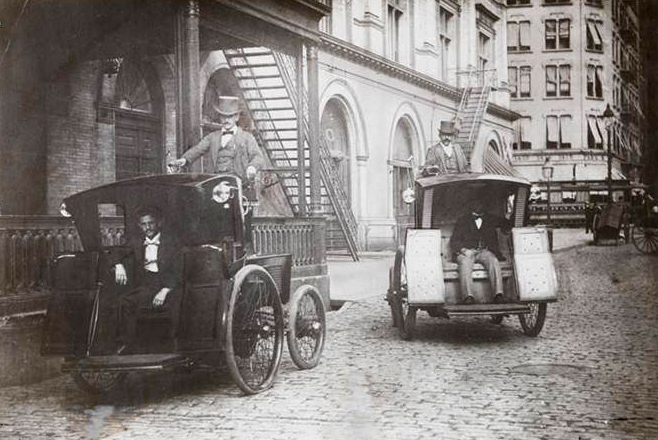
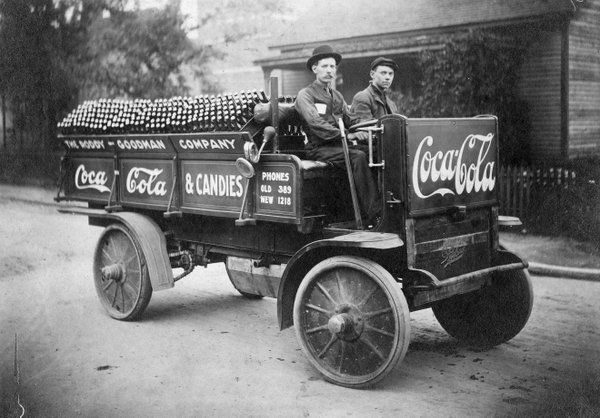
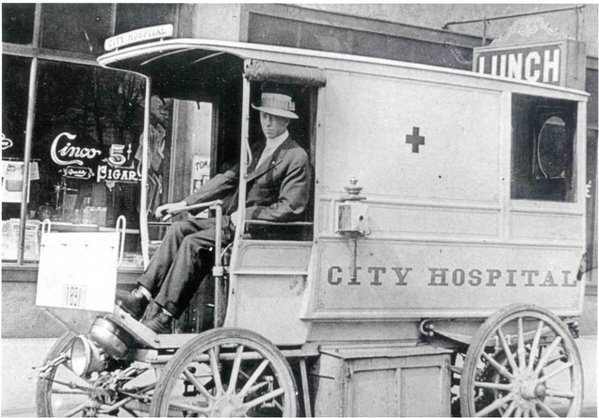
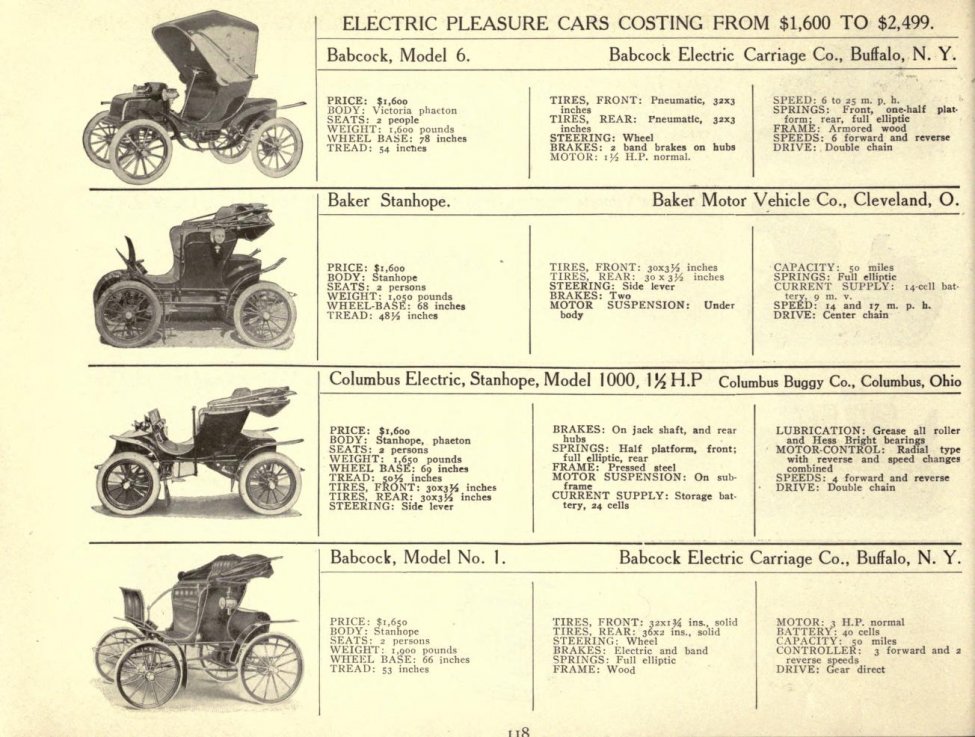
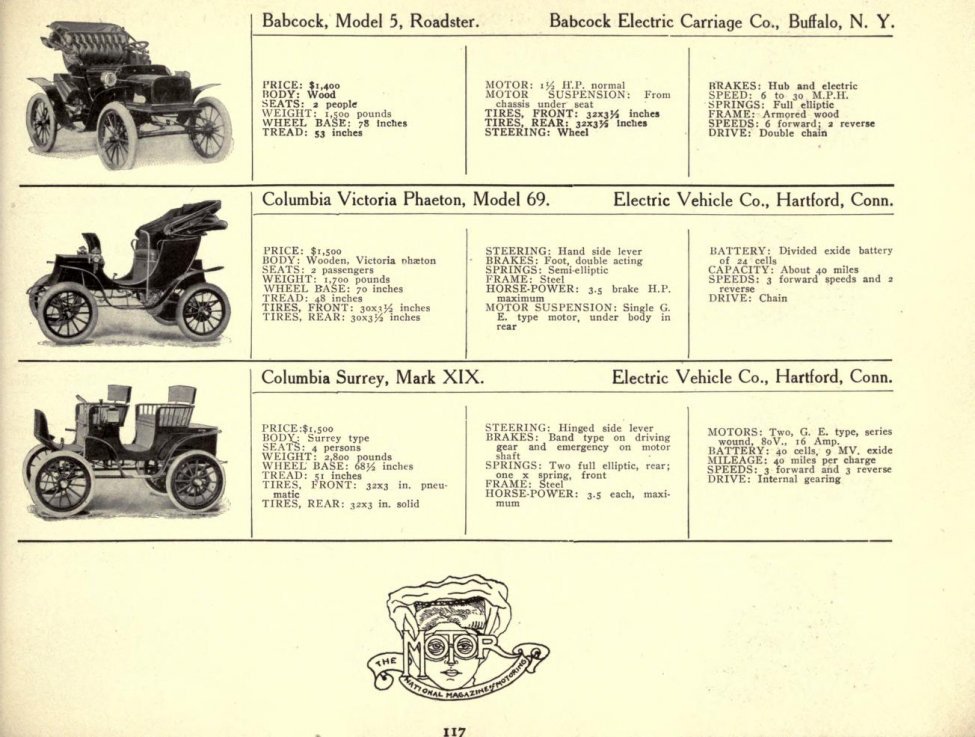
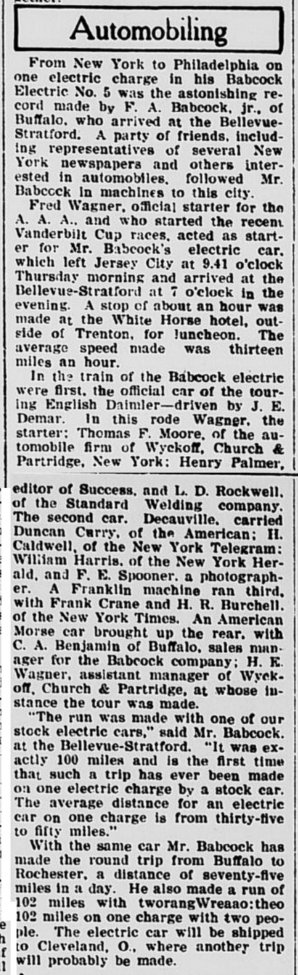
How many electric car models do you know of the top of your head? Probably three or four. If you are really into it, may be ten, though I'm not even sure there are ten contemporary electric car models out there. Well, in the beginning of the 20th century there were hundreds of different models. A few of those models you can observe in the attachments representing just one 1907 catalog. In reality there were many more. I mean like WAY more!
Appears, one hundred years ago electric cars were a pretty common sight on the streets. I have heard that there were electric cars back then, but not to this degree. Many of those cars have a range comparable to their today's counterparts. 1908 Fritchle Model A Victoria had the
exact same range as 2010 Nissan Leaf.
NOTE: Full size images are visible to registered users only. You are welcome to register, and participate in this forum.
Then in 1909 the Fritchle Electric coupe toured 2,140 miles from Lincoln, NE to Washington DC through 10 states. This Electric Automobile averaged 90 miles per day of travel. Advertising claims 100 miles per charge. In 1916 Fritchle announced a gasoline-electric automobile with a four cylinder air cooled engine. They sold very few and the following year abandoned all production.
I do not really know what to think about the below "Route of the 1244-mile tour through Illinois on one battery in a $ 1,600 Babcock Runabout." The
original is being kept at the
New York Public Library. I will base my opinion on more comprehensible distances.
The very first electric car, supposedly, was presented by Siemens and Halske in 1882. And those early electric cars looked neat, but very primitive. It also appears that most
body styles were derived from those available in horse-drawn carriages. And with all this visual simplicity, these vehicles had ranges we were only able to mass produce in the 21st century. Let us take a look at the battery powering 2010 Nissan Leaf which is equal in range to 1908 Fritchle Model A Victoria.
- Number of battery modules in a Nissan Leaf: 48
- Number of cells per module: 4
- Weight of pack: 300 kilograms (660 pounds)
- Amount of lithium in the pack: 4 grams
- 192 laminated prismatic cells
- 360 V nominal voltage
1908 Fritchle Model A Victoria had a 28-cell lead-acid battery weighing 400–600 lb. I was not able to find a picture of the Fritchle battery, but apparently it was powerful enough to tow an Oldsmobile. And the below letter of appreciation from a grateful customer speaks volumes.
The Fritchle batteries generally lasted for more than 10,000 mi and could be replaced at a cost of US$208. The cars were advertised and trademarked as "100-mile Fritchle Electrics," and they lived up to this claim.
Another feature of the Fritchle was a regeneration system in which the motor became a generator when the car was coasting downhill, thereby partly recharging the batteries.
Yes, the max speed of 1908 Fritchle Model A Victoria was only 22 MPH. Nissan Leaf is also heavier 3,300 lbs vs. 2,100 lbs for 1908 Fritchle Model A Victoria. But we are talking about 1908. Today's battery makers have over 100 years of scientific R&D experience on those from the late 19th - early 20th century, and we are still at about 350 miles per charge.
Those people from over a century back, with their extremely limited scientific base were able to achieve similar things we are enjoying today. Where did this "ahead of its time" technology come from? I do not believe there was sufficient time for the natural, research based development for this quality level of power storage in 1900. Such a sharp technological contrast between the simplicity of the vehicle body and the durability of the power unit, suggests different levels of development. It's like the technology just fell into someone's lap. Be it in a way of documentation, or a whole warehouse fool of batteries.
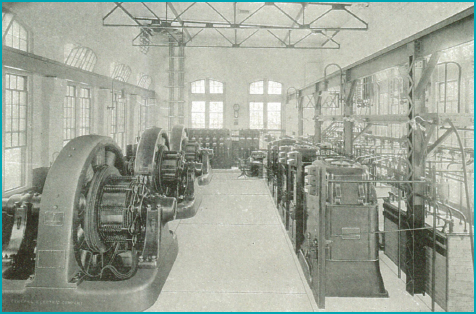
What about the infrastructure required for production of all these electric cars? The catalog above probably contains 5% of all the electric cars produced at the time. Just pick at the below list of
Early Electric Automobile Manufacturers. And those are electric cars only.
Early Electric Automobile Manufacturers
tents
Ugly crooked wooden utility poles, and dirt streets next to beautiful Colonial buildings
(not yet discussed), ridiculous
sails on gigantic 700 ft long iron ships,
high quality pneumatic train cars replaced by benches on wheels, and
many other things - all these are indicators of the unknown factor silently existing in our most recent past. The pneumatic train and electric car technologies quickly went away. Official reasons were similar: not profitable, not enough customers. Semi-official reason: gas sales bring more money. I think the real reason was that gifted technology without sufficient understanding is prone to being lost. They simply were unable to do anything with it.
It's so easy to explain everything by an "Industrial Revolution" excuse. We were dumb and stupid for centuries, and all over sudden everyone got smart at the same time. And only these little big mismatches stick out. They are only visible if you look, for if you don't, they are invisible. Well camouflaged by the fake historical non-sense they are. Our society prefers not to see all the contradictions hiding in the mysterious 19th century
(and recent history in general.) I wonder why?