Note: This post was recovered from the Sh.org archive.
Username: Randolph C
Date: 2020-07-16 14:42:13
Reaction Score: 2
There is
plenty of weird info in the texts. Here is an
example from some 1898 pub, but pertains to 1803 as far as I understand.
This here is
from 1884.
The favorite one of mine is this
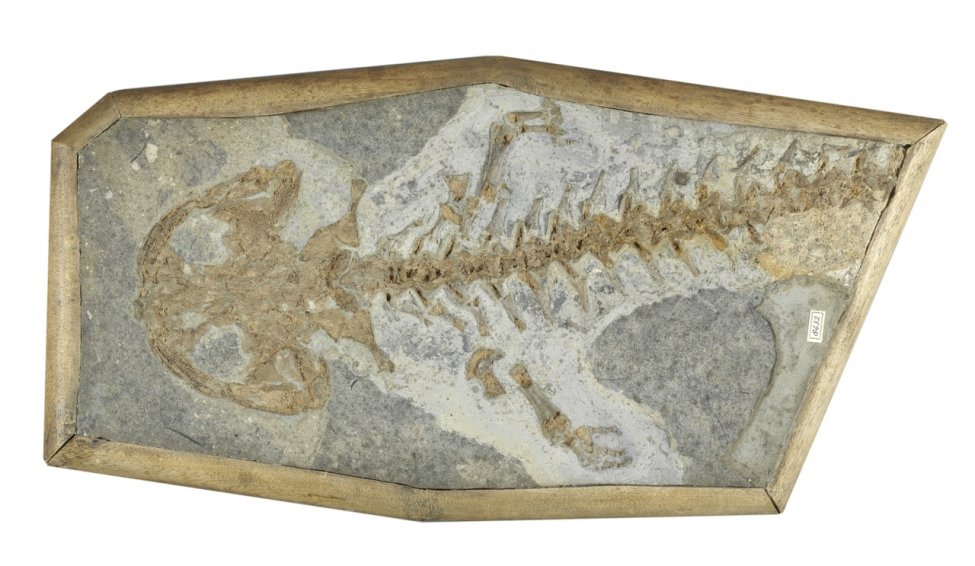
Homo Diluvii Testis which ended up being a salamander.
Scheuchzer's
Homo diluvii testis is indeed nothing but a giant fossil salamander, nowadays called
Andrias scheuchzeri, a common fossil at Oehningen. The Scheuchzer specimen has, for whatever reason, survived all cataclysms and world wars and is still preserved in the Teyler Museum of Haarlem, the Netherlands.
It is remarkable as one of the oldest described fossils (in a historical sense) that is still preserved anywhere in the world. Reason for its outstanding endurance may be, that it is used since one and a half centuries as a text-book example to prove how "stupid" scientists were before the 19th century. How could anyone, let alone a renowned medical doctor and scholar, one of the most famous of his time, make such a ridiculous misidentification?
Homo diluvii testis has been used as probably the major cornerstone for discrediting pre-19th century, pre-evolutionary palaeontology as nothing but bullshit.
Here is the original specimen. I have once studied it personally. One has to be aware that is has been prepared further since Scheuchzer's publication, and Scheuchzer thus was not able to make out or figure all the details now seen. Everybody will surely admit that this thing has nothing to do with a human or humanoid skeleton. The entire thing is only about half a meter in length, so surely not making it a "giant" (only among salamanders)
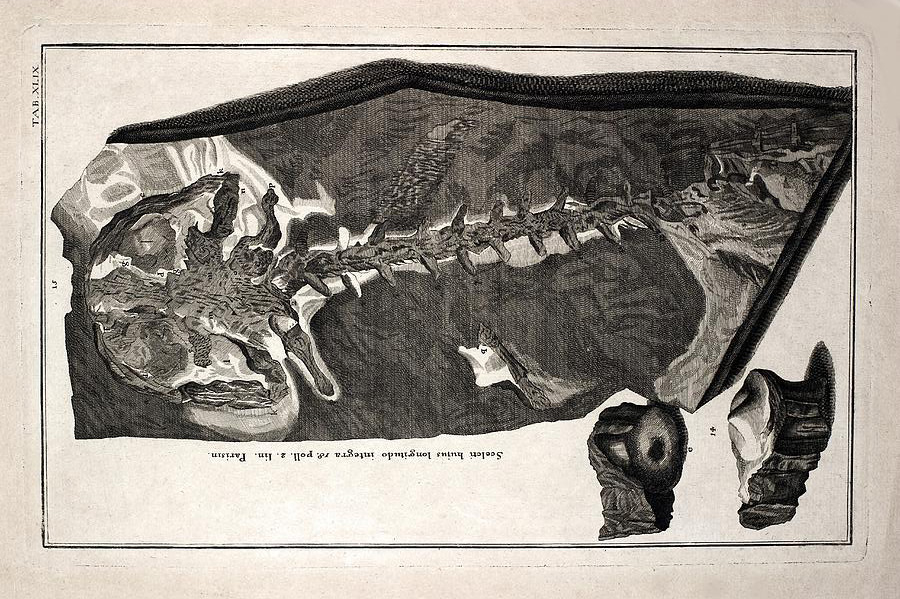
Here is one of Scheuchzer's original illustrations (he did several), I think this specific one was published in 1731 in his 4 volume "Physica sacra". I inverted it to make comparison easier. It is obviously the same specimen, of course with the wooden frame, added somewhen later, missing. In Scheuchzer's figure you can, for example, see part of the left forelimb, the rest still hiding under the rock, and the right (still unprepared) missing altogether in his figure (it was allegedly prepared by Georges Cuvier himself who also was the first to make the correct identification). The illustration by Scheuchzer (or rather his engraver) is nonetheless remarkably accurate for the time (not saying that the alleged publication date is absolutely reliable, but it is definitely a pre-Cuvier work).
This is the skelelon of a still living Japanese giant salamander (
Andrias japonicus)
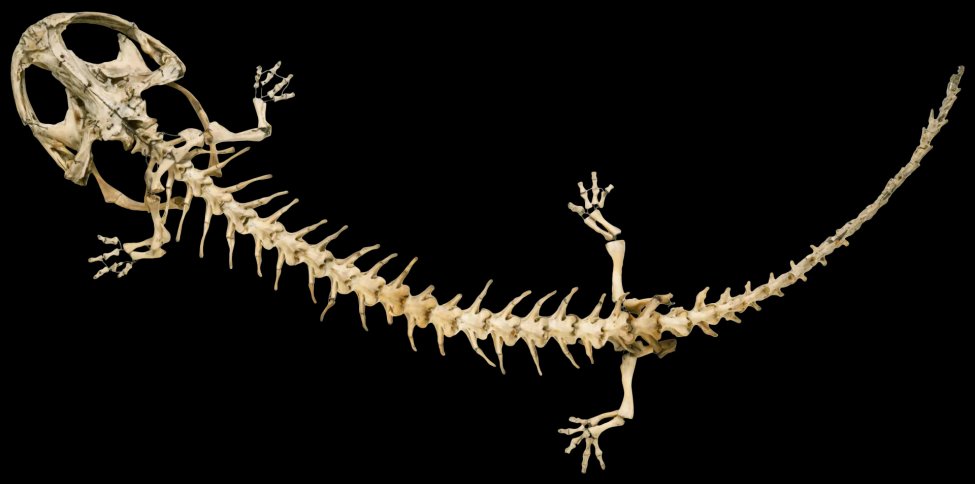
The sililarity beteween the two is striking. Note the big eye sockets, the strange horn-like bones behind the skull (which supported the gill apparatus in the larvae and are still partly kept in the adult) the extremely short neck, the very small forelimbs, the short ribs and so on. These are obvious differences to our species that even someone totally untrained in comparative anatomy will easily recognize.
Some scientists who studied both the fossil and living specimens even concluded, that they can not be kept apart on the basis of skeletal features and should all be called
Andrias scheuchzeri. The really interesting thing is that in this case this would be a species that existed for allegedly 25-30 million years (according to the current geological timeline) without notable change! Surprisingly
, Andrias is rarely talked about by Darwinists.
I think the text you cite, KD, refers to the giant living salamanders of Japan as "Japanese giants", which by most 19th century researchers were ascribed to a genus of their own, called
Megalobatrachus, which is also mentioned. As these are the largest salamanders in the world, which reach about 5 feet in total length, the term "giant" is surely appropriate.
Whereas the other texts you cite are truly intriguing and appear to refer to actual humans of outstanding size, the one about the big salamanders is not worth mentioning in this context.


 Well here's another clue for you all