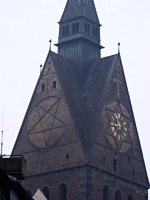
There was a similar looking aerial on this building in Dresden before WW2. No wonder they wanted to destroy it.
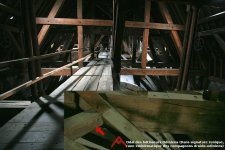
I think I said this already, but Martin Liedtke said ages ago that the antennae were repurposed as weathervanes to conceal their true purpose, and here we are starting to see evidence of that. He also said that bells were retrospectively fitted to towers.
Can you present a loudspeaker design that is meant to be powered from the atmosphere?
This is all contained in Meyl's book 'Communication of the Gods,' which is the subject of this thread
Temples and Churches as Radio Frequency Receivers
I've already written several high level summaries of this book on the above thread. I intend to write another one at some point.
I've read Meyl's book once, fairly carefully, and
I believe I am not misrepresenting him when I say the following -
1) Ancient temples were built to matching proportions / dimensions. So all the temples of Dionysis were similar to each other for example. This means they were resonant with each other, and communication could be achieved via various means. For example a pendulum swung in head office would cause pendulums to swing in sub-branches of the same cult. Meyl goes into a lot of detail how these communication systems might have worked.
In particular, he says that all the ancient Roman and Greek gods were set up in a
one-to-many form of communication, so they were command and control structures, whereas the Phoenicians set up a
many-to-one network which served as a means of gathering information and relaying it back to the head office.
An animal sacrifice was needed to enable voice communication. Again,
I believe I am not misrepresenting Meyl to say it's actually the fine membranes around the entrails which acted as a loudspeaker, responding to the vibrations within the ether and converting them to sound.
2) Meyl says that the later design of churches with the dome structure were able to achieve direct voice communication without the need to perform sacrifices. So - St Paul's cathedral, St Peter's basilisk in the Vatican for example. And similar domed structures all over the ancient worlds, including every US state capitol building. Again, Meyl goes into detailed arguments to support this assertion.