

- Joined
- Aug 31, 2020
- Messages
- 1,141
- Reaction score
- 2,177
I read this article earlier:
Contents of containers of fossils from 1909 expedition reconstructed nondestructively
Here is a summary quote:
So, in 1909-1913 an expedition collected loads of of material that has remained unlooked at. For fear of harming the artifacts, they historians have taken scans etc of the contents - and these are being distributed. The key line, imo is this:
I'm happy to accept this story at face value - I'm sure historians don't want to damage their fossils. And as they have recovered so many fossils over the years.. This is a great answer, no? If only we could go over all the backlog we have in museums. Could we scan all of it in this way? Could we fire up an AI to review and tag the apparent content of the scans? These are the questions that are surely being considered..
But, if we consider this from a slightly different, more conspiratorial angle, this is a troubling development. Are we stepping into a situation where a scan and then the representation of that scan to the world, is now officially part of the historical record? Is it acceptable, trustworthy to have AI scan and study the backlog of artifacts that museums, universities have sitting around? I can even imagine a situation, where, in the name of preservation, it becomes incredibly rare for anyone to ever see an actual artifact! Eg: 'No you cannot see this - the air will damage the bone/parchment/etc - just use the scan'.
For me this is deeply problematic - it involves all sorts of levels of trust that I simply do not have. If it is impossible to personally verify whatever-it-is, and we simply have to take a lab or history department's word for it, we leave ourselves wide open to fakery.
Dall-e: "generate a picture of a rare dinosaur jaw fragment in the style of a CT medical scanner"
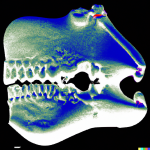
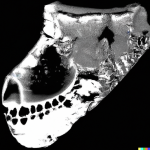
2 generated images from the prompt. How easy is that?
In my view, AI is just a better bullshit creator than what we've had to date.
But if academia are prepared to leave themselves wide open to very easy falsifying of 'data' (as if this is not already the case), it will be incredibly simple to spin any sort of tale you fancy and have the historical record updated to support that idea. I think has already been going on, of course.
What's new is the general awareness of the simplicity and speed with which it will be possible to create whatever compelling, expedient datapoint you would like in the historical record. And how low the threshold is for what is generally accepted as true.
Contents of containers of fossils from 1909 expedition reconstructed nondestructively
Here is a summary quote:
Between 1909 and 1913, the Museum für Naturkunde Berlin organized and financed the German Tendaguru Expedition (GTE) to southern Tanzania, at that time still the German colony of Deutsch-Ostafrika. With the participation of more than 500 local African excavation workers, a large number of porters, and two Berlin scientists, a total of more than 230 tons of fossil dinosaur material was taken to Berlin.
The dinosaur material originating from Tendaguru proved to be so rich and spectacular that the site remains one of the most important dinosaur localities in the world today. Of the dinosaur material from Tendaguru, 40 original packed and unopened bamboo corsets and six wooden crates with unprepared bones are still in the vertebrate collection of the MfN—their exact contents are unknown thus far. This work is part of a large interdisciplinary scientific program in which the Museum für Naturkunde Berlin deals with its colonial past.
Using their high-quality medical CT scanners, colleagues from IZW and Charité now helped to analyze the contents of the shipping containers non-destructively. "It was very exciting for all of us to finally know exactly what was inside the bamboo corsets without having to open them right away," says Daniela Schwarz, head of the study. "Until now, there was a lot of uncertainty about how to handle this material, because physical preparation really takes a lot of time, and you also don't want to destroy historical documents of the era."
The virtual preparation revealed many individual bones from the small gazelle dinosaur Dysalotosaurus lettowvorbecki, but also some pieces of the spiked dinosaur Kentrosaurus and of sauropods.
So, in 1909-1913 an expedition collected loads of of material that has remained unlooked at. For fear of harming the artifacts, they historians have taken scans etc of the contents - and these are being distributed. The key line, imo is this:
Using their high-quality medical CT scanners, colleagues from IZW and Charité now helped to analyze the contents of the shipping containers non-destructively
I'm happy to accept this story at face value - I'm sure historians don't want to damage their fossils. And as they have recovered so many fossils over the years.. This is a great answer, no? If only we could go over all the backlog we have in museums. Could we scan all of it in this way? Could we fire up an AI to review and tag the apparent content of the scans? These are the questions that are surely being considered..
But, if we consider this from a slightly different, more conspiratorial angle, this is a troubling development. Are we stepping into a situation where a scan and then the representation of that scan to the world, is now officially part of the historical record? Is it acceptable, trustworthy to have AI scan and study the backlog of artifacts that museums, universities have sitting around? I can even imagine a situation, where, in the name of preservation, it becomes incredibly rare for anyone to ever see an actual artifact! Eg: 'No you cannot see this - the air will damage the bone/parchment/etc - just use the scan'.
For me this is deeply problematic - it involves all sorts of levels of trust that I simply do not have. If it is impossible to personally verify whatever-it-is, and we simply have to take a lab or history department's word for it, we leave ourselves wide open to fakery.
Dall-e: "generate a picture of a rare dinosaur jaw fragment in the style of a CT medical scanner"
2 generated images from the prompt. How easy is that?
In my view, AI is just a better bullshit creator than what we've had to date.
But if academia are prepared to leave themselves wide open to very easy falsifying of 'data' (as if this is not already the case), it will be incredibly simple to spin any sort of tale you fancy and have the historical record updated to support that idea. I think has already been going on, of course.
What's new is the general awareness of the simplicity and speed with which it will be possible to create whatever compelling, expedient datapoint you would like in the historical record. And how low the threshold is for what is generally accepted as true.
Last edited:


