

- Joined
- Mar 19, 2021
- Messages
- 131
- Reaction score
- 309
While there are solid arguments in favor of Fomenko's phantom time and added 1,000 years of history (here and here), a major issue opposing this theory exists that is not discussed: the presence of Hijri dates on a wide range of objects, including coins, books, financial documents, marriage documents and stone and non-stone inscriptions.
I came across this gravestone during a recent visit to a museum in a city in northeast Iran: (not a good quality photograph and no good angle as there were physical obstacles)
 Of course It is difficult to read, So I post the information note (which had its own mistakes !)
 In summary, for those who do not understand Persian/ Arabic: the gravestone belongs to a deceased man named Hashemi (a longer name), and it contains Quranic verses, Persian poem, and, most importantly, a date: Monday, 22 of Rabi' al-Akhirah, 837 A.H.
 Date is written in the Arabic alphabet, so forget confusion between J or I and number 1 at the beginning of Christian dates :
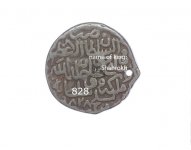
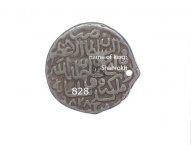
 Another example is a coin belonging to the same era
The date is written in the format of the Arabic numeral system:," 828 A.H., when Shahrokh was the king of Persia based on traditional recorded history
I used Calenderhome.com to convert the date of gravestone: 812 A.H. (solar calendar: Persian system) and 1433 Georgian / Julian calendar (it turned out that the day 22 of Rabi' al-Akhirah, 837 A.H. was Sunday and not Monday)

How will the new chronology (adding 1000 years to true history) explain it?
It is possible to argue that all objects with Hijri dates are forgeries. While coins and books are valuable and can be counterfeited and sold, what about scattered gravestones in remote areas? (Muslims typically bury dead bodies far from populated areas.) What about the inscriptions on mosques and other buildings, many of which are currently in ruins? Forging a gravestone is not profitable. It is also impractical to place them in graveyards scattered across a large area.
You could say that the reference epoch in the past was different from our current understanding. In other words, the Islamic calendar's reference epoch used to be 1152, so the gravestone will be dated year 1964 (1152+812): impossible. Even if the reference year was 1000, the year 1812 is too close to our time. I am confident that the above-mentioned coin and gravestone (along with many other objects) date from the middle of the 15th century, which is about 600 years old (or even older than that for other objects)
Remember, according to New Chronology, Islam and the Quran did not exist in the middle of the 15th century. Persian and Arabic languages have not been developed yet. The Russian-Horde world government ruled over the entire civilized world (who was King Shahrokh?)
Or perhaps there is yet another explanation for Hijri dates that I am unaware of.
I came across this gravestone during a recent visit to a museum in a city in northeast Iran: (not a good quality photograph and no good angle as there were physical obstacles)
The date is written in the format of the Arabic numeral system:," 828 A.H., when Shahrokh was the king of Persia based on traditional recorded history
I used Calenderhome.com to convert the date of gravestone: 812 A.H. (solar calendar: Persian system) and 1433 Georgian / Julian calendar (it turned out that the day 22 of Rabi' al-Akhirah, 837 A.H. was Sunday and not Monday)
How will the new chronology (adding 1000 years to true history) explain it?
It is possible to argue that all objects with Hijri dates are forgeries. While coins and books are valuable and can be counterfeited and sold, what about scattered gravestones in remote areas? (Muslims typically bury dead bodies far from populated areas.) What about the inscriptions on mosques and other buildings, many of which are currently in ruins? Forging a gravestone is not profitable. It is also impractical to place them in graveyards scattered across a large area.
You could say that the reference epoch in the past was different from our current understanding. In other words, the Islamic calendar's reference epoch used to be 1152, so the gravestone will be dated year 1964 (1152+812): impossible. Even if the reference year was 1000, the year 1812 is too close to our time. I am confident that the above-mentioned coin and gravestone (along with many other objects) date from the middle of the 15th century, which is about 600 years old (or even older than that for other objects)
Remember, according to New Chronology, Islam and the Quran did not exist in the middle of the 15th century. Persian and Arabic languages have not been developed yet. The Russian-Horde world government ruled over the entire civilized world (who was King Shahrokh?)
Or perhaps there is yet another explanation for Hijri dates that I am unaware of.
Attachments
Last edited:


 ) (1808 AD) it is called Hayriye Gold.


