Hijri dates on gravestones and coins (Two examples)

MaziarMohajer

Core Member
Active Member
Joined
Mar 19, 2021
Messages
131
Reaction score
308
While there are solid arguments in favor of Fomenko's phantom time and added 1,000 years of history (here and here), a major issue opposing this theory exists that is not discussed: the presence of Hijri dates on a wide range of objects, including coins, books, financial documents, marriage documents and stone and non-stone inscriptions.
I came across this gravestone during a recent visit to a museum in a city in northeast Iran: (not a good quality photograph and no good angle as there were physical obstacles)
gravestone.JPG
Of course It is difficult to read, So I post the information note (which had its own mistakes !)
IMG_5472.JPG
In summary, for those who do not understand Persian/ Arabic: the gravestone belongs to a deceased man named Hashemi (a longer name), and it contains Quranic verses, Persian poem, and, most importantly, a date: Monday, 22 of Rabi' al-Akhirah, 837 A.H.
gravestone copy.jpg
Date is written in the Arabic alphabet, so forget confusion between J or I and number 1 at the beginning of Christian dates :
i1745.jpg
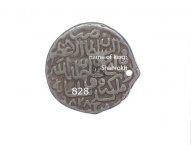
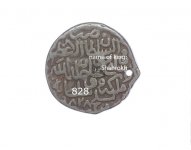
Another example is a coin belonging to the same era
The date is written in the format of the Arabic numeral system:," 828 A.H., when Shahrokh was the king of Persia based on traditional recorded history

I used Calenderhome.com to convert the date of gravestone: 812 A.H. (solar calendar: Persian system) and 1433 Georgian / Julian calendar (it turned out that the day 22 of Rabi' al-Akhirah, 837 A.H. was Sunday and not Monday)
CALa.jpg

How will the new chronology (adding 1000 years to true history) explain it?
It is possible to argue that all objects with Hijri dates are forgeries. While coins and books are valuable and can be counterfeited and sold, what about scattered gravestones in remote areas? (Muslims typically bury dead bodies far from populated areas.) What about the inscriptions on mosques and other buildings, many of which are currently in ruins? Forging a gravestone is not profitable. It is also impractical to place them in graveyards scattered across a large area.
You could say that the reference epoch in the past was different from our current understanding. In other words, the Islamic calendar's reference epoch used to be 1152, so the gravestone will be dated year 1964 (1152+812): impossible. Even if the reference year was 1000, the year 1812 is too close to our time. I am confident that the above-mentioned coin and gravestone (along with many other objects) date from the middle of the 15th century, which is about 600 years old (or even older than that for other objects)
Remember, according to New Chronology, Islam and the Quran did not exist in the middle of the 15th century. Persian and Arabic languages have not been developed yet. The Russian-Horde world government ruled over the entire civilized world (who was King Shahrokh?)
Or perhaps there is yet another explanation for Hijri dates that I am unaware of.
 

Attachments
  • سکه شاهرخ copy.jpg
    سکه شاهرخ copy.jpg
    87.3 KB · Views: 178
  • seke.jpg
    seke.jpg
    87.3 KB · Views: 179
Last edited:
You could say that the reference epoch in the past was different from our current understanding. In other words, the Islamic calendar's reference epoch used to be 1152, so the gravestone will be dated year 1964 (1152+812): impossible. Even if the reference year was 1000, the year 1812 is too close to our time.
Unless i'm missing something i don't see how it's impossible. The middle east is a tricky one due to how it has been obliterated since the late 1800s. My knowledge of the language is minimal, i'll research more to try forming a better opinion
 
You could say that the reference epoch in the past was different from our current understanding. In other words, the Islamic calendar's reference epoch used to be 1152, so the gravestone will be dated year 1964 (1152+812): impossible. Even if the reference year was 1000, the year 1812 is too close to our time. I am confident that the above-mentioned coin and gravestone (along with many other objects) date from the middle of the 15th century
I’m confused. Why must the reference epoch be 1000 or 1152?

You said you’re confident that the objects are from the 15th century, what evidence is this based on?
 
Unless i'm missing something i don't see how it's impossible. The middle east is a tricky one due to how it has been obliterated since the late 1800s. My knowledge of the language is minimal, i'll research more to try forming a better opinion
I will try to explain more. All documents and dates for the last 100 years have been written in Permian, not Arabic, and we have been using the Shamsi calendar since 1911. Even today, you can find gravestones with about 200 years of antiquity in local graveyards, and they have dates over them, say 1227 A.H., clearly written in numbers or in Arabic alphabets. I will give more examples of presence objects with dates from the 15th to 16th centuries in post replies. I am looking forward to reading your opinion.
I’m confused. Why must the reference epoch be 1000 or 1152?

You said you’re confident that the objects are from the 15th century, what evidence is this based on?
1000 is the date Dr Fomenko believes is the real reference epoch (actually 1052)
He says: There is no information in surviving written sources about any events prior to the XI century. There was no writing at that time.

Yes, I am confident that the gravestone is from the 15th century, and I will give you more evidence.
 
Last edited:
While there are solid arguments in favor of Fomenko's phantom time and added 1,000 years of history (here and here), a major issue opposing this theory exists that is not discussed: the presence of Hijri dates on a wide range of objects, including coins, books, financial documents, marriage documents and stone and non-stone inscriptions.
I came across this gravestone during a recent visit to a museum in a city in northeast Iran: (not a good quality photograph and no good angle as there were physical obstacles)
Of course It is difficult to read, So I post the information note (which had its own mistakes !)In summary, for those who do not understand Persian/ Arabic: the gravestone belongs to a deceased man named Hashemi (a longer name), and it contains Quranic verses, Persian poem, and, most importantly, a date: Monday, 22 of Rabi' al-Akhirah, 837 A.H.Date is written in the Arabic alphabet, so forget confusion between J or I and number 1 at the beginning of Christian dates : Another example is a coin belonging to the same era
The date is written in the format of the Arabic numeral system:," 828 A.H., when Shahrokh was the king of Persia based on traditional recorded history

I used Calenderhome.com to convert the date of gravestone: 812 A.H. (solar calendar: Persian system) and 1433 Georgian / Julian calendar (it turned out that the day 22 of Rabi' al-Akhirah, 837 A.H. was Sunday and not Monday)
How will the new chronology (adding 1000 years to true history) explain it?
It is possible to argue that all objects with Hijri dates are forgeries. While coins and books are valuable and can be counterfeited and sold, what about scattered gravestones in remote areas? (Muslims typically bury dead bodies far from populated areas.) What about the inscriptions on mosques and other buildings, many of which are currently in ruins? Forging a gravestone is not profitable. It is also impractical to place them in graveyards scattered across a large area.
You could say that the reference epoch in the past was different from our current understanding. In other words, the Islamic calendar's reference epoch used to be 1152, so the gravestone will be dated year 1964 (1152+812): impossible. Even if the reference year was 1000, the year 1812 is too close to our time. I am confident that the above-mentioned coin and gravestone (along with many other objects) date from the middle of the 15th century, which is about 600 years old (or even older than that for other objects)
Remember, according to New Chronology, Islam and the Quran did not exist in the middle of the 15th century. Persian and Arabic languages have not been developed yet. The Russian-Horde world government ruled over the entire civilized world (who was King Shahrokh?)
Or perhaps there is yet another explanation for Hijri dates that I am unaware of.
There are numerous objects in the Islamic world that bear clear Hijri dates. It is beyond my ability and knowledge to discuss all of them.
They must, however, be considered in any discussion of calendar forgery and alternative historical viewpoints. So, I'll concentrate on a specific region (northeast Iran), dates ranging from the 15th to 16th centuries, and objects that are very hard to forge.

First, some basic information on what I will discuss:

Imam Reza shrine : sanctuary of Imam Reza') in Mashhad, Iran, is a complex which contains the mausoleum of Imam Reza, the eighth Imam of the Twelver Shias. It is the largest mosque in the world by area.

Astan Quds Razavi: the administrative organization which manages the Imam Reza shrine and various institutions which belong to it. The main resource of the institution is endowments (Waqf)

Waqf: is an inalienable charitable endowment under Islamic law. It typically involves donating a building, a plot of land, or other assets for Muslim religious or charitable purposes with no intention of reclaiming the assets.

What I'm going to show you are Waqf-Name = donation-documents from the Astan Quds Razavi library. (financial documents showing that a specific asset has been donated to the shrine for charitable purposes, almost all of them with exact and clear date)

The first issue is the continuity of these documents from the early 16th century to the present day, and then I will explain why they are impossible to forge and their dating is correct for at least 500 years.
list.jpg
This is a list of Waqf-Name, gathered about 150 years ago in Astan Quds Razavi library and now kept in the same place. Their dates range from 931 A.H. to 1288 A.H. (1525 to 1813 A.D.) here.
Goharshad Begum's Waqf-Name, which was written in 829 AH, is considered the oldest Waqf-Name of the shrine, but since the original of this Waqf-Name no longer exists, there are doubts about it. (1426 A.D.)

This is the oldest Waqf-Name dated to 1525 which is called Atiqi Waqf-Name.(unfortunately I could not find the written date)
371215_668.jpg
Some more Waqf-Name (donation-papers)
This one is from 1147 A.H., which is 1735 A.D.
14000201000374_Test_NewPhotoFree (1) copy.jpg
This was written in 1213 A.H. which is 1799 A.D.
14000201000380_Test_NewPhotoFree copy.jpg

Why are these documents genuine?
Because the descendants of the benefactor, some generations after him, are living in Mashhad, and they know their ancestors. Even in the case of Atiq Waqf-Name (500 years ago), affairs and the administration of lands and assets are now under the responsibility of a member of Atiq family.
This family (Sarw-Qad) has their own website with Waqf-Name that dates back to 1078 A.H (1668 A.D.) . They have their family tree on the site, as well as a photograph of the original donation paper. These are real people, and I know some of them.
Even today, financial issues, sometimes with very high values, are based on endowment documents (Waqf-Name), some of which date back to the first quarter of the 16th century. (1525 A.D)
Believing that Joseph Justus Scaliger (1540–1609) created or even finalized the current chronology, especially for the entire world, is far too radical.
 
I found this photograph here
(visual survey of Central Asia from the perspective of the Russian imperial government that took control of the area in the 1850s and 1860s)
I am quite sure many buildings and inscriptions shown on this album were destroyed by Bolsheviks.
By the way, Right side inscription is in Farsi and has a clear date on second line : noh sad o haftad o noh = 979 A.H. which is 1572 A.D. this inscription talks about a war in which Ali khaghan and his allies defeated Malak e soltan. As the result, there was blood instead of water in rivers for one month (!)
The left is in Arabic, and It was difficult for me to read, but with good accuracy, the last line has a date: 828 Helalieh (A.H) = 1425 A.D.
ins.jpg
 
I've been pondering on the nature of said tablets, the first ones you posted were about land donations right, and this last one about a said war that completely polluted the rivers for a month.......

All of this makes me think of one possibility, stolen land and destruction of the loser side. It's the same exact modus operandi the robber barons used in europe & americas!

Translation wise, i'll have to look it up with the same mentality as i look at hieroglyphs of egypt, a possible mistranslation but i'll get to it at a later time
 
I've been pondering on the nature of said tablets, the first ones you posted were about land donations right, and this last one about a said war that completely polluted the rivers for a month.......

All of this makes me think of one possibility, stolen land and destruction of the loser side. It's the same exact modus operandi the robber barons used in europe & americas!

Translation wise, i'll have to look it up with the same mentality as i look at hieroglyphs of egypt, a possible mistranslation but i'll get to it at a later time
I agree
It is difficult to reconstruct the true history of the Islamic world.
Before the Timurid Empire, there's almost no trace of any archeological/ real historical finding.

Regarding the papers / inscriptions/ documents which I have posted, these are simple Arabic or Persian writings that can be easily understood even now (some difficulty only with handwriting)
 
So many calendar changes in history. Could be they just add or deduct whatever time fits the narrative knowing by the time humanity figures all this out and argues about it it will be to late anyways.

I don’t in any way agree or disagree with your logic. However when land titles and large amounts of wealth are concerned this could mean the difference between a family being destitute or delivered from poverty. I personally would forge a piece of paper if it meant eternal wealth for my family…..

My only observation here is those land grant docs are in remarkable condition for their age. Paper is hard to preserve for even 100 years.
500 is well, remarkable.
 
Muslim days start after sunset/dusk/maghrib. 7 pm on Sunday is 7 pm of Monday for us. That could explain the difference between days. But Muslim rarely bury the dead one after sunset.
 
Because the descendants of the benefactor, some generations after him, are living in Mashhad, and they know their ancestors. Even in the case of Atiq Waqf-Name (500 years ago), affairs and the administration of lands and assets are now under the responsibility of a member of Atiq family.
This family (Sarw-Qad) has their own website with Waqf-Name that dates back to 1078 A.H (1668 A.D.) . They have their family tree on the site, as well as a photograph of the original donation paper. These are real people, and I know some of them.

My family on my father side, as well as my mother side, each possesses a “book of lineage”, I do not believe in either of them. The problem with these records is that, they can easily be forged: since the family name is not uncommon, the book/record could have been bought, and then the last few generations added to the end of the records; or the record could also be created wholecloth. While I know my parents and grandparents exist, and my grandparents affirm their parents exist; it already becomes problematic as I have no way to verify whether my grandparents were lying about their lineage.

Why would someone lie about their lineage? I can think of multiple reasons: to lay false claim on land, property, title, inheritance; to associate oneself to a family with a higher social status (nobles); or to legitimize one’s status - for example certain families (in the past) would only hire someone with a certain social status. It can even be just for fun - like what people are doing now with the DNA genealogy tests - and as time passed, a joke gets mistaken for the real thing.

So, to say someone ‘knows their ancestors’ - even if you personally know the latest generation - is hardly proof that their ‘ancestry’ is real
 
Here is another example of an interesting stone inscription:
In Fars province of Iran, there is a rock-cut mosque. It is called Masjed Sangi.
The inscription inside the building says that 652 H (1254 CE) is the date of construction.
masjed sangi1.jpg
m2.jpg
m3.jpg
فی رمضان سنه اثنی و خمسین و ستماِیه

I will discuss other interesting aspects of this "Masjid" in another post.
Links: photos / article.
 
belki de olabilir
Congratulations Moziar,

Yes, how Fomenko ignored the documents written in Persian and Arabic. I am amazed. Since the old Ottoman bureaucrats also came from a system that worked in Arabic and Persian, their writings were written in Arabic. The oldest documents, coins, and inscriptions were in Arabic. As you said, there are very few documents before the 15th century.

Let's see if anyone objects with other solid evidence. Because the objections are not satisfactory.

Extra note: I have a coin belonging to Mahmud II, dated 1223 :)) (1808 AD) it is called Hayriye Gold.
 
Sorry, can you explain what you mean is impossible?
To begin with, isnt that webcalenderconverter depended on scaligerian chronology?
The old gravestone with quranic verses is from the 1500s, which you say is around the time Fomenko talks about.
And perhaps the inscription at the Msje Sangicould be newer than the building, and the construction could've been something else before it was said to be a mosque. Could you clarify your theory thanks! :)
 
Sorry, can you explain what you mean is impossible?
To begin with, isnt that webcalenderconverter depended on scaligerian chronology?
The old gravestone with quranic verses is from the 1500s, which you say is around the time Fomenko talks about.
And perhaps the inscription at the Msje Sangicould be newer than the building, and the construction could've been something else before it was said to be a mosque. Could you clarify your theory thanks! :)
Hello
It is impossible to use " added millennium" theory in Islamic dates as the time gets too close to our era or even paases. For example, if you find a coin with 900 AH date on it , with adding 1000 it would be 1900 AH while we live in about 1400 AH.
I am writing an article explaining the method which can be used to correct first 500 years of Hijri dating system. I ll post it in few days.
 
I'm not in agreement with Scaliger, I believe Heinsohn's interpretation of ~700 years inserted (during renaissance times) before the beginning of the 2nd millenium is more rational and logical, considering we have a pretty much consistent timeline of genuine extant texts back to the 10th century in western Europe

I don't see how these Hijri dates can conflict with years that have been retro-inserted into the first millenium, since they are centuries later. looks good to me :)
 
Tips
Tips
Please respect our Posting Rules.
Back
Top