SH Archive History of Britain as told in the British Records

SH.org OP Username
jd755
SH.org OP Date
2019-12-15 16:38:11
SH.org Reaction Score
57
SH.org Reply Count
57
Note: This post was recovered from the Sh.org archive.
Username: Felixnoille
Date: 2019-12-20 14:46:33
Reaction Score: 1
Yes I wonder the very same thing. Perhaps it's related to the huge dumping of what archaeologists call 'Muck' all over the Arctic Circle area, which was a tropical paradise at the time?

At school we used to get taught that Hadrian built the wall to keep out the wild blue-painted Pict savages. I think I'd get pretty wild if I couldn't get out of there.

There's another wall just above the one known as Hadrian's, but it's more like an earthwork construction.
 
Note: This post was recovered from the Sh.org archive.
Username: jd755
Date: 2019-12-20 15:08:26
Reaction Score: 1
Never heard of the bloke. Getting away from wikiwaki I found this;Procopius
After reading through that article Voltaire and his fairy story about Charles XII of Sweden came to mind. Ergo if the character Procopius (pro copious) was a live historical being his tales are in the same vein, to me as Voltaire's.
There is at least one other west to east wall on this island and it got given the name Antonine. Further north still than the Hadrian version.
Not in the least bit convinced there were any such people as Anglo-Saxons on this island. Celts seem to have appeared in the 18th century in books, writings, fables, stories and tales. Evidence in stone of Celts is dubious and is rooted as far as I can tell in 'expert' attribution and 'religious finagling'. The symbology could be given any one of a number of names. There is now way to know for sure.
It all feels recent rather than distant and manufactured as in actual events overlaid with obfuscating drapes of time, names, peoples, locations etc for a reason I know not, yet.
 
Note: This post was recovered from the Sh.org archive.
Username: Grumpy Owl
Date: 2019-12-21 18:30:10
Reaction Score: 2
And of course Khumry gives us the Welsh language translation of Wales as 'Cymru'.

I discovered Richplanet earlier this year and have been working through a number of his videos, but so far have managed to avoid his shows with Wilson and Blackett, but will certainly give them a go now.


While we learned about the Romans in history classes at school, and I also studied Latin & Roman Civilisation at college, I somehow have this impression that the Romans successfully invaded a Britain inhabited by 'primitive tribes' and that it was the Romans that 'civilised' us.

Luckily I have now reached a stage in my life where seemingly everything I ever learned about is now open to question, and I must say I'm having a lot of fun 'learning' again, but from a completely different standpoint.
 
Note: This post was recovered from the Sh.org archive.
Username: Starmonkey
Date: 2019-12-21 18:40:17
Reaction Score: 0
That word popped into my head a few days ago. CYMRU.
So, Welsh is the language they base "faerie" on?...
VERY interesting. And some of those ISLANDS around there have interesting pasts as well.
 
Note: This post was recovered from the Sh.org archive.
Username: jd755
Date: 2019-12-21 21:09:11
Reaction Score: 0
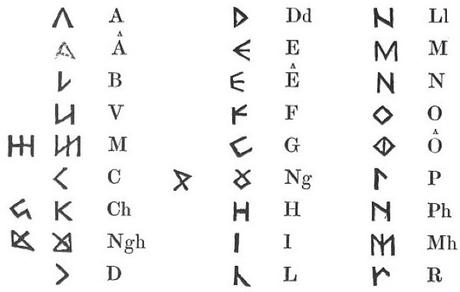
Clock this.
alphabet.html
alan-wilson-and-baram-blacketts-coelbren-alph-L-WA8Mb9.jpeg
 
Note: This post was recovered from the Sh.org archive.
Username: Starmonkey
Date: 2019-12-21 21:55:09
Reaction Score: 0
So what do their names for places mean?
Tir na nog?
I'm really curious to study more into pre-Latin languages and especially NAMES, because they actually meant something.
And then we recreate the map.
 
Note: This post was recovered from the Sh.org archive.
Username: jd755
Date: 2019-12-22 11:06:02
Reaction Score: 1
To me it's the sounds made not the writing that is where ITS at.
 
Note: This post was recovered from the Sh.org archive.
Username: aero618
Date: 2019-12-22 13:24:08
Reaction Score: 0
Hi guys, I read in 1990's that following Norman invasion, 1/2 generations on, Geoffrey of Monmouth was sent a scribe who spent next 20 years or so recording history of Wales (1135?). When he presented his final account to G of Monmouth he wrote a preface "now do with it as you will"- this origional was still with the Duke of Monmouth family in 1990's and was examined by a researcher for the first time then.
I read that- apparently following the origional (1036'ish) 5 rewritten/manipulated copies were made and circulated to the Norman heirachy- Historia Regulum Britannaie BUT rewritten to superimpose the History of Wales as the History of England (ie Britain became England).
In the late 1990's the origional form of the document was transcribed/released~ I never followed it up.
Does this have any relevence to the thread? anyone want to comment

Edit: just found post started by @0harris0 earlier this year, Pre-Roman History of Britain - Brutus, Trojans and Giants! about the Geoffrey of Monmouth manuscript
 
Note: This post was recovered from the Sh.org archive.
Username: usselo
Date: 2019-12-22 13:34:15
Reaction Score: 0
And another, shorter earthen wall called "Devil's Dkye" whose remains run east-west to the north east of Cambridge. Origin unknown.

I used to think it was a 'tax dyke' that forced cart traffic on to narrow, tollable roadways. The road from Cambridge to Burwell passes through it in the kind of gap I mean. But I'm wasn't certain and am less certain now. Given its location more or less bounding the southern edge of the eastern fens, it may well have been for flood control. Equally, the fens were - and still are - known for being a bit wild.

Although Offa's Dyke runs north-south, in From Exodus to Arthur, Mike Baillie speculates it might have been built to separate a death and disease-prone west from the relatively safe east. I should check that reference before saying it with certainty but I think I'm right.
 
Note: This post was recovered from the Sh.org archive.
Username: jd755
Date: 2019-12-22 18:21:48
Reaction Score: 1
Nah you don't need those things. They are illusions.
When I was in t'shipyard I worked with a Welshman who was a member of our squad and he spooke Welsh. Along comes an apprentice one day who was also Welsh. One was from North Wales the other from South Wales cannot remember which was which, sadly.
However one day shortly after the apprentices arrival the older man spoke to him in Welsh. The young lad said "That's not Welsh. Some words are but the others aren't."
To cut the story down basically the older man never actually learnt any Welsh he just spoke English but picked up some Welsh words from other people in Wales.
To the point, at long last I don't hear you say.
The sounds the young lad made were very unusual is my remberance of it. His pronunciation of Welsh was both fast and melodious almost mesmerising. Hell it was mesmerising when he spoke on a bit rather than an odd sentence. Getting him telling a tale in Welsh brought a transformation via sound of another place and time.
As you can see I am strugling to put a feeling into written words.

That is what I mean by the use of Coelbren. The difficulty is that there seems no way to know what a coelbren speaker sounded like but a fluent Welsh seaker or best of all two talking to each other cannot be that far away.
The sounds the voices make is 'in the beggining' to me.
I have a dim memory of this story. Cannot recall from where though. Possibly in something Flinders Petrie wrote.
Any idea of the title that was given to the translation?
 
Note: This post was recovered from the Sh.org archive.
Username: Starmonkey
Date: 2019-12-22 18:41:39
Reaction Score: 0
I can understand most of the dialects of your islands.
Secret of Roan Inish.
So, to me, a several generations removed but most of my lineage from there, Irish and Welsh have similarities.
And, except for a few actors out there who have mostly hidden their accents or lost them, I just don't get exposed to that much.
Recommendations for watching and listening?
 
Note: This post was recovered from the Sh.org archive.
Username: GlobeHead69
Date: 2019-12-22 21:40:50
Reaction Score: 1
"The numerous, strong, culturally advanced British nations had to be transformed into primitive tribes of uneducated barely civilized peasant barbarians and the German origins of the Anglo Saxons needed to be promoted and extolled"

From this website Alan Wilson

Something else that struck me,

"The near 80 successive Khumric Kings, who ruled from circa 500 BC to AD 1300, included King Arthur I (the first Arthur) son of Mascen Wledig of circa AD 345 -400, who did defeat the Romans as Soissons "

Seisson, is the Welsh word for....

The ENGLISH
 
Note: This post was recovered from the Sh.org archive.
Username: Starmonkey
Date: 2019-12-22 22:34:19
Reaction Score: 0
The "Vikings" or Normans (north men?) came down from above. Heard the Orkneys were occupied by them as well for awhile. So, the Scottish? Where do they fit in?
If the Normans and the "Romans" teamed up to take out the Welsh and Irish, etc...
 
Note: This post was recovered from the Sh.org archive.
Username: jd755
Date: 2019-12-23 09:43:23
Reaction Score: 1
Sorry/ I'm a rare visitor to the utubes. Perhaps there is a recording of Welsh speakers or a Welsh language program radio or tv from the black and white days there or possibly the Pathe news site has one or two in their archive.
Also there are a couple of people on here who are Welsh sp if they pick this post up could you point starmonkey in the right direction?
 
Note: This post was recovered from the Sh.org archive.
Username: Witchcraft
Date: 2019-12-23 12:41:30
Reaction Score: 1
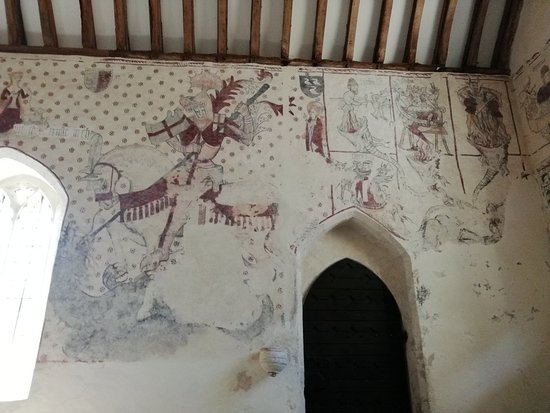
You might enjoy this BBC clip on St Cadoc's in Llancarfan. Some of the art they're uncovering in there is fascinating -

Welsh church uncovers stunning medieval wall painting

Built on the site of a 7th century monastery and founded around 1200, St Cadoc's in Llancarfan, Vale of Glamorgan is, from the outside, just another beautiful small Welsh village church.
But inside, conservators have uncovered some stunning 15th century wall paintings to the delight of locals, visitors and experts alike.
After the discovery of a thin red line of paint on the wall, a team of experts were brought in to investigate what else was lurking behind the 20 layers of limewash added over five centuries.
Now, after five years of restoration work, the church is revealing its treasures: startlingly bold images of the seven deadly sins, a royal family, a ghoulish death figure - and what has been described as one of the largest and most spectacular tableaux of St George and the Dragon ever seen in a British church.
 
Note: This post was recovered from the Sh.org archive.
Username: jd755
Date: 2019-12-23 22:40:41
Reaction Score: 0
How in the name of all that's holy does anyone accurately age paint on a wall?
Also 20 coats of limewash in 500 years?
img-20180629-121755-largejpg.jpg
 
Tips
Tips
Please respect our Posting Rules.
Back
Top