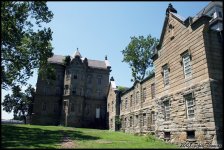
Lunatic asylum and other strange structures of West Virginia

The official tale as you and the signage tell it is cobblers.
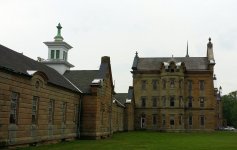
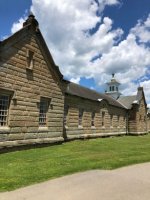
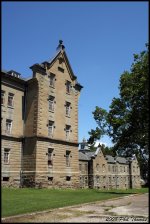
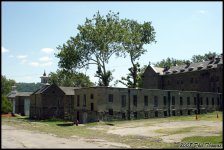
Looking at these two buildings practically it is crystal the one with a single floor of rusticated stone was the first iteration of the building as it is under the worked stone second floor.

The working of the stone on the second floor is identical to the working of the stone on the other wing building. Therefore the upper floor of the original wing and the totality of the other wing were constructed at the same time.
If I were to guess one sex was insane in greater numbers than the others hence the need for a second floor.

This naturally brings into question the other rusticated, a silly term really its just rough cut stone in reality, walls on site. I would suggest they were all built at or around the same time as the original wing was constructed and likely left at the height we see them today for some reason. Could be local events, politics, fallouts between investors, the death of some key personality, lack of tradesmen or even running out of cash.

The intention could well have been to do the entire outer walls of the main connecting building in worked stone but by the time whaterver caused the delay had settled down again either the lack of skilled me, or the cost of them, possibly both and a possible shrinking of the funds available coupled with the speed of bricklaying over the speed of stone laying meant brick was used instead.

Not saying that the case but it makes sense practically.

Did you get to see anything of the interiors of either wing.

Edit to add.
Sorry forgot about the basements. Yes I would suggest both buildings have basements and both feature rough cut stone walls.
The reason why one has its windows sealed over could be nothing more than a change of use or perhaps sealing them over was more cost effective to whichever body runs this site.
Only way to know for sure is to get insideand have a butchers.
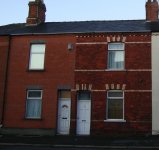
In the street where I live the oldest houses were built late 1800's with basements. In the street are cast iron gratings over the light well and in the wall is a full height window or probably four or five feet.
If it ever stops raining here I'll nip along and grab a couple of photos.
 
Last edited:
The invention that really allowed this historical fantasy to take shape was a a calendar. Nothing other than a human has any use nor need for such a thing. I would argue humans have no need for one either.
Look man I'm not trying to be pedantic, but as someone who regularly works with contracts I would unreservedly say having a calendar is useful and necessary. It lets you know when you have to have something finished, when you can expect money, visits, holidays, when businesses are open, etc. It's not an evil in and of itself.
 
[

It stopped raining!
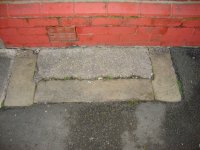
Here is the light well of the house along the street, the one on the left as we look at the image below it, where the window opening has been filled in with concrete block but it still reveals the scale of the opening as in a full size window.

DSC06905.JPG

DSC06906.JPG

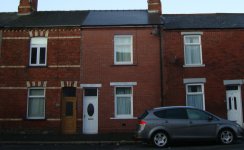
As you can see these houses have quite a bit of ornamentation on them ergo they are the oldest built in the 1890.s because in the next image you see the change in style.

DSC06907.JPG

Ignore the middle of the three. Its front face is only four years old. Prior to that it looked exactly like the one to its right. The house to its left is all but devoid of ornamentation and its build date is no later than 1910 as the house I'm in is part of the same run and I have the deeds to hand.
You can also see the roofline changes and the type of brick changes. The 1910 houses are faced with engineering brick, the same as used in sewer brickwork, the older 1890;s houses are faced in commons.

And here is a concreted over light well in front of what is now a chippy.
DSC06904.JPG
 
Last edited:
.
.
.

First, let's look again at the following two photos:
1.jpg
2.jpg
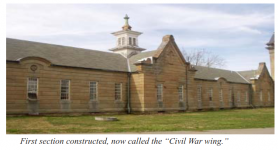
The first photo is of the "Civil War Wing", which supposedly was the first to be completed in 1861, so three years after construction started. The second photo is of the identical wing on the opposite side of the main building.
3.png
We are given the following painting of the hospital as it existed at the time of the Civil War and the supposed gold heist:
4.jpeg
What you see in the back left is the Civil War Wing, #1 above. Here it appears to have two stories, not one. Construction of the central hall has not even begun.

We are told again and again that the Trans-Allegheny Lunatic Asylum is a classic example of a structure built according to the Kirkbride Plan. In other words, it was not built piece by piece but rather conceived as a whole.

QUESTION: is it normal construction practice to complete a small side wing before even beginning the central structure?

Let's assume that that's what happened, since that's what the painting shows and what the tour guide told me. We now encounter our first contradiction. The one-story Civil War Wing was built of the smoother, non-rusticated stone we see on the second floor of the mirror-image two story wing. But shouldn't the earliest-built structure feature the rusticated stone, which clearly was used earlier on the rest of the building, as evidenced from the photographs?

Next contradiction, the buried windows we see peeking out in the Civil War Wing:
5.jpg
Jd755, you suggest that these buried windows were put in to allow light to get into the basement. But look again at the two photos above. In photo #1 we have buried basement windows, but in photo #2 we have none. In other words, were the basement windows intentional, we should ALSO find them in wing #2. We don't, which tells me the windows we see peeking out in photo #1 are indeed full-fledged windows that belong to a buried first floor built of rusticated stone.

I don't know what this proves about the larger structure, but to my mind it conclusively disproves the idea that the basement windows were designed that way. There is a buried first floor under the Civil War Wing. Of that I am 95% certain. Why? Putting aside all other speculation and all other circumstantial evidence, this fact alone suffices to tell me that the story we are told about this building is incomplete at best and an outright lie at worst. There will be no inconsistencies in the truth. Figuring out what really happened will always involve speculation, imagination, and error, but figuring out what didn't happen is something we can do with relative certainty.

Obviously, there is a buried first floor under the Civil War Wing.
Clearly, it's a symmetrical building with both wings having 2 floors.
The CWW's 2nd floor's stone matches the other wing's 2nd floor's stone.
The CWW's 1st floor is simply hidden by dirt, as any honest person should admit.
The CWW's 1st floor stone, when dug out, will match the other wing's 1st-floor stone.
Refusing to quickly admit THAT is the most probable case: seems like purposeful diversion.
One should simply admit the photos show a buried floor, before pontificating about plumbing.
An honest human should naturally admit the simple fact which Frostychud altruistically shared.
An actual truth seeker would quickly admit: there's a higher chance of wing symmetry, than not.

Implying "No, there's a HIGHER chance the CWW wing has merely ONE floor" is NOT honest, IMO.
As is implying "What we see now, with dirt surrounding the CWW wing, is probably how it was built."
As is implying "Until you go and risk arrest trying to dig it out, my 'probably 1 floor' theory is better."
As is implying "The onus is on Frostychud to show 'extraordinary proof for his extraordinary theory'."
In my opinion: the onus of proof is on JD's extraordinary theory that the 2 wings are not symmetrical.

And IMO, one should simply admit which situation one thinks is more likely, before diverting away OT.
And IMO, focusing on the fact those who found it refurbished inside with cheaper bricks is diversion.
And IMO, it's a sneaky tactic to imply "I have no opinion" after implying "Frostychud's opinion wrong."
And IMO, it's even wrong to back-pedal by implying "Not wrong, simply lacking in evidence currently."

IMO, this style of implying theories are wrong, while claiming "I just refuse to speculate" is cowardly.
IMO, if one truly refuses to speculate: one should stop habitually implying logical theories are wrong.
IMO, the habitual time-waster admitted CWW is 2 floors: he's just calling the 1st Floor "a basement."

Opinions about the mudflood theory in general should not outweigh logically looking at the 2 photos.
It's not extraordinary to say, "probably wings are symmetrical, thus dirt is covering CWW's 1st Floor."
I think any logical honest courageous person looking at the photos, and the painting, can admit that.
 
Last edited:
Thanks for proving my point. Your life is run to the calendar. It tells you what to do and when and in what sequence.
I expect a little better than this from Stolen History.

A calendar allows me to schedule things like having babysitters come over so I can have date nights with my wife. Is that a calendar running my life? I've used it to get money and property.

Tell me, other than a calendar of accepted dates, how do I schedule a home inspection on a property where the seller is still living? Does the inspector just show up? Does he have to drive over or call repeatedly until it's a good time? Or can the two parties pick a date and time that works for both of them using that ghastly thing called a calendar?

Now, you can say TPTB use the calendar retroactively to flesh out their lies and I would agree with you. But to say a calendar runs my life when I just use it as a reference to achieve my goals or coordinate shared goals isn't accurate. It's disingenuous and goofy.
 
Sorry to press you, I just want to try to keep the level of discourse high. Hopefully I didn't make you feel singled out.
Why would I?

If anyone would care to peruse these two videos one will see the ground level across the back of entire building is the same.
The rusticated stone wing aka the two story wing is on the exact same level as the worked stone aka single story wing.
As indeed is the entirety of the main as in linking building between the two wings.
Getty Images
Getty Images

On the level one might say.
 
https://www.loc.gov/resource/highsm.31656/?r=0.83,0.438,0.112,0.049,0
Here in this photo one can see the rough cut stone to first floor level on the wing where it meets the rough cut stone on the main building and above it the worked stone on the second floor matches the worked stone on the main building.

There is line of longer rough cut stone blocks running along the wall where the ground floor meets the first. This line continues across the face of the main building.
This shows there is no change in levels between the two parts of the building.
There is a corresponding line of longer rough cut stones where the wall meets the ground. Its not clear in the photo whether this line continues along the base of the main building wall.

Under this lower line of longer stones the rough cut stone continues into the ground.
Wing and main building appear to have been designed as part and parcel of the same structure as the floor levels are the same.

Given the exposure of the rough cut stone at the front of the building I suggest either the whole site was excavated and the stone external and possibly internal foundation laid at once or the foundation trench was the only thing dug into the ground and the rough cut basement walls were built to ground floor level and then the ground was built up around all rough cut wall barring the front elevation to create the groundwork we see today.

In essence if the latter is the case then the original ground level of the site is the level we see at the front of the main building and back and sides are backfilled or it could simply have been a cut into a slope that was already there. The cut into a pre-existing sloping site is by far the easiest and most efficient way of creating a wide area basement.
 
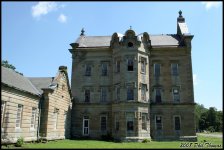
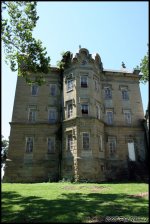
Here are three photos of the wing the signage at the asylum claim is the civil war wing.
Clearly its a worked stone faced brick built building.
The first one has to be a link because the photographer has disabled download.
Trans-Allegheny Lunatic Asylum - Civil War Wing
This one is on trip advisor.

download-19.jpeg
This one is in start page image search but the link doesn't work.

download-20.jpeg

This is the on here Trans-Allegheny Lunatic Asylum
aa1d13ae-6452-45c8-8e45-6065e2def3f8e55a51850e1c893d57_D7A630FD-5C62-4032-A596-CEDFA530E084.jpg
Jackpot.
I was wrong about the site being level across the rear. These pictures from these wonderful blog pages clearly show the two story wing is at lower ground level than the civil war wing as its called.
Octoberfarm
IMG_0789.jpg
IMG_0809.jpg
And this one from flicker shows the sloping ground mirrored at the front of the building.
Trans-Allegheny Lunatic Asylum

14326135033_c61a21ab71_c.jpg
 
Last edited:
More older 'stuff' about this asylum over the years.
http://cantonasylumforinsaneindians...ds/2011/07/Trans-Allegheny-Lunatic-Asylum.jpg
https://www.wvhistoryonview.org/image/042882.jpg
Weston Historical Gallery
Photo Gallery
Colored Asylums | Indians, Insanity, and American History Blog
View on Lawn, Hospital for Insane
Weston State Hospital
https://opacity.us/images/db/190/resource/weston_campus_map_1985.jpg
I do not trust academia as a rule but the construction details contained in chapter one of this PDF make sense to me.
As does the cronyism and political manipulation at the time. A sad facet of human behaviour still with us today.
https://core.ac.uk/download/pdf/230475599.pdf
Some quotes and a couple of images from the PDF.

William Tuke and Quakers in York, England, had followed this philosophy in setting up a retreat for the mentally ill in 1796, where patients were treated with gentleness, provided plenty of food, and kept busy with tasks such as gardening, sewing, and reading.14
The Quakers attempted to bring out the “inner light” in each patient—believing that each was capable of goodness in a positive environment.15 Transferred to America, this philosophy was followed from the 1840s to the 1880s at the Pennsylvania Hospital for the
Insane under the supervision of Dr. Kirkbride, himself a Quaker. He was described as“humble, soft-spoken, simple in his dress, and reflective in his thoughts.”16 Kirkbride’s hospital near Philadelphia included a beautiful dining room, a game room, a bowling
alley, a greenhouse, a museum, and a library. Attractive landscaping and flowerbeds graced the grounds.

A Quaker no less. Mixed up with local government of the day. I wonder how many of the Weston men in "power" in Richmond were also Quakers?

Kirkbride also wrote in detail of the practical needs of an institution. He knew that for 250 patients, at least 100,000 gallons of
water should be stored in tanks to handle the laundry, toilets, cleaning, cooking, and water treatments for the ill, as well as to have an ample supply in case of fire. He estimated that 50,000 gallons a day were required for normal use.18 Kirkbride described the proper ways to install drainage, plastering, fire protection, and many other details.19 He was quite knowledgeable, even though he was not an architect himself, and many hospitals throughout the United States were based on his plan, and are known as Kirkbride buildings.

Hmm so a man skilled in the right sort of care for mental patients is skilled enough in architecural proactice to design a plan of what is required. That may well be true in as far as it goes for practical needs of the patients to be met by the buulding and grounds so a plan of those needs makes sense but an architect or rather architects would be required to create the building plans and layout. Structural knowledge alone is a skilled area of expertise and I have yet to read of an architect who sidelined in doctoring.

work began on the asylum in Weston in the spring of 1859. The construction of this huge institution employed many workers for a number of years. Some of the first laborers brought in to clear the site were African American convicts sent by Governor Wise from Richmond in October of 1858.

So some handy and free labour used to kickstart the excavatoons how convenient. Was Governor Wise also a Quaker?

Many workers, some hired and some convict labor, made bricks and quarried stone.An excellent quality of blue sandstone was used, which was easily tooled with a hammerand chisel. Initially the sandstone was quarried at Mt. Clare in neighboring Harrison County
and at other quarries, and then hauled to the site by wagon.24 In 1870, a new quarry was opened on the bank of the river just 600 feet in front of the hospital, and a tramway was built to transport the stone to the main building with a single mule hauling the blocks.
Another quarry was opened on the hillside behind the main building, one-third of a mile away.The saw mill, brick ovens, planing mill, and lath mill were all set up to be run from the same power house.

Well we now know what sort of stone we are looking at, blue sandstone and where it came from.

In May of 1861 there were ten stonecutters and twelve stonemasons employed, along with four bricklayers and eleven carpenters.
There were thirteen carters and fifty-one laborers.

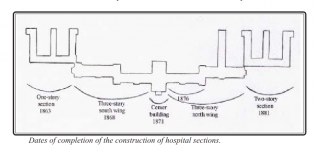
Work on the asylum continued through the rest of the Civil War. A report to the state of West Virginia from the Board of Directors, signed Dec. 21, 1863, described the progress of construction. The nearly completed one-story section was 220 feet long and twenty-nine feet wide. It had three wings running back from it at a right angle, each 120 feet long, with two that were twenty-seven feet wide and the other nineteen feet wide. Three cupolas, covered in tin, provided ventilation for this section. A twelve-foot wide hallway ran the length of this section, and the two wider wings had main hallways also. The third wing was a gymnasium. At this point they were waiting for the mortar of the floors to dry before laying the wooden flooring, which was prepared and waiting. Oak boards 1¾ inch thick would form the floor planks. The heating system was being completed by John Sutherland, Esq., of Philadelphia, who was highly recommended by Dr. Kirkbride and had been the building superintendent for the Pennsylvania Hospital for the Insane.

So I got it wrong in regards build order. If the report is accepted as authentic to the time it was produced then this building was in the state of work as described.

The adjoining south three-story wing was also under construction in 1863 and measured 520 feet to where it would meet the center building. The walls of this section had been constructed almost to the level of the ceiling of the first floor according to the
December 1863 report. They had paused on the stonework in mid-November, anticipating inadequate funds, and had covered the walls with planks to protect them from frost.
Seventy-five logs had been cut and sawed to provide this covering.
Both wings were being put up simultaneously with one in a more advanced state of construction than the other due to have being started earlier.

A main sewer for this wing, 520 feet in length, required an eight to ten foot wide and ten to thirteen foot deep excavation.
The sewer was thirty-six inches wide, constructed of brick, and laid in hydraulic cement.
This was to receive sewage from various pipes in the three-story wing, and it ran to Polk Creek, a small stream nearby, into which it discharged. The report stated, “This sewer was a tedious and expensive job, as it should have been done during the summer, while the weather was dry, it having been put off until the fall rains set in, thereby increasing the expense very considerably.”

Poor Polk Creek and whatever river it ran into.

The board of directors made excuses in this report as to why the one-story buildings were not quite ready. They explained that much of their money had been used on the three-story part of the south wing. Also, several projects should have been started earlier in the season before the fall rains began,drainage culverts, mortar between the floors, the main sewer, the main ventilation stack, and the plastering. Much of this work had been suspended due to wet, cool weather, or had continued, but at greater cost and more trouble than it would have in the warmer seasons.

Ground work is always delayed by adverse weather but I have to say its also a hand way to hide funds going out in backhanders.

The report further noted that construction was almost complete on the three-story section of the south wing, which would lead up to the center building. The walls were up,the wood work of the roof was in position, and slate was being put on it. They expected
to be able to open this section in April of 1868, and would have the furnishings ready at that time so as to be able to quickly receive more patients. They were preparing furnishings and manufacturing bedsteads in their own shops. There was a plan for a railway to be built in the basement, so that the food could be easily distributed to dumb-waiters and elevated to the eating rooms in the various stories. A later report mentioned this railway, which connected the kitchen via a tunnel with the main hospital building. The railway ran under all parts of it, and the food was raised by dumb waiters to all the wards.For lighting, they had been using lamps and carbon oil, but this was not considered safe, economical, or convenient. Pipes for gas were being installed as the building progressed.

The planned central section of the building would contain the kitchens, store room, dispensary, offices for business, receiving room, chapel, principal entrance and main hallway, homes “for the Superintendent, Matron, Assistant Physician, and other officers, and sleeping rooms for all the employees, from the highest to the lowest. Until that is done, these necessities must be temporarily and imperfectly provided for in the departments intended for patients, thereby necessarily restricting their room and their numbers.”49 Cost of the center building was estimated to be $71,367. Additional costs for heating, furniture, and fixtures
would be $10,000.

The north wing of the hospital was completed in 1881.64 The last section of the north wing was originally planned to be a one-story structure, like the south wing’s end section. The lay of the land, however, would have required considerable fill, and the basement would have needed twelve-foot walls in order to match the rest of the building. Therefore the decision was made to instead build two stories in this section and provide more room for patients. The cost was less than it would have been to fill in the area with earth to reach the necessary height.

Screenshot_2023-11-13_12-05-00.png Screenshot_2023-11-13_12-19-47.png


More construction and surroundings info here.
https://npgallery.nps.gov/NRHP/GetAsset/NHLS/78002805_text

Screen grabs.
Screenshot_2023-11-13_16-01-28.png
Screenshot_2023-11-13_15-58-24.png
Screenshot_2023-11-13_15-57-28.png
Screenshot_2023-11-13_15-56-16.png
 
Last edited:
I recently took a trip to West Virginia. This state is a time capsule. I’ve traveled a lot in the United States, including to many of the forgotten places, but West Virginia is frozen in time to a degree I haven’t encountered anywhere else. Only Mississippi comes close.

I had a free day, so I went to Grafton to see the old abandoned train station and Weston to see the Trans-Allegheny Lunatic Asylum.

Grafton is poor and depressing. Every city in West Virginia is full of meth demons skulking and staring with hollow eyes. It’s the most obese state in America and maybe the poorest as well. Grafton must once have been a happening spot, but it’s almost a ghost town today.

The railroad created the place, according to official history. Or maybe they just found the railroads here. Either way there was a handy plaque outside the abandoned train station and fancy hotel:

View attachment 30424
Exactly thirty-three trains a day, of course.

What struck me most about Grafton were all the old stone walls and staircases everywhere. I got the feeling in West Virginia that the pre-Reset past was right at the surface and would require very little digging to unearth. Check out the big stones under the bricks.

View attachment 30425View attachment 30444
View attachment 30445
But Grafton was just an appetizer. Weston was the main dish.

To get there, I just hopped onto the following convenient highway cut and blasted through the mountains by doughty pioneers on horseback:
View attachment 30429
I wonder how they settled on that number?

I passed by some beautiful civic art on the way. Look, it says WV, kids! What a creative way to write it!
View attachment 30431
After arriving in Weston, I stopped at the conveniently located Gomart gas station to fill up:
View attachment 30430
Where have I seen that logo before?
I stopped for a delicious bag of Utz brand potato chips at the Mountaineer Mart:
View attachment 30433
Where have I seen that logo before?
View attachment 30434
As I was eating my potato chips I espied a disproportionately monumental building a few streets away. City Hall? The public library? The local high school mayhaps? I approached it to get a closer look.
View attachment 30435
...right. I think everyone is starting to get the picture. The Masons have West Virginia on lock, baby.

Why do they have such a big presence in Weston, population 3890?

It couldn’t be because of the giant stone castle located there, could it?
View attachment 30441View attachment 30442View attachment 30443
I have learned that the best approach to adopt when doing historical research is a kind of split mind. Half of my mind immediately buys into whatever hypothesis I am investigating while the other half remains strictly neutral. Regarding the dug-out cities hypothesis, I have enthusiastically read everything I can find documenting it. I am simultaneously convinced and skeptical…if that makes sense. That said, the Trans-Allegheny Lunatic Asylum is the closest thing to a smoking gun for the Mud Flood that I have ever seen with my own eyes.

Let’s start with the signs out front:
View attachment 30437View attachment 30438
So let me get this straight. In 1858, when the population of Weston was between two and three hundred (according to the tour guide), the state decides to build the largest hand-cut stone building in North America…to house a few dozen lunatics?

According to the book West Virginia’s Dark Tourism, only the Kremlin tops it as far as hand-cut stone buildings go (!):
Please note as well that we have a big fat numerological wink in the construction date: March 22 or 322, the Skull and Bones code.

I mean, this place is huge. It really looks and feels like a European castle. I have never gotten such a strong Old World feeling in the United States.

The asylum was bought from the state by the Jordan family in 2007. They left it pretty much as is, thankfully, and make money by offering corny Haunted Tours led by guides in old-timey nurse costumes. Well, it’s better than tearing it down.

According to the tour guide, the stone was quarried and cut twenty-five miles away and carted by horse to the construction site. Is that realistic? Who knows? She also mentioned that the laborers were all prisoners sent over by the Governor. In other words, built (or dug out) using slave labor.

She described the building style as “rubble construction”. When I asked her if that meant the building was...reassembled from rubble, she said that it simply referred to the practice of putting imperfectly shaped stones together.

Years ago I stayed at a 17th century stone house in a remote mountainous area of the Lozere region of France. I was surprised when the host, a Swiss hippie, told me that when he and his father had bought the property thirty years earlier, the house was nothing but a pile of rubble. All they had to do was pick up the stones and stack them back up into walls over the building's remaining footprint. There was absolutely no way to tell that this house had ever been demolished and rebuilt. It looked exactly like all the other old houses around it. Two guys working occasionally on it for a few years was all it took.

I got excited when we went out back and saw this:
View attachment 30440
This is supposedly the oldest wing of the hospital, completed during the Civil War.

Why do they say it was completed during the Civil War? Simple, because the entire West Virginia statehood narrative is anchored to the place. West Virginia supposedly declared its independence from Virginia in 1863 to join the Union.

Here’s the laughable story:

https://www.google.com/amp/s/www.wt...-gold-heist-in-what-is-now-west-virginia/amp/

Most Mountaineers have heard of how West Virginia became the 35th State to join the union, but there’s one crucial event that took place to help tip the scales that many don’t remember being taught in West Virginia History class. (...) The event in question is the seizure of gold from the Exchange Bank of Virginia in 1861.

To tell the story we need to go back a few years to 1850, where overcrowding and high demand led the Virginia legislature to approve the building of a new mental institution, which would later become the Trans-Allegheny Lunatic Asylum.


"Overcrowding and high demand"

After touring several towns the Legislature picked Weston, then still in the state of Virginia. The towns’ people went all out to sway the legislations decision. They made sure their homes and businesses were freshly painted, repaired dilapidated streets and sidewalks, and even cleaned the streets of trash in preparation for the committee’s visit.

They even went as far as to meet the arriving committee with a brass parade. During the visit, the town folk made sure to show the committee all of the natural resources that would aid in construction including coal, stone, timber, and even water power from the local river. The efforts of the townspeople paid off and the committee chose Weston as the site for their new mental institution.


Of course.

Construction for the Trans-Allegheny Lunatic Asylum began in 1858. However, shortly after the Civil War broke out in 1861 the Virginia Legislature halted construction on the building and demanded that the remaining funds for the project, in the form of gold, be returned to Virginia to aid the state in its preparations for war. Governor of the Restored Government of Virginia, Francis H. Pierpont, feared this money would fund the confederacy and informed Union General George B. McClellan of the situation. General McClellan ordered the Seventh Ohio Infantry to march overnight to Weston to secure the funds, which were about $30,000 in gold.

At dawn on June 30, 1861, the federal troops arrived in the town. After securing a perimeter the Union troops made their way into the bank and secured the funds. The next day the troop escorted the gold north to Clarksburg and then placed it on a guarded train bound for Wheeling, where the funds helped finance the fledgling Restored Government of Virginia.


I mean…sure.

Continued in Part Two.
You should play some Fallout 76, it is based right here, has zombies and reads like the intro to your thread.
 
I found some odd texts from the 1800's when I searching through archives.org that were specifically written as (Fire Prevention for for Lunatic Asylums and Hospitals for the Insaine) or something along those lines and I find it really strange why the fire protection would be specifically directed at Asylums. I believe this was Scotland oriented.
 
I found some odd texts from the 1800's when I searching through archives.org that were specifically written as (Fire Prevention for for Lunatic Asylums and Hospitals for the Insaine) or something along those lines and I find it really strange why the fire protection would be specifically directed at Asylums. I believe this was Scotland oriented.
Could you add them in here if you don't mind?
I've only been in one insane ward in Lancaster Moor hospital, as a visitor, and didn't notice any extra fire protection such as hoses, extinguisherrs etc.
Not saying they weren't there just I didn't notice any however the patient we were visiting used to live in a local to me centre for the mentally handicapped one without locks on the outside doors, and small fires were not unknown amongst the patients. So the centre must have had more extinguishers than the couple I saw but whether it had extra fire prevention beyond that I couldn't say.
Both my girlfriend of the day, whose mother ran the centre for the local council, and the centre itself are gone now.
 
Last edited:
I found some odd texts from the 1800's when I searching through archives.org that were specifically written as (Fire Prevention for for Lunatic Asylums and Hospitals for the Insaine) or something along those lines and I find it really strange why the fire protection would be specifically directed at Asylums. I believe this was Scotland oriented.
Possible mundane explanation: If you're familiar with bureaucracy, typically a guide like that is generated after an accident, usually a well-publicized one. If everyone is talking about an asylum fire that happened somewhere, some department head or politician will mandate the creation of a guide, force everyone to sit through a seminar, and then say their team (whether it be the asylum staff or firemen) are "certified" and ready for a situation, that everyone is safe (and warm and cozy, etc).

"Security theater," basically.
 
Here's a little indirect evidence the asylum was dug out.

This is one of those articles that illustrates just how easy it is to brush anomalies under the rug.

It's easy because (1) almost no one cares and (2) the forgers can count on our own entrained cognitive dissonance to do their work for them.

I've noticed this technique before. It's incredibly effective. It consists in simply presenting an anomaly with no explanation at all. By skipping over the explanation, the forgers (1) don't have to lie and risk getting caught and (2) lull us into believing the situation is under control. Read the entire article and witness real-time hypnosis in action:

Prehistoric mystery underlies ancient 'Egypt' in Mount Hope, W.Va.

Prehistoric mystery underlies ancient "Egypt" in Mount Hope, W.Va.​


MOUNT HOPE, W.Va. — Due to its remarkable fertility, the valley of Dunloup Creek in south-central West Virginia was once called by settlers "Egypt." But pioneers discovered something even more remarkable when they arrived—a prehistoric ruin built by an earlier culture, and only a few recollections of the ancient stone works survive.

They call this place "Ancient Egypt". The mockery begins right away. I take it a simultaneous double admission that (1) Ancient Egypt is fake and (2) West Virginia history is fake.

The legendary ruin stood near what's now the center of Mount Hope, West Virginia, a small but well-preserved city of nearly 1,000 residents near the New River Gorge National Park and Preserve. Once a coal-ming boomtown, it's now a quiet residential community with a touristy edge.

In the late 1800s, its growth obliterated the fort, yet some early sources say its stones may have been used in the foundations of early wooden buildings and later-built brick and stone structures. This means they may still be present!

Local historians are considering the mystery of what became of the stone, some of which might have been used in the city's historic public walls, built during the Roosevelt New Deal era.


So here we have a mainstream claim of stones being scavenged from pre-Reset structures. Not that we needed one, a pair of eyes suffice, but I'll take it anyway.

"We're interested in discovering more about Mount Hope's prehistory," Carrie Kidd said while chronicling events for the Mount Hope Landmarks Commission. "The city's recent history is well documented, but there's a lot to be discovered about what happened here before Europeans settled."

They admit it's prehistoric.

Archaeologists now know that mound-builders inhabited West Virginia as early as 1000 B.C., building small villages and raising small ceremonial mounds in small valley areas such as those along Dunloup Creek and establishing larger villages and larger mounds in larger valleys, such as that of the Kanawha.

But the purpose of stone works such as the "fort" are less well known. Darlington described the site in some detail, much of which appears to have been based on research by historian Shirley Donnelly.


So now they're just telling us with a straight face that Indians built stone forts. The mockery!

In 1960, Donnelly interviewed Elizabeth Mosley, then 95 years old, regarding her memories of the landmark.

"The fort was situated a few rods east of the row of mounds and just behind the present cemetery, a portion of the site having been cut away by the railroad grade. It was a large, walled structure, circular in form, and constructed of native pick-up stone that was said to be well matched and fitted.


They have to say it was made of pick-up stone because they can't admit it might have been hewn. We'll never know. Keep in mind that this is the historian paraphrasing the original witness.

The walls were about ten feet high and three feet thick. The earthen floor of the enclosed space was considerably lower than the surface of the ground on the outside. This was noticeable when, upon entering the fort, one had to step down on the inside. This is the word-picture of the old Indian fort as recounted by a lady ninety-two years of age (Elizabeth Mosley) who, as a small girl, played inside the fort which stood in the yard of her grandfather's home."

What became of the ruin? Darlington in his 1988 book claims that it had been dismantled in the 1880s, just before mining operations were established near Mount Hope at MacDonald.

"It stood there for seventy years after it was last used as a human lodging. Children played inside the ruins. Boys satisfied their adventurous urges by scaling its vine-covered walls with whoop and halloo. Eventually the crumbling ruin grew dangerous, and about one hundred years ago, it was razed and the stones utilized for building foundations."


It grew dangerous, huh?

They then offer a weak alternate explanation for the "fort" as well: "made by early European hunters". But then, a few paragraphs later, referring to another similar anomalous site elsewhere in West Virginia, we get:

Archaeologists who explored the Armstrong Mountain walls concluded their purpose was ceremonial — a conclusion drawn on the lack of any other explanation. Sigfus Olafson, Joseph W. Inghram, and Edward V. McMichael wrote in 1972 that the walls were not defensive and not intended as enclosures.

"This then leaves the possibility that these structures may have had some ritualistic or ceremonial significance in the life of the people who built them. However, this is only supportable by virtue of the fact that other explanations are inadequate and are eliminated."


The last sentence says it all. Once you're inside the orthodoxy box, you have no choice but to embarrass yourself.

So, what is it guys? An Indian fort? A hunting camp? A ritual site?
 
Last edited:
Here's a little indirect evidence the asylum was dug out.

This is one of those articles that illustrates just how easy it is to brush anomalies under the rug.

It's easy because (1) almost no one cares and (2) the forgers can count on our own entrained cognitive dissonance to do their work for them.

I've noticed this technique before. It's incredibly effective. It consists in simply presenting an anomaly with no explanation at all. By skipping over the explanation, the forgers (1) don't have to lie and risk getting caught and (2) lull us into believing the situation is under control. Read the entire article and witness real-time hypnosis in action:

Prehistoric mystery underlies ancient 'Egypt' in Mount Hope, W.Va.

Prehistoric mystery underlies ancient "Egypt" in Mount Hope, W.Va.​


MOUNT HOPE, W.Va. — Due to its remarkable fertility, the valley of Dunloup Creek in south-central West Virginia was once called by settlers "Egypt." But pioneers discovered something even more remarkable when they arrived—a prehistoric ruin built by an earlier culture, and only a few recollections of the ancient stone works survive.

They call this place "Ancient Egypt". The mockery begins right away. I take it a simultaneous double admission that (1) Ancient Egypt is fake and (2) West Virginia history is fake.

The legendary ruin stood near what's now the center of Mount Hope, West Virginia, a small but well-preserved city of nearly 1,000 residents near the New River Gorge National Park and Preserve. Once a coal-ming boomtown, it's now a quiet residential community with a touristy edge.

In the late 1800s, its growth obliterated the fort, yet some early sources say its stones may have been used in the foundations of early wooden buildings and later-built brick and stone structures. This means they may still be present!

Local historians are considering the mystery of what became of the stone, some of which might have been used in the city's historic public walls, built during the Roosevelt New Deal era.


So here we have a mainstream claim of stones being scavenged from pre-Reset structures. Not that we needed one, a pair of eyes suffice, but I'll take it anyway.

"We're interested in discovering more about Mount Hope's prehistory," Carrie Kidd said while chronicling events for the Mount Hope Landmarks Commission. "The city's recent history is well documented, but there's a lot to be discovered about what happened here before Europeans settled."

They admit it's prehistoric.

Archaeologists now know that mound-builders inhabited West Virginia as early as 1000 B.C., building small villages and raising small ceremonial mounds in small valley areas such as those along Dunloup Creek and establishing larger villages and larger mounds in larger valleys, such as that of the Kanawha.

But the purpose of stone works such as the "fort" are less well known. Darlington described the site in some detail, much of which appears to have been based on research by historian Shirley Donnelly.


So now they're just telling us with a straight face that Indians built stone forts. The mockery!

In 1960, Donnelly interviewed Elizabeth Mosley, then 95 years old, regarding her memories of the landmark.

"The fort was situated a few rods east of the row of mounds and just behind the present cemetery, a portion of the site having been cut away by the railroad grade. It was a large, walled structure, circular in form, and constructed of native pick-up stone that was said to be well matched and fitted.


They have to say it was made of pick-up stone because they can't admit it might have been hewn. We'll never know. Keep in mind that this is the historian paraphrasing the original witness.

The walls were about ten feet high and three feet thick. The earthen floor of the enclosed space was considerably lower than the surface of the ground on the outside. This was noticeable when, upon entering the fort, one had to step down on the inside. This is the word-picture of the old Indian fort as recounted by a lady ninety-two years of age (Elizabeth Mosley) who, as a small girl, played inside the fort which stood in the yard of her grandfather's home."

What became of the ruin? Darlington in his 1988 book claims that it had been dismantled in the 1880s, just before mining operations were established near Mount Hope at MacDonald.

"It stood there for seventy years after it was last used as a human lodging. Children played inside the ruins. Boys satisfied their adventurous urges by scaling its vine-covered walls with whoop and halloo. Eventually the crumbling ruin grew dangerous, and about one hundred years ago, it was razed and the stones utilized for building foundations."


It grew dangerous, huh?

They then offer a weak alternate explanation for the "fort" as well: "made by early European hunters". But then, a few paragraphs later, referring to another similar anomalous site elsewhere in West Virginia, we get:

Archaeologists who explored the Armstrong Mountain walls concluded their purpose was ceremonial — a conclusion drawn on the lack of any other explanation. Sigfus Olafson, Joseph W. Inghram, and Edward V. McMichael wrote in 1972 that the walls were not defensive and not intended as enclosures.

"This then leaves the possibility that these structures may have had some ritualistic or ceremonial significance in the life of the people who built them. However, this is only supportable by virtue of the fact that other explanations are inadequate and are eliminated."


The last sentence says it all. Once you're inside the orthodoxy box, you have no choice but to embarrass yourself.

So, what is it guys? An Indian fort? A hunting camp? A ritual site?
Isn't that cemetery, this cemetery?
The Daily Fake
 
Isn't that cemetery, this cemetery?
The Daily Fake
No, it's on the other side of West Virginia. The whole state is full of weird stuff.

A quick add. In the article I linked to, they compare the Mount Hope site with the "Old Stone Fort" in Tennessee.

Old Stone Fort (Tennessee) - Wikipedia

The Old Stone Fort is a prehistoric Native American structure located in Coffee County, Tennessee, in the Southeastern United States. The structure was most likely built between 80 and 550 AD during the Middle Woodland period. It is the most complex hilltop enclosure found in the South and was likely used for ceremonial purposes rather than defense.[1][2]

Go ahead and read the whole entry.

What I found interesting was the following photo:
Stone-fort-paper-mill-tennessee.jpg
The ruins of the Stone Fort Paper Mill near Big Falls at the Old Stone Fort's northwestern section

So we get a photo of stones that look hewn, and we are told they were part of a paper mill that was built over the prehistoric site in the mid-19th century.

The powerful Duck River made the Old Stone Fort's peninsula an attractive site for mills as early as 1823, when Samuel Murray built a rope factory on the Little Duck River. Although the factory burned in 1847, it was followed by W.S. Whitman's paper mill further downstream in 1852. In 1862, Whitman built a powder factory adjacent to his paper mill to supply the Confederacy during the Civil War; it was destroyed by Union troops the following year. In 1879, the Stone Fort Paper Company built a large mill near Big Falls on the Duck River. The mill supplied paper to newspapers throughout the Southeast— including the Nashville Banner and the Atlanta Constitution— until the early 20th century. The mill's foundations are on the bluffs overlooking Big Falls, and can be accessed via the Old Stone Fort Loop Trail.

I am starting to get the feeling that the original article was limited hangout. They don’t mind admitting the relatively rare rough "pick-up" stone structures are a mystery. What they DO NOT want to admit is that the hewn stone structures were just as found as the rough ones. Hence the confusing story of multiple burned-down and abandoned mills on the property to destroy the history beyond hope. I am not suggesting there was never a paper mill here (although I suppose that's possible too), simply that the ruins are piggybacked onto the burned-down mill, which was possibly put there to take advantage of the site and all the stones lying around.
3275e7b9-d05c-4aaa-af22-a7b35141227486bb22f242e078249a_Ruins_of_the_Old_Stone_Fort_Walls_1.jpg
This is a photo from the Atlas Obscura entry. It's not clear if this is one of the "prehistoric" walls or ine of the "new" ones.

I admit that this is conjecture, and there's no way for me to verify any of this without examining the site myself.

ADDED: Incidentally, the description of this site sounds very similar to a "Keltenschanze" or "Celtic Square". From Mystery of the ancient “celtic squares” :

About 20 years ago, I read a German-language book called Keltenschanzen which roughly translates as “celtic squares” or “celtic enclosures”. According to the book, these were geomantic places of power used to influence weather and atop which celtic warriors “energetically charged” themselves for battle.

The author admits that the celts were probably not the builders of the original squares. They used them, but the builders are of an older, forgotten age.

Europe is covered in hundreds of thousands of “celtic squares”. Unbeknownst to most, they are the most common structure in the world. Almost all old towns and cities are surrounded by them and they often come in a system of nine squares forming a ring. Nobody knows who made them.

Nowadays most squares are no longer recognizable to the eye, they are grown over. The average size is that of a soccer field. It’s surrounded by a ridge, bank or wall surrounded by a ditch. The ditches were presumably created while digging to build the wall. The entrances usually pointed to the east, sometimes to the south or west but never to the north.


The enclosures were not for military or defense. They were not strategically placed, could be looked into from all sides and the wall was rarely higher than 7 feet (2 meters). Archaeologists have tried to brush them off as defense-related fortresses, but that’s obviously not their purpose.

images-1.jpg
download (27).jpeg
This sounds and looks a little like the Old Stone Fort, the walls of which are about the same height, are also buried in dirt, and are also surrounded by ditches.
oldstonefort_parkmaptrimmed.jpg
arch_old-stone-fort_2009-profile-wall-section-ut.jpg
The walls of the Old Stone Fort consist of stone and earthwork, and are on average approximately 4–6 feet high. The walls originally consisted of an inner and outer layer of crudely stacked rocks and slabs with gravel and earthen fill in between. Over the centuries, the earthen fill has spilled over the rock layers, giving the walls their current mound-like appearance.

A substantial ditch, known as the "moat", parallels the southern wall at the base of the ridge. This ditch is a natural feature and is actually an abandoned river channel. However, it is not known if this channel was artificially kept open in prehistory.
[3]

Sounds and looks kind of similar.

In Europe it's probably not unusual to find newer (but still very old) hewn stone walls and structures built over and around these Celtic Squares.

Maybe it's not unusual in West Virginia, either.
 
Last edited:
This is supposedly the oldest wing of the hospital, completed during the Civil War.
You know, it really is amazing how much stuff gets built during wars, when one would assume that the majority of a nation's funding would be going towards the actual war, with little left over for beautiful architecture. At most, one would expect the very simplest of structures to be erected. If a hospital was needed, it would be a wooden structure put up as cheaply and quickly as possible, not this massive stone and brick structure that had to have taken several years to finish and a lot of young, strong men to do it. And they would have been needed for the fighting, so who built this during the Civil War, and who manufactured all the materials? Elderly men?
 
Tips
Tips
Please respect our Posting Rules.
Back
Top