

- Joined
- Aug 31, 2020
- Messages
- 1,141
- Reaction score
- 2,177
Something I saw yesterday:
https://greekreporter.com/2024/01/05/greece-opens-restored-palace-of-philip-ii-at-aigai/
Palace of Aigai: Greece reopens huge Alexander the Great monument
Royal Palace of Philip II in Aiges to Open Soon for Visitors | GTP Headlines
This story piqued my interest especially, as I had previously visited the palace years and years ago - well before the "refurbishment". Here are some pictures of the palace now:
 Ancient ruins - all those columns - no roof though.... yet..
 All those sparkly new marble blocks and columns!
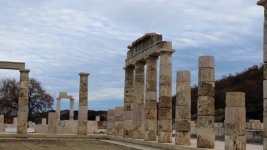
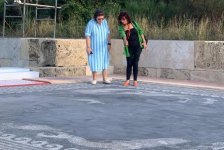
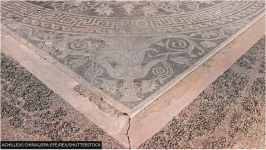
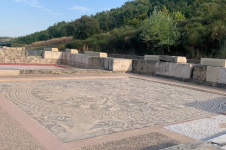
Above are a selection of images from the three sites I link to discussing the latest restoration.
So the renovation of the 2300 year old palace started 16 years ago - in around 2008. It cost 20 million euros.
My personal issue is that these images were so different away from my recollection, I thought I must have made an error in thinking I had ever visited! I remember some stones here and there... but really, there was very little to see.
So I spent some time trying to track down some older photos.
Here are some photos obviously in the middle of the latest restoration:
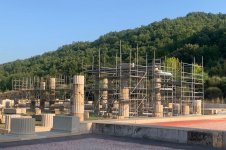
2018 Scaffolding, cranes.
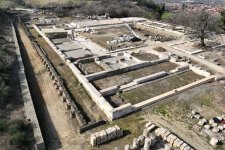
I found a 2018 (10 years into the "restoration") article with some aerial imagery:
 from https://greekreporter.com/2018/02/22/restored-ancient-greek-palace-gets-ready-for-visitors/
No columns... lots of differences.
Undated photo - pre-restoration.

This random internet photo is much more like what I remember. Nothing was standing. There were no clear floors. On the ground, you were hard pushed to see anything much at all.
Its actually quite hard to find older photos of recent events, but this site has some photos, where they say the date is 1990:
Pella (Site)

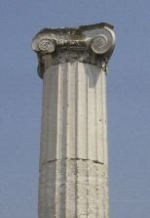
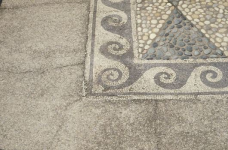
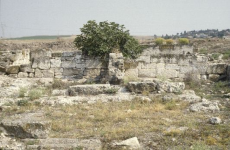
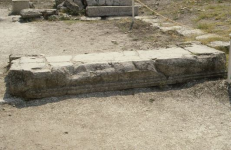
If you ask me, neither that column, nor the mosaic floor look untouched - both look like they have been worked on more recently than the build 2300 years ago, or even the discovery 110 years ago.
If we look at the history of the area on wikipedia:
If we look at the official site for the palace, there are even more undated photos from before the restoration:
 I'm no expert, but the grey blocks in the distance look newer than the blocks in the foreground. They have sharp edges. Maybe they have been put out to weather?
 I don't see a single column! Barely a block is visible.
 A deep and stony cultural layer.
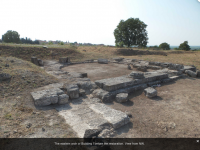
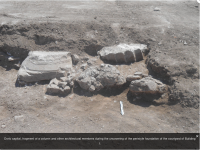
from THE PALACE – The archaeological investigation – KINGDOM OF MACEDON – THE PALACE OF PELLA - there are more photos there.
What's to say?
I can't find any really old photos, from when "the first excavation was begun by G. Oikonomos in 1914–15" - I can't even comment on what he purportedly found - my searches returned no images and hardly any info.
It does seem to me that the blocks have been worked in previous restorations. The grey blocks shown in the official site for the palace will no doubt have aged having been exposed to the elements. In the latest restoration, I don't really see any grey blocks at all. And obviously they have just added loads of new material to the site.
I have to wonder - is this what ancient history has always been? Someone starts something off, then that work is drafted and re-drafted for the current requirements, like an email, until the tone is right, if ever? Perhaps the current requirement here is to attract tourists to the area? Does this sort of "restoration" help us better understand our past, or is it more akin to a prop in a story?
https://greekreporter.com/2024/01/05/greece-opens-restored-palace-of-philip-ii-at-aigai/
Palace of Aigai: Greece reopens huge Alexander the Great monument
Royal Palace of Philip II in Aiges to Open Soon for Visitors | GTP Headlines
This story piqued my interest especially, as I had previously visited the palace years and years ago - well before the "refurbishment". Here are some pictures of the palace now:
Above are a selection of images from the three sites I link to discussing the latest restoration.
from Palace of Aigai: Greece reopens huge Alexander the Great monumentThe site of one of the most important monuments in classical antiquity - the palace where Alexander the Great was crowned king - has reopened after a 16-year restoration.
The Palace of Aigai, near Greece's northern port city of Thessaloniki, was built more than 2,300 years ago.
It was later destroyed by the Romans and unearthed through excavations beginning in the 19th Century.
Its renovation cost more than €20m (£17m; $22m), with help from the EU.
So the renovation of the 2300 year old palace started 16 years ago - in around 2008. It cost 20 million euros.
My personal issue is that these images were so different away from my recollection, I thought I must have made an error in thinking I had ever visited! I remember some stones here and there... but really, there was very little to see.
So I spent some time trying to track down some older photos.
Here are some photos obviously in the middle of the latest restoration:
2018 Scaffolding, cranes.
I found a 2018 (10 years into the "restoration") article with some aerial imagery:
No columns... lots of differences.
Undated photo - pre-restoration.
This random internet photo is much more like what I remember. Nothing was standing. There were no clear floors. On the ground, you were hard pushed to see anything much at all.
Its actually quite hard to find older photos of recent events, but this site has some photos, where they say the date is 1990:
Pella (Site)
If you ask me, neither that column, nor the mosaic floor look untouched - both look like they have been worked on more recently than the build 2300 years ago, or even the discovery 110 years ago.
If we look at the history of the area on wikipedia:
from Pella - WikipediaThe site was explored by 19th-century voyagers including Holand[who?], François Pouqueville, Félix de Beaujour, Cousinéry, Delacoulonche, Hahn[who?], Gustave Glotz and Struck, based on the descriptions provided by Titus Livius. The first excavation was begun by G. Oikonomos in 1914–15. The modern systematic exploration of the site began in 1953 and work has continued since then uncovering significant parts of the extensive city.
In February 2006, a farmer accidentally uncovered the largest tomb ever found in Greece.[citation needed] The names of the noble ancient Macedonian family are still on inscriptions and painted sculptures and walls have survived. The tomb dates to the 2nd or 3rd century BC.[19] Overall, archaeologists have uncovered 1,000 tombs at Pella since 2000, but these only represent an estimated 5% of those at the site. In 2009 43 graves containing rich and elaborate grave goods were found and in 2010 37 tombs dating from 650 to 280 BC were discovered containing rich ancient Macedonian artifacts ranging from ceramics to precious metals. One of the tombs was the final resting place of a warrior from the 6th century BC with a bronze helmet with a gold mouthplate, weapons and jewellery.[20]
Since 2011, much of the palace has been excavated and from 2017 parts of it have been restored.[21]
Many artefacts are displayed in the Archaeological Museum of Pella.
If we look at the official site for the palace, there are even more undated photos from before the restoration:
from THE PALACE – The archaeological investigation – KINGDOM OF MACEDON – THE PALACE OF PELLA - there are more photos there.
What's to say?
I can't find any really old photos, from when "the first excavation was begun by G. Oikonomos in 1914–15" - I can't even comment on what he purportedly found - my searches returned no images and hardly any info.
It does seem to me that the blocks have been worked in previous restorations. The grey blocks shown in the official site for the palace will no doubt have aged having been exposed to the elements. In the latest restoration, I don't really see any grey blocks at all. And obviously they have just added loads of new material to the site.
I have to wonder - is this what ancient history has always been? Someone starts something off, then that work is drafted and re-drafted for the current requirements, like an email, until the tone is right, if ever? Perhaps the current requirement here is to attract tourists to the area? Does this sort of "restoration" help us better understand our past, or is it more akin to a prop in a story?
Last edited:


