Post-cataclyscmic waste management misatributed to medieval times

SH.org OP Username
dreamtime
SH.org OP Date
2018-12-01 13:52:23
SH.org Reaction Score
66
SH.org Reply Count
19

dreamtime

Administrator
Staff member
Joined
Aug 25, 2020
Messages
2,005
Reaction score
8,103

I want to expand on the thoughts in the above video.
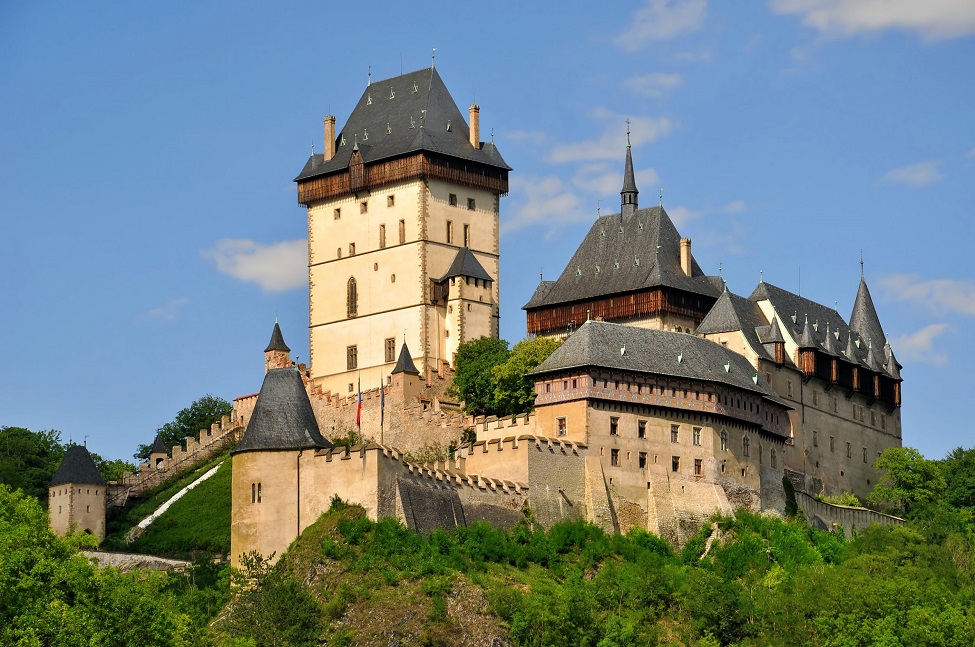
karlstejn-castle.jpg

Medieval castles have a surprising lack of any kind of infrastructure we associate with basic human needs, especially hygine. No toilets, no running water, nothing. Indoor plumbing was only added later, according to historians, so even washing hands was impossible, which supposedly led to countless epidemics, not even speaking about the inconveniences all of this would have caused the people living in such a castle.

In the official history, society decayed from the Roman times on, and everything became worse, including hygiene. So no toilets in the middle ages.

Here's a common description:
Toilets in today's sense were not known in the 15th century - or rather no longer. In Roman times, toilets in private toilets or public toilets with flushing were still used. In the Middle Ages there was nothing left of these hygienic achievements: Those who had to relieve themselves did so in the next bush, behind the house or in a chamber pot, which was tilted out of the window at the next opportunity.
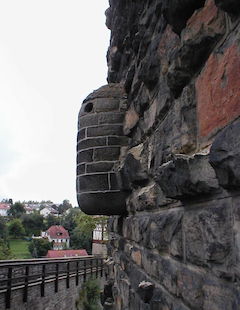
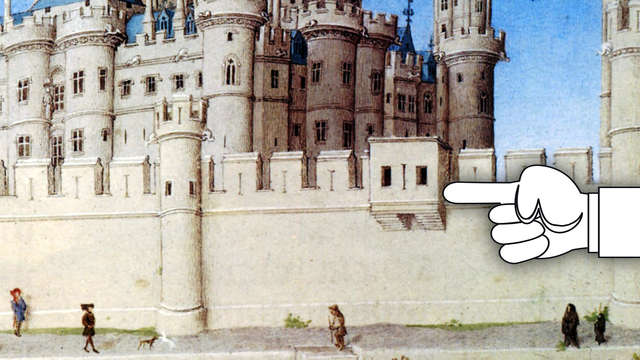
The walls of the castle and palace were lined with garderobes: fresh air lumps high above the ground, in which the faeces finally rotted after a short free flight. And with the nobility it was common practice until the 18th century to relieve oneself in the middle of the room - so that the pile would be removed by the servants.

In those supposedly medieval castles, just like in the one above, you can find something called Garderobe - Wikipedia
Garderobe - Wikipedia

It usually looks something like this

800px-Wimpfen-roter-turm-aborterker.JPG
serveimage.jpg

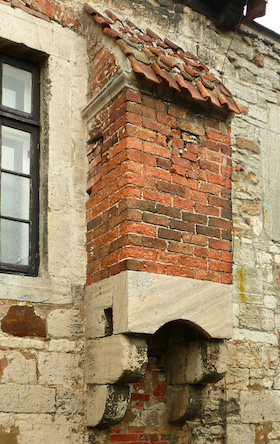
Often those outdoor toilets were added to the city wall to make it easier to control the hygiene within the city. Surprisingly it looks like most of them are made of entirely different material than the original castle wall, suggesting that they are not part of the original castle design. When you look through images of those castle toilets the pattern becomes obvious. It seems that no castle had those things built into it originally.
serveimage1.jpg

Doesn't those bricks look more like 19th century than 15th century middle ages?

Below is an interesting painting from 1876, which shows the outdoor toilets in use. I suggest that this kind of low level infrastructure wasn't in use until the 19th Century. According to historians we lived in such a way for more than 1000 years. Nope, only two or three generations maybe, in the 19th Century. It's not possible to survive as a society if you don't care about sanitation for 500-100 years. Any society with basic intelligence would push for a solution as quickly as possible. A society without sanitation will not create people like Vivaldi and other Renaissance geniuses.

I just can't believe that thousands and thousands of castles were built with extraordinary level of detail, excellent quality of architectural design, but no one thought about basic things. That doesn't make any sense. As a society you can't even manage hundreds of thousands of workers without having decent sanitation.

I think just like outlined by Conspiracy-R-US all changes related to the Great Stink, lack of hygine, usually associated with medieval times, happened only in the 19th Century, and was later misattributed into the distant middle ages, without any evidence at all.

We are looking at a drastic change into how society works, and how do people react after a drastic change? They create short-term solutions that work more or less, before thinking about applying more structural solutions. So people added these outdoor toilets to city walls, castles and buildings, which led to some kind of health crisis culminating in events like the Great Stink of London. It is no coincidence that the Great Stink only became a problem in 1850. So for 1000 years business as usual and suddenly everything breaks down? No, the entire primitive sanitation infrastructure did not exist prior to 1700 or 1800.
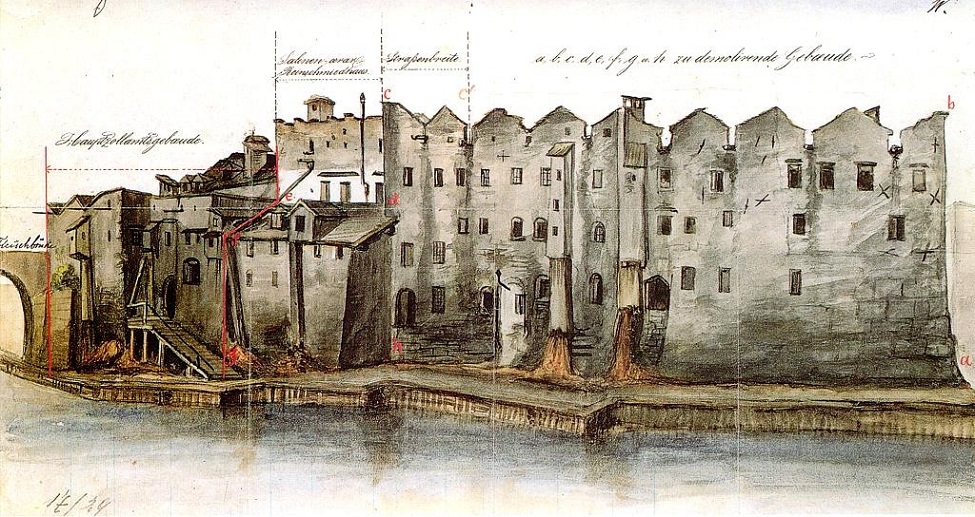
kufferhaeuser1024.jpg

But this leads to the question why not only Versailles, St. Petersburg, London, but also all administrative buildings of the most powerful people of that time (castles) did not include infrastructure for sanitation and human waste. I haven't found an answer, but this newearth video might be relevant.

Just like Versailles, looking at all those medieval castles, it looks to me that whoever lived inside, either wasn't human, or had technology thad made sanitation and eating unnecessary. Were the medieval castles abandoned by their original owners, just like Versailles, and those who moved in later made the best out of the situation?

Those 13th-16th Century castles were created for ruling over a large territory, and the people who lived inside where the most powerful and rich people back then. The image we have of castles isn't complete. The original castles were painted beutifully, but most of the plaster is gone, probably after some kind of cataclysmic event, so when people think about castles, they usually think about castle ruins. During the 18th or 19th Century it seems some families tried to repair some of the damage, and continued to live in such castles, and I think only after the cataclysm due to the damage most castles became associated with bad air quality, crypts, darkness, moisture, etc. Originally they might have been quite decent to live in.

Still the question should be asked why the most epic buildings of the past that we can wittness around us were never planned to be inhabited by normal humans with sanitation needs.

Ideas:

- Somewhere between 1700 and 1800 an event of epic proportions destroyed a high technology civilization that had primitive things like sanitation figured out on a higher level, afterwards the new rulers moved into the structural remains of that past society and remodeled the buildings
- The buildings were home to the ruling elite, which wasn't human, and thus didn't produce any waste. Around 1700 together with a global cataclysm they abruptly disappear from the planet, and leave behind only myths (like Dracula, vampires, or other parasitic rulers in dark castles)
- Since we are talking about both cities and administrative buildings being affected by this lack of infrastructure, a sudden disappearance of technology or even complete change in human biological make up sounds possible to me.
- I'm not entirely sure all of this is related to the 1700 catastrophe that gave rise to the post-renaissance paintings of destroyed Rome, or an event at the beginning of 1800.

What other possibilities do exist?
Note: This OP was recovered from the Wayback Archive.
 
Now I wish I had never kissed the Blarney Stone ?
 
I've read on old SH.org website a thesis about automaton and robots, and well they pointed the fact that there were no WC in castles, and made some link between past robots and the construction of castle
 
- Somewhere between 1700 and 1800 an event of epic proportions destroyed a high technology civilization that had primitive things like sanitation figured out on a higher level, afterwards the new rulers moved into the structural remains of that past society and remodeled the buildings<br/>
- The buildings were home to the ruling elite, which wasn't human, and thus didn't produce any waste. Around 1700 together with a global cataclysm they abruptly disappear from the planet, and leave behind only myths (like Dracula, vampires, or other parasitic rulers in dark castles)<br/>
- Since we are talking about both cities and administrative buildings being affected by this lack of infrastructure, a sudden disappearance of technology or even complete change in human biological make up sounds possible to me.<br/>
- I'm not entirely sure all of this is related to the 1700 catastrophe that gave rise to the post-renaissance paintings of destroyed Rome, or an event at the beginning of 1800.<br/>
<br/>
What other possibilities do exist?[/PARSEHTML]

This is really interesting. I'd like to reverse-engineer a thought from scripture if I may? Revelations in the Bible talks about how those that return with Jesus Christ will "rule and reign with Him" for 1000 years in the "new earth". Is this maybe what happened before? Is it possible that Noah and his sons, and their wives, were a people of advances abilities as well as technology that devolved over each generation, while those God chose "ruled and reigned" over these new generations as immortals? Every culture has folklore and legends about immortals and beings of great abilities. Granted I am working with scripture that was modified via King James, but isn't there a grain of truth in every lie?
 
- The buildings were home to the ruling elite, which wasn't human, and thus didn't produce any waste. Around 1700 together with a global cataclysm they abruptly disappear from the planet, and leave behind only myths (like Dracula, vampires, or other parasitic rulers in dark castles)
What other possibilities do exist?

Another possibility that exists.... The nobility back then all practiced breatharianism and did not eat or drink, and therefore produced no waste materials. Similar to what you suggested, but not necessarily non-human.

I'm sure I read a crazy theory somewhere that food is the primary cause of all ageing. I know it's a strange idea, but what if there really is something to this idea?
Maybe the occupants of those buildings were TPTB, and maybe they are still here today.

Perhaps someone realized their secret at some point, resulting in a hasty 'reset' - some wars and falsification of history - and then set about normalizing the consumption of food by peasants, and doing their best to disappear from public view.

Fasting is a big deal in religious terms. Strange name for it, too. Whereas eating is a very physical, material activity.
 
I'm sure I read a crazy theory somewhere that food is the primary cause of all ageing.

I heard the same thing. I met a woman who had been studying breatharianism for ten years, she had done training courses with a teacher in Sri Lanka and another one in Russia.

She expressed it like this - it's the emotional body that is the cause of all the problems, and the only reason we need to eat is to feed the emotional body. To put it the other way round - in order to live without eating, you first need to let go of all emotions.
 
Has anyone ever thought that castles and palaces could also have been built just for attraction purposes ? Perhaps no one lived in them, but castles and palaces were invented in step with the invention of the Middle Ages as a time period.
 
Perhaps no one lived in them, but castles and palaces were invented in step with the invention of the Middle Ages as a time period.

That would be quite funny. Earth as a big theme park. But I doubt it. To me they seem to be governance structures from the past, placed strategically all over the world.
 
I heard the same thing. I met a woman who had been studying breatharianism for ten years, she had done training courses with a teacher in Sri Lanka and another one in Russia.

She expressed it like this - it's the emotional body that is the cause of all the problems, and the only reason we need to eat is to feed the emotional body. To put it the other way round - in order to live without eating, you first need to let go of all emotions.
There is no doubt that fasting has multiple psychological and psychical benefits. But how do you explain all the Chinese that died during the ''Great Leap Forward'' or all the dead Ukrainians during the Holodomor? Did they just have to meditate and release all their emotions and they would've been fine?
Fasting, yes, but not eating and somehow survive for hundreds of years? Not consistent with what is observed in the real world.
 
Im certainly no expert on the subject, but from what I understand, you are right than you cannot just suddenly stop eating food and not be affected by this change to your lifestyle.

Now, this is a fairly unusual subject, but from what I have seen so far, you basically have to start by weaning yourself off of food gradually - and it is not just a case of eating less, but also about eating 'lighter' foods. Salad greens like lettuce might be a good example, or things with a high water/juice content like cucumbers or oranges.

I think another aspect of this is practicing breathing techniques, and learning to literally nourish yourself with the air you breathe. Theres a big difference between the regular breathing you do subconsciously during the day whilst you go about your schedule, and actually sitting down and intently focusing on breathing in a disciplined and particular way.

I did say it's unusual, and I'm certainly not advocating it, or suggesting people rush out and try it, and certainly not without educating themselves properly first. However, the topic exists, and some claim it works.

Is it truly possible to go without food indefinitely? I couldn't say for sure, and it would certainly seem doubtful - but who knows? The human body (and mind/will/spirit) is capable of incredible things.
 
She expressed it like this - it's the emotional body that is the cause of all the problems, and the only reason we need to eat is to feed the emotional body. To put it the other way round - in order to live without eating, you first need to let go of all emotions.

From what I remember, breatharianism is an interesting theoretical concept, but is full of fraud, and there's no actual evidence it works.

Maybe some Yogis in Tibet managed to not eat for extended periods of time, by downregulating their metabolism in the mountain areas with low oxygen pressure, decreasing their breathing frequency, increasing CO2 and essentially conservating their body, but this is not possibly in our modern life.

Those breathing techniques do work, and they can reduce calory requirement by a large extent, but it takes years to get there, and you still have to eat. Those Yogis can reduce their breathing frequency to around 1-2 breaths per minute, and this can extend life-span and reduces metabolic waste products, thus making the food way more effiicient.

That's probably the reason many people need to eat way too much - their metabolism wastes too much energy, and this can definitely be optimized by conscious breathing practices, movement, and other forms of meditation.
 
Let's clarify what the emotional body is.

The classic model of the auric field is like Russian dolls, with smaller bodies contained within larger bodies. It is said that you grow an extra layer every seven years, for example the mental body, the astral body and so on.

When you are a child up to 7 years, you are purely in the emotional body. You experience a completely unfiltered emotional response to everything. As you grow, you learn and form your sense of identity. Everything you subsequently become is built upon those formative childhood experiences.

To completely let go of the emotional body is a very difficult thing to do. You are removing the underpinnings of everything you imagine yourself to be. You have to completely change who you are. To say you have to let go of all emotions, as I did earlier, is a gross simplification.

I can't imagine doing this myself. However, if I wanted to become breatharian, I would first try to imagine this.
 
From what I remember, breatharianism is an interesting theoretical concept, but is full of fraud, and there's no actual evidence it works.

Maybe some Yogis in Tibet managed to not eat for extended periods of time, by downregulating their metabolism in the mountain areas with low oxygen pressure, decreasing their breathing frequency, increasing CO2 and essentially conservating their body, but this is not possibly in our modern life.

Those breathing techniques do work, and they can reduce calory requirement by a large extent, but it takes years to get there, and you still have to eat. Those Yogis can reduce their breathing frequency to around 1-2 breaths per minute, and this can extend life-span and reduces metabolic waste products, thus making the food way more effiicient.

That's probably the reason many people need to eat way too much - their metabolism wastes too much energy, and this can definitely be optimized by conscious breathing practices, movement, and other forms of meditation.
Breathing techniques combined with meditation do improve, by a lot the overall well being of anyone that knows how to do it, in the beggining is tough, but once it clicks prepare for miracles hahahah
I'm kinda skeptical of this whole bretharian thing too, sounds a lot like modern shake oil idea. It reminded me of a guy on insta that pushes this crap as some kinda supreme truth and if you don't agree you're a shill..... sounds like Cult of personality to me
 
Breathing techniques combined with meditation do improve, by a lot the overall well being of anyone that knows how to do it, in the beggining is tough, but once it clicks prepare for miracles hahahah
I'm kinda skeptical of this whole bretharian thing too, sounds a lot like modern shake oil idea. It reminded me of a guy on insta that pushes this crap as some kinda supreme truth and if you don't agree you're a shill..... sounds like Cult of personality to me
I do wonder, after fasting, who decided how much we needed to eat. Or sleep? Or drink? I feel better with intermittent fasting but it’s only because I naturally do t want food until 2 or 3 pm. My husband needs food by 10 or he’s very physically sub par. So listening to your rhythm is good. I wonder if I didn’t feel like it was “time” to eat when I would break bread?
 
Tips
Tips
Please respect our Posting Rules.
Back
Top