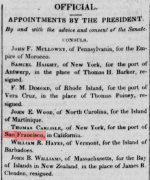
San Francisco as part of Mexico

Starfire

Moderator
Staff member
Active Member
Joined
Jun 15, 2022
Messages
216
Reaction score
696
Location
Cleveland, Ohio
Found this on the False History website, in an article about San Francisco. It is a list of consuls being appointed by the president of the USA in the year 1842.

According to Merriam Webster:
"Consul - an official appointed by a government to reside in a foreign country to represent the commercial interests of citizens of the appointing country"

The position is similar to an ambassador, but deals with business interests instead of politics with a foreign country. There can only be one ambassador to each foreign country. But there can be several consuls, one for each large trade center.

From falsehistory.net:

This is from the Madisonian, March 18 in 1842,

mar-15-842-daily-madisonian.png

San Francisco and California were foreign places to the USA in 1842, as part of Mexico. But San Francisco was not the capital of the Mexican state of California, Monterrey was. San Francisco was a big city with enough American business interests to require a consul to keep an eye on things. Yet they try and tell us there was nothing there when the Gold Rush started 7 years later!
 
Last edited:
I believe and its just my opinion, but it looks to me like San Francisco was part of a cataclysm, especially if you look at the topography. Rolling alluvial plains (sand), and very barren.

I think they brought people there to build over and populate a once forgotten very populated land. Just like they have done in places all over the world. These people knew what they were doing when it came to taking the land of what we now call as the United States of America. They knew what was here and they knew how they were going to rule, and start a new empire on their own terms. And what do we know of the dealings with the Spanish and the French. Yes only what we are told in the fake "hi(story)" books, but if you read between the lines and look deep enough you will find bits and pieces that create a new narrative, one that has not been told to us in schools, but the real story of the past.
 
Here's the "official" story regarding San Francisco's early history condensed from various wiki entries:

The original Spanish name is Yerba Buena, meaning "good herb." Apparently there was a bunch of this particular herb growing there.

In 1769 the Spanish "discovered" San Francisco Bay and "claimed" it as a strategic military and trading location.

In 1774 the Spanish started moving and in 1776 established The Presidio of San Francisco military base and the Mission San Francisco de Asis who "began the cultural and religious conversion of some 10,000 Ohlone who lived in the area". The mission later became known as Mission Dolores.

Various traders and explorers visit and then settle the area, including French, British and Russian. The Russian Hill section of San Francisco is named after the. Some Brits set up a settlement across the bay. The Hudson's Bay Company had a short lived trading post there.

In 1821 Spain ceded California to Mexico.

In 1835 a street grid plan is laid out for expanding Yerba Buena. American settlers start coming.

In 1846 the US army invaded and took the area from the Mexicans stationed at The Presidio military base at Yerba Buena.

In 1847, January 30, the US occupation force officially changed the name of Yerba Buena to San Francisco.

The city and the rest of California officially became American in 1848 by the Treaty of Guadalupe Hidalgo, which ended the Mexican–American War.

In 1850, September 9, California was admitted to the U.S. as a state.

There is still a Yerba Buena Island. Yerba Buena Cove got filled in and is now downtown San Francisco.

The population of San Francisco is listed as 459 in 1947, 1000 in 1848 and 25,000 in 1849 due to the gold rush. Up to 300,000 by 1890.

________

Of course there are contradictory parts to the story as there always is when deception and coverup are occuring.

The Senate Consular Appointees list that started this thread is supposedly from 1842 and calls the city San Francisco already. So is the United States Senate choosing to misname Yerba Buena? Or did everyone who was anyone already call it San Francisco? After the name El Presidio de San Francisco or Mission San Francisco de Asis?
Perhaps this was a military Consul being appointed to The Presidio, rather than a trade Consul to the port town.

Then there is tge matter of the population of SF...
If the Mission was converting 10,000 natives, wouldn't at least a few of them be living in an around the area of Yerba Buena? Unless the mission cames to be called Dolores because of all the tears it caused. And the soldiers at The Presidio would have enslaved or indentured natives at the fort.
And there had to be plenty of Spanish / Mexican children born in the 50-60 years since the Spanish settlers came.
And if Russian Hill had enough Russians to name it after them, why don't we see their settlements on the maps?
And what about the British and French traders? Some of them must have settled there as well. Perhaps Nob Hill and Telegraph Hill were where each of those groups lived. I'll be doing more research.

Soon I will post several maps that show the official narrative of the area, also with contradictions.
 
When I was in San Francisco many years ago there were public information boards that said the Russians occupied SF in the 1700s. It's a long time ago now, but my recollection is the Russians pulled out of the area for no given reason, but maintained a presence in Northern California until the early 1900s.
The Russians did not sell Alaska to the USA until the 1950s.
 
When I was in San Francisco many years ago there were public information boards that said the Russians occupied SF in the 1700s. It's a long time ago now, but my recollection is the Russians pulled out of the area for no given reason, but maintained a presence in Northern California until the early 1900s.
The Russians did not sell Alaska to the USA until the 1950s.
You sent me on an exploration into the Russians on the Pacific Rim...

Here's what happened with them:
Russian fur trappers were running out of animals in Siberia to kill for their furs. So they worked their way along the coasts from Kamchatka to Alaska in 1741, where they found many animals to kill for furs that they sold in China.

This created a buzz among the world's money hungry jackals, of course. During the late 1700's pretty much every country with a boat was poaching furs on the Pacific Northwest coast. But the Russians didn't really have large sea-faring boats. They had migrated along the coasts and islands in hide boats. They had Aleut hunters working for them that had kayak type boats. So they went into trade partnership with various Americans with ships.

The Spanish had claimed California as part of New Spain / Mexico. But they only established permanent settlements there after all the other countries threatened their supremacy of North America. The Spanish proceded to establish 19 settlements on the California coast with Missions and Presidios (forts) at each one. Yerba Beuna (San Francisco) was the farthest north and was founded in 1776.

The Russians founded a permanent settlement in Alaska in 1784, and started the Russian American Company in 1799. They over-hunted the abundant wildlife there and were close to starving due to poor resupplying. So they went south (in an American ship). They pulled into Yerba Buena to resupply in 1806. The Spaniards were polite and eventually reprovisioned them, but refused any formal trade agreement. The Russian diplomat that was on board managed to get himself engaged to a Spanish diplomat's daughter, but he died before the marriage could be completed.

The Russians liked the Bay area and established three different forts a bit north of Yerba Buena. Right around present day Russian River. They proceeded to over-hunt the abundant wildlife there (AGAIN?!?), nearly causing extinction of the sea otter. They also snuck overland around the south side of the Bay to poach right under the noses of the Spaniards. This may have been related to present day Russian Hill in San Francisco. The story is that settlers during the Gold Rush found some gravestones there with Cyrillic writing, and that's how it got named.

Beacause of the Napoleonic Wars raging in Europe, including the War of 1812, the Czar was a little busy at home and was unable to focus on expansion in North America.

In 1822 the Republic of Mexico was founded independent of Spanish rule. Guess the Spanish king was a little busy at home, too.

In 1823 the Monroe Doctrine put forth by the US made it clear that they considered the Western lands to belong to the US and that any colonial incursion would be met with military force. This shut down the Russians from further expansion or they would face the wrath of the US Navy.

These Russian forts became unprofitable due to the over-hunting of fur bearing animals. (Go figure.) And some US settlers were coming around. And the Mexicans built a couple of missions and presidios north of the Bay in Sonoma to extend their reach. And the political climate had changed in Russia and Europe. So in 1842 the Russians leave California and head back up to Alaska.

Around the same time the Hudson's Bay Company sold off their branch trading post in Yerba Buena. It was British owned and they must have also felt the same pressures as the Russians.

Then a few years later the Mexican American War broke out and the US ended up with California in 1848.Then the Gold Rush started and California became a state in 1850.

And Russia sold Alaska to the US in 1867.


At least that's the official version.

I think it's more likely the Russians lived on Russian Hill while they were busy looting the buildings buried in mud. A group got shot by the Spanish and the survivors buried the dead guys.

And I think the Gold Rush was manufactured to get a bunch of strong single men with an adventurous attitude and their own picks and shovels to come by boat or overland quickly at their own expense. They would have been used to dig out the buildings and move the dirt into the marshy area to create more land. They probably were able to take whatever they found or get some payment for it from the foremen. Then they were either sent off to do some actual gold mining or the smarter guys would have stayed in town to make money off the dumb guys out prospecting.
 
Again, you lead me to research, this time into my own mind...
I have been a student of history and esoteric subjects all my life, always trying to read original source documents. But it's been less than a year since I learned that most source documents are forged or altered and the historical timeline is pretty much a fabrication. Your questions are helping me focus some of my new thoughts.

Regarding the photograph:
Way too many buildings, including some really big ones, to have all been built from the ground up in 30 years. The biggest buildings and whatever houses survived the cataclysm were dug out of the dirt. The wooden and rough brick houses were all built since 1846 by US settlers.

This is supposed to be San Francisco in 1846-1848. The period in between being taken by the US from Mexico, and before the gold rush. The one from 1848 doesn't even show the roads that were apparently planned and constructed during 1847.

360px-CF1850_SAN_FRANCISCO_IN_NOVEMBER_1848.jpg

920x920.jpg

th-1263625998.jpg

Who built the big buildings?
The Old World Builders that built most of the mammoth buildings around the world. More than 1000 years ago. They had both giants and humans as part of the culture, as evidenced by many of the buildings having both tall and short stories. Then they got buried 10-30 feet deep in mud either by a flood or sunk into the ground by earthquakes. The giants on the lower stories mostly died and the humans carried on.

How did they build them?
It depends who the Builders were.
• If they were giants or used giants it would be pretty easy to make the buildings built with stacked granite stones or brick. The giants were tall and strong.
• If it was just humans building them, it would be too labor intensive and cost prohibitive to build such high doorways, ceilings and windows for such short people. What a waste of effort! Not likely.
• It's more likely that some kind of antigravity was used to get heavy stones to high places. Maybe using a technological device or maybe using mental power.
• I don't know how far away the stones were supposedly quarried, but that's a factor too. A Youtube contributor named WISE UP has shown some visual evidence supporting that large building stones started as shaped polymer bags of liquid concrete, that harden into square blocks. These "stones" wouldn't have to be quarried.
• However, recently I have started to consider another possibility. These buildings may have been created on the spot with mental or technological effort. They may have even been grown in place in some way. Granite has crystal in it, and crystal is grown and shaped into many things these days. Crystal also acts as a storage device, apparently one crystal can store the information of many computer hard drives. So it could definitely store some kind crystalline DNA blueprint for a beautifully symmetrical, functional, purposeful structure. I do think it would take a large amount of mental energy as well. Perhaps 500 Old World Builders (with superior mental powers compared to modern man) joined hands surrounding the site of the new mammoth civic building and concentrated their thoughts together. Smaller buildings and houses could be created by smaller groups like guilds and families. Perhaps the cornerstone of a building has the DNA blueprint in it for the whole building. This would be why the cornerstone has so much significance. It's the one stone that is placed, and the rest are created.
 
Again, you lead me to research, this time into my own mind...

That's good to hear. Thanks for posting the pictures.

There is a massive disconnect between the pictures from 1847 and the photo from 1877. It makes me wonder if the entire city was buried and the 'Gold rush' we are told about was actually miners flocking to the area to dig the buildings out of the mud. Maybe the buildings were full of treasure if they had been buried suddenly.

They called it the 'Gold rush' at the time because those in the know didn't want other people to catch on to what was happening.

If you look into popular culture from the era before I was born 'Streets paved with gold' was a common theme. It occurs in songs, books and so on. Nowadays we are taught that it's a metaphor, but maybe it was literally true.

My understanding is the official narrative states that entire cities in America were covered in gold, with gold roofs, statues and so on. Certainly this was said about Tenochtitlan (Mexico City). The Europeans arrived and just started removing the gold in the case of Tenochtitlan.
 
It seems unlikely or even impossible to reconcile the older images of San Francisco with just 30 years later. It's hard to fathom the depth of mud covering the city to make it look like rolling hills. Please take a look at Seattle's story regarding the "Denny Regrade".

SH Archive - Seattle regrading or unearthing? Which one was it?

I grew up in Seattle. Everyone knew the story that the city used to have taller hills and the founding fathers flattened some hills and filled in some low places to make it more liveable. But I never saw the pictures until last month. This picture particularly strikes me. Each of those tall hills of dirt are hiding a building. You can see the sqareish outline on the top of each pile.

3509-e680d10759340a0c9d6dabb92e4673f8.jpg

There are some houses that were built on top of the mud, prior to the Denny Regrade. These were most likely built by early Scandinavian fishermen who became settlers. These buildings had to be lowered to the new ground level, like below.

3514-c5d36e7feebe701a92af7ba3d812c31c.jpg
3513-f31adf1f31f5e52811c5c379ed17558f.jpg

The piles of dirt were sluiced away with giant water hoses and the mud ran down into the bay and created more land.

In San Francisco, there weren't as many new houses built, so nothing much to lower. They were probably just shacks that got torn down once the nice brick houses were uncovered. And there was plenty of water to sluice the mud into the bay. The area that got filled in had hundreds of boats abandoned in it that got covered over and is now the Financial District. They still find remnants of boats today when digging in that area.

abandoned-vessels-in-san-francisco-bay-everett.jpg
 
You sent me on an exploration into the Russians on the Pacific Rim...

Here's what happened with them:
Russian fur trappers were running out of animals in Siberia to kill for their furs. So they worked their way along the coasts from Kamchatka to Alaska in 1741, where they found many animals to kill for furs that they sold in China.

This created a buzz among the world's money hungry jackals, of course. During the late 1700's pretty much every country with a boat was poaching furs on the Pacific Northwest coast. But the Russians didn't really have large sea-faring boats. They had migrated along the coasts and islands in hide boats. They had Aleut hunters working for them that had kayak type boats. So they went into trade partnership with various Americans with ships.

The Spanish had claimed California as part of New Spain / Mexico. But they only established permanent settlements there after all the other countries threatened their supremacy of North America. The Spanish proceded to establish 19 settlements on the California coast with Missions and Presidios (forts) at each one. Yerba Beuna (San Francisco) was the farthest north and was founded in 1776.

The Russians founded a permanent settlement in Alaska in 1784, and started the Russian American Company in 1799. They over-hunted the abundant wildlife there and were close to starving due to poor resupplying. So they went south (in an American ship). They pulled into Yerba Buena to resupply in 1806. The Spaniards were polite and eventually reprovisioned them, but refused any formal trade agreement. The Russian diplomat that was on board managed to get himself engaged to a Spanish diplomat's daughter, but he died before the marriage could be completed.

The Russians liked the Bay area and established three different forts a bit north of Yerba Buena. Right around present day Russian River. They proceeded to over-hunt the abundant wildlife there (AGAIN?!?), nearly causing extinction of the sea otter. They also snuck overland around the south side of the Bay to poach right under the noses of the Spaniards. This may have been related to present day Russian Hill in San Francisco. The story is that settlers during the Gold Rush found some gravestones there with Cyrillic writing, and that's how it got named.

Beacause of the Napoleonic Wars raging in Europe, including the War of 1812, the Czar was a little busy at home and was unable to focus on expansion in North America.

In 1822 the Republic of Mexico was founded independent of Spanish rule. Guess the Spanish king was a little busy at home, too.

In 1823 the Monroe Doctrine put forth by the US made it clear that they considered the Western lands to belong to the US and that any colonial incursion would be met with military force. This shut down the Russians from further expansion or they would face the wrath of the US Navy.

These Russian forts became unprofitable due to the over-hunting of fur bearing animals. (Go figure.) And some US settlers were coming around. And the Mexicans built a couple of missions and presidios north of the Bay in Sonoma to extend their reach. And the political climate had changed in Russia and Europe. So in 1842 the Russians leave California and head back up to Alaska.

Around the same time the Hudson's Bay Company sold off their branch trading post in Yerba Buena. It was British owned and they must have also felt the same pressures as the Russians.

Then a few years later the Mexican American War broke out and the US ended up with California in 1848.Then the Gold Rush started and California became a state in 1850.

And Russia sold Alaska to the US in 1867.


At least that's the official version.

I think it's more likely the Russians lived on Russian Hill while they were busy looting the buildings buried in mud. A group got shot by the Spanish and the survivors buried the dead guys.

And I think the Gold Rush was manufactured to get a bunch of strong single men with an adventurous attitude and their own picks and shovels to come by boat or overland quickly at their own expense. They would have been used to dig out the buildings and move the dirt into the marshy area to create more land. They probably were able to take whatever they found or get some payment for it from the foremen. Then they were either sent off to do some actual gold mining or the smarter guys would have stayed in town to make money off the dumb guys out prospecting.
It may seem off the topic, but I just wanted to add that there is evidence of Denisovans that were from the Russia region, so South America was also populated not only by the land bridge, but also by way of the Atlantic coast of Brazil. I just thought it was interesting and kind of telling.
 
It may seem off the topic, but I just wanted to add that there is evidence of Denisovans that were from the Russia region, so South America was also populated not only by the land bridge, but also by way of the Atlantic coast of Brazil. I just thought it was interesting and kind of telling.
I don't know a lot about Denisovans, so I just read up on them. Could you please elaborate on your thought? I may be missing something.
Or are you saying the Russians came way back then and they never stopped coming?
 
It may seem off the topic, but I just wanted to add that there is evidence of Denisovans that were from the Russia region, so South America was also populated not only by the land bridge, but also by way of the Atlantic coast of Brazil. I just thought it was interesting and kind of telling.
Please could you post the evidence you have found?

I think they brought people there to build over and populate a once forgotten very populated land. Just like they have done in places all over the world. These people knew what
Please could you post the evidence you have found?

I will try later. I'm still getting the finer points of posting pictures. I got them off this thread, where they may be bigger.
SH Archive - Seattle regrading or unearthing? Which one was it?
So you are arguing photos of buildings on a stack of logs or piles of earth are evidence of a catastrophic mudflood?
Surely you have it the wrong way round.
Were a building or range of buildings being dug out from the earth would be evidence of some unknown burial process that no longer goes on.

If I find the thread in the archive where there is lots of documented evidence that contrary to the still mythical mudflood process results being photographed its much a much more mundane explanation.
Ownership of the land under the buildingfs could not be established so the regrading had to work around these pockets of land until the states legal process resulted in compulsory purchase, I'll append it here.
 
Last edited:
I don't know a lot about Denisovans, so I just read up on them. Could you please elaborate on your thought? I may be missing something.
Or are you saying the Russians came way back then and they never stopped coming?
Yes, sorry, I had fallen ill for the past week and could not concentrate. I did leave my comment hanging in the wind.
What I meant to insinuate is just that, yes, I think they have been coming and yes, never have stopped. I know it is main stream news about the Denisovans, but if it is true, it is the proof. If you just google the question of ancient Russian DNA found in South America it comes up but in a round about way.

I believe a cataclysm had happened and the proof are the alluvial plains, rolling hills, and if you have ever been to California you would understand the terrain a little more. That's why pictures are a wonderful tool, but seeing with your own eyes is really something, especially if you are schooled in Geology and Geography of that particular land. I am not an expert on any of these subjects, its just from gathering information and trying to read what it is telling me, that is what I do and like to share. If I can accommodate with where I get information I will, but I am not that great at posting stuff.
 
Tips
Tips
Please respect our Posting Rules.
Back
Top